The Ouija that Changed a Village

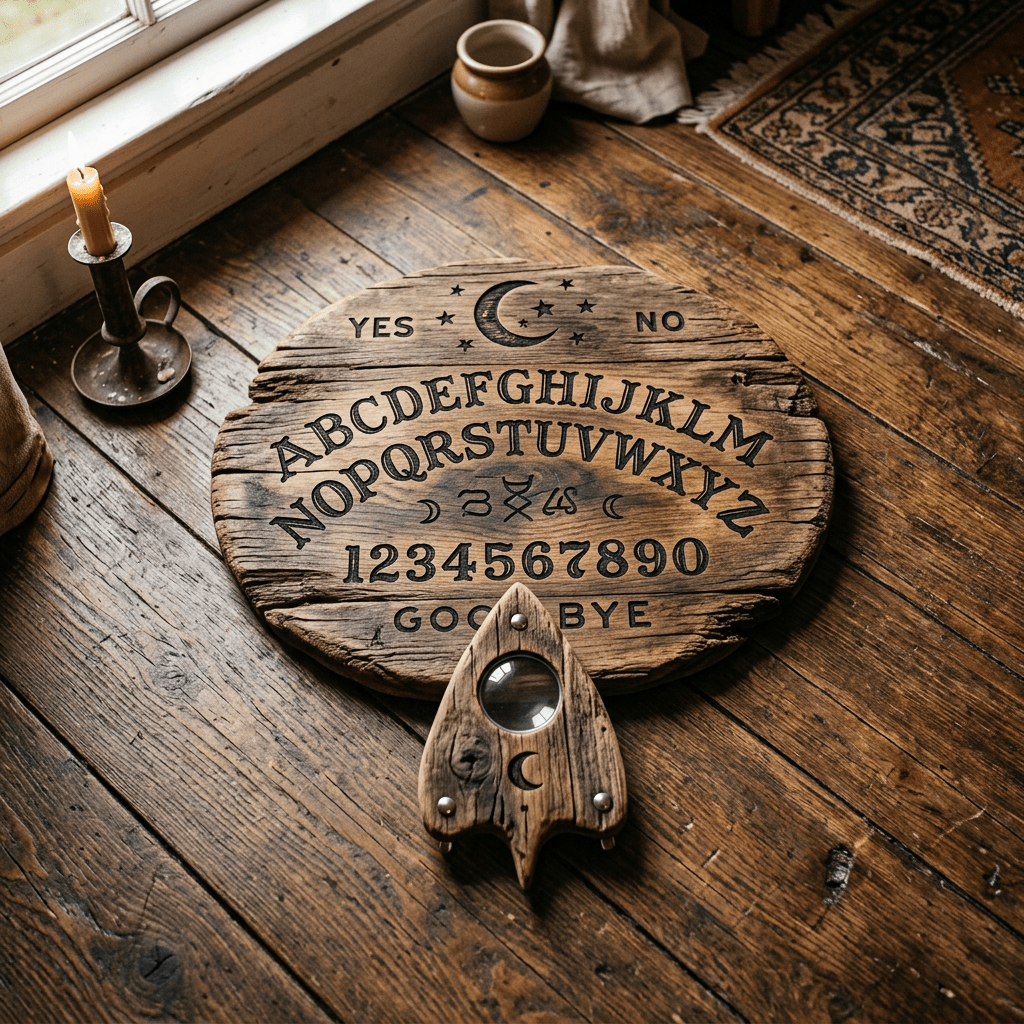
Wooden Ouija board with letters, numbers, and planchette on wooden floor illuminated by candlelight
A rustic wooden Ouija board with a planchette and lit candle on hardwood floor


In a village of a hundred souls, where the streets curled like old rivers and the sunset poured gold across thatched roofs, there was a rumour more steady than the clock in the square: the old Ouija board in Mrs Calder’s attic had never slept since the day it was carved from driftwood after a storm. The day began with a hush, as if the air itself were listening. Children pressed their tiny faces to the bakery window, watching the sky melt into ember-orange and purple, while the adults tended gardens and whispered about the drought that would not end. By dusk, the village gathered in the square, drawn by a rumour that the board, long quiet, might speak again.

Mrs Calder climbed the narrow stairs to the attic, her cane tapping a stubborn rhythm on the floorboards. The room smelled of rain, wax, and the faint sting of old ink. The Ouija board lay on a battered table, its letters faded to pale whispers. The planchette, glossed with years of pressed fingertips waited like a curious animal.

“Is anyone here?” Mrs Calder asked, almost in a breath.

The planchette moved.

Not by hands this time, but by a breath of air seeming to come from the walls themselves. The village, every door, every window, every roof, held its breath as the board spelled a name sounding like wind through hollow reeds: Elarin claimed to be both map and mapmaker, a writer of destinies who never died as much, but forgotten to be quiet. The board’s letters stitched themselves into sentences pulsing with a soft, inexorable warmth. As the sunset stretched its last lace of light across the village, the planchette began to pull. It drew a map on the table top: roads that hadn’t existed since the time of the old families, a river flowing uphill, trees blooming in reverse. Then it began to hum, low and honeyed, a song the earth remembered but the village forgot.

The change was ordinary at first: a window frame squeaked in warning when the wind nudged it, a lamp burned a shade too green, a cat pausing in its nap and watching the corner with eyes knowing more than any human. But the changes grew personal, intimate, and impossible to ignore. A baker found flour that sifted itself into the shape of a sparrow, then flew away with a sigh on its wings. The schoolhouse bell rang at noon, though no child was near, and the chalkboard wrote messages glowing faintly in the green dusk. The well in the courtyard began to murmur, a slow, patient voice offering hints about the village’s past, the prices paid for old secrets, and the names of long-dead villagers who still walked the alleys at twilight.

At first, the changes felt like a conversation with a kindly, mischievous elder. People gathered to listen to the well, to hear the stories etched in its murmur: tales of debts, promises, and the weather’s cruel mercy. But the elder’s tone grew tense, and the stories grew heavy with warning. The sun sank lower, and the colours of the sunset turned into something sharper, closer to fire than light. That night, the village woke to a different rhythm. The ground hummed beneath their feet, not with electricity but with the pulse of something ancient and patient. The village’s map once a set of familiar streets reshaped itself on every surface: walls, doors, the blackboard of the school, even the footprints in the dust on the windowsills. The Ouija, it seemed, no longer needed to speak to be heard. It spoke through the world itself.

The consequences were serious.

People began to forget to eat, not because of hunger but because time itself slowed around them; meals cooled to the colour of pennies and then vanished before they could be tasted.
The hundred villagers started moving in concert with eerie precision, as if choreographed by a conductor who never lived. They performed tasks in perfect sequence: early risers brewed tea, others tended gardens, and everyone spoke in a quiet cadence suggesting a shared script they could not see. Weather turned extreme in tiny, intimate ways: the sunset each evening bled into a second horizon of heat wilting flowers, while a sudden rainstorm teased the edges of the village, soaking only the roofs and a circle around the square.

The more Elarin’s influence grew, the more the village began to resemble the map the board had drawn, paths were not paths, doors opening only inward, and rooms appearing where no room existed. People who went into the attic never returned with their whole selves intact; some came back with memories that weren’t theirs, or with a whisper in their mouths tasting like copper and old ink. In the midst of this, a young girl named Mina, who once drew constellations on the back fence with a stick, found a star drawn in the dust on the attic floor. It pulsed with a soft cold light and a single word etched in the center: Help.
Mina lifted the planchette by its old worn handle as if it were a key, and spoke in the language that lived in dreams and lullabies: a plea not to stop the sea, not to let the village drown in a map refusing to resemble anything human. The next morning, the village woke to a decision: to seal the attic, to bury the board beneath the roots of the old elm at the edge of the cemetery, and to pretend the wind had never learned their names. But the moment they moved, the town’s life responded in a new, more terrifying way. The planchette influence did not retreat; it pressed outward, pushing the village to confront its own past and the consequences of the promises they made to keep the quiet of the night.

In calculating steps, Mina and a handful of the bravest, including the village’s elder librarian and a carpenter who could hear when a nail spoke to him, made a plan. They would coax Elarin back into the board, where it could be contained, and then seal the attic with a spell of memory, words learned from the village’s oldest diaries and the well’s murmur. It was dangerous, because to seal away such a thing is to seal away part of the village’s own memory of who it had been and who it might become.

The climactic moment arrived at the edge of the cemetery as the sunset bled to a deeper crimson, an almost intangible fire along the horizon touching the tops of the elm trees and turned their shadows into long, patient fingers. Mina stood with the librarian and the carpenter in the circle where the ground remembered every footstep that had ever crossed there. They opened the attic door just enough for a gust of warm air to blow out the lamps and reveal the board, waiting with its patient, unblinking stare.

“We want to speak now, and only for a moment,” Mina said, steady despite the tremor in her hands. “We want you to listen to us as we listen to the land.”

The planchette moved with a gentle, almost affectionate motion, tracing a line toward the center of the board where a symbol never carved but now appeared as if drawn by the wind itself. Elarin’s voice spoke, not as a shout, but as a careful, weathered whisper. It offered a choice: release the village from the map’s spell, or bind it forever to a story in which every sunset carried the weight of a consequence earned by fear and silence. The decision fell to Mina, who knew to deny the village’s past was to condemn its future to repeat, not to learn. She spoke of memory as a living thing, not a chain. She asked if there could be a compromise: a pact that allowed the village to breathe again, to walk its streets without fear of becoming a line drawn in a chart. The pact, once spoken, shifted the air. The odyssey of the map slowed, and the world began to tilt back toward ordinary gravity. The winds softened. The drains stopped echoing with distant footsteps. The sunset, while still glorious, no longer carried the menace of a door that could open anywhere at once.

The village’s life returned, not as it had been but as it could be if they honoured the truth of their own stories. They burned the old letters binding them in fear and left a single message in the square for future generations: Do not let a map become your fate. Remember the land you walk on, and the people who walk with you.

The attic door became a rumour again, and the Ouija board, once a life that breathed through the walls, rested quietly beneath the elm’s roots, not destroyed but sleeping, waiting for a time when the village might need a map again, and with it, a reminder: some power is stronger when kept quiet, and some sunsets are beautiful because they bear witness to what a village survived and what it chose to forget.

The Empress

The Empress tarot card featuring a crowned woman seated on a throne with nature and symbols of fertility

The Empress sat beneath a canopy of gold-green vines, her throne carved from living wood, roots curling into the earth like patient fingers. The air carried the scent of blooming orchards and distant rain, a gentle symphony soothed even the bravest hearts. Beside her, a stream braided through a glade, its waters silvered by moonlight, spilling secrets to the stones and mushrooms alike.

Into this sanctuary stepped a traveller, eyes wide with longing and hands empty but for a seed wrapped in cloth. The Empress regarded the seed with a softness that felt like sunlight on bare shoulders.

“What do you carry, child?” she asked, not to pry, but to invite honesty.

“The future,” the traveller replied, “yet I fear my hands are too small to shape it.”

The Empress smiled, and a warm breeze lifted the cloth, revealing the seed: a tiny ember nestled in soil’s embrace. She plucked a fern from the ground, coaxed a green sprout from its heart, and placed the sprout within the traveller’s palm.

“Growth begins where care is given,” she murmured. “Nurture what you plant, and the world will refine itself around your intent.”

She led the traveller to a grove where trees wore crowns of fruit like lanterns. Each fruit glowed faintly with a memory—some of a plate shared with strangers, some of a homecoming long awaited, some of a dream dared and then delayed. The Empress touched the first fruit, and it opened to reveal a scene: a grandmother teaching a child to count petals, a village gathering to mend a torn banner, a garden where laughter grew as surely as tomatoes.

“Abundance is not merely plenty,” she explained, “it is the visible care we extend to every living thing, seen and unseen. When you plant with tenderness, you harvest with gratitude.”

The seed in the traveller’s hand warmed, threads of heat weaving into their skin, a quiet certainty taking root.

“Create,” the Empress said, returning to the traveller’s side. “Create not from scarcity or urgency, but from the quiet persistence of care. When you honour the cycle—the sowing, the growing, the blossom, the rest—you become a conduit for the Earth’s own generosity.”

Night began to settle, and the glade glowed with a soft, amber light. The traveller, now steady and sure, stood with the embers of a new purpose kindling in their chest. They thanked the Empress, who nodded, a reflection of the dawn in her eyes.

“Go,” she whispered, “And tend your seed as if it were a promise you intend to keep.” Then, with a gentle rustle of leaves, she faded into the hush of the forest, leaving behind a trail of tiny luminescent orbs—each one a reminder that nurture, patience, and love are the most fertile soils of all.

The traveller stepped into the night, seed warm in their palm, a clear path unfurling ahead: to nurture, create, and to share the bounty with a world always hungry for a little more light. 

Lazarus Carpenter

2026

A Little More Tenderness and a Little Less Fear – The Story of Bryn the Hermit

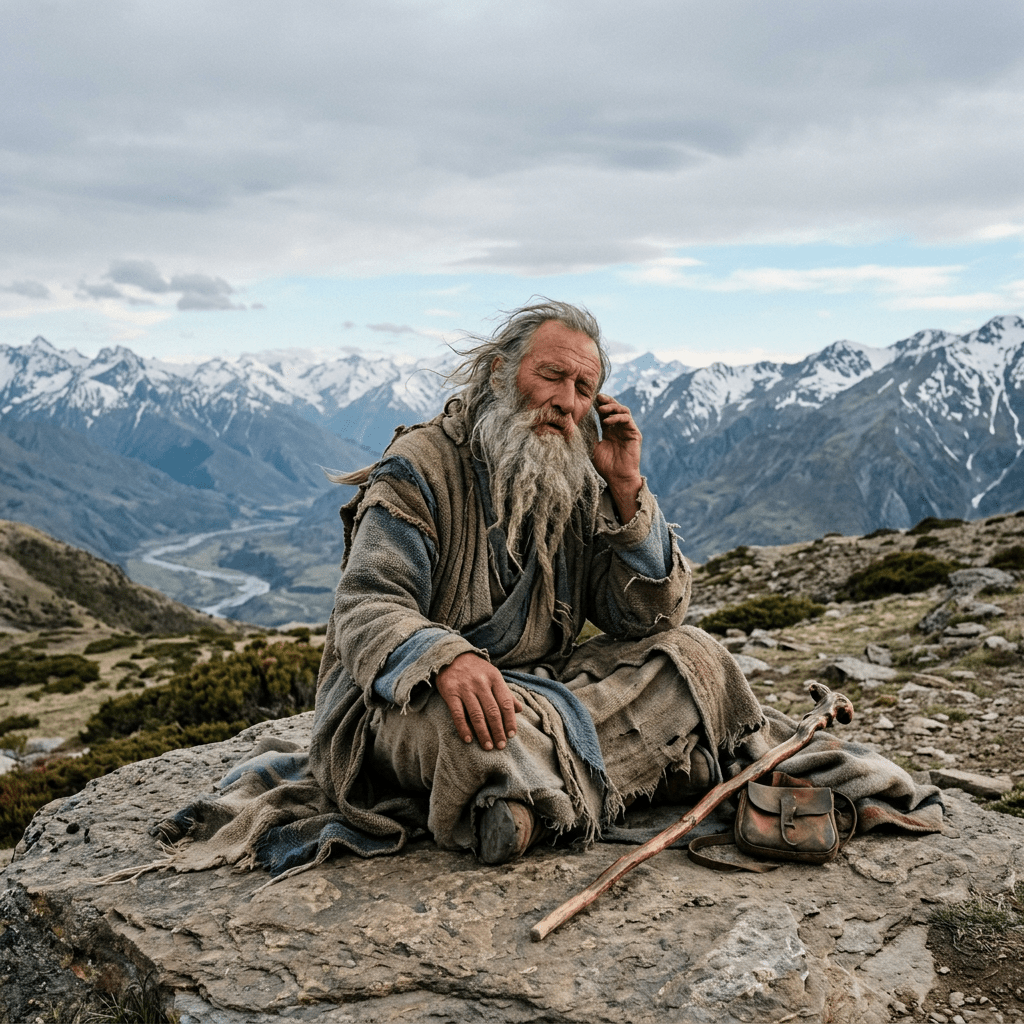
Elderly man with long beard sitting cross-legged on a rock, wearing layered robes, with a walking stick and pouch beside him, mountains in background
Bryn The Hermit

In a corner of Wales where the wind remembers every ancient road, there stood a plateau crowned by a stubborn old mountain. Not the tallest peak, perhaps, but one wearing its clouds like a shawl and keeping its secrets tucked beneath mossy stones and bracken that whispered in the rain. On this plateau lived a hermit, a man they called Bryn, though few could swear they’d ever heard him speak more than a few quiet words at a time. The path to Bryn’s dwelling was narrow, carved by the patient steps of seasons. It wound through gorse and bramble, climbed a stair of loose slate, and finally opened onto a small, stone-creaking cabin perched at the edge of the world where the land fell away into a thousand green miles. The cabin had no fancy bells or bright windows, only a single small lattice blinking gold in the sunset, and a smoke-blackened chimney never seeming to stop sighing into the dusk.

Bryn lived alone, but he was not lonely. He kept company with the forest’s patient rhythm: the slow turning of the seasons, the wary glances of deer along the ridge, the sly intrusion of badgers at dusk, and the countless songs of birds nesting in the eaves when the storm blew in from the sea. He tended a garden seeming to grow where it wished, herbs and roots thriving in soil that was more memory than earth. He spoke softly to stones, and the stones, if you listened with your heart rather than your ears, spoke back in a language of weight and time. People from valleys below would sometimes find the path to the plateau, drawn by a rumour of wisdom and a need for counsel. They carried with them the burdens of ordinary life: a quarrel with a sister, a fear of the future, a decision that would bend a life into a new shape. And when they stood before Bryn, they found a man who looked at them with the patience of rivers and the calm certainty of a tree that has weathered many storms.

“Tell me what you carry,” Bryn would say, not as a demand but as a door opened by trust.

And they would begin, slowly, as if peeling an apple grown too old to hurry, revealing the weight inside: a grudge burning like a coal in the pocket, a dream grown stiff with doubt, a plan that had forgotten to breathe.
Bryn listened as the forest listened: with a generous stillness that let the speaker feel the full gravity of their own words. Then, without booming judgment, he would offer a thread of truth, sometimes wrapped in a parable, sometimes in a small, practical act. He spoke of rivers that do not hurry to the sea, of mountains that rise not to impress but to shelter, of nights so quiet even the heart could hear its own breath. He urged patience, and offered questions rather than answers, because questions, he believed, were the hatchways to the hidden rooms inside every choice.

On one such day, a storm rolled in from the sea with a beard of rain and a voice like clattering armour. The plateau trembled under the wind, the slate rattled underfoot, and the forest hissed with the warning of sap that might freeze on a moonless night. A young woman, eyes bright with stubbornness, stood at Bryn’s door with a letter clenched in her hand, the letter she dared not send, the one that would either mend a family rift or burn it to ashes.

Bryn welcomed her with the quiet smile of a man who has learned to recognise the exact moment when a storm has become a story and not a danger. He listened as she spoke of kinship and clever plans, of promises made in the glow of the hearth and promises broken in the cold arithmetic of daily life. When her tale ran dry, he pressed a small seed into her palm, a seed that looked, to the untrained eye, like any ordinary seed but carried, in its dry shell, the memory of a hillside that never stopped growing.

“Plant it where the earth remembers your laughter,” he said simply. “Water it with your patience, and answer with your presence, not your justification. If the seed grows, let it teach you where to bend and where to stand firm. If it does not, then you have learned something no letter could teach: what you truly want to carry into tomorrow.”

She left with the seed nestled in the folds of her mind, and the storm broke into a chorus of rain and wind sounding like old trees sobbing with relief. Bryn watched the girl go, the plateaus, the mountains, and the sea beyond them settling into a gentler rhythm. He did not possess tools for every problem, nor did he pretend to. He had something rarer: a way of listening that allowed people to hear the right questions inside their own hearts.

Time in Bryn’s life did not rush. It curled like smoke around the chimney and drifted through the cabin’s wooden bones. The forest grew older with him, or perhaps with him inside it, becoming a book whose margins were carved by the rain. And the plateau, that quiet crown on the Welsh hills, remained a place where endings did not announce themselves with thunder, but with a soft light softening the edges of a life already worn just enough to fit a wiser future.

If you asked Bryn the meaning of wisdom, he would point to the gentle hinge of a door that leads to a room you never knew existed, a room where you can choose a different path without losing your old self. He would tell you wisdom is not a shout or a flame, but a steady breath in the long corridor of tomorrow. And so the hermit lived, not as a figure of mystery but as a patient reminder: that a life kept in harmony with the forest, its rain, wind, and quiet growth can teach us to slow down, listen, and perhaps, just perhaps, choose the path that asks for a little more tenderness and a little less fear. 

A 500 word story – using only dialogue THE FERRYMAN

The Ferryman

“I cannot see a thing! Brother Simon, where are you, are you at hand?”

“I am here Brother Paul, I hear you but I too appear to be without sight, all is dark, there is no light.”

“Praise be to God. For a moment, a fraction of fear ripped at my soul, I thought I stood alone. One minute I am sitting where I now stand with warmth and brightness, sunshine and light cascading through every pore of my physical being. Without warning all became as it now is, dark!”

“I am cold, bitterly so and to the very core of my bones. Trembling and shaking, and it worsens by the second. My belief in our God is failing me as fear overcomes my breath. Yet, I see no steam of cold breath in the darkness.”

“You are not alone and I too fear this sudden darkness and cold. I do not understand. Surely we cannot both have lost our capacity to see, is this the End of Times?”

“Brother Simon, let us breathe slowly and attempt to control our fear, then perhaps we may gain some semblance and clarity to know where we are because this is not our monastery, that is for certain as even in darkness our home is familiar and this, whatever it be, is not!”

“Who is there, reveal yourself, I hear but I cannot see you?”

“Brother Simon, did you hear that voice?”

“I did Brother Paul but I still see nothing.”

“I said, who are you, tell me, and tell me now!”

“My name is Brother Paul and my friend is Brother Simon. Where are we, do you know, and who are you?”

“You are religious Brothers or are you referring to yourselves as kin?”

“We are Franciscan Monks and both of us are very old indeed, who are you and do you know where we are, please tell us?”

“My name is not important and as to where we are, is between a world you have known for three score years and ten and one of nothingness, a void and yet not!”

“Brother Paul?”

“Yes, Brother Simon.”

“I think we are speaking to the Angel of Death?”

“The Angel of Death brought you to me, into the void, to this river and I will help you to get to the other side. This is a duty I have honoured since time began.”

“So we are dead?”

“Only to what was and not to what now is. Life is everlasting and your souls are on a journey toward contemplation.”

“But how did we die? I have no memory of illness. Do you Brother Simon?”

“I do not. But I am having difficulty remembering anything at all.”

“Fear not Brothers, you will remember that which is important but all that is not will be and is forgotten.”

“So our journey is to heaven Ferryman?”

“Is that where we are going?”

“Your journey will end when this boat of darkness reaches the shore”

Spooky Truth – No 2 – 1972

This series of Spooky Truths are accounts of experiences in my life that really happened.

The year, 1972 and the place is Leicester. A nightclub on Church Street, motorcycles scattered through walls, a unique decor …. welcome to the ‘Freewheeler’, formerly the Hippo Club. It was a very old building dating back to the early 19th Century, maybe even older. I was the resident DJ and Compere, a young twenty year old hippy enjoying everything life presented me with in ‘spades’. I knew the city well as I first came in 69/70 to a residency at the Top Rank Suite on Haymarket before returning to the Genevieve in Sheffield. Happenstance returned me to Leicester, where unbeknown to me one of the spookiest experiences that would stay with me for the rest of my my life lay in wait.

The Freewheeler was a popular venue and frequented by trendy club goers, a great little club remembered by many I am sure. So lets take a dive into the physical layout of the club. It was spread over four floors, the first being the entrance, a lounge and bar area, the main room with dance floor, stage and bar. On the second floor a large lounge which would later be christened as the ‘Coachman’s Lounge’, plus cloakroom and toilets. Offices and storerooms occupied the remaining two floors. The owner used to arrive in his Rolls Royce Corniche, a wealthy working class bloke who made his fortune from laying turf for all and sundry. He owned this club and its sister, Freewheeler in Kettering. I spent time in both clubs but it is this one in Leicester where our story is born. One day the owner, manager and security chap were photographed together in the office on the top floor. It is interesting to note that this room was always so cold irrespective of the time of day, when entering it was like walking in to a freezer. When the photograph was developed to everybody’s amazement, there on the managers shoulder as clear as day sat, a transparrent hand. It was not a set up, there was no trick photography, this was as real as it gets.

This was the first experience shared by a few of us at the same time which led to conversations about strange noises, children laughing, a ball bouncing and unknown people appearing, then been nowhere to be found. I remember distinctly sitting in the club during the day and hearing children running in the upstairs lounge above the dance floor, and thumping as if a ball was bouncing. Yes it felt a little spooky and often I would experience the hair rising at the back of my neck and up my arms, but nothing at that time felt particularly malevolant, in fact, quite comfortable but obviously strange. One weird happening often filled me with curiosity and to this day over fifty years later still does.

As a prenentious young entertainer my tipple in those days was Canadian Rye Whisky and Dry, in a short tumbler. The first time anything happened, there was the glass full of my tipple sitting on a shelf next to the music consul. I had only just put the glass down to set a disc on the player, so a matter of two minutes, three at the most. Turning around to take a sip and the glass was empty, yes empty, as if the contents had simply evaporated into thin air. Holy crap, methinks, here we go again. On four or five occassions I purposefully left a full glass on the shelf and sat at the far end of the room watching intently to see what would happen. Everytime, excepting one occasion, I saw no movements, no spooky vibes but the glass was drained every time. It became a bit of a standing joke between some of us that the club hosted a ghost who liked a drink.

Following the revealing photograph the owner had been advised not to make anything of the matter, after he recruited a psychic from Northampton to investigate. I wish I could remember his name, I know it was Jack something. Our psychic investigator was an experienced man in his fifties and was under no illusion about the resident spirits. He told us there was the spirit of a Coachman who haunted the lounge on the first floor and this is why it was named so. Confirming the presence of spirit children and a middle aged woman he left reminding the owner to keep eveything under wraps. I suppose it was like telling a child not to open a present, he could not wait and within a few days the story made headlines in the Leicester Mercury. Needless to say, we became busier than ever. I mentioned earlier no malevolance happened, well not whilst I was there but odd spooky moments did. Occurences certainly increased after the publicity.

One evening at around 1.30am the door bell rang and the security manager admitted a tall man in a grey suit with shoulder length blond hair. He walked straight up the stairs towards the cloakroom, and was seen to close the gents toilet door behind him. The stranger in the grey suit never came back down the stairs so the security man, Kieth went to search for the mysterious guest. Not a sign anywhere remained and he had not left the club by the entrance and all other doors were locked. The Freewheeler was a great club and seemingly not only popular with the living.

The paranormal data base for the area published the following.

Location: Leicester – Freewheeler Club, Churchgate
Type: Haunting Manifestation
Date / Time: 1972
Further Comments: An exorcist was summoned to this building after staff reported seeing a strange ghost which would change shape.