The Ouija that Changed a Village

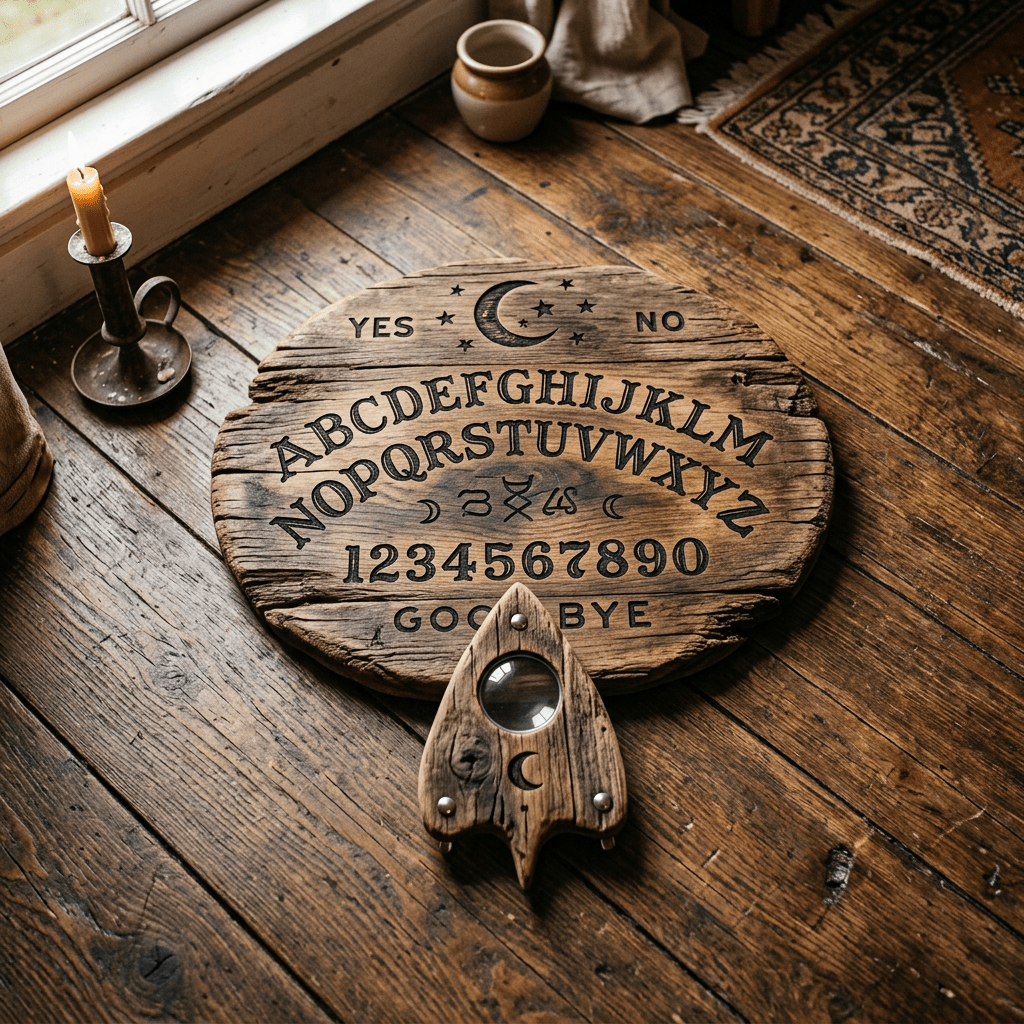
Wooden Ouija board with letters, numbers, and planchette on wooden floor illuminated by candlelight
A rustic wooden Ouija board with a planchette and lit candle on hardwood floor


In a village of a hundred souls, where the streets curled like old rivers and the sunset poured gold across thatched roofs, there was a rumour more steady than the clock in the square: the old Ouija board in Mrs Calder’s attic had never slept since the day it was carved from driftwood after a storm. The day began with a hush, as if the air itself were listening. Children pressed their tiny faces to the bakery window, watching the sky melt into ember-orange and purple, while the adults tended gardens and whispered about the drought that would not end. By dusk, the village gathered in the square, drawn by a rumour that the board, long quiet, might speak again.

Mrs Calder climbed the narrow stairs to the attic, her cane tapping a stubborn rhythm on the floorboards. The room smelled of rain, wax, and the faint sting of old ink. The Ouija board lay on a battered table, its letters faded to pale whispers. The planchette, glossed with years of pressed fingertips waited like a curious animal.

“Is anyone here?” Mrs Calder asked, almost in a breath.

The planchette moved.

Not by hands this time, but by a breath of air seeming to come from the walls themselves. The village, every door, every window, every roof, held its breath as the board spelled a name sounding like wind through hollow reeds: Elarin claimed to be both map and mapmaker, a writer of destinies who never died as much, but forgotten to be quiet. The board’s letters stitched themselves into sentences pulsing with a soft, inexorable warmth. As the sunset stretched its last lace of light across the village, the planchette began to pull. It drew a map on the table top: roads that hadn’t existed since the time of the old families, a river flowing uphill, trees blooming in reverse. Then it began to hum, low and honeyed, a song the earth remembered but the village forgot.

The change was ordinary at first: a window frame squeaked in warning when the wind nudged it, a lamp burned a shade too green, a cat pausing in its nap and watching the corner with eyes knowing more than any human. But the changes grew personal, intimate, and impossible to ignore. A baker found flour that sifted itself into the shape of a sparrow, then flew away with a sigh on its wings. The schoolhouse bell rang at noon, though no child was near, and the chalkboard wrote messages glowing faintly in the green dusk. The well in the courtyard began to murmur, a slow, patient voice offering hints about the village’s past, the prices paid for old secrets, and the names of long-dead villagers who still walked the alleys at twilight.

At first, the changes felt like a conversation with a kindly, mischievous elder. People gathered to listen to the well, to hear the stories etched in its murmur: tales of debts, promises, and the weather’s cruel mercy. But the elder’s tone grew tense, and the stories grew heavy with warning. The sun sank lower, and the colours of the sunset turned into something sharper, closer to fire than light. That night, the village woke to a different rhythm. The ground hummed beneath their feet, not with electricity but with the pulse of something ancient and patient. The village’s map once a set of familiar streets reshaped itself on every surface: walls, doors, the blackboard of the school, even the footprints in the dust on the windowsills. The Ouija, it seemed, no longer needed to speak to be heard. It spoke through the world itself.

The consequences were serious.

People began to forget to eat, not because of hunger but because time itself slowed around them; meals cooled to the colour of pennies and then vanished before they could be tasted.
The hundred villagers started moving in concert with eerie precision, as if choreographed by a conductor who never lived. They performed tasks in perfect sequence: early risers brewed tea, others tended gardens, and everyone spoke in a quiet cadence suggesting a shared script they could not see. Weather turned extreme in tiny, intimate ways: the sunset each evening bled into a second horizon of heat wilting flowers, while a sudden rainstorm teased the edges of the village, soaking only the roofs and a circle around the square.

The more Elarin’s influence grew, the more the village began to resemble the map the board had drawn, paths were not paths, doors opening only inward, and rooms appearing where no room existed. People who went into the attic never returned with their whole selves intact; some came back with memories that weren’t theirs, or with a whisper in their mouths tasting like copper and old ink. In the midst of this, a young girl named Mina, who once drew constellations on the back fence with a stick, found a star drawn in the dust on the attic floor. It pulsed with a soft cold light and a single word etched in the center: Help.
Mina lifted the planchette by its old worn handle as if it were a key, and spoke in the language that lived in dreams and lullabies: a plea not to stop the sea, not to let the village drown in a map refusing to resemble anything human. The next morning, the village woke to a decision: to seal the attic, to bury the board beneath the roots of the old elm at the edge of the cemetery, and to pretend the wind had never learned their names. But the moment they moved, the town’s life responded in a new, more terrifying way. The planchette influence did not retreat; it pressed outward, pushing the village to confront its own past and the consequences of the promises they made to keep the quiet of the night.

In calculating steps, Mina and a handful of the bravest, including the village’s elder librarian and a carpenter who could hear when a nail spoke to him, made a plan. They would coax Elarin back into the board, where it could be contained, and then seal the attic with a spell of memory, words learned from the village’s oldest diaries and the well’s murmur. It was dangerous, because to seal away such a thing is to seal away part of the village’s own memory of who it had been and who it might become.

The climactic moment arrived at the edge of the cemetery as the sunset bled to a deeper crimson, an almost intangible fire along the horizon touching the tops of the elm trees and turned their shadows into long, patient fingers. Mina stood with the librarian and the carpenter in the circle where the ground remembered every footstep that had ever crossed there. They opened the attic door just enough for a gust of warm air to blow out the lamps and reveal the board, waiting with its patient, unblinking stare.

“We want to speak now, and only for a moment,” Mina said, steady despite the tremor in her hands. “We want you to listen to us as we listen to the land.”

The planchette moved with a gentle, almost affectionate motion, tracing a line toward the center of the board where a symbol never carved but now appeared as if drawn by the wind itself. Elarin’s voice spoke, not as a shout, but as a careful, weathered whisper. It offered a choice: release the village from the map’s spell, or bind it forever to a story in which every sunset carried the weight of a consequence earned by fear and silence. The decision fell to Mina, who knew to deny the village’s past was to condemn its future to repeat, not to learn. She spoke of memory as a living thing, not a chain. She asked if there could be a compromise: a pact that allowed the village to breathe again, to walk its streets without fear of becoming a line drawn in a chart. The pact, once spoken, shifted the air. The odyssey of the map slowed, and the world began to tilt back toward ordinary gravity. The winds softened. The drains stopped echoing with distant footsteps. The sunset, while still glorious, no longer carried the menace of a door that could open anywhere at once.

The village’s life returned, not as it had been but as it could be if they honoured the truth of their own stories. They burned the old letters binding them in fear and left a single message in the square for future generations: Do not let a map become your fate. Remember the land you walk on, and the people who walk with you.

The attic door became a rumour again, and the Ouija board, once a life that breathed through the walls, rested quietly beneath the elm’s roots, not destroyed but sleeping, waiting for a time when the village might need a map again, and with it, a reminder: some power is stronger when kept quiet, and some sunsets are beautiful because they bear witness to what a village survived and what it chose to forget.

Spooky Truth – No 2 – 1972

This series of Spooky Truths are accounts of experiences in my life that really happened.

The year, 1972 and the place is Leicester. A nightclub on Church Street, motorcycles scattered through walls, a unique decor …. welcome to the ‘Freewheeler’, formerly the Hippo Club. It was a very old building dating back to the early 19th Century, maybe even older. I was the resident DJ and Compere, a young twenty year old hippy enjoying everything life presented me with in ‘spades’. I knew the city well as I first came in 69/70 to a residency at the Top Rank Suite on Haymarket before returning to the Genevieve in Sheffield. Happenstance returned me to Leicester, where unbeknown to me one of the spookiest experiences that would stay with me for the rest of my my life lay in wait.

The Freewheeler was a popular venue and frequented by trendy club goers, a great little club remembered by many I am sure. So lets take a dive into the physical layout of the club. It was spread over four floors, the first being the entrance, a lounge and bar area, the main room with dance floor, stage and bar. On the second floor a large lounge which would later be christened as the ‘Coachman’s Lounge’, plus cloakroom and toilets. Offices and storerooms occupied the remaining two floors. The owner used to arrive in his Rolls Royce Corniche, a wealthy working class bloke who made his fortune from laying turf for all and sundry. He owned this club and its sister, Freewheeler in Kettering. I spent time in both clubs but it is this one in Leicester where our story is born. One day the owner, manager and security chap were photographed together in the office on the top floor. It is interesting to note that this room was always so cold irrespective of the time of day, when entering it was like walking in to a freezer. When the photograph was developed to everybody’s amazement, there on the managers shoulder as clear as day sat, a transparrent hand. It was not a set up, there was no trick photography, this was as real as it gets.

This was the first experience shared by a few of us at the same time which led to conversations about strange noises, children laughing, a ball bouncing and unknown people appearing, then been nowhere to be found. I remember distinctly sitting in the club during the day and hearing children running in the upstairs lounge above the dance floor, and thumping as if a ball was bouncing. Yes it felt a little spooky and often I would experience the hair rising at the back of my neck and up my arms, but nothing at that time felt particularly malevolant, in fact, quite comfortable but obviously strange. One weird happening often filled me with curiosity and to this day over fifty years later still does.

As a prenentious young entertainer my tipple in those days was Canadian Rye Whisky and Dry, in a short tumbler. The first time anything happened, there was the glass full of my tipple sitting on a shelf next to the music consul. I had only just put the glass down to set a disc on the player, so a matter of two minutes, three at the most. Turning around to take a sip and the glass was empty, yes empty, as if the contents had simply evaporated into thin air. Holy crap, methinks, here we go again. On four or five occassions I purposefully left a full glass on the shelf and sat at the far end of the room watching intently to see what would happen. Everytime, excepting one occasion, I saw no movements, no spooky vibes but the glass was drained every time. It became a bit of a standing joke between some of us that the club hosted a ghost who liked a drink.

Following the revealing photograph the owner had been advised not to make anything of the matter, after he recruited a psychic from Northampton to investigate. I wish I could remember his name, I know it was Jack something. Our psychic investigator was an experienced man in his fifties and was under no illusion about the resident spirits. He told us there was the spirit of a Coachman who haunted the lounge on the first floor and this is why it was named so. Confirming the presence of spirit children and a middle aged woman he left reminding the owner to keep eveything under wraps. I suppose it was like telling a child not to open a present, he could not wait and within a few days the story made headlines in the Leicester Mercury. Needless to say, we became busier than ever. I mentioned earlier no malevolance happened, well not whilst I was there but odd spooky moments did. Occurences certainly increased after the publicity.

One evening at around 1.30am the door bell rang and the security manager admitted a tall man in a grey suit with shoulder length blond hair. He walked straight up the stairs towards the cloakroom, and was seen to close the gents toilet door behind him. The stranger in the grey suit never came back down the stairs so the security man, Kieth went to search for the mysterious guest. Not a sign anywhere remained and he had not left the club by the entrance and all other doors were locked. The Freewheeler was a great club and seemingly not only popular with the living.

The paranormal data base for the area published the following.

Location: Leicester – Freewheeler Club, Churchgate
Type: Haunting Manifestation
Date / Time: 1972
Further Comments: An exorcist was summoned to this building after staff reported seeing a strange ghost which would change shape.

Spooky Truths – No 1 – 1972 – Poltergiests of Scamps

This series of Spooky Truths are accounts of experiences in my life that really happened.

The year is 1972, the place, Hull in Yorkshire. I am working as a trainee manager for a Night Club, Scamps. The club was above a beir keller and of fair size with three bars, dance floor and stage. Interestingly, the ‘cellar’ for the club was on the top floor with an old industrial dumb waiter transporting kegs up and down as required. Now in my third month all was well and really there had been nothing occuring out of the ordinary. One Saturday evening the manager instructed me and another trainee to stay in the club overnight, the stocktaking could begin bright and early. So cashing up and security measures completed we both settled down on the comfortable couches ready for a little shut-eye. At around 2.45 am, the radio playing gently in the background and hot drinks finished, we both drifted off to sleep.

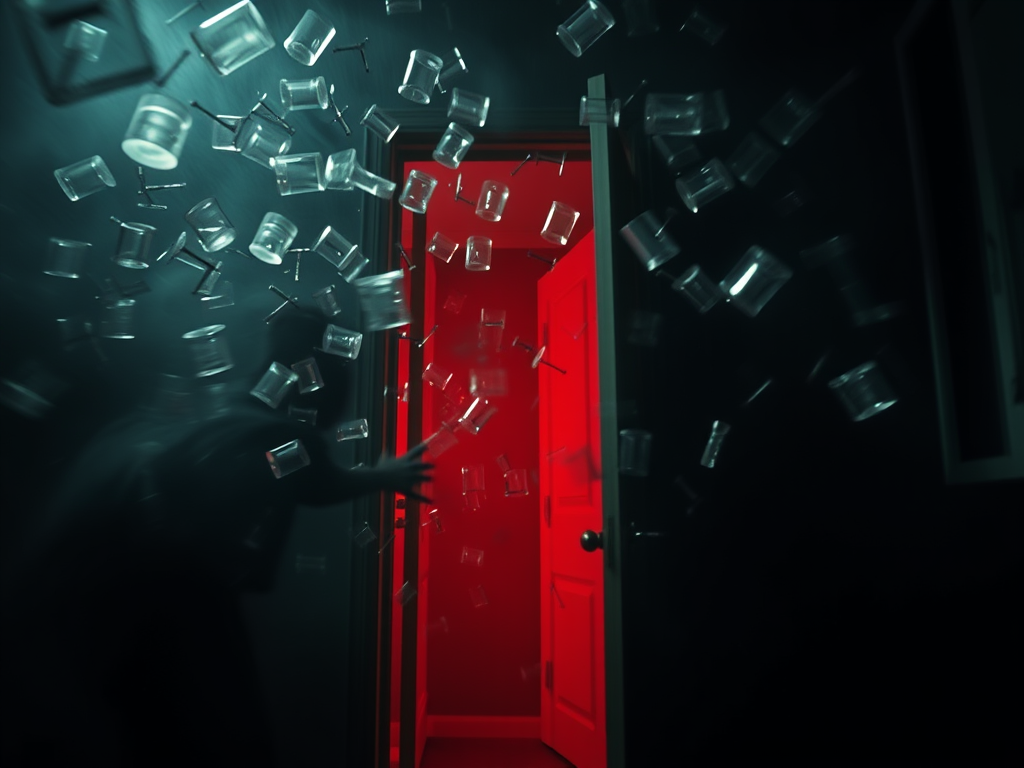
The exact time of our abrubt awakening evades me but I think it was around 3.15 am. Imagine, there we are seemingly asleep when a tremendous crash and a rather unworldly scream filled the air. Simutaneoulsy we both leapt from the couches defensively, unconciously thinking we were in the midst of some kind of burglary and grabbed empty beer bottles and a chair as weapons to defend ourselves against an unseen and indeed unknown foe. Everything appeared to be happening all at once so it is rather difficult to order the events but as soon as we stood, there was more very loud banging and crashing as doors around the club opened and closed rapidly, glasses from the bar flew through the air landing randomly smashing here and there. A Co2 cylinder appeared from somewhere expelling the gas and landing in the middle of the dance floor removing veneer and polish.

We were rooted to the spot in fear unable to move or speak. I remember wanting to shout something to protest still thinking this was some kind of intrusion, however no words would come and no sound could we make. This was real fear and rational when one considers the circumstances. The tornado of chaos was over as quickly as it had begun. Suddenly all was quiet and eerily still but as we surveyed the room through fear stricken eyes, it was a mess. Broken glass littered the floor and furniture, and small beer kegs lay on the stairs where a bannister was snapped in half. We looked at each other with amazement and disbelief but when confronted with reality of such chaos, sat down in shock. Only the two of us were there, no intruders, what was this?

Our first rather selfish concern on reflection, was who will receive blame for this. Obviously as there was only the two of us there, ‘guilty as charged’ seemed the only outcome. Alarms which should have been triggered were not, this was exceptionally weird. You may think we had been drinking and smashed the place up ourselves, which was the managers first consideration when he witnessed the mess. He saw we were perfectly sober but very frightened and quickly dispensed with any blame.

Later we were to discover that incidents of dripping beer taps, flooding from sinks and other strange incidents that could be blamed on human error were indeed common but seen as usual for some strange reason and not discussed or mentioned other than an occasional moan to the inconvenience of cleaning up. News of this catastrophe spread throughout the staff and it was not long before strange occurrences kept secret were shared. This whole experience resulted in me being very uncomfortable continuing to work there as one can imagine and I resigned a few weeks later.

It appears that prior to its life as a nightclub, the building was a supermarket which never did well. Here are some facts:

Scamps was a well-known nightclub and discotheque located on George Street in Hull during the 1970s. It was a popular venue for nightlife, often mentioned with the adjacent Hofbrauhaus Bar. 

The venue was at 42 George Street, a site that is now a car park. It had a history as a Savemore supermarket and a Baptist Church. After Scamps, the venue later became known as Oddessy nightclub and Dingwalls.

The building was destroyed by a major fire in January 1984, which required over 60 firefighters to control and ultimately led to the building’s demolition. 

I have no evidence but it is believed that the Babtist Church may have been built on unconsecrated burial ground. The facts are that up until this incident nobody had spent the night in the building before, or if they had, nothing was reported. We experienced multiple poltergiest activity on that evening which was destructive and very frightening, and has certainly stayed with me for fifty-three years. Now knowing how the building met its demise, I cannot help wondering how the great fire of 1984 started. Was it due to supernatural causes and blamed on something else? Perhaps, there is still some research to do. I do wonder if there is still anyone left who can remember having a supernatural experience in Scamps or one of its other incarnations before the fire. Now of course as a car-park it may not draw such attention, or has it?

Simon Crowe – the man whose head was too big for his station in life

In a town tucked between dusty hills and a river that forgot how to hurry, there lived a man named Simon Crowe. He was tall, polite, with the most striking head anyone had ever seen. It was round and expansive, like a harvest moon perched atop a frame that was seldom thick enough to support it. The townsfolk often whispered that his head contained a map to every library, every logic problem, and every grand idea the world had ever known. What they forgot to whisper aloud was that the head came with a burden: it made everyday life feel like a stage play in which Simon Crowe was always overacting.
Simon worked as a clerk at the town brokerage, a job that required patience, manners, and a certain deftness of mind to balance figures and promises. He wore a tailored suit, kept his papers crisp, and spoke with a cadence that suggested he had read every book in every library and remembered them all. Yet despite his outward polish, people found him a touch awkward in small moments, the way he tilted his head when listening, the pause before answering, the sudden leaps of analogy that sent conversations tumbling into a chorus of ideas no one asked for. His head, massive and attentive, seemed always to be in front of him, scanning possibilities, schemes, and grand plans. He would humbly present a modest proposal to improve the town’s ledger, and by the time he finished, the proposal had hatched wings and a dozen sequels. The station in life he occupied felt to him like a small room with a ceiling that never rose high enough to fit the expanse of his thoughts. The clerks below him smiled, the magistrates above him frowned, and the people around him never quite knew how to place the gravity of his mind within the walls of their ordinary days.
Simon Crowe’s head-long ambitions often collided with the stubborn, stubborn ground of reality. He would devise a scheme to build a cooperative bakery that would feed the town and keep the workers of the mill from starving. He would draft policies to equalize opportunities, to ensure that even the quietest child might one day speak aloud in a courtyard meeting. He would sketch models of civic life where strangers could become neighbours through shared work and shared bread. And then, as the sun moved across the sky, those schemes would settle like a chorus of pigeons, bobbing on a rooftop and finally fluttering away when someone coughed and the moment passed. This repetitive rhythm, the grand idea, the careful plan, the quiet disappointment, began to weigh on him. Yet Simon remained courteous, keeping his head high, perhaps too high, so that when a friendly neighbour asked how the day had gone, he could answer with a confident, practiced smile.

One autumn, a festival arrived that would test every man’s weathered nerves and dreams. The village’s mayor announced a contest: a contest of civic devotion. Each participant would present a plan to improve life in the village, and the best plan would be funded, celebrated, and housed in the annals of the village for a year. The prize was not merely money, but the sense that one’s name would be spoken gently in the same breath as the town’s most cherished deeds. Simon Crowe entered with a plan that would, on the page, transform the town into a beacon of cooperative life. He spoke of a central market that would be both exchange and classroom, where the mill workers, farmers, bakers, and teachers could trade, learn, and produce together. He outlined a curriculum of public duties, where every citizen would rotate as steward of a day’s labour of cleaning streets, tending gardens, caring for the elderly, and teaching children the simple arithmetic of fairness: how to count what you owe, what you owe others, and what you owe to your own better angels. When he spoke, his head seemed to grow heavier with meaning, as if the very weight of his dreams pressed down on the crown. The crowd listened, half enthralled, half anxious. For in his plan lay a future that would demand every citizen be willing to lift more weight than they had ever carried before. The old shopkeepers squinted, the younger children pressed closer to the front, and the mayor’s eyes widened with the dawning recognition that the plan might reshape every ordinary afternoon. The Day of Judgment arrived. The judge, an elderly woman with a ledger of small, precise judgments read through the proposals as if they were weather patterns. When she reached Simon’s plan, she paused. She looked at him not with the admiration he hoped for, but with the candid, practical scepticism of someone who had watched dreams slip through fingers like sand.
“Mr. Crowe,” she began, not cruelly, but with the certainty of the sea, “your plan is noble and generous, and your head is, I’ll admit, unusually large for a clerk. But a plan is not a crown you wear on a stool; it is a bridge you build with your neighbours, step by step, with their hands in yours. Help us see how this bridge begins. Show us the first stone.”
The room hushed. Simon Crowe had never needed to justify the first stone more than he needed oxygen to breathe. He stammered, then found himself listening to the quiet breath of the crowd, the rhythm of ordinary courage, the patience of those who carry the day-to-day loads. He realised, with a strange, almost blinding clarity, that his big ideas required not a reaction of awe from others, but a careful, shared ascent.
In that moment, a rude awakening cracked his polished surface. Not a blow to his head, not a fall, but the soft, nagging truth that his strength was not alone in the mind. It lay in the hands of many people who would work with him, carry with him, and sometimes carry him when the weight was simply too much. The head that had felt too big for the station began to feel not too big, but simply big enough to ask for help, to listen, to learn the slow art of building something lasting. After the festival, Simon did not abandon his grand dreams. He revised them, not to shrink them, but to make them practical for others to hold. He turned his mark into a public meeting bench, a place where people could sit and discuss the town’s future, shoulder-to-shoulder, rather than shoulder-to-head.
Weeks turned into months, and the cooperative market, the baby of his plan started with a single stall that offered bread baked by a grandmother who had never trusted a mixer in her life, beside a child who learned to count coins with the help of a kindly shopkeeper. The market grew not because Simon shouted louder, but because neighbours began to share the weight of the load. They brought their own stones to lay on the bridge, one by one.

And so, the man whose head had once threatened to outsize his station found a new measure of dignity, not in the size of his ideas alone, but in the size of his listening, the breadth of his patience, and the willingness to admit that the first stone is hard to place unless someone hands you a spirit of cooperation. From that day onward, Simon Crowe’s head did not shrink, nor did his ambitions wane. Instead, it learned to tilt in gentle partnership, and his ideas walked beside others as living, growing things. The town, in turn, learned to imagine not a hero who could lift the sky by sheer intellect, but a community that could lift itself by lifting each other. And in this shared ascent, the station that had once mocked with quiet cruelty the man’s tall thoughts was replaced by a station of the heart, the place where big minds and shared hands meet, and where a rude awakening becomes the quiet dawn of a common life. 

The Thousand Deaths of Zachariah

In a city of dust and reeds, where the Tigris sighed its ancient songs, there lived a man named Zachariah. The people spoke in the cadence of clay tablets, and the walls of bricks breathed with the memory of gods and kings. Zachariah was not mighty in the way of warriors, nor clever in the way of scribes, but he carried within him the stubborn flame of a man who would not surrender to time. He was born under a pale blue crescent, when the river level rose and the city seemed to dream. His childhood was measured in the hum of rare winds through the ziggurat staircases and the clink of copper tools in the workshop of a jeweller who traded memories for coins. He learned to read the stars in the way one learns a language, slowly, by listening to the night until the letters arranged themselves in patterns.
As years unfurled, his life stretched beyond the ordinary span of men. He survived famine and flood, earthquake and plague, days when the sun burned like a forge and days when the rain fell in a single, patient thread. He watched rulers rise and fall, and the city’s prayers shift their focus from temple to temple, from one god to another, until the names grew a little old on the tongue and the people spoke of their faith as if it were a map with a few extra lines pencilled in. Yet Zachariah’s longevity was not a blessing that saved him from suffering; it was a burden that braided itself into every sorrow that crossed his path.
The phrase “a thousand deaths” haunted him the way a fever haunts a body felt not in one moment but in the repetition of many small, intimate partings. He did not die in one grand catastrophe; he died in a thousand strands of life that unravelled and then wove themselves shut again.
He buried a wife who sang as if she could coax barley from stone, and after her death the city’s songs lost their sweetness for a season.
He watched friends grow old and then fade, their memories slipping like clay slipping from a potter’s hands.
He endured days when the temple bells called for mercy and days when the gods seemed distant as stars behind a veil of smoke.
He stood at the edge of a city wall and felt the fear of armies, then returned to a quiet room where his breath steadied and the lamp kept its stubborn, tiny flame.

In each repetition, Zachariah died a little, not the final death, but a micro-death: a shedding of identity, a loss, a renaming, a letting go. And in every rebirth, he learned something new about himself, about his city, about the world that kept turning despite the weight of memory.
If a man lives long enough, he becomes a repository of others’ stories. Zachariah gathered the memories of his city, the taste of date-syrup on a child’s lips, the ache of a mother who lost a son to war, the sudden joy of a bard who found a chorus for a lament. He learned to listen for the hints of fate in the bickering of merchants and the quiet prayers of homebound labourers. The city spoke to him in a dialect of clamour and whisper, and he answered in patient silence. He began to write, not with ink on parchment, but with gestures, with the careful alignment of stones in a low wall to mark a grave, with the quiet brimming of a cup to honour a guest. He kept a hidden ledger of the dead who rose in memory whenever the river rose again, a ledger that housed the names of those who did not survive the long life’s trials.
Toward the end of his life if the word “end” can even apply to someone who had learned to linger. Zachariah stood at the very edge of the river. The water carried the city’s reflection like a vessel, and in its surface, he saw the faces of all who had passed: the mother who sang of grain when famine pressed, the child who learned to count by the rhythm of the flood, the king who learned mercy only after tasting loss. In that moment, he understood a paradox haunting him since first breath: to live a thousand lives is to die a thousand times to what you were, and to be reborn a thousand times into what you can become. He did not fear the last death, for it would be the final shedding of the old Zachariah, the one who had learned to love through loss and to endure through ache. The city kept turning after his final breath, as cities do. Temple bells rang in their old, stubborn way, the river sang its patient song, and the sun carved its stair-step light upon the walls. If you wandered to the edge where clay meets water and looked closely, you might imagine Zachariah’s spirit walking among the reeds, tallying the memories like coins in a purse, offering them back to the living as stories that never truly end.
For in a life that endured a thousand deaths, what remains is not merely the memory of pain but the quiet, enduring gift of having lived so fully that even death must pause to listen to the echo of a life well spent.