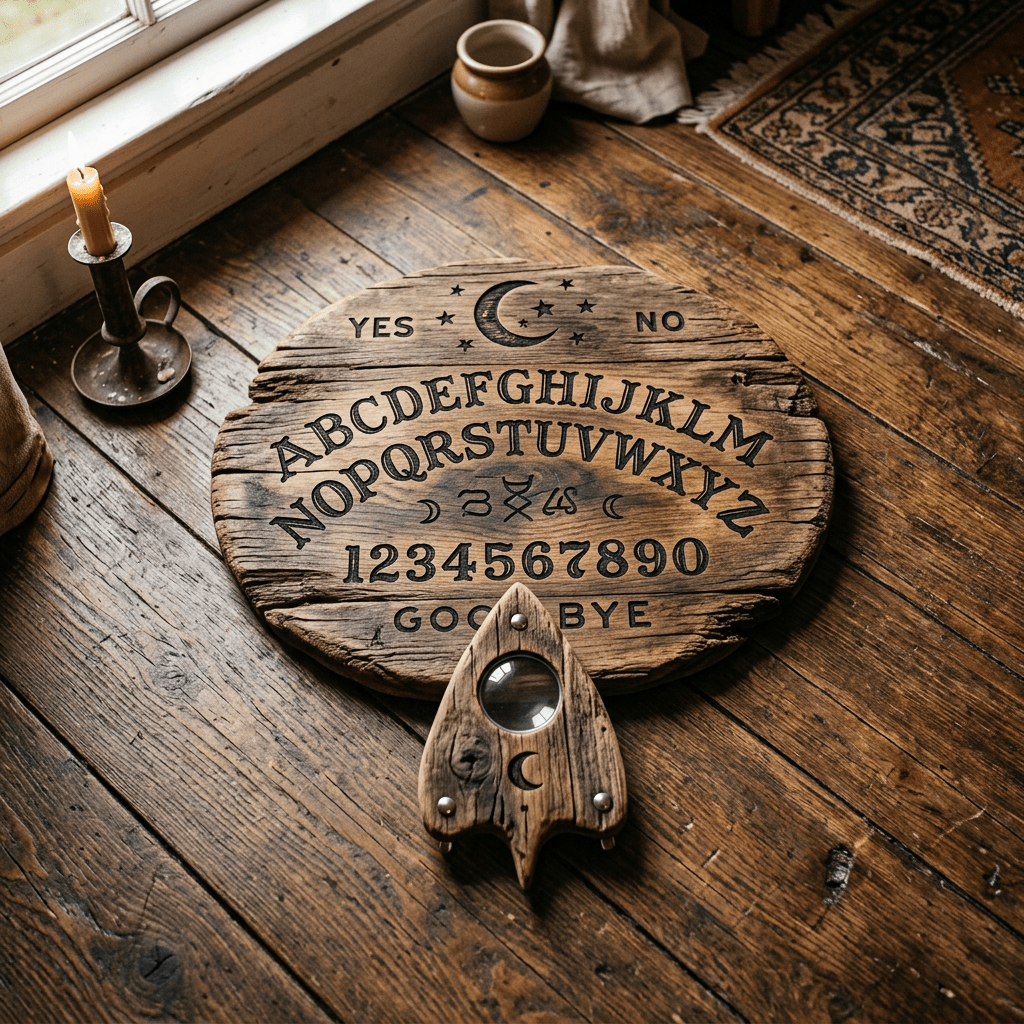
In a village of a hundred souls, where the streets curled like old rivers and the sunset poured gold across thatched roofs, there was a rumour more steady than the clock in the square: the old Ouija board in Mrs Calder’s attic had never slept since the day it was carved from driftwood after a storm. The day began with a hush, as if the air itself were listening. Children pressed their tiny faces to the bakery window, watching the sky melt into ember-orange and purple, while the adults tended gardens and whispered about the drought that would not end. By dusk, the village gathered in the square, drawn by a rumour that the board, long quiet, might speak again.
Mrs Calder climbed the narrow stairs to the attic, her cane tapping a stubborn rhythm on the floorboards. The room smelled of rain, wax, and the faint sting of old ink. The Ouija board lay on a battered table, its letters faded to pale whispers. The planchette, glossed with years of pressed fingertips waited like a curious animal.
“Is anyone here?” Mrs Calder asked, almost in a breath.
The planchette moved.
Not by hands this time, but by a breath of air seeming to come from the walls themselves. The village, every door, every window, every roof, held its breath as the board spelled a name sounding like wind through hollow reeds: Elarin claimed to be both map and mapmaker, a writer of destinies who never died as much, but forgotten to be quiet. The board’s letters stitched themselves into sentences pulsing with a soft, inexorable warmth. As the sunset stretched its last lace of light across the village, the planchette began to pull. It drew a map on the table top: roads that hadn’t existed since the time of the old families, a river flowing uphill, trees blooming in reverse. Then it began to hum, low and honeyed, a song the earth remembered but the village forgot.
The change was ordinary at first: a window frame squeaked in warning when the wind nudged it, a lamp burned a shade too green, a cat pausing in its nap and watching the corner with eyes knowing more than any human. But the changes grew personal, intimate, and impossible to ignore. A baker found flour that sifted itself into the shape of a sparrow, then flew away with a sigh on its wings. The schoolhouse bell rang at noon, though no child was near, and the chalkboard wrote messages glowing faintly in the green dusk. The well in the courtyard began to murmur, a slow, patient voice offering hints about the village’s past, the prices paid for old secrets, and the names of long-dead villagers who still walked the alleys at twilight.
At first, the changes felt like a conversation with a kindly, mischievous elder. People gathered to listen to the well, to hear the stories etched in its murmur: tales of debts, promises, and the weather’s cruel mercy. But the elder’s tone grew tense, and the stories grew heavy with warning. The sun sank lower, and the colours of the sunset turned into something sharper, closer to fire than light. That night, the village woke to a different rhythm. The ground hummed beneath their feet, not with electricity but with the pulse of something ancient and patient. The village’s map once a set of familiar streets reshaped itself on every surface: walls, doors, the blackboard of the school, even the footprints in the dust on the windowsills. The Ouija, it seemed, no longer needed to speak to be heard. It spoke through the world itself.
The consequences were serious.
People began to forget to eat, not because of hunger but because time itself slowed around them; meals cooled to the colour of pennies and then vanished before they could be tasted.
The hundred villagers started moving in concert with eerie precision, as if choreographed by a conductor who never lived. They performed tasks in perfect sequence: early risers brewed tea, others tended gardens, and everyone spoke in a quiet cadence suggesting a shared script they could not see. Weather turned extreme in tiny, intimate ways: the sunset each evening bled into a second horizon of heat wilting flowers, while a sudden rainstorm teased the edges of the village, soaking only the roofs and a circle around the square.
The more Elarin’s influence grew, the more the village began to resemble the map the board had drawn, paths were not paths, doors opening only inward, and rooms appearing where no room existed. People who went into the attic never returned with their whole selves intact; some came back with memories that weren’t theirs, or with a whisper in their mouths tasting like copper and old ink. In the midst of this, a young girl named Mina, who once drew constellations on the back fence with a stick, found a star drawn in the dust on the attic floor. It pulsed with a soft cold light and a single word etched in the center: Help.
Mina lifted the planchette by its old worn handle as if it were a key, and spoke in the language that lived in dreams and lullabies: a plea not to stop the sea, not to let the village drown in a map refusing to resemble anything human. The next morning, the village woke to a decision: to seal the attic, to bury the board beneath the roots of the old elm at the edge of the cemetery, and to pretend the wind had never learned their names. But the moment they moved, the town’s life responded in a new, more terrifying way. The planchette influence did not retreat; it pressed outward, pushing the village to confront its own past and the consequences of the promises they made to keep the quiet of the night.
In calculating steps, Mina and a handful of the bravest, including the village’s elder librarian and a carpenter who could hear when a nail spoke to him, made a plan. They would coax Elarin back into the board, where it could be contained, and then seal the attic with a spell of memory, words learned from the village’s oldest diaries and the well’s murmur. It was dangerous, because to seal away such a thing is to seal away part of the village’s own memory of who it had been and who it might become.
The climactic moment arrived at the edge of the cemetery as the sunset bled to a deeper crimson, an almost intangible fire along the horizon touching the tops of the elm trees and turned their shadows into long, patient fingers. Mina stood with the librarian and the carpenter in the circle where the ground remembered every footstep that had ever crossed there. They opened the attic door just enough for a gust of warm air to blow out the lamps and reveal the board, waiting with its patient, unblinking stare.
“We want to speak now, and only for a moment,” Mina said, steady despite the tremor in her hands. “We want you to listen to us as we listen to the land.”
The planchette moved with a gentle, almost affectionate motion, tracing a line toward the center of the board where a symbol never carved but now appeared as if drawn by the wind itself. Elarin’s voice spoke, not as a shout, but as a careful, weathered whisper. It offered a choice: release the village from the map’s spell, or bind it forever to a story in which every sunset carried the weight of a consequence earned by fear and silence. The decision fell to Mina, who knew to deny the village’s past was to condemn its future to repeat, not to learn. She spoke of memory as a living thing, not a chain. She asked if there could be a compromise: a pact that allowed the village to breathe again, to walk its streets without fear of becoming a line drawn in a chart. The pact, once spoken, shifted the air. The odyssey of the map slowed, and the world began to tilt back toward ordinary gravity. The winds softened. The drains stopped echoing with distant footsteps. The sunset, while still glorious, no longer carried the menace of a door that could open anywhere at once.
The village’s life returned, not as it had been but as it could be if they honoured the truth of their own stories. They burned the old letters binding them in fear and left a single message in the square for future generations: Do not let a map become your fate. Remember the land you walk on, and the people who walk with you.
The attic door became a rumour again, and the Ouija board, once a life that breathed through the walls, rested quietly beneath the elm’s roots, not destroyed but sleeping, waiting for a time when the village might need a map again, and with it, a reminder: some power is stronger when kept quiet, and some sunsets are beautiful because they bear witness to what a village survived and what it chose to forget.


