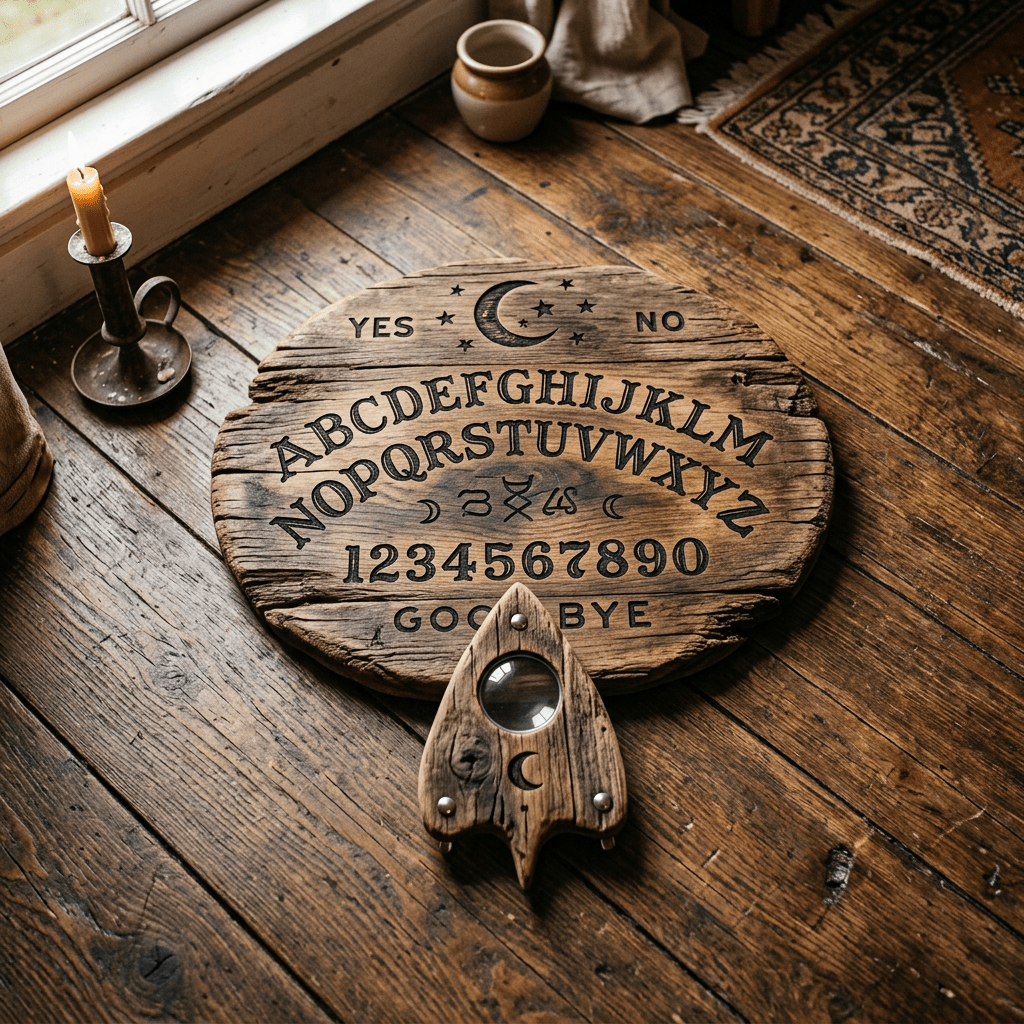
The Ouija that Changed a Village

Wooden Ouija board with letters, numbers, and planchette on wooden floor illuminated by candlelight
A rustic wooden Ouija board with a planchette and lit candle on hardwood floor


In a village of a hundred souls, where the streets curled like old rivers and the sunset poured gold across thatched roofs, there was a rumour more steady than the clock in the square: the old Ouija board in Mrs Calder’s attic had never slept since the day it was carved from driftwood after a storm. The day began with a hush, as if the air itself were listening. Children pressed their tiny faces to the bakery window, watching the sky melt into ember-orange and purple, while the adults tended gardens and whispered about the drought that would not end. By dusk, the village gathered in the square, drawn by a rumour that the board, long quiet, might speak again.

Mrs Calder climbed the narrow stairs to the attic, her cane tapping a stubborn rhythm on the floorboards. The room smelled of rain, wax, and the faint sting of old ink. The Ouija board lay on a battered table, its letters faded to pale whispers. The planchette, glossed with years of pressed fingertips waited like a curious animal.

“Is anyone here?” Mrs Calder asked, almost in a breath.

The planchette moved.

Not by hands this time, but by a breath of air seeming to come from the walls themselves. The village, every door, every window, every roof, held its breath as the board spelled a name sounding like wind through hollow reeds: Elarin claimed to be both map and mapmaker, a writer of destinies who never died as much, but forgotten to be quiet. The board’s letters stitched themselves into sentences pulsing with a soft, inexorable warmth. As the sunset stretched its last lace of light across the village, the planchette began to pull. It drew a map on the table top: roads that hadn’t existed since the time of the old families, a river flowing uphill, trees blooming in reverse. Then it began to hum, low and honeyed, a song the earth remembered but the village forgot.

The change was ordinary at first: a window frame squeaked in warning when the wind nudged it, a lamp burned a shade too green, a cat pausing in its nap and watching the corner with eyes knowing more than any human. But the changes grew personal, intimate, and impossible to ignore. A baker found flour that sifted itself into the shape of a sparrow, then flew away with a sigh on its wings. The schoolhouse bell rang at noon, though no child was near, and the chalkboard wrote messages glowing faintly in the green dusk. The well in the courtyard began to murmur, a slow, patient voice offering hints about the village’s past, the prices paid for old secrets, and the names of long-dead villagers who still walked the alleys at twilight.

At first, the changes felt like a conversation with a kindly, mischievous elder. People gathered to listen to the well, to hear the stories etched in its murmur: tales of debts, promises, and the weather’s cruel mercy. But the elder’s tone grew tense, and the stories grew heavy with warning. The sun sank lower, and the colours of the sunset turned into something sharper, closer to fire than light. That night, the village woke to a different rhythm. The ground hummed beneath their feet, not with electricity but with the pulse of something ancient and patient. The village’s map once a set of familiar streets reshaped itself on every surface: walls, doors, the blackboard of the school, even the footprints in the dust on the windowsills. The Ouija, it seemed, no longer needed to speak to be heard. It spoke through the world itself.

The consequences were serious.

People began to forget to eat, not because of hunger but because time itself slowed around them; meals cooled to the colour of pennies and then vanished before they could be tasted.
The hundred villagers started moving in concert with eerie precision, as if choreographed by a conductor who never lived. They performed tasks in perfect sequence: early risers brewed tea, others tended gardens, and everyone spoke in a quiet cadence suggesting a shared script they could not see. Weather turned extreme in tiny, intimate ways: the sunset each evening bled into a second horizon of heat wilting flowers, while a sudden rainstorm teased the edges of the village, soaking only the roofs and a circle around the square.

The more Elarin’s influence grew, the more the village began to resemble the map the board had drawn, paths were not paths, doors opening only inward, and rooms appearing where no room existed. People who went into the attic never returned with their whole selves intact; some came back with memories that weren’t theirs, or with a whisper in their mouths tasting like copper and old ink. In the midst of this, a young girl named Mina, who once drew constellations on the back fence with a stick, found a star drawn in the dust on the attic floor. It pulsed with a soft cold light and a single word etched in the center: Help.
Mina lifted the planchette by its old worn handle as if it were a key, and spoke in the language that lived in dreams and lullabies: a plea not to stop the sea, not to let the village drown in a map refusing to resemble anything human. The next morning, the village woke to a decision: to seal the attic, to bury the board beneath the roots of the old elm at the edge of the cemetery, and to pretend the wind had never learned their names. But the moment they moved, the town’s life responded in a new, more terrifying way. The planchette influence did not retreat; it pressed outward, pushing the village to confront its own past and the consequences of the promises they made to keep the quiet of the night.

In calculating steps, Mina and a handful of the bravest, including the village’s elder librarian and a carpenter who could hear when a nail spoke to him, made a plan. They would coax Elarin back into the board, where it could be contained, and then seal the attic with a spell of memory, words learned from the village’s oldest diaries and the well’s murmur. It was dangerous, because to seal away such a thing is to seal away part of the village’s own memory of who it had been and who it might become.

The climactic moment arrived at the edge of the cemetery as the sunset bled to a deeper crimson, an almost intangible fire along the horizon touching the tops of the elm trees and turned their shadows into long, patient fingers. Mina stood with the librarian and the carpenter in the circle where the ground remembered every footstep that had ever crossed there. They opened the attic door just enough for a gust of warm air to blow out the lamps and reveal the board, waiting with its patient, unblinking stare.

“We want to speak now, and only for a moment,” Mina said, steady despite the tremor in her hands. “We want you to listen to us as we listen to the land.”

The planchette moved with a gentle, almost affectionate motion, tracing a line toward the center of the board where a symbol never carved but now appeared as if drawn by the wind itself. Elarin’s voice spoke, not as a shout, but as a careful, weathered whisper. It offered a choice: release the village from the map’s spell, or bind it forever to a story in which every sunset carried the weight of a consequence earned by fear and silence. The decision fell to Mina, who knew to deny the village’s past was to condemn its future to repeat, not to learn. She spoke of memory as a living thing, not a chain. She asked if there could be a compromise: a pact that allowed the village to breathe again, to walk its streets without fear of becoming a line drawn in a chart. The pact, once spoken, shifted the air. The odyssey of the map slowed, and the world began to tilt back toward ordinary gravity. The winds softened. The drains stopped echoing with distant footsteps. The sunset, while still glorious, no longer carried the menace of a door that could open anywhere at once.

The village’s life returned, not as it had been but as it could be if they honoured the truth of their own stories. They burned the old letters binding them in fear and left a single message in the square for future generations: Do not let a map become your fate. Remember the land you walk on, and the people who walk with you.

The attic door became a rumour again, and the Ouija board, once a life that breathed through the walls, rested quietly beneath the elm’s roots, not destroyed but sleeping, waiting for a time when the village might need a map again, and with it, a reminder: some power is stronger when kept quiet, and some sunsets are beautiful because they bear witness to what a village survived and what it chose to forget.


The Broken Wand and Light of the Spirit

In a realm where magic flowed like the wind, Josiah Wormongdale was once a renowned magician, celebrated for his daring spells and radiant charm. But one fateful night, during a fierce confrontation with a shadowy entity, his beloved wand shattered into splinters. The broken wood lay on the ground, pulsating with dark, swirling energies that threatened to consume him. Josiah’s spirit was undeterred, yet his magic waned as the dark energies grew stronger, wrapping around him like a suffocating shroud. He knew he needed help, something beyond his own power, beyond even the most fantastic enchantments he knew.

In his despair, he recalled tales of Llwd ap Crachan Llwyd, an ancient wizard from the spirit world, renowned for his wisdom and mastery over the balance between light and darkness. Legend said Llwyd’s spirit lingered in the boundary between worlds, waiting for those who sought true understanding. Determined, Josiah called out into the night, summoning the spirit of Llwyd. To his astonishment, a shimmering figure materialised before him, an elderly wizard cloaked in flowing robes woven with starlight, eyes gleaming with ageless wisdom.

“Who dares summon Llwd ap Crachan Llwyd?” the spirit whispered, voice echoing like distant thunder.

“I am Josiah Wormongdale,” Josiah replied, trembling but resolute. “My wand is broken, and dark energies threaten to consume my magic and my soul. I seek your aid.”

Llwyd studied him silently, then nodded.

“A fractured wand is a vessel of imbalance. To mend it, one must understand the darkness that corrupted it and be willing to release it.”

With a gentle wave of his hand, Llwyd extended his spirit-energy toward Josiah’s broken wand. Light poured from the elder’s fingertips, enveloping the shards. As the light touched the dark energies, they writhed and shrieked, trying to cling to the wand’s remnants.

“Let go,” Llwyd urged. “Embrace the light, and release what binds you to darkness.”

Josiah closed his eyes, feeling the weight of his fears and regrets. Slowly, he surrendered his attachment to the dark energies, allowing Llwyd’s luminous power to dissolve them. The darkness dissolved into shimmering particles that drifted away like ash in the wind. Then, Llwyd’s spirit wove his magic into the broken wood, mending the cracks with threads of pure light. The wand shimmered and pulsed with a new, radiant energy, stronger and more balanced than ever before.

“Your path now is clearer,” Llwyd said softly. “Remember, true power lies not in dominance over darkness but in understanding and harmony. Carry this lesson with you.”

With a final nod, Llwyd’s spirit faded into the ether, leaving Josiah holding a restored wand glowing with a gentle, luminous aura. From that day forward, Josiah Wormongdale used his renewed magic to bring light to the darkest corners of the realm, always remembering the elder wizard’s wisdom: that light and dark are but two sides of the same coin, and true mastery is found in balance.

The Key

Once upon a time, in the ancient land of Eldor, there lived a once-mighty wizard named Eldrin. In his youth, Eldrin commanded the forces of nature, conjured storms, and spoke with the stars. But as time passed, his magic waned, and he found himself in a world that no longer believed in the wonders he once created. Now, he was just a shadow of his former self, living in a crumbling tower at the edge of the Whispering Woods. Eldrin spent his days reminiscing about the grandeur of his past, often gazing into the crystal ball that had once revealed the secrets of the universe. Yet, all he saw now was his own reflection, a reminder of lost power. His heart ached with longing for the magic that had defined him.

One fateful evening, while wandering through the forest in search of herbs for his dwindling potions, he stumbled upon an ancient oak tree. Its gnarled roots twisted around a curious stone pedestal, upon which lay a small, ornate key. It glimmered in the fading light, engraved with symbols that seemed to pulse with energy. Intrigued, Eldrin picked it up, feeling a surge of warmth flow through his fingers. As he turned the key, a strange sensation overcame him; it was like the key was whispering secrets of untold power. Eldrin hurried back to his tower, where he placed the key on his workbench and studied it for hours. He realized this was no ordinary key; it was a key to a hidden realm where magic thrived.

Driven by curiosity and desperation, Eldrin began to decipher the symbols etched into the key. After days of research, he discovered that to unlock the realm, he needed to recite an incantation at the stroke of midnight during the next full moon. The thought of reclaiming his magic filled him with hope, and he prepared for the night with fervor. When night finally arrived, Eldrin stood before an ancient mirror, clutching the key tightly. As the moonlight streamed through his window, he recited the incantation. The air shimmered, and the mirror rippled like water, revealing a gateway to the hidden realm. With a deep breath, he stepped through the portal. Eldrin found himself in a vibrant world teeming with magical creatures and lush landscapes. The air was thick with enchantment, and he felt a spark ignite within him. As he explored this realm, he encountered wise beings and learned forgotten spells that revitalized his craft.

But Eldrin soon realized that the key’s true power was not just to restore his magic; it was to connect him with the essence of magic itself. He understood that magic was not merely a tool to wield but a bond that intertwined all living things. With his newfound knowledge, Eldrin returned to Eldor, his heart brimming with magic once more. He used his powers to heal the land, rekindle hope in the people’s hearts, and teach them about the wonders of the world around them. No longer just a wizard, he became a guardian of magic, ensuring it would never fade away again. And so, Eldrin, the wizard with no magic left, became a legend, reminding everyone that sometimes, the greatest magic lies not in spells or incantations but in the connections we forge and the love we share with the world. 

Kaya – Dark Tales from the Outback Abstract

Once, in the remote Australian outback, there lived an aborigine named Kaya. He was a skilled tracker and hunter who roamed the vast, desolate lands with an air of quiet confidence. Kaya had always felt a deep connection to the spirits of the land, and his people often spoke of the ancient stories that warned of the dangers lurking in the wilderness. One moonless night, Kaya set out on a hunting expedition, guided only by the faint glow of the stars. His senses were sharp, and he moved through the rugged terrain with the ease of a shadow.

As he ventured deeper into the heart of the outback, a strange unease settled over him. The usual sounds of the night were absent, and an eerie silence enveloped the land. Suddenly, a piercing scream shattered the stillness, causing Kaya to halt in his tracks. The hair on the back of his neck stood on end as he tried to locate the source of the chilling cry. Following the sound, he stumbled upon a clearing where he saw a lone kangaroo, its eyes wide with terror as it desperately tried to escape an unseen force.

Kaya watched in horror as the kangaroo was dragged into the darkness by an unseen entity, its screams fading into the night. The aborigine felt a chill run down his spine, for he knew that the spirit world held many dark and malevolent forces. He knew he had stumbled upon something sinister, something beyond his understanding. Determined to uncover the truth, Kaya embarked on a quest to seek guidance from the wise elders of his tribe.

They revealed to him the ancient legend of a vengeful spirit that had been unleashed upon the land, seeking to wreak havoc on the living. The elders warned Kaya that the spirit had taken the form of a monstrous kangaroo driven by an insatiable thirst for blood. Armed with the knowledge passed down by his ancestors, Kaya set out to confront the malevolent spirit. Armed with ancient symbols and blessed talismans, he ventured back into the wilderness. As he delved deeper into the treacherous terrain, the air grew thick with an otherworldly presence, and the ground seemed to tremble beneath his feet.

Finally, he came face to face with the monstrous kangaroo, its eyes glowing with an unholy light. The creature lunged at Kaya with supernatural speed and ferocity, but the aborigine stood his ground, wielding the protective symbols and chanting the sacred incantations. A fierce battle ensued as Kaya fought to banish the vengeful spirit from the mortal realm. The very fabric of reality seemed to warp and twist around them, and the night itself seemed to hold its breath as the two clashed in a struggle that transcended the physical world. In the end, with a final burst of mystical energy, Kaya managed to seal the spirit away, restoring peace to the land.

As the first light of dawn broke over the horizon, the outback was once again filled with the sounds of life, and Kaya knew he had fulfilled his duty as a guardian of his people. From that day on, the legend of Kaya and the malevolent kangaroo spirit became a cautionary tale, a reminder of the ancient forces that still linger in the wild places of the world. And though the memory of that fateful encounter would always haunt him, Kaya continued to roam the outback with a newfound sense of purpose and a deep respect for the mysteries of the land.

Over time, Kaya’s reputation as a protector and a keeper of ancient wisdom spread far and wide, and he became a revered figure among his people. Years passed, and Kaya’s hair turned grey, but his spirit remained unyielding. He passed down the knowledge he had gained to the younger generations, teaching them to honour the delicate balance between the physical and spiritual realms. His story became a part of the oral tradition, woven into the tapestry of his people’s history as a testament to the enduring power of courage and wisdom.

As the seasons changed and the land continued to whisper its secrets, Kaya’s name became synonymous with resilience and reverence for the natural world. His legacy endured, and the memory of his heroic encounter with the malevolent kangaroo spirit lived on as a reminder of the dangers that lay hidden in the heart of the outback. The tale of Kaya and the vengeful spirit served as a timeless lesson, teaching the importance of humility and the need to safeguard the delicate harmony between humanity and the ancient forces that dwelled in the shadows. It became a parable of the enduring strength of the human spirit and the profound connection that binds all living things.

And so, in the vast expanse of the Australian outback, Kaya’s story echoed through the ages, a testament to the enduring power of the human spirit in the face of the unknown. And though the world continued to change, the legend of Kaya and the malevolent kangaroo spirit remained etched in the very fabric of the land, a testament to the enduring legacy of a humble aborigine who had stood against the darkness and triumphed.

The Magic Crucifix’s

In the heart of ancient Babylon, beneath the sprawling ziggurats and bustling markets, a pair of crucifixes lay hidden, each imbued with mystical powers. These artefacts, forged when magic and the divine intertwined, were said to grant their bearers extraordinary abilities—healing, knowledge, and the gift of tongues.

The first crucifix was discovered by a humble healer named Isha. While searching for rare herbs in the sacred gardens, she stumbled upon the crucifix half-buried in the earth, its surface glimmering with an otherworldly light. As she picked it up, a surge of energy coursed through her, and she felt an ancient wisdom fill her mind. From that moment, she could mend wounds with a mere touch and cure ailments that had plagued her village for generations. Word of Isha’s miraculous abilities spread like wildfire, drawing the attention of kings and scholars alike. With her newfound power, she travelled far and wide, teaching others the art of healing and sharing the knowledge that flowed through her. Yet, she remained grounded, using her gifts to uplift her community and protect those in need.

Meanwhile, the second crucifix found its way into the hands of a wandering scholar named Kadir. He stumbled upon it in the ruins of a forgotten temple, hidden among dusty scrolls and crumbling stones. As he lifted the crucifix, he felt an immediate connection to the world’s ancient languages. Words flowed into his mind, enabling him to understand and speak any tongue. With this gift, Kadir travelled to distant lands, bridging cultures and sharing his stories.

The paths of Isha and Kadir eventually intertwined when they met at a great festival in Babylon, where people from across the known world had gathered. Recognizing the power they both held, they formed a bond, vowing to use their gifts in harmony. Together, they created a sanctuary where knowledge and healing could flourish, teaching others the importance of understanding and compassion. As the years passed, the crucifixes changed hands many times, each new bearer adding to their legacy. They were passed down through generations, from a wise queen who united warring tribes to a brave warrior who healed his comrades on the battlefield. Each bearer, touched by the crucifixes’ magic, spread the gifts of healing, knowing, and language far and wide, transforming lives and connecting disparate cultures.

However, the crucifixes also attracted the attention of those with darker intentions. A powerful sorcerer sought to claim them for himself, believing that he could dominate the world with their magic. He unleashed chaos across the land, causing fear and division. But the bond between those who held the crucifixes—now a lineage of healers and scholars—remained strong. With courage and unity, they faced the sorcerer, combining their powers. Isha’s healing light and Kadir’s eloquence inspired the people to rise against the darkness. In a climactic battle, the sorcerer was defeated, his ambitions thwarted by the gifts he sought to control. The crucifixes, glowing with renewed energy, restored balance to the world.

As centuries passed, the story of the crucifixes became a legend. They were a testament to the enduring power of compassion, knowledge, and connection. Though the artefacts themselves faded into myth, their essence lived on in the hearts of those who believed in the magic of healing and understanding, reminding future generations that true power lies not in domination but in unity and love.