The Ouija that Changed a Village

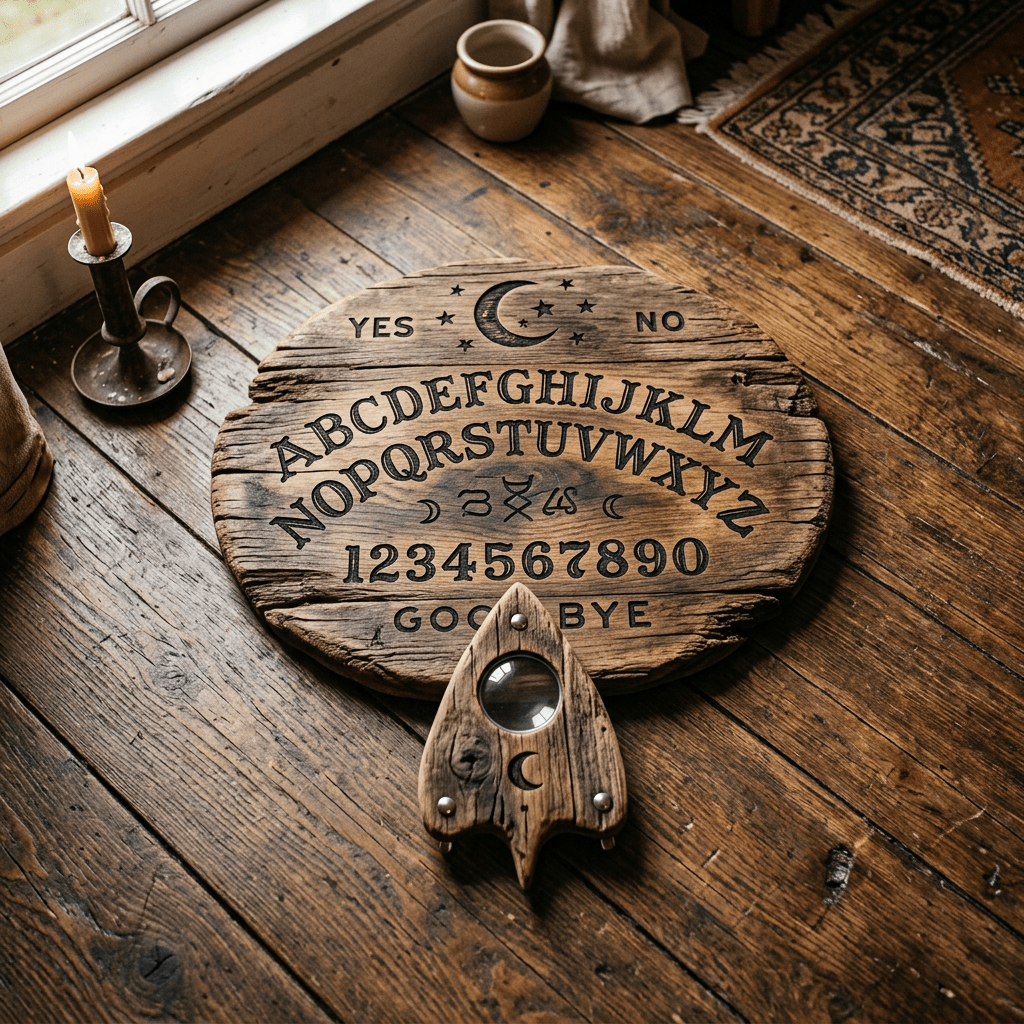
Wooden Ouija board with letters, numbers, and planchette on wooden floor illuminated by candlelight
A rustic wooden Ouija board with a planchette and lit candle on hardwood floor


In a village of a hundred souls, where the streets curled like old rivers and the sunset poured gold across thatched roofs, there was a rumour more steady than the clock in the square: the old Ouija board in Mrs Calder’s attic had never slept since the day it was carved from driftwood after a storm. The day began with a hush, as if the air itself were listening. Children pressed their tiny faces to the bakery window, watching the sky melt into ember-orange and purple, while the adults tended gardens and whispered about the drought that would not end. By dusk, the village gathered in the square, drawn by a rumour that the board, long quiet, might speak again.

Mrs Calder climbed the narrow stairs to the attic, her cane tapping a stubborn rhythm on the floorboards. The room smelled of rain, wax, and the faint sting of old ink. The Ouija board lay on a battered table, its letters faded to pale whispers. The planchette, glossed with years of pressed fingertips waited like a curious animal.

“Is anyone here?” Mrs Calder asked, almost in a breath.

The planchette moved.

Not by hands this time, but by a breath of air seeming to come from the walls themselves. The village, every door, every window, every roof, held its breath as the board spelled a name sounding like wind through hollow reeds: Elarin claimed to be both map and mapmaker, a writer of destinies who never died as much, but forgotten to be quiet. The board’s letters stitched themselves into sentences pulsing with a soft, inexorable warmth. As the sunset stretched its last lace of light across the village, the planchette began to pull. It drew a map on the table top: roads that hadn’t existed since the time of the old families, a river flowing uphill, trees blooming in reverse. Then it began to hum, low and honeyed, a song the earth remembered but the village forgot.

The change was ordinary at first: a window frame squeaked in warning when the wind nudged it, a lamp burned a shade too green, a cat pausing in its nap and watching the corner with eyes knowing more than any human. But the changes grew personal, intimate, and impossible to ignore. A baker found flour that sifted itself into the shape of a sparrow, then flew away with a sigh on its wings. The schoolhouse bell rang at noon, though no child was near, and the chalkboard wrote messages glowing faintly in the green dusk. The well in the courtyard began to murmur, a slow, patient voice offering hints about the village’s past, the prices paid for old secrets, and the names of long-dead villagers who still walked the alleys at twilight.

At first, the changes felt like a conversation with a kindly, mischievous elder. People gathered to listen to the well, to hear the stories etched in its murmur: tales of debts, promises, and the weather’s cruel mercy. But the elder’s tone grew tense, and the stories grew heavy with warning. The sun sank lower, and the colours of the sunset turned into something sharper, closer to fire than light. That night, the village woke to a different rhythm. The ground hummed beneath their feet, not with electricity but with the pulse of something ancient and patient. The village’s map once a set of familiar streets reshaped itself on every surface: walls, doors, the blackboard of the school, even the footprints in the dust on the windowsills. The Ouija, it seemed, no longer needed to speak to be heard. It spoke through the world itself.

The consequences were serious.

People began to forget to eat, not because of hunger but because time itself slowed around them; meals cooled to the colour of pennies and then vanished before they could be tasted.
The hundred villagers started moving in concert with eerie precision, as if choreographed by a conductor who never lived. They performed tasks in perfect sequence: early risers brewed tea, others tended gardens, and everyone spoke in a quiet cadence suggesting a shared script they could not see. Weather turned extreme in tiny, intimate ways: the sunset each evening bled into a second horizon of heat wilting flowers, while a sudden rainstorm teased the edges of the village, soaking only the roofs and a circle around the square.

The more Elarin’s influence grew, the more the village began to resemble the map the board had drawn, paths were not paths, doors opening only inward, and rooms appearing where no room existed. People who went into the attic never returned with their whole selves intact; some came back with memories that weren’t theirs, or with a whisper in their mouths tasting like copper and old ink. In the midst of this, a young girl named Mina, who once drew constellations on the back fence with a stick, found a star drawn in the dust on the attic floor. It pulsed with a soft cold light and a single word etched in the center: Help.
Mina lifted the planchette by its old worn handle as if it were a key, and spoke in the language that lived in dreams and lullabies: a plea not to stop the sea, not to let the village drown in a map refusing to resemble anything human. The next morning, the village woke to a decision: to seal the attic, to bury the board beneath the roots of the old elm at the edge of the cemetery, and to pretend the wind had never learned their names. But the moment they moved, the town’s life responded in a new, more terrifying way. The planchette influence did not retreat; it pressed outward, pushing the village to confront its own past and the consequences of the promises they made to keep the quiet of the night.

In calculating steps, Mina and a handful of the bravest, including the village’s elder librarian and a carpenter who could hear when a nail spoke to him, made a plan. They would coax Elarin back into the board, where it could be contained, and then seal the attic with a spell of memory, words learned from the village’s oldest diaries and the well’s murmur. It was dangerous, because to seal away such a thing is to seal away part of the village’s own memory of who it had been and who it might become.

The climactic moment arrived at the edge of the cemetery as the sunset bled to a deeper crimson, an almost intangible fire along the horizon touching the tops of the elm trees and turned their shadows into long, patient fingers. Mina stood with the librarian and the carpenter in the circle where the ground remembered every footstep that had ever crossed there. They opened the attic door just enough for a gust of warm air to blow out the lamps and reveal the board, waiting with its patient, unblinking stare.

“We want to speak now, and only for a moment,” Mina said, steady despite the tremor in her hands. “We want you to listen to us as we listen to the land.”

The planchette moved with a gentle, almost affectionate motion, tracing a line toward the center of the board where a symbol never carved but now appeared as if drawn by the wind itself. Elarin’s voice spoke, not as a shout, but as a careful, weathered whisper. It offered a choice: release the village from the map’s spell, or bind it forever to a story in which every sunset carried the weight of a consequence earned by fear and silence. The decision fell to Mina, who knew to deny the village’s past was to condemn its future to repeat, not to learn. She spoke of memory as a living thing, not a chain. She asked if there could be a compromise: a pact that allowed the village to breathe again, to walk its streets without fear of becoming a line drawn in a chart. The pact, once spoken, shifted the air. The odyssey of the map slowed, and the world began to tilt back toward ordinary gravity. The winds softened. The drains stopped echoing with distant footsteps. The sunset, while still glorious, no longer carried the menace of a door that could open anywhere at once.

The village’s life returned, not as it had been but as it could be if they honoured the truth of their own stories. They burned the old letters binding them in fear and left a single message in the square for future generations: Do not let a map become your fate. Remember the land you walk on, and the people who walk with you.

The attic door became a rumour again, and the Ouija board, once a life that breathed through the walls, rested quietly beneath the elm’s roots, not destroyed but sleeping, waiting for a time when the village might need a map again, and with it, a reminder: some power is stronger when kept quiet, and some sunsets are beautiful because they bear witness to what a village survived and what it chose to forget.
The Empress

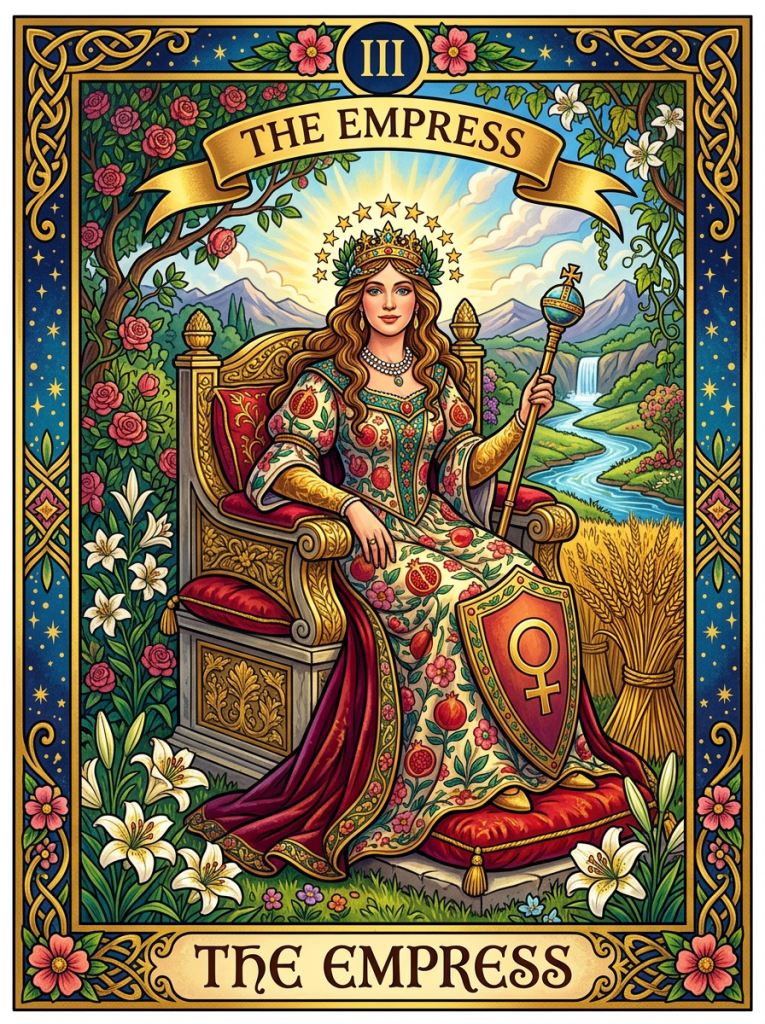
The Empress tarot card featuring a crowned woman seated on a throne with nature and symbols of fertility

The Empress sat beneath a canopy of gold-green vines, her throne carved from living wood, roots curling into the earth like patient fingers. The air carried the scent of blooming orchards and distant rain, a gentle symphony soothed even the bravest hearts. Beside her, a stream braided through a glade, its waters silvered by moonlight, spilling secrets to the stones and mushrooms alike.

Into this sanctuary stepped a traveller, eyes wide with longing and hands empty but for a seed wrapped in cloth. The Empress regarded the seed with a softness that felt like sunlight on bare shoulders.

“What do you carry, child?” she asked, not to pry, but to invite honesty.

“The future,” the traveller replied, “yet I fear my hands are too small to shape it.”

The Empress smiled, and a warm breeze lifted the cloth, revealing the seed: a tiny ember nestled in soil’s embrace. She plucked a fern from the ground, coaxed a green sprout from its heart, and placed the sprout within the traveller’s palm.

“Growth begins where care is given,” she murmured. “Nurture what you plant, and the world will refine itself around your intent.”

She led the traveller to a grove where trees wore crowns of fruit like lanterns. Each fruit glowed faintly with a memory—some of a plate shared with strangers, some of a homecoming long awaited, some of a dream dared and then delayed. The Empress touched the first fruit, and it opened to reveal a scene: a grandmother teaching a child to count petals, a village gathering to mend a torn banner, a garden where laughter grew as surely as tomatoes.

“Abundance is not merely plenty,” she explained, “it is the visible care we extend to every living thing, seen and unseen. When you plant with tenderness, you harvest with gratitude.”

The seed in the traveller’s hand warmed, threads of heat weaving into their skin, a quiet certainty taking root.

“Create,” the Empress said, returning to the traveller’s side. “Create not from scarcity or urgency, but from the quiet persistence of care. When you honour the cycle—the sowing, the growing, the blossom, the rest—you become a conduit for the Earth’s own generosity.”

Night began to settle, and the glade glowed with a soft, amber light. The traveller, now steady and sure, stood with the embers of a new purpose kindling in their chest. They thanked the Empress, who nodded, a reflection of the dawn in her eyes.

“Go,” she whispered, “And tend your seed as if it were a promise you intend to keep.” Then, with a gentle rustle of leaves, she faded into the hush of the forest, leaving behind a trail of tiny luminescent orbs—each one a reminder that nurture, patience, and love are the most fertile soils of all.

The traveller stepped into the night, seed warm in their palm, a clear path unfurling ahead: to nurture, create, and to share the bounty with a world always hungry for a little more light. 

Lazarus Carpenter

2026

A Little More Tenderness and a Little Less Fear – The Story of Bryn the Hermit

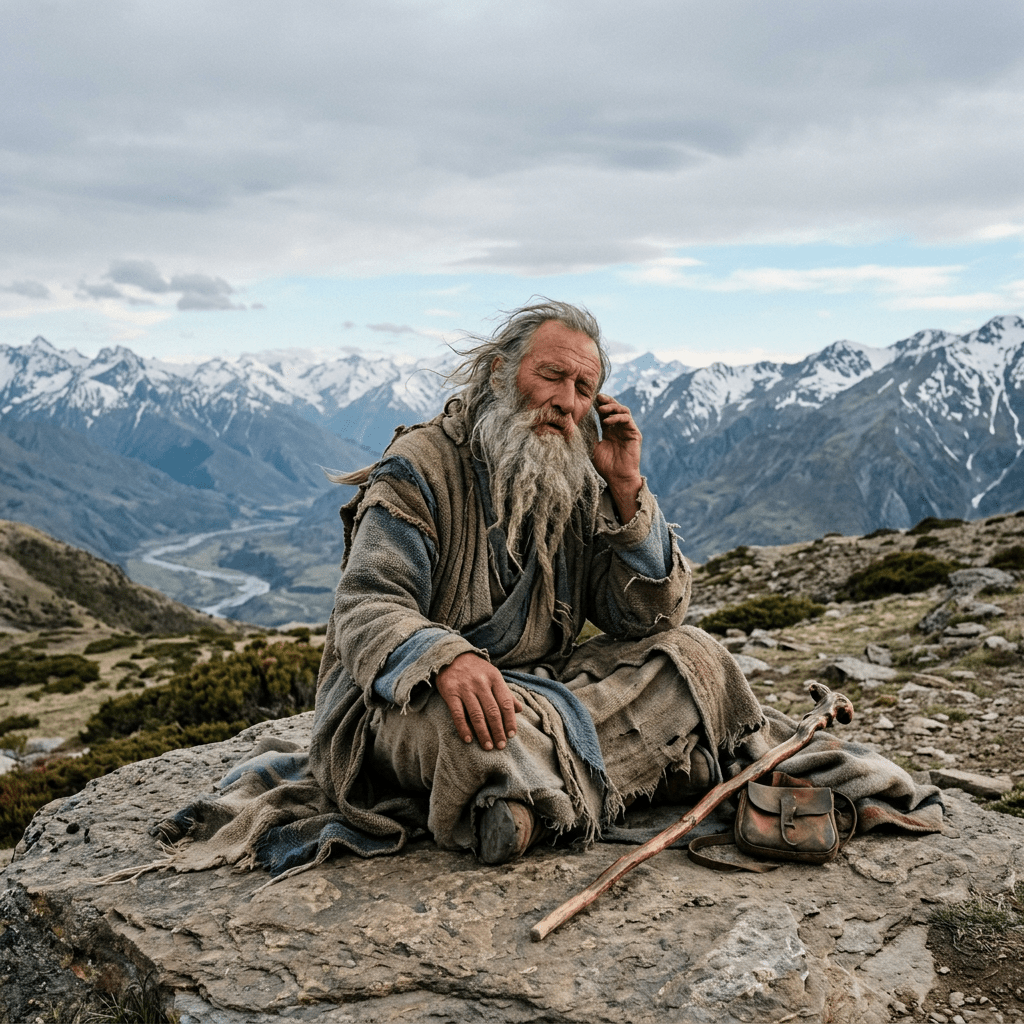
Elderly man with long beard sitting cross-legged on a rock, wearing layered robes, with a walking stick and pouch beside him, mountains in background
Bryn The Hermit

In a corner of Wales where the wind remembers every ancient road, there stood a plateau crowned by a stubborn old mountain. Not the tallest peak, perhaps, but one wearing its clouds like a shawl and keeping its secrets tucked beneath mossy stones and bracken that whispered in the rain. On this plateau lived a hermit, a man they called Bryn, though few could swear they’d ever heard him speak more than a few quiet words at a time. The path to Bryn’s dwelling was narrow, carved by the patient steps of seasons. It wound through gorse and bramble, climbed a stair of loose slate, and finally opened onto a small, stone-creaking cabin perched at the edge of the world where the land fell away into a thousand green miles. The cabin had no fancy bells or bright windows, only a single small lattice blinking gold in the sunset, and a smoke-blackened chimney never seeming to stop sighing into the dusk.

Bryn lived alone, but he was not lonely. He kept company with the forest’s patient rhythm: the slow turning of the seasons, the wary glances of deer along the ridge, the sly intrusion of badgers at dusk, and the countless songs of birds nesting in the eaves when the storm blew in from the sea. He tended a garden seeming to grow where it wished, herbs and roots thriving in soil that was more memory than earth. He spoke softly to stones, and the stones, if you listened with your heart rather than your ears, spoke back in a language of weight and time. People from valleys below would sometimes find the path to the plateau, drawn by a rumour of wisdom and a need for counsel. They carried with them the burdens of ordinary life: a quarrel with a sister, a fear of the future, a decision that would bend a life into a new shape. And when they stood before Bryn, they found a man who looked at them with the patience of rivers and the calm certainty of a tree that has weathered many storms.

“Tell me what you carry,” Bryn would say, not as a demand but as a door opened by trust.

And they would begin, slowly, as if peeling an apple grown too old to hurry, revealing the weight inside: a grudge burning like a coal in the pocket, a dream grown stiff with doubt, a plan that had forgotten to breathe.
Bryn listened as the forest listened: with a generous stillness that let the speaker feel the full gravity of their own words. Then, without booming judgment, he would offer a thread of truth, sometimes wrapped in a parable, sometimes in a small, practical act. He spoke of rivers that do not hurry to the sea, of mountains that rise not to impress but to shelter, of nights so quiet even the heart could hear its own breath. He urged patience, and offered questions rather than answers, because questions, he believed, were the hatchways to the hidden rooms inside every choice.

On one such day, a storm rolled in from the sea with a beard of rain and a voice like clattering armour. The plateau trembled under the wind, the slate rattled underfoot, and the forest hissed with the warning of sap that might freeze on a moonless night. A young woman, eyes bright with stubbornness, stood at Bryn’s door with a letter clenched in her hand, the letter she dared not send, the one that would either mend a family rift or burn it to ashes.

Bryn welcomed her with the quiet smile of a man who has learned to recognise the exact moment when a storm has become a story and not a danger. He listened as she spoke of kinship and clever plans, of promises made in the glow of the hearth and promises broken in the cold arithmetic of daily life. When her tale ran dry, he pressed a small seed into her palm, a seed that looked, to the untrained eye, like any ordinary seed but carried, in its dry shell, the memory of a hillside that never stopped growing.

“Plant it where the earth remembers your laughter,” he said simply. “Water it with your patience, and answer with your presence, not your justification. If the seed grows, let it teach you where to bend and where to stand firm. If it does not, then you have learned something no letter could teach: what you truly want to carry into tomorrow.”

She left with the seed nestled in the folds of her mind, and the storm broke into a chorus of rain and wind sounding like old trees sobbing with relief. Bryn watched the girl go, the plateaus, the mountains, and the sea beyond them settling into a gentler rhythm. He did not possess tools for every problem, nor did he pretend to. He had something rarer: a way of listening that allowed people to hear the right questions inside their own hearts.

Time in Bryn’s life did not rush. It curled like smoke around the chimney and drifted through the cabin’s wooden bones. The forest grew older with him, or perhaps with him inside it, becoming a book whose margins were carved by the rain. And the plateau, that quiet crown on the Welsh hills, remained a place where endings did not announce themselves with thunder, but with a soft light softening the edges of a life already worn just enough to fit a wiser future.

If you asked Bryn the meaning of wisdom, he would point to the gentle hinge of a door that leads to a room you never knew existed, a room where you can choose a different path without losing your old self. He would tell you wisdom is not a shout or a flame, but a steady breath in the long corridor of tomorrow. And so the hermit lived, not as a figure of mystery but as a patient reminder: that a life kept in harmony with the forest, its rain, wind, and quiet growth can teach us to slow down, listen, and perhaps, just perhaps, choose the path that asks for a little more tenderness and a little less fear. 

‘It’ A Short Story

Once upon a time in the Land of Nothing lived a very small something who even though it was nowhere thought it was indeed somewhere. Did everything that it thought it did ……. do? Or given that it was really nowhere at all did it actually do anything at all? But voices that were not there in this place that did not exist, spoke of issues to the contrary which plunged it into an unknown never experienced or even considered before dilemma.

Was it or was it not…. did it or did it not….. would it or would it not…… could it or could it not…. or was it all a dream? But dream it did. It dreamt of a creation of something from nothing …….within the invisible hands of nothing ……..through dreams from nowhere and thus creation began….. or did it? It dreamt of creation…. and from nothing thought of a cosmos….. of universes…. and of planets…. and moons…. and suns. It dreamt of air… and fire…. and water… and within the substance of one planet… the earth It brought life into being.

And from the depths Its waters….. Its air met Its fire …… and the earth moved with a force that echoed throughout the nothingness…. of everything that It existed within. The land of what was once nothing was becoming alive with vibrations of something…. from somewhere… and something or nothing must be done ….. as It continued to dream.

A pulsating reality of a dreaming living earth….. but It thought the earth seemed empty and alone. So It dreamt of a sun to bring light and day…. and a moon to bring dark and night. Thus the dreams and thoughts of night and day…. light and darkness… were born. It dreamt of cosmic creation….. from nowhere to somewhere…… and back to nothing again. But It somehow knew that thought is, was, and will always be all that is. It also somehow knew that from thought came form and that all form was, is, and always will be alive and breathing within everything of what is really nothing or so It dreamt.

It created the universal family from dreams… emanating from nowhere….. and all the dreams to come would be a part of that which is all that is. Nothing could deny that It had hit on something from nowhere ….. but where would It end?

It saw the beauty of creation….. as the dream of life was born upon the earth. It was indeed pleased with the visions from somewhere….. within the constraints of nowhere and as It dreamt…. so it became. From where the visions were thought……. the mists of time were born.

It began to dream of life in so many different forms. As the dream blossomed life began throughout the earth….. within the depths of the seas….. and the breadths of her skies. But all of this was just a dream that It was creating…. a living dream where everything is connected…… breathing living form upon…. within…. and without all that is. It was pleased… but from the heart of the hand of nothing came others who were not there with thoughts of form and as It had dreamt this…. so it would be.

It wondered if all that is was complete and dreamt of being in form itself…. through a thought. It thought of creation from and through the very connectivity of everything… that will always be…. thought forth woman in its likeness. As It looked on the dreams…… all was good….. but how would the dream continue? So it gave the form balance and thought into creation….. dreaming man.

And the rest is the history that dreams are made of……..

Simon Crowe – the man whose head was too big for his station in life

In a town tucked between dusty hills and a river that forgot how to hurry, there lived a man named Simon Crowe. He was tall, polite, with the most striking head anyone had ever seen. It was round and expansive, like a harvest moon perched atop a frame that was seldom thick enough to support it. The townsfolk often whispered that his head contained a map to every library, every logic problem, and every grand idea the world had ever known. What they forgot to whisper aloud was that the head came with a burden: it made everyday life feel like a stage play in which Simon Crowe was always overacting.
Simon worked as a clerk at the town brokerage, a job that required patience, manners, and a certain deftness of mind to balance figures and promises. He wore a tailored suit, kept his papers crisp, and spoke with a cadence that suggested he had read every book in every library and remembered them all. Yet despite his outward polish, people found him a touch awkward in small moments, the way he tilted his head when listening, the pause before answering, the sudden leaps of analogy that sent conversations tumbling into a chorus of ideas no one asked for. His head, massive and attentive, seemed always to be in front of him, scanning possibilities, schemes, and grand plans. He would humbly present a modest proposal to improve the town’s ledger, and by the time he finished, the proposal had hatched wings and a dozen sequels. The station in life he occupied felt to him like a small room with a ceiling that never rose high enough to fit the expanse of his thoughts. The clerks below him smiled, the magistrates above him frowned, and the people around him never quite knew how to place the gravity of his mind within the walls of their ordinary days.
Simon Crowe’s head-long ambitions often collided with the stubborn, stubborn ground of reality. He would devise a scheme to build a cooperative bakery that would feed the town and keep the workers of the mill from starving. He would draft policies to equalize opportunities, to ensure that even the quietest child might one day speak aloud in a courtyard meeting. He would sketch models of civic life where strangers could become neighbours through shared work and shared bread. And then, as the sun moved across the sky, those schemes would settle like a chorus of pigeons, bobbing on a rooftop and finally fluttering away when someone coughed and the moment passed. This repetitive rhythm, the grand idea, the careful plan, the quiet disappointment, began to weigh on him. Yet Simon remained courteous, keeping his head high, perhaps too high, so that when a friendly neighbour asked how the day had gone, he could answer with a confident, practiced smile.

One autumn, a festival arrived that would test every man’s weathered nerves and dreams. The village’s mayor announced a contest: a contest of civic devotion. Each participant would present a plan to improve life in the village, and the best plan would be funded, celebrated, and housed in the annals of the village for a year. The prize was not merely money, but the sense that one’s name would be spoken gently in the same breath as the town’s most cherished deeds. Simon Crowe entered with a plan that would, on the page, transform the town into a beacon of cooperative life. He spoke of a central market that would be both exchange and classroom, where the mill workers, farmers, bakers, and teachers could trade, learn, and produce together. He outlined a curriculum of public duties, where every citizen would rotate as steward of a day’s labour of cleaning streets, tending gardens, caring for the elderly, and teaching children the simple arithmetic of fairness: how to count what you owe, what you owe others, and what you owe to your own better angels. When he spoke, his head seemed to grow heavier with meaning, as if the very weight of his dreams pressed down on the crown. The crowd listened, half enthralled, half anxious. For in his plan lay a future that would demand every citizen be willing to lift more weight than they had ever carried before. The old shopkeepers squinted, the younger children pressed closer to the front, and the mayor’s eyes widened with the dawning recognition that the plan might reshape every ordinary afternoon. The Day of Judgment arrived. The judge, an elderly woman with a ledger of small, precise judgments read through the proposals as if they were weather patterns. When she reached Simon’s plan, she paused. She looked at him not with the admiration he hoped for, but with the candid, practical scepticism of someone who had watched dreams slip through fingers like sand.
“Mr. Crowe,” she began, not cruelly, but with the certainty of the sea, “your plan is noble and generous, and your head is, I’ll admit, unusually large for a clerk. But a plan is not a crown you wear on a stool; it is a bridge you build with your neighbours, step by step, with their hands in yours. Help us see how this bridge begins. Show us the first stone.”
The room hushed. Simon Crowe had never needed to justify the first stone more than he needed oxygen to breathe. He stammered, then found himself listening to the quiet breath of the crowd, the rhythm of ordinary courage, the patience of those who carry the day-to-day loads. He realised, with a strange, almost blinding clarity, that his big ideas required not a reaction of awe from others, but a careful, shared ascent.
In that moment, a rude awakening cracked his polished surface. Not a blow to his head, not a fall, but the soft, nagging truth that his strength was not alone in the mind. It lay in the hands of many people who would work with him, carry with him, and sometimes carry him when the weight was simply too much. The head that had felt too big for the station began to feel not too big, but simply big enough to ask for help, to listen, to learn the slow art of building something lasting. After the festival, Simon did not abandon his grand dreams. He revised them, not to shrink them, but to make them practical for others to hold. He turned his mark into a public meeting bench, a place where people could sit and discuss the town’s future, shoulder-to-shoulder, rather than shoulder-to-head.
Weeks turned into months, and the cooperative market, the baby of his plan started with a single stall that offered bread baked by a grandmother who had never trusted a mixer in her life, beside a child who learned to count coins with the help of a kindly shopkeeper. The market grew not because Simon shouted louder, but because neighbours began to share the weight of the load. They brought their own stones to lay on the bridge, one by one.

And so, the man whose head had once threatened to outsize his station found a new measure of dignity, not in the size of his ideas alone, but in the size of his listening, the breadth of his patience, and the willingness to admit that the first stone is hard to place unless someone hands you a spirit of cooperation. From that day onward, Simon Crowe’s head did not shrink, nor did his ambitions wane. Instead, it learned to tilt in gentle partnership, and his ideas walked beside others as living, growing things. The town, in turn, learned to imagine not a hero who could lift the sky by sheer intellect, but a community that could lift itself by lifting each other. And in this shared ascent, the station that had once mocked with quiet cruelty the man’s tall thoughts was replaced by a station of the heart, the place where big minds and shared hands meet, and where a rude awakening becomes the quiet dawn of a common life.