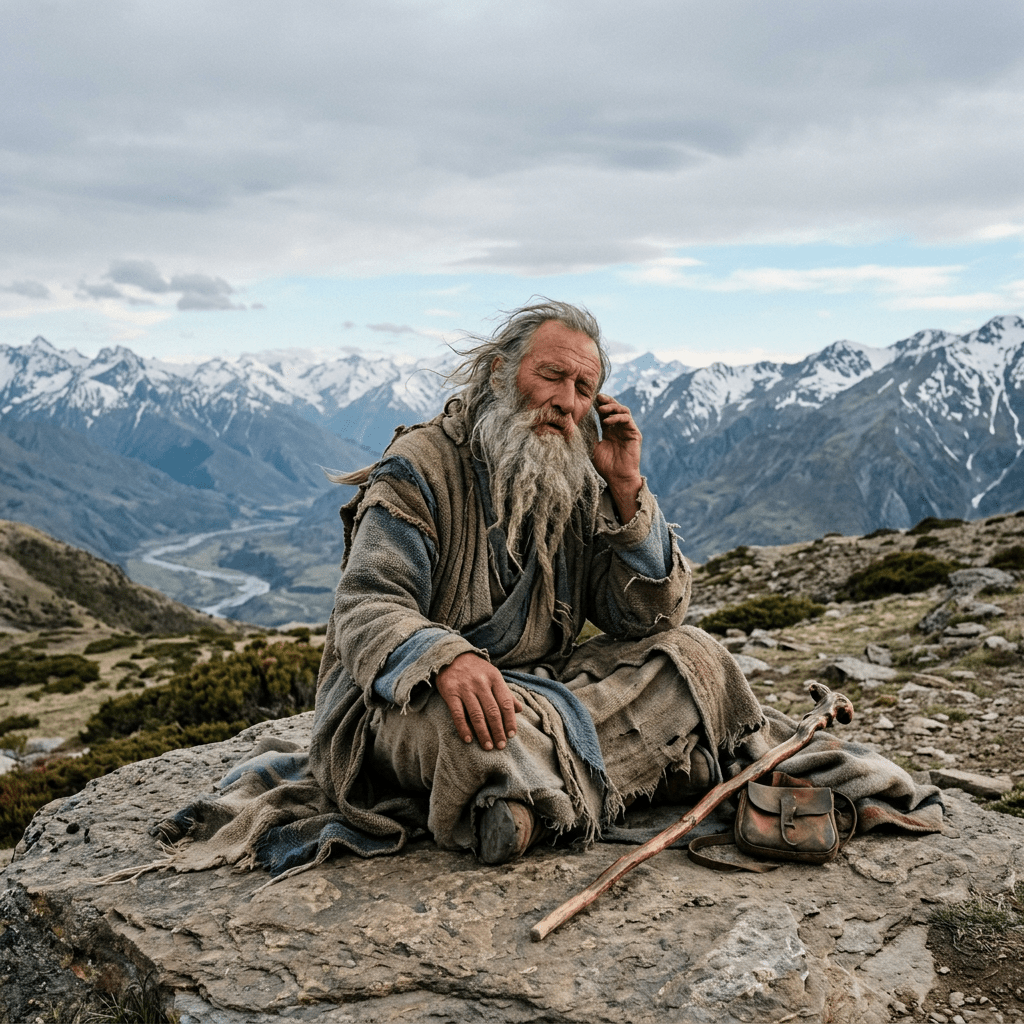
In a corner of Wales where the wind remembers every ancient road, there stood a plateau crowned by a stubborn old mountain. Not the tallest peak, perhaps, but one wearing its clouds like a shawl and keeping its secrets tucked beneath mossy stones and bracken that whispered in the rain. On this plateau lived a hermit, a man they called Bryn, though few could swear they’d ever heard him speak more than a few quiet words at a time. The path to Bryn’s dwelling was narrow, carved by the patient steps of seasons. It wound through gorse and bramble, climbed a stair of loose slate, and finally opened onto a small, stone-creaking cabin perched at the edge of the world where the land fell away into a thousand green miles. The cabin had no fancy bells or bright windows, only a single small lattice blinking gold in the sunset, and a smoke-blackened chimney never seeming to stop sighing into the dusk.
Bryn lived alone, but he was not lonely. He kept company with the forest’s patient rhythm: the slow turning of the seasons, the wary glances of deer along the ridge, the sly intrusion of badgers at dusk, and the countless songs of birds nesting in the eaves when the storm blew in from the sea. He tended a garden seeming to grow where it wished, herbs and roots thriving in soil that was more memory than earth. He spoke softly to stones, and the stones, if you listened with your heart rather than your ears, spoke back in a language of weight and time. People from valleys below would sometimes find the path to the plateau, drawn by a rumour of wisdom and a need for counsel. They carried with them the burdens of ordinary life: a quarrel with a sister, a fear of the future, a decision that would bend a life into a new shape. And when they stood before Bryn, they found a man who looked at them with the patience of rivers and the calm certainty of a tree that has weathered many storms.
“Tell me what you carry,” Bryn would say, not as a demand but as a door opened by trust.
And they would begin, slowly, as if peeling an apple grown too old to hurry, revealing the weight inside: a grudge burning like a coal in the pocket, a dream grown stiff with doubt, a plan that had forgotten to breathe.
Bryn listened as the forest listened: with a generous stillness that let the speaker feel the full gravity of their own words. Then, without booming judgment, he would offer a thread of truth, sometimes wrapped in a parable, sometimes in a small, practical act. He spoke of rivers that do not hurry to the sea, of mountains that rise not to impress but to shelter, of nights so quiet even the heart could hear its own breath. He urged patience, and offered questions rather than answers, because questions, he believed, were the hatchways to the hidden rooms inside every choice.
On one such day, a storm rolled in from the sea with a beard of rain and a voice like clattering armour. The plateau trembled under the wind, the slate rattled underfoot, and the forest hissed with the warning of sap that might freeze on a moonless night. A young woman, eyes bright with stubbornness, stood at Bryn’s door with a letter clenched in her hand, the letter she dared not send, the one that would either mend a family rift or burn it to ashes.
Bryn welcomed her with the quiet smile of a man who has learned to recognise the exact moment when a storm has become a story and not a danger. He listened as she spoke of kinship and clever plans, of promises made in the glow of the hearth and promises broken in the cold arithmetic of daily life. When her tale ran dry, he pressed a small seed into her palm, a seed that looked, to the untrained eye, like any ordinary seed but carried, in its dry shell, the memory of a hillside that never stopped growing.
“Plant it where the earth remembers your laughter,” he said simply. “Water it with your patience, and answer with your presence, not your justification. If the seed grows, let it teach you where to bend and where to stand firm. If it does not, then you have learned something no letter could teach: what you truly want to carry into tomorrow.”
She left with the seed nestled in the folds of her mind, and the storm broke into a chorus of rain and wind sounding like old trees sobbing with relief. Bryn watched the girl go, the plateaus, the mountains, and the sea beyond them settling into a gentler rhythm. He did not possess tools for every problem, nor did he pretend to. He had something rarer: a way of listening that allowed people to hear the right questions inside their own hearts.
Time in Bryn’s life did not rush. It curled like smoke around the chimney and drifted through the cabin’s wooden bones. The forest grew older with him, or perhaps with him inside it, becoming a book whose margins were carved by the rain. And the plateau, that quiet crown on the Welsh hills, remained a place where endings did not announce themselves with thunder, but with a soft light softening the edges of a life already worn just enough to fit a wiser future.
If you asked Bryn the meaning of wisdom, he would point to the gentle hinge of a door that leads to a room you never knew existed, a room where you can choose a different path without losing your old self. He would tell you wisdom is not a shout or a flame, but a steady breath in the long corridor of tomorrow. And so the hermit lived, not as a figure of mystery but as a patient reminder: that a life kept in harmony with the forest, its rain, wind, and quiet growth can teach us to slow down, listen, and perhaps, just perhaps, choose the path that asks for a little more tenderness and a little less fear.


