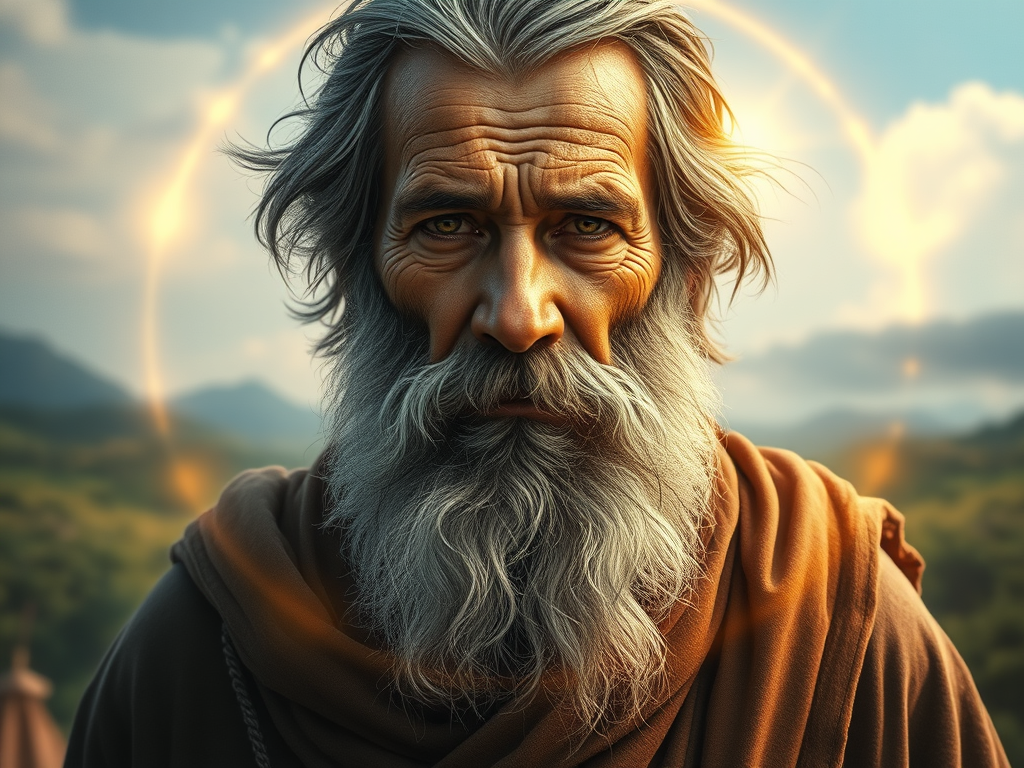
Elias

Once upon a time, in a quiet village nestled between rolling hills, there lived an old man named Elias. Known for his wisdom and gentle spirit, Elias was often seen tending to his garden or sharing stories with the village children. Few knew of his past; he had once been a renowned scholar and adventurer who travelled the world searching for knowledge and truth. One fateful day, a dark cloud descended upon the land. An ancient evil, long thought vanquished, had awakened. Creatures of shadow began to emerge, spreading fear and chaos. The villagers were terrified, and many fled their homes, believing nothing could save them.

Elias, however, felt a familiar stirring within him. He remembered the old prophecies about the “Keeper of Light” rising in times of darkness. Determined to protect his home, he gathered his few belongings and set off on a quest to confront the evil that threatened the world. His journey led him to the Whispering Woods, where he sought the wisdom of the ancient spirits. They revealed that the source of the darkness was a powerful crystal hidden deep within the Caves of Despair. Only by uniting the fragments of the Light Stone scattered across the land could he hope to confront the malevolence.

Elias travelled far and wide, facing numerous challenges along the way. He helped a village beset by drought by teaching them sustainable farming techniques, earning the first fragment of the Light Stone. He rescued a trapped beast in the mountains, gaining another fragment in gratitude. Each act of kindness brought him closer to his goal and rekindled hope in the hearts of those he encountered. Finally, after many trials, Elias gathered all the fragments and made his way to the Caves of Despair. Inside, he faced the embodiment of darkness itself—a towering figure wreathed in shadows. With courage in his heart, Elias held the Light Stone high, channelling the love and kindness he had shared throughout his journey.

A brilliant light erupted from the stone, clashing with the darkness. The power of his compassion and bravery pierced through the shadows, banishing the evil that had plagued the land. As the light spread, it illuminated the cave and transformed the darkness into shimmering stars, restoring balance to the world. Exhausted but triumphant, Elias returned to his village, where he was greeted as a hero. Yet, he humbly declined the title, choosing instead to continue his quiet life among the people he loved. Inspired by his bravery and kindness, the villagers began rebuilding their lives and spreading their lessons. Elias spent his remaining years sharing stories of hope and resilience, reminding everyone that true strength comes not from power or might but from compassion and the willingness to act in the face of adversity. And so, the old man who saved the world became a cherished legend, his tale whispered through generations, a beacon of light against the darkness. 

Image by AI
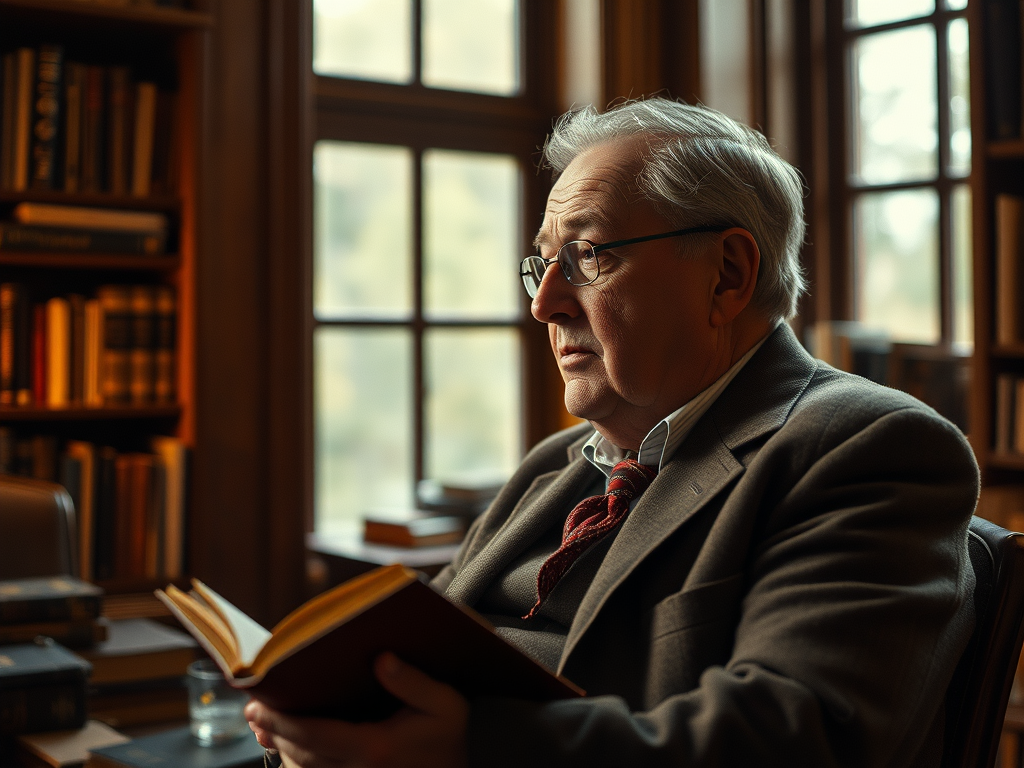
C.S. Lewis

Clive Staples Lewis, commonly known as C.S. Lewis, was a British writer and academic. He is best known for his works of fiction, especially “The Chronicles of Narnia,” a series of seven fantasy novels that have become classics of children’s literature. Lewis was also a renowned Christian apologist, known for books such as “Mere Christianity” and “The Screwtape Letters,” in which he defended and explained the Christian faith.

In addition to his fiction and apologetic works, Lewis was a scholar of medieval literature and a fellow at Oxford University and Cambridge University. He was close friends with J.R.R. Tolkien, the author of “The Lord of the Rings,” and was a member of the informal literary group known as the Inklings, which met regularly to discuss literature and share their work.

C.S. Lewis’s writing continues to be widely read and influential, both in the fields of literature and theology. Although he passed away in 1963, his works remain popular and have been adapted into films, television series, and stage plays. 

The Blade of Elys

In a world where legends intertwine with the fabric of reality, there lay a magical sword known as the Blade of Elys. Forged over ten thousand years ago by the ancient gods, this sword was imbued with the power to restore peace and vanquish darkness. Its hilt was adorned with intricate engravings that shimmered like stars, and the blade gleamed with an ethereal light, said to be the essence of hope itself.

The tale begins with Aeloria, a fierce warrior of the Eldrin tribe. Her people lived in harmony with nature, but their peace was shattered when the Shadow Wraiths, malevolent spirits from the Netherrealm, threatened to engulf the world in despair. The skies darkened, and a chilling fear gripped the heart of every living being. Aeloria, driven by a vision of a radiant sword and a call from the gods, embarked on a perilous journey to the Sacred Caverns of Lumina. Deep within, she discovered the Blade of Elys, resting atop a pedestal bathed in celestial light. She felt a surge of power and purpose as she grasped its hilt. With the sword in hand, Aeloria united the fragmented tribes of the land, rallying them against the encroaching darkness. In the heart of the Valley of Whispers, Aeloria faced the Wraith King, a creature born from the very shadows it sought to spread. The battle raged for days, echoing with the clash of steel and the cries of warriors. Yet, with a final, resounding strike of the Blade of Elys, Aeloria shattered the Wraith King’s essence, dispersing the shadows and bringing light back to the realm. The tribes celebrated her as a hero. Aeloria, knowing the sword’s power was too great for any one person, entrusted it to the Eldrin Council, vowing to protect it for future generations.

Centuries passed, and the sword lay dormant, waiting for the next worthy hero. That hero arrived in the form of Thorian, a humble blacksmith’s son from the village of Eldergrove. Known for his unwavering courage and kind heart, Thorian lived a simple life, unaware that destiny had greater plans for him. When a fierce dragon named Zephyrax descended upon the land, scorching villages and hoarding treasures, Thorian felt the call of destiny. Guided by dreams of Aeloria and whispers of the past, he sought the Blade of Elys, hidden deep within the Whispering Woods. Upon retrieving the sword, Thorian confronted Zephyrax atop the fiery peaks of Mount Solara. The dragon roared, its flames threatening to consume all. But Thorian, with the guidance of the sword, harnessed the power of the winds. The battle was fierce, but he struck the beast’s heart with a swift and decisive blow, releasing a torrent of fire into the sky. The skies cleared, and peace returned as the dragon’s hoard was shared among the people, ensuring prosperity.

Millennia later, the world faced a new threat: the Veil of Sorrow, a dark mist that drained joy and hope from the people’s hearts. Lyra, a gifted mage with a deep connection to nature, felt the sword’s pull as she wandered the Whispering Woods. She found the Blade of Elys, still radiant and powerful, waiting for her to wield it. Lyra journeyed to the source of the Veil, a cursed grove where sorrowful spirits lingered. With the sword, she channelled the ancient magic of the earth, transforming the blade into a beacon of light. As she faced the spirit of despair, she spoke words of love and remembrance, reminding the spirits of their past joys. The sword glowed brightly, and the mist began to lift, revealing the world’s beauty beneath. The spirits were freed, and harmony was restored.

Through the ages, the Blade of Elys symbolised hope and unity. Each hero, Aeloria, Thorian, and Lyra, left their mark on history, their stories woven into the very fabric of the land. The sword itself, a silent guardian, rested in the Eldrin Council’s sanctuary, awaiting the next hero who would rise in the face of darkness. As the years turned into aeons, the tales of the Blade of Elys echoed through the mists of time, reminding all that true strength lies not in the sword itself but in the hearts of those who wield it. And so, the legacy of peace and courage continued, a timeless reminder that hope would always shine through, even in the darkest of times. The stories of these heroes became legends, told around campfires and recorded in ancient tomes, inspiring generations to come. The Blade of Elys, a beacon of hope, stood as a testament to the enduring spirit of those who dared to dream and fight for a better world. 

Image by AI

The Magic Crucifix’s

In the heart of ancient Babylon, beneath the sprawling ziggurats and bustling markets, a pair of crucifixes lay hidden, each imbued with mystical powers. These artefacts, forged when magic and the divine intertwined, were said to grant their bearers extraordinary abilities—healing, knowledge, and the gift of tongues.

The first crucifix was discovered by a humble healer named Isha. While searching for rare herbs in the sacred gardens, she stumbled upon the crucifix half-buried in the earth, its surface glimmering with an otherworldly light. As she picked it up, a surge of energy coursed through her, and she felt an ancient wisdom fill her mind. From that moment, she could mend wounds with a mere touch and cure ailments that had plagued her village for generations. Word of Isha’s miraculous abilities spread like wildfire, drawing the attention of kings and scholars alike. With her newfound power, she travelled far and wide, teaching others the art of healing and sharing the knowledge that flowed through her. Yet, she remained grounded, using her gifts to uplift her community and protect those in need.

Meanwhile, the second crucifix found its way into the hands of a wandering scholar named Kadir. He stumbled upon it in the ruins of a forgotten temple, hidden among dusty scrolls and crumbling stones. As he lifted the crucifix, he felt an immediate connection to the world’s ancient languages. Words flowed into his mind, enabling him to understand and speak any tongue. With this gift, Kadir travelled to distant lands, bridging cultures and sharing his stories.

The paths of Isha and Kadir eventually intertwined when they met at a great festival in Babylon, where people from across the known world had gathered. Recognizing the power they both held, they formed a bond, vowing to use their gifts in harmony. Together, they created a sanctuary where knowledge and healing could flourish, teaching others the importance of understanding and compassion. As the years passed, the crucifixes changed hands many times, each new bearer adding to their legacy. They were passed down through generations, from a wise queen who united warring tribes to a brave warrior who healed his comrades on the battlefield. Each bearer, touched by the crucifixes’ magic, spread the gifts of healing, knowing, and language far and wide, transforming lives and connecting disparate cultures.

However, the crucifixes also attracted the attention of those with darker intentions. A powerful sorcerer sought to claim them for himself, believing that he could dominate the world with their magic. He unleashed chaos across the land, causing fear and division. But the bond between those who held the crucifixes—now a lineage of healers and scholars—remained strong. With courage and unity, they faced the sorcerer, combining their powers. Isha’s healing light and Kadir’s eloquence inspired the people to rise against the darkness. In a climactic battle, the sorcerer was defeated, his ambitions thwarted by the gifts he sought to control. The crucifixes, glowing with renewed energy, restored balance to the world.

As centuries passed, the story of the crucifixes became a legend. They were a testament to the enduring power of compassion, knowledge, and connection. Though the artefacts themselves faded into myth, their essence lived on in the hearts of those who believed in the magic of healing and understanding, reminding future generations that true power lies not in domination but in unity and love. 

Samuel Taylor Coleridge

Samuel Taylor Coleridge (1772-1834) was an English poet, literary critic, philosopher, and theologian who was a key figure in the Romantic movement in England. He is best known for his poems “The Rime of the Ancient Mariner” and “Kubla Khan.” Coleridge was a close friend of fellow poet William Wordsworth. Together, they published a collection of poems called “Lyrical Ballads” in 1798, which is considered a seminal work in the Romantic movement. Coleridge’s poetry often explores themes of nature, imagination, and the supernatural.

In addition to his poetry, Coleridge was a prolific prose writer, including literary criticism and philosophical works. He is known for his literary theory, especially his concept of the “willing suspension of disbelief,” which suggests that readers should temporarily suspend their critical faculties to fully engage with fiction. Coleridge’s influence on English literature and poetry has been profound, and his works continue to be studied and celebrated for their beauty, depth, and complexity.Â