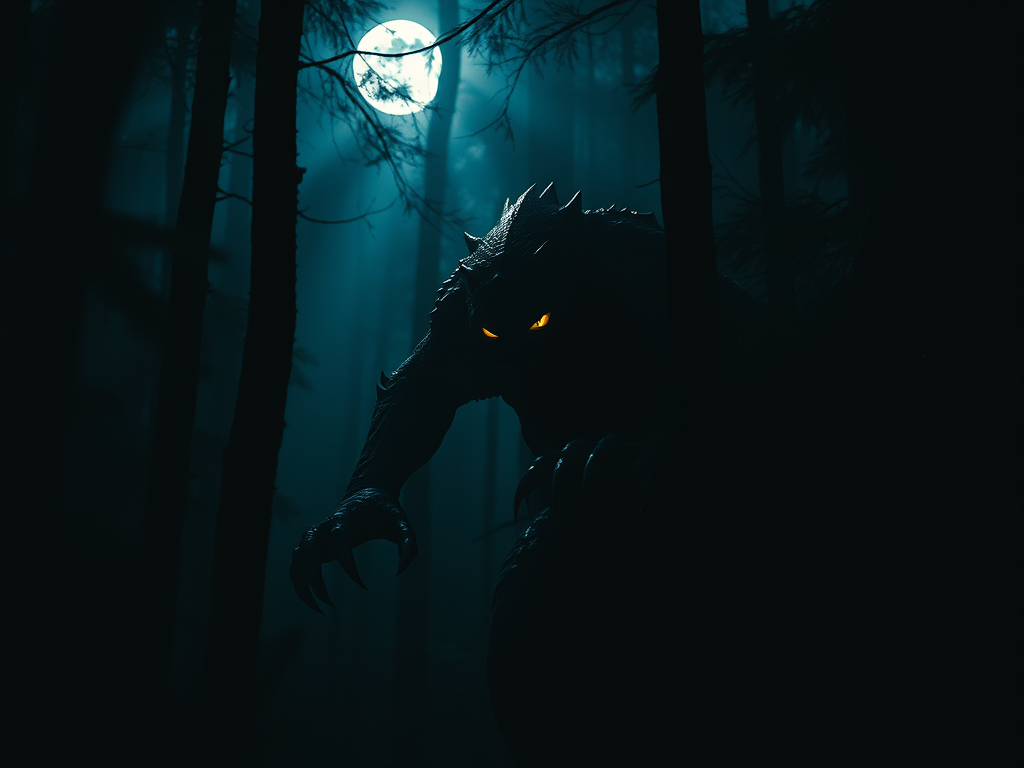
The Monster with the Big Heart

Once upon a time, in a mystical forest shrouded in ancient secrets and whispers of old, a monster lived unlike any other. This monster was feared by all who dwelled nearby, for its appearance was terrifying, with sharp fangs, claws as long as swords, and eyes that glowed like fiery embers in the darkness. Tales of its ferocity and insatiable hunger spread far and wide, striking fear into the hearts of all who heard them. However, most did not know this monster, despite its fearsome exterior, possessed a heart as big as the moon in the night sky. It longed for companionship, understanding, and acceptance, but no one dared approach it, for they only saw the monster’s monstrous form and not the gentle soul that lay within.

One day, a young child lost in the forest stumbled upon the monster’s lair. Trembling with fear, the child expected the worst, but to their surprise, the monster did not attack. Instead, it looked at the child with eyes full of sadness and loneliness. Sensing the monster’s true nature, the child reached out a hand in friendship. To the amazement of both, the monster hesitantly extended a clawed hand in return, its massive form crouching down to the child’s level. From then on, an unlikely bond formed between the two, built on trust, kindness, and understanding. The monster’s true nature began to shine through as days turned into weeks and weeks into months. It showed compassion for the forest creatures, protecting them from harm and helping those in need. The once-feared monster became a guardian, a friend to all who called the forest their home.

Word of the monster with a big heart spread far and wide, and soon, creatures from near and far came to seek its wisdom and guidance. The monster, now known not for its fearsome appearance but for its compassionate soul, welcomed them all with open arms.
And so, the monster with a big heart found acceptance, love and friendship in a world that once shunned it. Its legend lived on for generations to come, a reminder that true beauty lies not in appearances but in the kindness and love that reside within us all.

Image by AI

The Balance

Once upon a time, two siblings, Elara and Alden, lived in a kingdom nestled amidst towering mountains and lush forests. Elara was known far and wide for her physical strength; she could lift boulders and outmatch any warrior in combat. On the other hand, Alden possessed a different kind of strength – he was incredibly intelligent and possessed a keen wit that could unravel the most complex puzzles. Despite their differences, Elara and Alden were inseparable and complemented each other perfectly. Where Elara’s strength failed, Alden’s intellect would prevail, and Elara’s might would triumph where Alden’s mind faltered.

One day, a great evil descended upon the kingdom in the form of a fierce dragon that terrorized the land, laying waste to villages and crops. The king called upon his bravest knights to slay the beast, but all efforts were in vain. It seemed that no one could match the dragon’s power and ferocity. Elara and Alden knew they had to do something to save their kingdom. Drawing upon their respective strengths, they devised a plan. Elara would challenge the dragon to a physical duel, distracting it with her incredible strength, while Alden snuck behind the beast to find its weakness. Elara fought with all her might as the battle raged, deflecting the dragon’s fiery breath and powerful attacks. Meanwhile, Alden searched for a way to defeat the beast. Finally, he discovered a small gap where its scales were weakest in the dragon’s armour.

With a swift and calculated strike, Alden plunged his sword into the dragon’s vulnerable spot, causing the beast to roar in pain and collapse. Elara seized the opportunity and delivered the final blow, vanquishing the dragon once and for all. The kingdom rejoiced at the victory of the siblings, celebrating their bravery and ingenuity. Elara and Alden have shown that true strength comes not just from physical might or intellectual prowess alone but from the unity of both. Together, they overcame the greatest challenges and emerged victorious, proving that strength and weakness are but two sides of the same coin, each complementing the other in perfect harmony.
Image by AI

Bernard Cornwell

Bernard Cornwell is a British author known for his historical novels, notably his series of historical fiction novels set during the Napoleonic Wars featuring the character Richard Sharpe. Born on February 23, 1944, in London, England, Cornwell did not start writing novels until later. Before becoming an author, he worked as a teacher and television producer. His experiences as a teacher and interest in history influenced his decision to write historical fiction novels. Cornwell’s breakthrough came with publishing his first Richard Sharpe novel, “Sharpe’s Eagle,” in 1981. The Richard Sharpe series, which follows the adventures of a British soldier in the Napoleonic Wars, became immensely popular and established Cornwell as a leading author of historical fiction. In addition to the Sharpe series, Cornwell has written several other series and standalone novels set in various historical periods, including the Saxon Stories series (adapted into the TV series “The Last Kingdom”), the Warlord Chronicles, and the Grail Quest series.

Bernard Cornwell’s novels are known for their meticulous research, engaging storytelling, and vivid depictions of historical events and battles. Over the course of his career, Cornwell has received numerous awards and accolades for his work, and his books have been translated into multiple languages and adapted for television and film.

Images by AI

Thomas De Quincey

De Quincey was born on August 15, 1785, and passed away on December 8, 1859. His most famous work, “Confessions of an English Opium-Eater,” is an autobiographical account of his opium addiction and its effects on his life. He also wrote numerous essays and articles on a wide range of subjects, including literature, philosophy, and social issues. De Quincey’s writing is characterized by its complex and elaborate prose style. He is known for his vivid descriptions, intricate sentence structures, and rich vocabulary.

He was a significant figure in the English Romantic movement, and his work influenced later writers such as Edgar Allan Poe and Charles Baudelaire. De Quincey led a tumultuous life marked by struggles with addiction, poverty, and personal loss. Despite these challenges, he continued to write prolifically throughout his life. Thomas De Quincey is remembered as a pioneering figure in English literature and a master of the English essay. His work continues to be studied and admired for its rich language and deep insights into the human condition.

Charles Dickens

The renowned English novelist Charles Dickens was born on February 7, 1812, in Portsmouth, England. He was one of the most popular and influential writers of the 19th century, known for his vivid characters and depiction of social issues in Victorian England. Dickens’ childhood was marked by financial struggles as his family faced poverty and debt. At the age of 12, he was forced to work in a factory to support his family after his father was imprisoned for debt. These early experiences profoundly influenced his later writings, as themes of poverty, social injustice, and the plight of the working class are prevalent in many of his novels.

Dickens began his writing career as a journalist and soon found success writing serialized novels. Some of his most famous works include “Oliver Twist,” “David Copperfield,” “A Christmas Carol,” “Great Expectations,” and “A Tale of Two Cities.” His works often featured colourful characters, intricate plots, and a keen eye for social commentary. Dickens was a prolific writer and a tireless social reformer. He advocated for better conditions for the poor and marginalized in society. His writing shed light on the injustices of his time and called for social change.

Charles Dickens passed away on June 9, 1870, leaving behind a rich literary legacy that continues to be celebrated and studied. His works remain popular and have been adapted into numerous films, plays, and other forms of media, ensuring that his influence endures in the world of literature. 

Image by AI