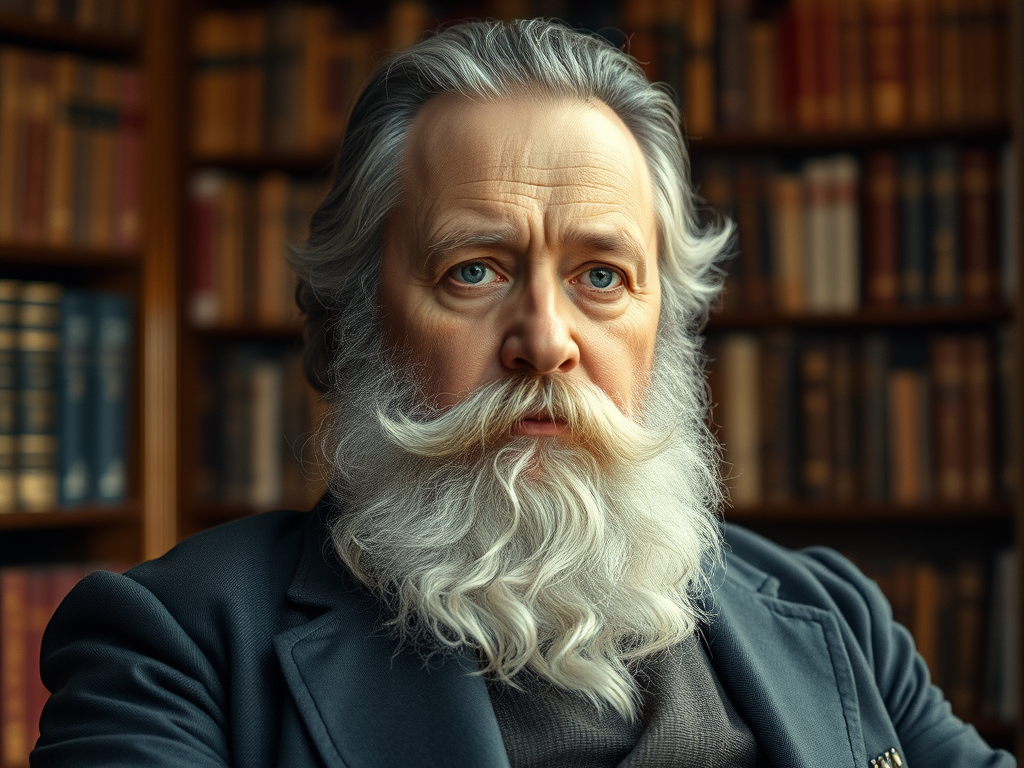
Victor Hugo

Victor Hugo (1802-1885) was a renowned French poet, novelist, and playwright who played a significant role in the Romantic literary movement. His works often explored themes of love, politics, and social injustice. Hugo was born on February 26, 1802, in Besançon, France. His father was a general in Napoleon’s army, and his mother was a royalist and supporter of the Bourbon monarchy. He showed early literary talent and published his first book of poetry at age twenty. Hugo married Adèle Foucher in 1822, and they had five children together.

Notable Works:
Les Misérables (1862)
One of Hugo’s most famous works, The Life of Jean Valjean, is a sprawling novel that follows the lives of several characters, including the ex-convict Jean Valjean, against the backdrop of social and political upheaval in 19th-century France.

The Hunchback of Notre Dame (1831)
This novel tells the story of Quasimodo, the hunchbacked bell ringer of Notre-Dame Cathedral in Paris, and Esmeralda, a beautiful gypsy girl. The book explores themes of love, fate, and social injustice.

Les Contemplations (1856)
   This collection of poetry is considered one of Hugo’s masterpieces. It reflects his personal experiences, including the death of his daughter, Léopoldine.

Victor Hugo was also known for his political activism. He was a staunch supporter of republicanism and opposed Napoleon III’s authoritarian rule. Due to his political beliefs, he was exiled from France in 1851 and spent over 15 years in various countries, including Belgium and the Channel Islands. Returning to France in 1870 after Napoleon III fell from power, he continued to write and be involved in politics until his death on May 22, 1885, in Paris.

Victor Hugo’s works have had a lasting impact on literature and continue to be studied and celebrated today. He is regarded as one of the greatest French writers, known for his lyrical style, social commentary, and passionate storytelling. Hugo’s life and work exemplify his commitment to art, justice, and human rights, making him a towering figure in French literature and culture. 

Image by AI

Alexander – Guardian, Protector of Humanity

Once upon a time, in a world much like our own but with a touch of magic woven into its fabric, there lived a man named Alexander. Alexander was blessed with an extraordinary gift – he could remember every detail of every moment he had ever experienced. His memory was a vast and intricate tapestry, a living archive of his existence. However, this gift soon turned into a curse for Alexander. The burden of remembering every joy, every sorrow, every triumph, and every failure became too heavy for him to bear. The pain of reliving past traumas and heartaches was a constant companion, a shadow that followed him wherever he went. Despite his suffering, Alexander’s remarkable memory made him indispensable to mankind. His unparalleled ability to recall information made him a living library, a repository of knowledge unprecedented in the history of the world. People came from far and wide to seek his counsel, learn from his wisdom, and benefit from his extraordinary gift.

As the years passed, Alexander became a legend, a figure shrouded in mystery and myth. Some believed he was immortal, that his memory was a divine gift bestowed upon him by the gods. Others whispered that he was a sorcerer of magic and power beyond mortal comprehension. But as time marched on, Alexander’s burden grew heavier. The weight of his memories threatened to crush and consume him from within. And so, he decided to change the course of history. On a cold winter’s night, as the world slept, Alexander walked alone to the edge of a cliff overlooking the vast expanse of the earth below. With a heavy heart and tears in his eyes, he gazed out into the darkness and made his final choice. He closed his eyes, took a deep breath, and let himself fall.

But a strange and wondrous thing happened as he plummeted towards the earth below. The world around him shimmered and shifted, and Alexander found himself suspended in mid-air, frozen in time. It was then that he understood the truth of his gift. His memory was not a curse but a blessing. His ability to remember every moment and detail was the key to mankind’s survival. Without him, the world would be lost, adrift in a sea of chaos and uncertainty. And so, Alexander made a solemn vow to himself and to the world. He would carry the burden of his memories, no matter how painful or heavy. For as long as he lived, mankind would thrive, secure in the knowledge that there was one among them who could never forget. So Alexander became a guardian, a protector of humanity, a beacon of hope in a world filled with darkness. Though his burden was great, his spirit was stronger still, a testament to the power of memory, the resilience of the human heart, and the enduring strength of the human spirit. 

Image by AI

The Crystal Crown

Once upon a time, in a world where darkness threatened to consume all light, there existed a legendary artefact known as the Crystal Crown. This crown was said to possess unimaginable power, bringing balance and harmony to the world. Long ago, when the forces of darkness, led by the malevolent sorcerer Malakar, sought to plunge the world into eternal night, a brave young heroine named Elara rose to the challenge. Elara was a skilled warrior and a master of magic, but her true strength lay in her unwavering courage and pure heart.

As the armies of darkness advanced, seeking to destroy all that was good and pure, Elara embarked on a perilous quest to find the Crystal Crown. Legends spoke of the crown’s ability to harness the very essence of light and channel it to drive back the darkness. Elara journeyed through treacherous forests, across vast deserts, and over towering mountains, facing fierce monsters and cunning traps set by Malakar’s minions. With each step, she grew stronger, her resolve unwavering as she drew closer to her goal. Finally, after a series of harrowing trials, Elara stood before the entrance to the Crystal Chamber, where the crown lay guarded by powerful enchantments. With a fierce determination burning in her eyes, Elara faced the challenges before her, overcoming each with skill and bravery.

At last, she reached the heart of the chamber, where the Crystal Crown shimmered with an ethereal light. Malakar appeared as she reached out to claim it, his dark magic crackling around him as he sought to stop her. A fierce battle ensued, with Elara and Malakar locked in a struggle that shook the very foundations of the chamber. But in the end, Elara’s courage and purity of heart triumphed. With a final burst of light, she seized the Crystal Crown and unleashed its power. The crown blazed with radiant light, driving back the darkness and banishing Malakar to the shadows, and the world was bathed in a warm, golden glow as the Crystal Crown’s magic spread, restoring balance and harmony to all lands. And so, the tale of the Crystal Crown that saved the world passed into legend, a reminder of the power of courage and compassion and the enduring light that shines within us all. 

James Herbert

James Herbert (1943-2013) was a renowned British author who made significant contributions to the horror genre with his chilling and suspenseful novels. Born in London, England, Herbert began his writing career in the 1970s and quickly gained popularity for his unique storytelling style, which blended horror, suspense, and supernatural elements. One of Herbert’s most notable works is “The Rats” (1974), a novel that follows a series of gruesome attacks by mutant rats on the inhabitants of London. This book, along with its sequels, established Herbert as a master of horror fiction and garnered him a devoted following of readers who were drawn to his vivid descriptions of terror and his ability to create a palpable sense of fear.

Throughout his career, James Herbert penned over 23 novels, including bestsellers like “The Fog” (1975), “The Dark” (1980), and “Haunted” (1988). His books often featured graphic depictions of violence and horror, pushing the boundaries of the genre and captivating audiences with their fast-paced plots and intense imagery. Herbert’s influence on the horror genre is undeniable. His works continue to be celebrated for their ability to evoke deep-seated fears and provoke a sense of unease in readers. His legacy as a master storyteller lives on through his novels, which have been translated into numerous languages and continue to captivate new generations of horror enthusiasts. My own personal favourite is ‘The Magic Cottage’.

James Herbert’s impact on the world of literature is profound, and his name remains synonymous with the essence of fear and suspense in horror fiction. His legacy as a trailblazer in the genre endures, and his works stand as a testament to his unparalleled talent for crafting tales that linger in the mind long after the final page is turned.

Image by AI

Aldous Huxley

Aldous Huxley, born in 1894 into a family of intellectuals and writers, was a prominent English author and philosopher renowned for his thought-provoking novels, essays, and other literary works. Huxley’s upbringing in a family with a rich literary heritage greatly influenced his own intellectual pursuits and creative endeavours. One of Aldous Huxley’s most famous works is the dystopian novel “Brave New World,” published in 1932. This novel presents a chilling vision of a future society where technology, mass production, and conditioning have effectively stifled individuality and freedom, exploring themes such as the consequences of a society driven by consumerism, conformity, and the dehumanization of individuals.

In addition to “Brave New World,” Huxley penned various works that delved into multiple themes and genres. His novel “Point Counter Point” uniquely portrays intellectual and social life in the interwar period. At the same time, “Eyeless in Gaza” explores themes of pacifism, personal growth, and societal change. Huxley’s non-fiction works, such as “The Doors of Perception,” reflect his interest in mysticism, consciousness, and exploring altered states of mind. Throughout his career, Huxley also engaged with philosophical and spiritual ideas, drawing inspiration from Eastern philosophies and mysticism. His writings often grapple with questions of human existence, the nature of reality, and the search for meaning in a rapidly changing world. Huxley’s keen insights into the human condition and his critiques of modern society resonate with readers and scholars alike.

Aldous Huxley’s legacy as a visionary thinker and literary figure remains enduring. His works continue to provoke reflection and inspire discussions on topics ranging from technology and society to individual freedom and the pursuit of truth. His unique blend of intellectual rigour, imaginative storytelling, and philosophical depth ensures that his contributions to literature and thought will be cherished for future generations. 

Image by AI