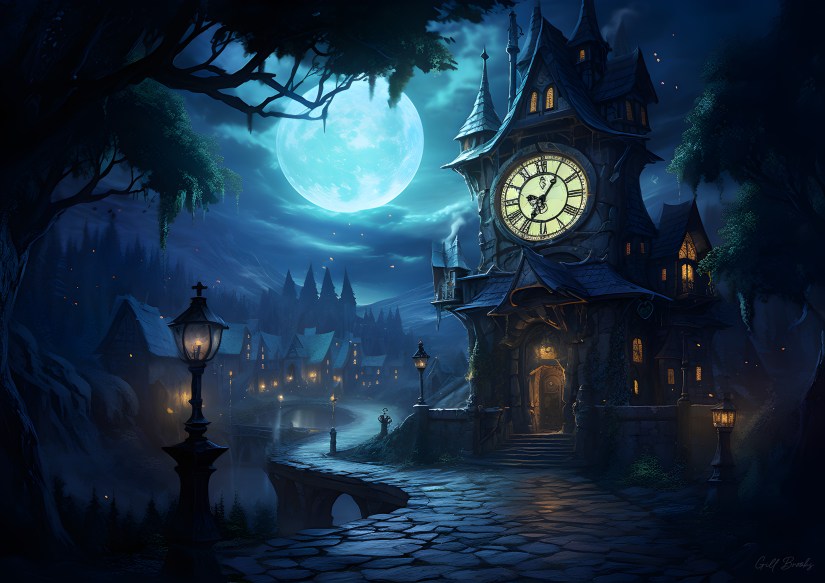
A Tale for Halloween – Legend of Whitaker House

In the quaint town of Willow Creek, the legend of the Whitaker House had woven itself into the fabric of local folklore. On a moonless Halloween night, the wind howled through the barren trees, carrying the tales of the past. The mansion stood at the edge of the woods, its silhouetted form looming ominously against the dark sky. The townspeople avoided it, their imaginations haunted by stories of Eliza Whitaker, the young girl who vanished one fateful Halloween night decades ago. Despite the warnings, five adventurous teenagers, Jack, Lily, Sam, Emma, and Tom, decided to test their courage by entering the infamous house. Armed with flashlights, they approached the mansion; its grandeur faded, the windows boarded up, and ivy crawled over its stone facade.

As they stepped inside, the air turned frigid, and the scent of decay filled their nostrils. The door creaked ominously behind them, closing with a resounding thud. The group exchanged nervous glances but pressed on, their footsteps echoing through the dusty corridors. They split up to explore, each taking a different path through the labyrinthine interior. Jack and Lily entered the parlour, where cobwebs draped over antique furniture. A grand piano stood in one corner, its keys yellowed and silent. A haunting melody filled the air as Lily ran her fingers across the keys, though her hands never moved. Meanwhile, Sam and Tom found themselves in a dimly lit library, its shelves lined with ancient tomes. A heavy book lay open on a table, its pages filled with Eliza’s diary entries. As they read, a chill swept through the room. Eliza had written of hearing voices, whispers calling her to the forest, and a shadowy figure that appeared in her dreams.

Emma, exploring alone, stumbled upon the attic stairs. Curiosity getting the better of her, she ascended into the darkness. The attic was cluttered with forgotten relics and dusty trunks. There, she found a tarnished mirror, its surface cloudy. As she peered into it, the reflection shifted, revealing a young girl in a white gown, her eyes pleading. Suddenly, a loud crash echoed through the house, drawing the group back together. They converged in the hallway, their breaths visible in the freezing air. The house seemed to pulse with a life of its own, the walls groaning as if in pain. Determined to uncover the truth, they followed a trail of cold air leading to a hidden door behind a tattered tapestry. Pushing it open, they descended a narrow staircase into a forgotten basement. The air was damp and heavy, and the flickering light of their flashlights revealed a room filled with old toys and a small bed. A porcelain doll eerily resembling Eliza stood in the corner, its eyes glinting in the darkness. As they approached, the temperature dropped further, and a translucent and sorrowful spectral figure emerged. It was Eliza, her voice a mere whisper.

“You must help me,” she implored. I am trapped between worlds.”

The teens realized that Eliza’s spirit was bound to the house, unable to move on. Determined to help, they formed a circle, holding hands as they recited a passage from her diary, hoping to free her soul. As they chanted, the room filled with a blinding light, the walls trembling as if resisting the ritual. The ground shook violently, and the whispers grew into a deafening roar. Shadows writhed around them, and the dolls in the room seemed to come alive, their faces twisted in anguish. But the teens held firm, their voices rising above the chaos. The light exploded outward with a final, heart-stopping crescendo, and the mansion fell silent. The oppressive cold lifted, and Eliza’s spirit appeared before them, her face serene.

“Thank you,” she whispered, her form dissolving into shimmering light.

The group fled the basement, racing through the now-silent house and into the night. Behind them, the Whitaker House stood still, its aura of menace gone. They vowed to keep Eliza’s story alive, a reminder of the power of compassion and courage. Every Halloween, the townsfolk would gather, sharing the tale of the brave teens who freed Eliza Whitaker’s spirit, ensuring her legend would be told for generations to come. And though the house remained empty, the haunting whispers ceased, leaving only the echoes of a past finally at peace. 

Image by Gill Brooks

Jack Kerouac

Jack Kerouac, born Jean-Louis Kérouac on March 12, 1922, in Lowell, Massachusetts, was an influential American novelist and poet who became a leading figure in the Beat Generation. His most famous work, “On the Road,” is a semi-autobiographical novel that chronicles his travels across North America in the late 1940s with his friend Neal Cassady.

Kerouac’s writing style was characterized by its spontaneous prose, influenced by jazz music and the idea of “spontaneous bop prosody.” He sought to capture the raw energy and immediacy of his experiences in his writing, often eschewing traditional narrative structures in favour of a more free-flowing and stream-of-consciousness style. In addition to “On the Road,” Kerouac wrote numerous other novels, including “The Dharma Bums,” “Big Sur,” and “Desolation Angels.” His works often explored themes such as the search for spiritual enlightenment, the rejection of societal norms, and the quest for authenticity in a rapidly changing world.

Kerouac’s writing profoundly impacted American literature and culture, influencing subsequent generations of writers and artists. Despite his success, Kerouac struggled with alcoholism and personal demons throughout his life. He passed away on October 21, 1969, at the age of 47. Today, Jack Kerouac is remembered as a literary icon whose work continues to resonate with readers worldwide. His contributions to literature and his exploration of the human experience have solidified his place in the pantheon of great American writers. 

F. Scott Fitzgerald

F. Scott Fitzgerald, whose full name was Francis Scott Key Fitzgerald, was an American novelist and short story writer. He was born on September 24, 1896, in St. Paul, Minnesota, and died in Hollywood, California on December 21, 1940. Fitzgerald is widely regarded as one of the greatest American writers of the 20th century. He is best known for his novel “The Great Gatsby,” considered a classic of American literature. The story explores decadence, idealism, resistance to change, and the American Dream in the 1920s. His writing often reflected the Jazz Age, a term he coined to describe the 1920s in America, a post-World War One time of economic prosperity, new social freedoms, and changing moral values.

Throughout his life, Fitzgerald struggled with alcoholism and financial difficulties. He was married to Zelda Sayre, who was an influential figure in his life and an aspiring writer herself. Their tumultuous relationship and Zelda’s struggles with mental health issues influenced much of Fitzgerald’s work. Some of his other notable works include “This Side of Paradise,” “Tender Is the Night,” and “The Beautiful and Damned.” Despite facing personal challenges and critical mixed reception during his lifetime, Fitzgerald’s work has endured. It continues to be celebrated for its lyrical prose, keen social observation, and exploration of the American experience.

Image by AI

Ernest Hemingway

Ernest Hemingway was an American novelist, short-story writer, and journalist widely regarded as one of the most influential writers of the 20th century. Hemingway was born on July 21, 1899, in Oak Park, Illinois. He grew up in a family intensely interested in outdoor activities and literature. Hemingway developed a passion for writing at a young age and worked for his high school newspaper. After graduating high school, Hemingway was a reporter for The Kansas City Star. He later volunteered as an ambulance driver during World War I and was seriously wounded in Italy. This experience greatly influenced his writing style and themes. His writing is known for its straightforward prose, understated dialogue, and themes of masculinity, war, and nature. Some of his most famous works include “The Old Man and the Sea,” “A Farewell to Arms,” “For Whom the Bell Tolls,” and “The Sun Also Rises.”


Hemingway led a tumultuous personal life characterized by multiple marriages, struggles with mental health issues, and a reputation for hard living. He lived in various places worldwide, including Paris, Key West, Cuba, and Idaho. In 1954, Hemingway was awarded the Nobel Prize in Literature for his mastery of narrative art. He is considered one of the greatest American writers of the 20th century and has had a lasting impact on literature and how writers approach storytelling. Tragically, Hemingway struggled with depression and physical ailments in his later years. On July 2, 1961, he died by suicide at his home in Ketchum, Idaho. Ernest Hemingway’s legacy continues to endure through his works, which are studied and celebrated by readers and scholars worldwide. 

Image by AI

H.G. Wells

Herbert George Wells, known as H.G. Wells, was a prominent English writer born on September 21, 1866, in Bromley, Kent, England. He is best known for his science fiction novels and works of social commentary. Wells was born into a working-class family. He struggled with health issues and financial constraints throughout his childhood. Despite facing challenges, Wells won a scholarship to the Normal School of Science in London, where he studied under Thomas Henry Huxley. He later earned a degree in biology.

Wells began his writing career as a novelist and journalist. He gained fame with works like “The Time Machine” (1895), “The Invisible Man” (1897), and “The War of the Worlds” (1898), which established him as a pioneer of science fiction. In addition to his science fiction, Wells wrote extensively on social and political issues. Works like “The War in the Air” (1908) and “The Shape of Things to Come” (1933) reflected his concerns about humanity’s future. He was known for his unconventional personal life. He had numerous affairs and marriages, including his relationship with writer Rebecca West. As he grew older, Wells’ writing shifted towards non-fiction and social criticism. He continued to write and lecture on various topics until his death. He is considered one of the founding fathers of science fiction and a key figure in the genre’s development. His works have had a lasting impact on popular culture and continue to be studied and adapted today.

H.G. Wells passed away on August 13, 1946, in London, leaving behind a rich literary legacy that has inspired generations of writers and readers. 

Image by AI