The Magic Crucifix’s

In the heart of ancient Babylon, beneath the sprawling ziggurats and bustling markets, a pair of crucifixes lay hidden, each imbued with mystical powers. These artefacts, forged when magic and the divine intertwined, were said to grant their bearers extraordinary abilities—healing, knowledge, and the gift of tongues.

The first crucifix was discovered by a humble healer named Isha. While searching for rare herbs in the sacred gardens, she stumbled upon the crucifix half-buried in the earth, its surface glimmering with an otherworldly light. As she picked it up, a surge of energy coursed through her, and she felt an ancient wisdom fill her mind. From that moment, she could mend wounds with a mere touch and cure ailments that had plagued her village for generations. Word of Isha’s miraculous abilities spread like wildfire, drawing the attention of kings and scholars alike. With her newfound power, she travelled far and wide, teaching others the art of healing and sharing the knowledge that flowed through her. Yet, she remained grounded, using her gifts to uplift her community and protect those in need.

Meanwhile, the second crucifix found its way into the hands of a wandering scholar named Kadir. He stumbled upon it in the ruins of a forgotten temple, hidden among dusty scrolls and crumbling stones. As he lifted the crucifix, he felt an immediate connection to the world’s ancient languages. Words flowed into his mind, enabling him to understand and speak any tongue. With this gift, Kadir travelled to distant lands, bridging cultures and sharing his stories.

The paths of Isha and Kadir eventually intertwined when they met at a great festival in Babylon, where people from across the known world had gathered. Recognizing the power they both held, they formed a bond, vowing to use their gifts in harmony. Together, they created a sanctuary where knowledge and healing could flourish, teaching others the importance of understanding and compassion. As the years passed, the crucifixes changed hands many times, each new bearer adding to their legacy. They were passed down through generations, from a wise queen who united warring tribes to a brave warrior who healed his comrades on the battlefield. Each bearer, touched by the crucifixes’ magic, spread the gifts of healing, knowing, and language far and wide, transforming lives and connecting disparate cultures.

However, the crucifixes also attracted the attention of those with darker intentions. A powerful sorcerer sought to claim them for himself, believing that he could dominate the world with their magic. He unleashed chaos across the land, causing fear and division. But the bond between those who held the crucifixes—now a lineage of healers and scholars—remained strong. With courage and unity, they faced the sorcerer, combining their powers. Isha’s healing light and Kadir’s eloquence inspired the people to rise against the darkness. In a climactic battle, the sorcerer was defeated, his ambitions thwarted by the gifts he sought to control. The crucifixes, glowing with renewed energy, restored balance to the world.

As centuries passed, the story of the crucifixes became a legend. They were a testament to the enduring power of compassion, knowledge, and connection. Though the artefacts themselves faded into myth, their essence lived on in the hearts of those who believed in the magic of healing and understanding, reminding future generations that true power lies not in domination but in unity and love. 

Samuel Taylor Coleridge

Samuel Taylor Coleridge (1772-1834) was an English poet, literary critic, philosopher, and theologian who was a key figure in the Romantic movement in England. He is best known for his poems “The Rime of the Ancient Mariner” and “Kubla Khan.” Coleridge was a close friend of fellow poet William Wordsworth. Together, they published a collection of poems called “Lyrical Ballads” in 1798, which is considered a seminal work in the Romantic movement. Coleridge’s poetry often explores themes of nature, imagination, and the supernatural.

In addition to his poetry, Coleridge was a prolific prose writer, including literary criticism and philosophical works. He is known for his literary theory, especially his concept of the “willing suspension of disbelief,” which suggests that readers should temporarily suspend their critical faculties to fully engage with fiction. Coleridge’s influence on English literature and poetry has been profound, and his works continue to be studied and celebrated for their beauty, depth, and complexity. 

The Tale of William Wanderlust

Once upon a time, in a quaint village, there lived a man named William Wanderlust. William had a restless spirit, constantly yearning for the promise of tomorrow. He dreamed of grand adventures, distant lands, and a life full of excitement, yet he never seemed to find the time to pursue his dreams. Instead, he spent his days planning and wishing while his nights were filled with longing for a future that remained just out of reach. One day, driven by an insatiable urge to chase his dreams, William embarked on a journey. He wandered through lush green forests, crossed sparkling rivers, and climbed steep mountains, all the while imagining the wonders that awaited him at every turn. But as each day passed, he found himself in the same cycle: dreaming of tomorrow while doing little to shape it. As his feet trod their path, all the beauty of the now evaded him, and his thoughts remained focused on the next step.

One afternoon, as he rested by a serene lake, William encountered a wise old monk sitting quietly on the shore. The monk’s presence emanated a calm that intrigued him. William approached the monk, sharing his dreams and desires and lamenting how he never seemed to achieve anything. The monk listened patiently and then smiled gently.

“William, you are like a bird perched on a branch, always looking at the horizon. You spend so much time dreaming of flight that you forget to spread your wings.”

Confused, William asked,

“What do you mean? I want to soar into the sky of tomorrow!”

The monk replied,

“Tomorrow is a beautiful illusion, but it is today that holds the key. You can only embrace tomorrow if you take action today. What steps have you taken towards your dreams?”

William realized he had been so focused on the future that he had neglected the present. The monk continued,

“Every journey begins with a single step. If you wish to explore the world, start by exploring yourself. What do you truly desire? What small actions can you take today?”

Inspired by the monk’s wisdom, William began to reflect. He understood that he needed to set achievable goals and take small steps toward them. He started by learning new skills, meeting people along the way, and immersing himself in the beauty of the present moment. As days turned into weeks, William found himself transforming. He learned to savour each experience, whether it was the taste of fresh bread from a local baker or a conversation with a fellow traveller. He no longer felt the weight of unfulfilled dreams; instead, he felt invigorated by the progress he was making. Eventually, William understood that tomorrow would always be there, but it was today that mattered most. With each small step, he navigated through life with purpose and passion. The adventures he once only dreamed of began to unfold before him, not as distant fantasies but as tangible experiences.

Years later, William returned to the lake where he first met the monk. He sat down in the same spot, reflecting on his journey. The monk appeared once more, his eyes twinkling with wisdom. William smiled, grateful for their encounter.

“Thank you for showing me the way,” he said. “I no longer lust after tomorrow. I cherish today and all that it brings.”

The monk nodded,

“Remember, the journey is not about the destination but the experiences along the way. Continue to embrace each moment, and tomorrow will take care of itself.”

With a heart full of gratitude, William Wanderlust had finally found what he had been searching for—not just the thrill of tomorrow but the joy of living fully in the present. And so, he continued his adventures, a man transformed by the wisdom of a simple yet profound truth. 

Images by AI

Bertrand the Sculptor

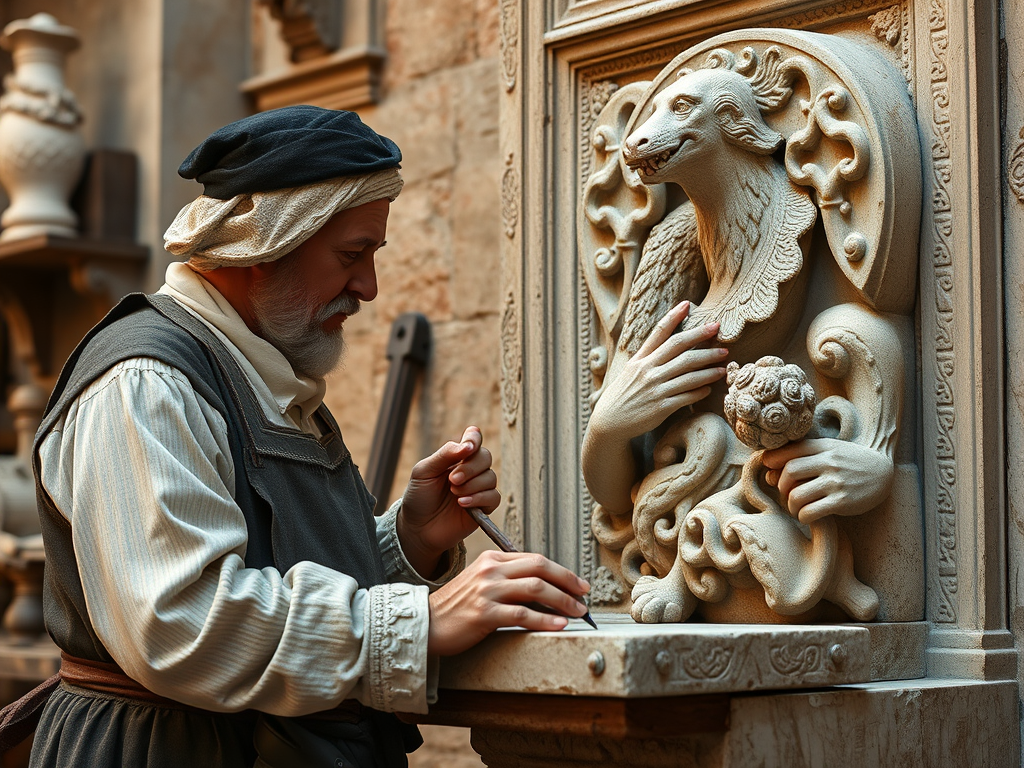
In the heart of Venice, amidst the winding canals and echoes of history, stood an art gallery known as “Galleria Fantasma.” This gallery was renowned not only for its exquisite collection of Renaissance masterpieces but also for its most enigmatic resident—Bertrand the Sculptor, a spectral artist who had haunted its halls since 1486. Bertrand was a gifted sculptor, celebrated for his ability to breathe life into stone. His works captured the depth of human emotion, a testament to his profound understanding of beauty and sorrow. However, his promising career was cut short when the plague swept through Venice, claiming his life at the age of 38. On his deathbed, surrounded by the unfinished sculptures that bore witness to his genius, Bertrand made a silent vow: his art would live on, even if he could not.

Upon his death, Bertrand’s soul found itself bound to his final creation—a haunting sculpture of a woman, her face a reflection of both melancholy and grace. This piece, known as “The Muse,” was said to embody a love lost to time, a muse who had inspired Bertrand’s greatest works. In the ethereal realm, Bertrand lingered, becoming a living, breathing ghost, his presence a whisper in the gallery’s corridors. Visitors to the Galleria Fantasma often reported eerie sensations—a sudden chill, the faint sound of chiselling, or a shadow glimpsed from the corner of the eye. These occurrences, though unsettling, seemed to possess an inexplicable warmth, as if the ghost meant no harm. Indeed, Bertrand’s intentions were pure; he sought not to frighten but to inspire.

Over the centuries, many artists and art lovers ventured into the gallery, drawn by its mysterious allure. Those sensitive to the supernatural sometimes found themselves in unexpected dialogue with Bertrand. He would guide them through the intricacies of art, offering insights that transcended time and space. His presence was most strongly felt near “The Muse,” where he appeared as a translucent figure, his spectral hands forever refining his masterpiece. Despite his spectral existence, Bertrand yearned for recognition—not as a ghost, but as an artist whose soul lived on through his work. As Venice evolved, the gallery became a sanctuary for those who admired the ethereal beauty of art. Yet, few understood the story behind the haunting presence within its walls.

One evening, Isabella, a fervent young art student, stumbled upon the gallery. Enchanted by “The Muse,” she felt an immediate connection as if the sculpture spoke directly to her heart. As she sketched, a gentle breeze brushed her cheek, and she sensed a presence watching over her. Encouraged, she spoke aloud, sharing her dreams and fears, the ache of unfulfilled longing. To her surprise, the atmosphere shifted, a warmth enveloping her—a sign that Bertrand was listening. Isabella returned to the gallery each night, her visits becoming a ritual. Through her art and passion, she forged a bond with Bertrand. Unbeknownst to her, Bertrand found renewed purpose in guiding this young artist. He revealed the secrets of his techniques, the emotions that fueled his creations, and the stories etched into every curve of “The Muse.” Together, they embarked on a creative journey, bridging the chasm between life and death.

As Isabella’s talent blossomed, the gallery thrived. She organized exhibitions that showcased her work and illuminated Bertrand’s legacy, weaving his story into the tapestry of her art. The tale of the living ghost who inspired a new generation spread, drawing visitors eager to experience the magic of Galleria Fantasma. In time, Bertrand’s name was spoken with reverence, his spirit woven into the fabric of Venice’s artistic heritage. No longer just a ghost haunting the gallery, he became a vital part of its story, celebrated through the creations of those he inspired. And in the quiet of the night, under the moon’s silver glow, Bertrand continued to sculpt, his heart at peace, knowing he would never be forgotten. 

Image by AI

Eldergrove

Once upon a time, in a secluded valley surrounded by towering mountains, there stood an ancient tree known as Eldergrove. This was no ordinary tree; it was said to be the oldest living organism in the world, over 5,000 years old. Its gnarled branches stretched wide, and its thick trunk was a tapestry of scars and knots, each telling a story of the centuries it had witnessed. Eldergrove was revered by the villagers who lived nearby. They believed the tree possessed profound wisdom and could answer the deepest questions of the heart and mind. On nights when the moon was full, villagers would gather around Eldergrove, sharing their worries and dreams, hoping to glean insights from its timeless presence.

One evening, a young woman named Lila approached the tree, her heart heavy with uncertainty. She was at a crossroads, torn between following her family’s wishes to take over the family business or pursuing her passion for art. Kneeling before the great tree, she placed her hands on its rough bark and closed her eyes.

“Great Eldergrove,” she whispered, “please help me find my path?”

A gentle breeze rustled the leaves above as if responding to her plea, creating a soft, melodic whisper. Lila listened intently, her heart calming as she felt a connection to the ancient spirit of the tree. In that moment, she sensed the stories of countless souls who had stood where she was, seeking guidance and clarity. The wind carried a message:

“Follow your heart, for it is the compass that will lead you to your true self. The world needs your light, just as it has needed the sun for millennia.”

Inspired, Lila stood up, a newfound clarity washing over her. She realized that while her family’s expectations were significant, her happiness and passion were paramount. She decided to pursue her art, creating pieces that reflected the beauty of the world around her. As the years passed, Lila’s art flourished, and her works began to resonate with many. She often returned to Eldergrove, sharing her successes and challenges, always finding comfort in the tree’s silent wisdom. One day, as she sat beneath its sprawling branches, she noticed a group of children playing nearby. They were laughing and weaving flower crowns, their innocence a reminder of the joy in simplicity. Lila smiled, realizing Eldergrove was a source of wisdom and a symbol of continuity and connection.

With each passing season, Eldergrove stood tall, nurturing generations with its ancient wisdom. The villagers taught their children to listen to the tree and seek its counsel in times of doubt. They understood that while the world was ever-changing, the lessons imparted by Eldergrove remained timeless. And so, the oldest tree in the world endured a steadfast guardian of wisdom, reminding all who sought its guidance that true fulfilment comes from embracing one’s authentic self and sharing that light with the world. 

Image by AI