Lost in Mist

Once upon a time, in a small town, lived a man named David who had a deep, unconditional love for his mother, Margaret. As a child, David had always admired her strength and warmth; she was his guiding light. But as the years passed, Margaret developed dementia, a cruel thief that slowly stole away her memories and her essence. At first, the changes were subtle. She would forget where she placed her glasses or repeat the same story she had shared moments before. David brushed it off as part of ageing, but as time went on, the forgetfulness escalated. Margaret began to forget names, faces, and even her own son. Despite the heartache, David remained steadfast. He visited her daily, bringing her favourite flowers and sitting beside her as they watched old movies together. He learned to speak in a way that reached her heart rather than her mind, sharing stories that evoked feelings rather than facts. He held her hand tightly, reminding her of their love, even when she struggled to recognise him.

During a particularly difficult visit, Margaret looked at David blankly. He felt despair wash over him for a moment, but then he remembered the countless moments of joy they had shared. He took a deep breath and began to sing her favourite lullaby, the one she used to sing to him as a child. Slowly, her eyes brightened, and a faint smile crept onto her lips. In that moment, David realized that while her memories may fade, the bonds of love remained unbroken. As the disease progressed, their roles began to shift. David became the caretaker, navigating the complexities of her care with patience and grace. He learned to celebrate small victories: the days when she recognized him, the moments when she laughed at a joke, or even simply when she smiled. Each of these moments became precious gems in the tapestry of their relationship.

Through it all, David found solace in the love that still flickered in his mother’s eyes. He understood that love transcended memory; it was a feeling that could not be erased. He dedicated himself to ensuring that Margaret felt safe and loved, surrounding her with familiar scents, sounds, and stories that connected her to the life they once shared. As the years passed, David’s unwavering devotion became a testament to the power of unconditional love. Even in the face of loss, he focused not on what was fading but on what remained. In his heart, he carried the essence of his mother, a woman who had taught him strength, compassion, and the true meaning of love. In the twilight of her life, Margaret may not have remembered her son, but David knew their love would forever linger, a beautiful melody echoing through the corridors of his heart. And so, he continued to sing, not just for her, but for the bond that would never fade—a love that endured beyond memory, an eternal love.


 Septimus: A Tale of Strength and Confidence

A boy named Septimus lived in the quaint village of Oldridge, nestled between rolling hills and dense forests. From a young age, Septimus was different. He was smaller than his peers, with a quiet demeanour that often made him feel overlooked. Yet, beneath his unassuming exterior lay a heart full of courage and an unwavering spirit. As Septimus grew older, the village faced challenges. A severe drought struck, leaving crops wilting and families in despair. Once vibrant and full of life, the villagers were burdened with worry. Many believed the drought was a punishment for their past mistakes, and fear began to take root in their hearts. While the adults lamented their fate, Septimus felt a flicker of determination ignite within him. He had always loved the stories of heroes who faced insurmountable odds and realized that perhaps it was time for him to become one of those heroes.

As the sun dipped below the horizon one evening, Septimus gathered his courage and climbed to the highest hill overlooking Oldridge. He gazed down at the parched fields and the worried faces of his neighbours. At that moment, he made a vow to himself: he would find a way to bring life back to their village. With a plan in mind, Septimus began to explore the ancient forest surrounding Oldridge. He remembered tales of a hidden spring that was said to have healing waters that could revive the land. The journey was fraught with challenges—thorns that scratched his arms, steep cliffs that tested his footing, and shadows that whispered doubt into his ears. But with each obstacle, Septimus drew strength from within, reminding himself of his purpose. After days of searching, he finally discovered the spring, a shimmering pool nestled among stones, surrounded by vibrant greenery. Septimus filled his small flask with the precious water, feeling a surge of hope as he returned to the village. When he arrived, the villagers were sceptical.

“How can a boy like you save us?” they asked, their voices tinged with doubt.

But Septimus stood tall, his confidence shining through.

“I believe we can revive our land if we work together,” he proclaimed.

With the water from the spring, Septimus led the villagers in a collective effort. They watered the crops, shared the precious liquid, and tended to the withering plants. Little by little, life began to return. Green shoots broke through the parched earth, and hope blossomed in the villagers’ hearts. As the days turned into weeks, the drought faded, replaced by the laughter of children and the joyful work of families. The village of Oldridge was once again vibrant, and Septimus, the boy who had once been overlooked, became a symbol of strength and resilience. Through his journey, Septimus learned that true strength comes not from physical prowess but from the courage to face adversity and the confidence to inspire others. His tale spread far and wide, reminding everyone that hope can emerge from the most unexpected places, even in the darkest times. And so, the village thrived, forever grateful for the boy who dared to believe in a brighter future. 

Image by AI

Elias

Once upon a time, in a quiet village nestled between rolling hills, there lived an old man named Elias. Known for his wisdom and gentle spirit, Elias was often seen tending to his garden or sharing stories with the village children. Few knew of his past; he had once been a renowned scholar and adventurer who travelled the world searching for knowledge and truth. One fateful day, a dark cloud descended upon the land. An ancient evil, long thought vanquished, had awakened. Creatures of shadow began to emerge, spreading fear and chaos. The villagers were terrified, and many fled their homes, believing nothing could save them.

Elias, however, felt a familiar stirring within him. He remembered the old prophecies about the “Keeper of Light” rising in times of darkness. Determined to protect his home, he gathered his few belongings and set off on a quest to confront the evil that threatened the world. His journey led him to the Whispering Woods, where he sought the wisdom of the ancient spirits. They revealed that the source of the darkness was a powerful crystal hidden deep within the Caves of Despair. Only by uniting the fragments of the Light Stone scattered across the land could he hope to confront the malevolence.

Elias travelled far and wide, facing numerous challenges along the way. He helped a village beset by drought by teaching them sustainable farming techniques, earning the first fragment of the Light Stone. He rescued a trapped beast in the mountains, gaining another fragment in gratitude. Each act of kindness brought him closer to his goal and rekindled hope in the hearts of those he encountered. Finally, after many trials, Elias gathered all the fragments and made his way to the Caves of Despair. Inside, he faced the embodiment of darkness itself—a towering figure wreathed in shadows. With courage in his heart, Elias held the Light Stone high, channelling the love and kindness he had shared throughout his journey.

A brilliant light erupted from the stone, clashing with the darkness. The power of his compassion and bravery pierced through the shadows, banishing the evil that had plagued the land. As the light spread, it illuminated the cave and transformed the darkness into shimmering stars, restoring balance to the world. Exhausted but triumphant, Elias returned to his village, where he was greeted as a hero. Yet, he humbly declined the title, choosing instead to continue his quiet life among the people he loved. Inspired by his bravery and kindness, the villagers began rebuilding their lives and spreading their lessons. Elias spent his remaining years sharing stories of hope and resilience, reminding everyone that true strength comes not from power or might but from compassion and the willingness to act in the face of adversity. And so, the old man who saved the world became a cherished legend, his tale whispered through generations, a beacon of light against the darkness. 

Image by AI

The Magic Crucifix’s

In the heart of ancient Babylon, beneath the sprawling ziggurats and bustling markets, a pair of crucifixes lay hidden, each imbued with mystical powers. These artefacts, forged when magic and the divine intertwined, were said to grant their bearers extraordinary abilities—healing, knowledge, and the gift of tongues.

The first crucifix was discovered by a humble healer named Isha. While searching for rare herbs in the sacred gardens, she stumbled upon the crucifix half-buried in the earth, its surface glimmering with an otherworldly light. As she picked it up, a surge of energy coursed through her, and she felt an ancient wisdom fill her mind. From that moment, she could mend wounds with a mere touch and cure ailments that had plagued her village for generations. Word of Isha’s miraculous abilities spread like wildfire, drawing the attention of kings and scholars alike. With her newfound power, she travelled far and wide, teaching others the art of healing and sharing the knowledge that flowed through her. Yet, she remained grounded, using her gifts to uplift her community and protect those in need.

Meanwhile, the second crucifix found its way into the hands of a wandering scholar named Kadir. He stumbled upon it in the ruins of a forgotten temple, hidden among dusty scrolls and crumbling stones. As he lifted the crucifix, he felt an immediate connection to the world’s ancient languages. Words flowed into his mind, enabling him to understand and speak any tongue. With this gift, Kadir travelled to distant lands, bridging cultures and sharing his stories.

The paths of Isha and Kadir eventually intertwined when they met at a great festival in Babylon, where people from across the known world had gathered. Recognizing the power they both held, they formed a bond, vowing to use their gifts in harmony. Together, they created a sanctuary where knowledge and healing could flourish, teaching others the importance of understanding and compassion. As the years passed, the crucifixes changed hands many times, each new bearer adding to their legacy. They were passed down through generations, from a wise queen who united warring tribes to a brave warrior who healed his comrades on the battlefield. Each bearer, touched by the crucifixes’ magic, spread the gifts of healing, knowing, and language far and wide, transforming lives and connecting disparate cultures.

However, the crucifixes also attracted the attention of those with darker intentions. A powerful sorcerer sought to claim them for himself, believing that he could dominate the world with their magic. He unleashed chaos across the land, causing fear and division. But the bond between those who held the crucifixes—now a lineage of healers and scholars—remained strong. With courage and unity, they faced the sorcerer, combining their powers. Isha’s healing light and Kadir’s eloquence inspired the people to rise against the darkness. In a climactic battle, the sorcerer was defeated, his ambitions thwarted by the gifts he sought to control. The crucifixes, glowing with renewed energy, restored balance to the world.

As centuries passed, the story of the crucifixes became a legend. They were a testament to the enduring power of compassion, knowledge, and connection. Though the artefacts themselves faded into myth, their essence lived on in the hearts of those who believed in the magic of healing and understanding, reminding future generations that true power lies not in domination but in unity and love. 

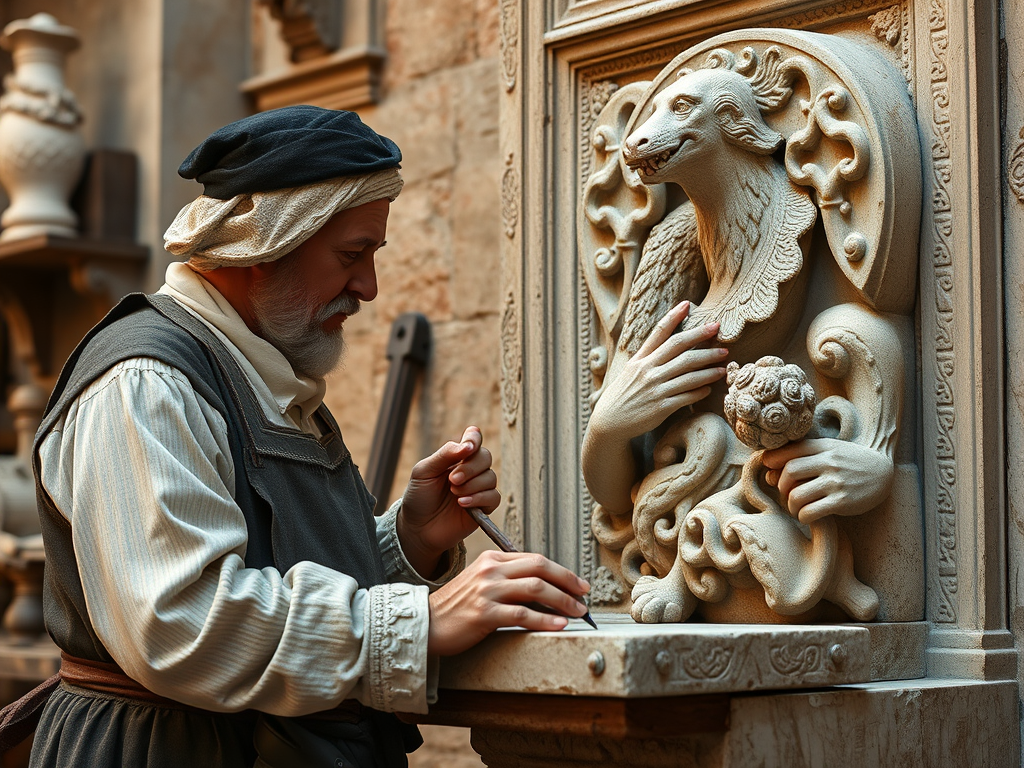
Bertrand the Sculptor

In the heart of Venice, amidst the winding canals and echoes of history, stood an art gallery known as “Galleria Fantasma.” This gallery was renowned not only for its exquisite collection of Renaissance masterpieces but also for its most enigmatic resident—Bertrand the Sculptor, a spectral artist who had haunted its halls since 1486. Bertrand was a gifted sculptor, celebrated for his ability to breathe life into stone. His works captured the depth of human emotion, a testament to his profound understanding of beauty and sorrow. However, his promising career was cut short when the plague swept through Venice, claiming his life at the age of 38. On his deathbed, surrounded by the unfinished sculptures that bore witness to his genius, Bertrand made a silent vow: his art would live on, even if he could not.

Upon his death, Bertrand’s soul found itself bound to his final creation—a haunting sculpture of a woman, her face a reflection of both melancholy and grace. This piece, known as “The Muse,” was said to embody a love lost to time, a muse who had inspired Bertrand’s greatest works. In the ethereal realm, Bertrand lingered, becoming a living, breathing ghost, his presence a whisper in the gallery’s corridors. Visitors to the Galleria Fantasma often reported eerie sensations—a sudden chill, the faint sound of chiselling, or a shadow glimpsed from the corner of the eye. These occurrences, though unsettling, seemed to possess an inexplicable warmth, as if the ghost meant no harm. Indeed, Bertrand’s intentions were pure; he sought not to frighten but to inspire.

Over the centuries, many artists and art lovers ventured into the gallery, drawn by its mysterious allure. Those sensitive to the supernatural sometimes found themselves in unexpected dialogue with Bertrand. He would guide them through the intricacies of art, offering insights that transcended time and space. His presence was most strongly felt near “The Muse,” where he appeared as a translucent figure, his spectral hands forever refining his masterpiece. Despite his spectral existence, Bertrand yearned for recognition—not as a ghost, but as an artist whose soul lived on through his work. As Venice evolved, the gallery became a sanctuary for those who admired the ethereal beauty of art. Yet, few understood the story behind the haunting presence within its walls.

One evening, Isabella, a fervent young art student, stumbled upon the gallery. Enchanted by “The Muse,” she felt an immediate connection as if the sculpture spoke directly to her heart. As she sketched, a gentle breeze brushed her cheek, and she sensed a presence watching over her. Encouraged, she spoke aloud, sharing her dreams and fears, the ache of unfulfilled longing. To her surprise, the atmosphere shifted, a warmth enveloping her—a sign that Bertrand was listening. Isabella returned to the gallery each night, her visits becoming a ritual. Through her art and passion, she forged a bond with Bertrand. Unbeknownst to her, Bertrand found renewed purpose in guiding this young artist. He revealed the secrets of his techniques, the emotions that fueled his creations, and the stories etched into every curve of “The Muse.” Together, they embarked on a creative journey, bridging the chasm between life and death.

As Isabella’s talent blossomed, the gallery thrived. She organized exhibitions that showcased her work and illuminated Bertrand’s legacy, weaving his story into the tapestry of her art. The tale of the living ghost who inspired a new generation spread, drawing visitors eager to experience the magic of Galleria Fantasma. In time, Bertrand’s name was spoken with reverence, his spirit woven into the fabric of Venice’s artistic heritage. No longer just a ghost haunting the gallery, he became a vital part of its story, celebrated through the creations of those he inspired. And in the quiet of the night, under the moon’s silver glow, Bertrand continued to sculpt, his heart at peace, knowing he would never be forgotten. 

Image by AI