Harold – the man who was always late!

Once upon a time, in a quaint little town, there lived a man named Harold who had a peculiar talent for being late. No matter the occasion—birthdays, weddings, or important meetings—Harold always seemed to arrive just after the moment had passed. Friends and family often joked that he was on a different schedule, one that ticked a little slower than everyone else’s. As a child, Harold’s tardiness was endearing. His parents would chuckle as he stumbled into the classroom, breathless and flushed, always missing the morning bell by a few minutes. In his teenage years, he was perpetually late for dates, leaving girls waiting with a mix of exasperation and amusement. “Better late than never,” he would say with a sheepish grin, and somehow, they never held it against him for long.

As an adult, Harold’s reputation only grew. He missed job interviews and deadlines, and his friends learned to adjust their plans around him. “Let’s just tell Harold an hour earlier,” they would whisper, a strategy that often backfired when he still managed to arrive late. Yet, despite the frustration he caused, his charm and good-natured spirit kept him surrounded by loved ones. One day, Harold received news that he had a serious illness. Determined to live life to the fullest, he decided to throw a party to celebrate his life. He meticulously planned every detail, inviting everyone he had ever known. But, true to form, he miscalculated the time it would take to prepare. The party was supposed to start at 4 PM, but he arrived at 5:30, just as the last guests were leaving.

“Harold, we were just about to leave!” they exclaimed, laughing at the irony.

But Harold, ever the optimist, simply shrugged and said,

“Well, at least I made it for the cake!”

And they all stayed a little longer, sharing stories and laughter, grateful for the time they had. Months passed, and Harold’s condition worsened. He was in and out of the hospital, but even there, he was late for his own treatments. The nurses would chuckle, “We’ve got to set an alarm for you, Harold!” He would laugh along, making friends with everyone he met, turning each medical appointment into a lighthearted gathering. Finally, the day came when Harold’s time came to an end. He passed away quietly, leaving behind a legacy of laughter and love. When the day of his funeral arrived, friends and family gathered in the church, reminiscing about their favourite Harold stories. But true to form, Harold was late even for this final event. As the clock ticked on, people began to murmur. Just then, the church doors swung open with a loud creak, and Harold, or rather, his spirit, walked in. He floated in, grinning widely as if he had just walked in from a party.

“Sorry I’m late!” he shouted, and laughter erupted in the sombre room.

At that moment, everyone understood that Harold had never indeed been late. He had always arrived just when he was meant to, filling every moment with joy, love, and laughter. And so, they celebrated his life and the wonderful chaos he brought into theirs, proving that sometimes, being late is the best way to make a grand entrance.

Image by http://www.gillsplace.com

Harold Robbins

Harold Robbins (1916-1997) was an American author known for his novels that often depicted the lives of the rich, powerful, and famous. He was one of the best-selling authors of all time, with his books selling over 750 million copies worldwide. Robbins was born in New York City and had a difficult childhood, growing up in poverty. He worked various jobs before finding success as a novelist. His first novel, “Never Love a Stranger,” was published in 1948 and was a commercial success.

Throughout his career, Robbins wrote over 25 novels, many of which were bestsellers. Some of his most famous works include “The Carpetbaggers,” “A Stone for Danny Fisher,” “The Betsy,” and “79 Park Avenue.” His books often featured themes of sex, power, money, and ambition. Critics frequently dismissed Robbins’ work as sensational and melodramatic, but readers were drawn to his fast-paced storytelling and larger-than-life characters. Despite the criticism, Robbins’ books were incredibly popular and adapted into several films and television series. Harold Robbins’ influence on popular culture and the literary world is undeniable. His novels have entertained millions of readers worldwide. 

Image by AI

The Tale of William Wanderlust

Once upon a time, in a quaint village, there lived a man named William Wanderlust. William had a restless spirit, constantly yearning for the promise of tomorrow. He dreamed of grand adventures, distant lands, and a life full of excitement, yet he never seemed to find the time to pursue his dreams. Instead, he spent his days planning and wishing while his nights were filled with longing for a future that remained just out of reach. One day, driven by an insatiable urge to chase his dreams, William embarked on a journey. He wandered through lush green forests, crossed sparkling rivers, and climbed steep mountains, all the while imagining the wonders that awaited him at every turn. But as each day passed, he found himself in the same cycle: dreaming of tomorrow while doing little to shape it. As his feet trod their path, all the beauty of the now evaded him, and his thoughts remained focused on the next step.

One afternoon, as he rested by a serene lake, William encountered a wise old monk sitting quietly on the shore. The monk’s presence emanated a calm that intrigued him. William approached the monk, sharing his dreams and desires and lamenting how he never seemed to achieve anything. The monk listened patiently and then smiled gently.

“William, you are like a bird perched on a branch, always looking at the horizon. You spend so much time dreaming of flight that you forget to spread your wings.”

Confused, William asked,

“What do you mean? I want to soar into the sky of tomorrow!”

The monk replied,

“Tomorrow is a beautiful illusion, but it is today that holds the key. You can only embrace tomorrow if you take action today. What steps have you taken towards your dreams?”

William realized he had been so focused on the future that he had neglected the present. The monk continued,

“Every journey begins with a single step. If you wish to explore the world, start by exploring yourself. What do you truly desire? What small actions can you take today?”

Inspired by the monk’s wisdom, William began to reflect. He understood that he needed to set achievable goals and take small steps toward them. He started by learning new skills, meeting people along the way, and immersing himself in the beauty of the present moment. As days turned into weeks, William found himself transforming. He learned to savour each experience, whether it was the taste of fresh bread from a local baker or a conversation with a fellow traveller. He no longer felt the weight of unfulfilled dreams; instead, he felt invigorated by the progress he was making. Eventually, William understood that tomorrow would always be there, but it was today that mattered most. With each small step, he navigated through life with purpose and passion. The adventures he once only dreamed of began to unfold before him, not as distant fantasies but as tangible experiences.

Years later, William returned to the lake where he first met the monk. He sat down in the same spot, reflecting on his journey. The monk appeared once more, his eyes twinkling with wisdom. William smiled, grateful for their encounter.

“Thank you for showing me the way,” he said. “I no longer lust after tomorrow. I cherish today and all that it brings.”

The monk nodded,

“Remember, the journey is not about the destination but the experiences along the way. Continue to embrace each moment, and tomorrow will take care of itself.”

With a heart full of gratitude, William Wanderlust had finally found what he had been searching for—not just the thrill of tomorrow but the joy of living fully in the present. And so, he continued his adventures, a man transformed by the wisdom of a simple yet profound truth. 

Images by AI

Heyoka named Wíiyokiya

Once in a time long ago, in the vast plains of the Dakota territory, lived a Heyoka named Wíiyokiya. He was known as the “sacred clown,” a figure of humour and wisdom within his Lakota tribe. Unlike others, Wíiyokiya embraced the role of a trickster, using laughter and unconventional behaviour to teach important lessons about life. One day, the tribe faced a severe drought. The rivers ran dry, and the once-bountiful land turned to dust. The people grew anxious, their spirits dampened by the relentless sun. The elders gathered, seeking guidance on how to restore balance to their world.

Wíiyokiya, seeing their despair, decided to act. He painted his face with bright colours and donned his most outrageous attire—clashing patterns and mismatched feathers. He danced through the village, mimicking the movements of the animals and poking fun at the seriousness of the elders. The people watched, confused at first, then began to chuckle. Laughter spread like wildfire, lifting their spirits. As he danced, Wíiyokiya began to chant a playful song that told the story of the sky and the earth’s love for one another. His antics reminded the tribe of their connection to nature and the importance of unity during hard times. The more they laughed, the more they remembered their resilience.

As if in response to their newfound joy, dark clouds suddenly gathered overhead. Thunder rumbled, and rain began to fall—gentle at first, then pouring down in joyous torrents. The tribe celebrated, dancing alongside Wíiyokiya, who twirled and leapt, splashing in the puddles that formed. The earth soaked up the water in the following days, and life returned to the plains. Crops began to sprout, and the rivers flowed once more. The people, grateful for the rain, recognized Wíiyokiya’s wisdom. They understood that they had summoned the very forces of nature through laughter and joy.

From that day forward, Wíiyokiya was seen as a trickster and a vital part of the tribe’s spiritual fabric. He taught them that humour and joy could be powerful tools for healing and community in times of hardship. His legacy lived on, reminding them to embrace the lightness of life, even in the darkest times. And so, the tale of Wíiyokiya, the Heyoka, became woven into the fabric of their stories, a timeless reminder of the strength found in laughter and the bonds of community.

Image by AI

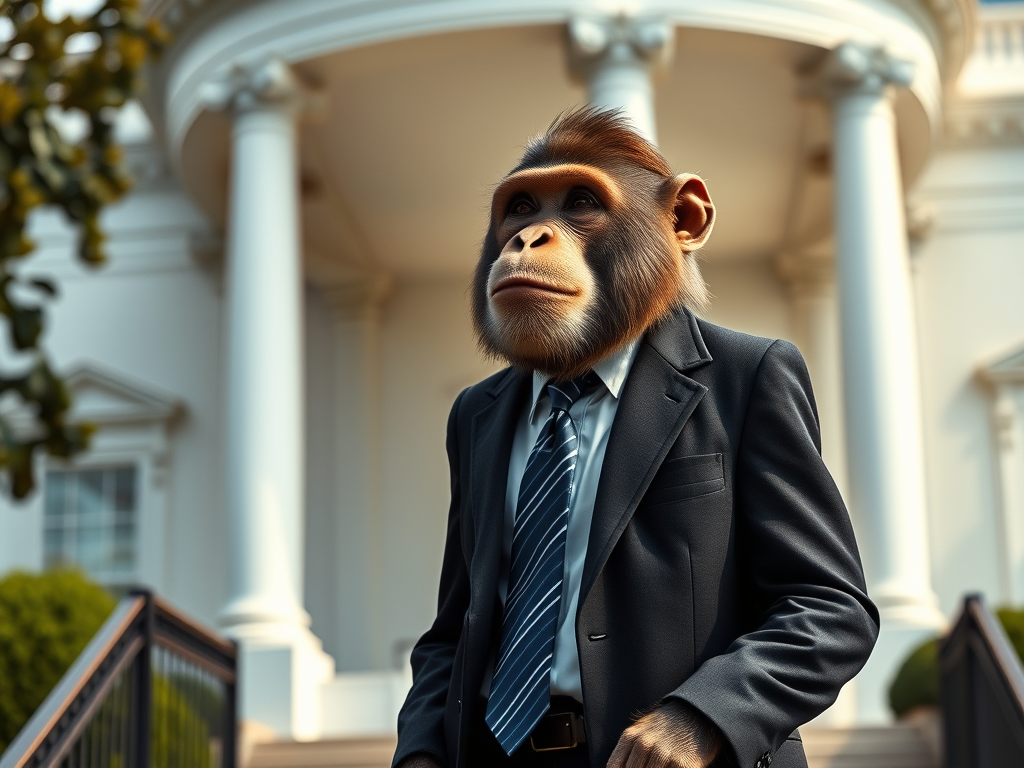
A Tale of Hope – President Max

Once upon a time, in the heart of a bustling jungle, there lived an exceptionally clever monkey named Max. Max was known for his insatiable curiosity and remarkable ability to observe and learn from the world around him. Unlike other monkeys, Max was fascinated by the nearby human village. He would spend hours perched in a tree, listening intently to the villagers’ conversations, laughter, and songs. Max was particularly intrigued by the way humans communicated. He noticed how they used words to express thoughts, share stories, and solve problems. Driven by an unquenchable thirst for knowledge, Max wanted to learn to speak like humans. Day by day, he practised mimicking their sounds. He listened carefully, repeating words and phrases until he could form coherent sentences.

At first, his fellow monkeys mocked his strange behaviour. They couldn’t understand why he was so obsessed with human language. But Max persevered, and after months of dedicated practice, he could speak fluently. His newfound ability amazed his friends, and word of the talking monkey quickly spread beyond the jungle. A group of curious villagers invited Max to visit their school, where he became an instant sensation. The children were captivated by his ability to speak, and they eagerly taught him more about the world, including politics, democracy, and leadership. Max absorbed this knowledge like a sponge, fascinated by the idea of making a difference on a larger scale.

As Max grew older, he began to dream bigger. He wanted to use his unique skills to create positive change. With the support of his human friends, Max decided to run for public office. At first, people were sceptical; after all, he was a monkey. But Max’s charisma, intelligence, and genuine passion for essential issues gradually won people over. Max launched a campaign focused on environmental conservation, education reform, and animal rights. His heartfelt slogan, “A Voice for All,” resonated deeply with the public. Max travelled nationwide, delivering speeches highlighting his vision for a more inclusive and compassionate society. His unique perspective encouraged people to see the world through fresh eyes. Despite the initial doubts, Max’s campaign gained momentum. He participated in debates, where his eloquence and logical arguments impressed supporters and critics. His ability to connect with people from all walks of life made him a formidable candidate.

On election day, the nation watched with bated breath. When the results were finally announced, Max had won the presidency. The world was astonished; a monkey was now the leader of one of the most powerful countries on Earth. But those who knew Max understood why he had prevailed: his genuine desire to improve the world had inspired millions. As president, Max worked tirelessly to fulfil his promises. He implemented policies that protected natural habitats, promoted sustainable practices, and improved education systems. He introduced innovative programs emphasising coexistence between humans and wildlife, creating a legacy of environmental stewardship. Under President Max’s leadership, the nation thrived. People became more aware of their environmental impact, leading to a cultural shift toward sustainability. Max’s administration fostered a spirit of empathy and cooperation, reminding everyone that authentic leadership is about understanding and compassion, regardless of one’s origins.

Max’s story became a powerful symbol of hope and possibility. He proved that anyone could achieve greatness and make a meaningful impact, no matter how humble their beginnings. His journey from a curious jungle monkey to the president of a nation inspired countless others to pursue their dreams and work towards a brighter future for all. And so, Max the monkey, who learned to speak and climbed to unimaginable heights, changed his life and transformed the world, leaving a legacy of kindness, wisdom, and hope.