LAZARUS’S BLA BLA BLOG

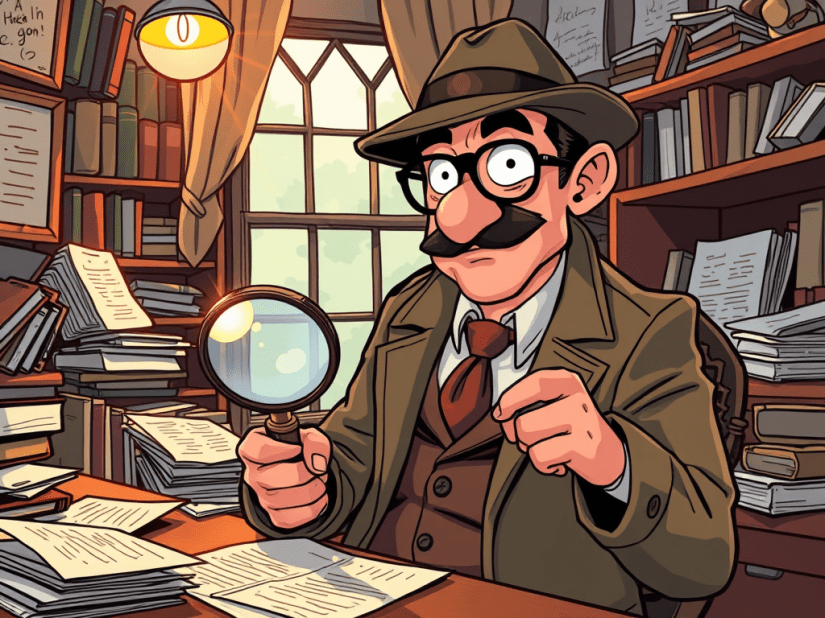
Inspector Septimus Summer-Garden and the Case of the Missing Kangaroo

In the quaint village of Willow, in the suburbs of the city where the most exciting event was the annual pie-eating contest, lived Inspector Septimus Summer-Garden. Known for his peculiar name and even more peculiar methods, Septimus was a detective whose heart was as big as his head was round. Despite his earnest efforts, he often found himself tangled in more confusion than clues. One bright Monday morning, the village awoke to startling news: Mr. Harold Hoppington, the eccentric zoo keeper, had reported that his prized kangaroo, Joey, had vanished without a trace. Joey was not just any kangaroo; he was a celebrity in Willow, known for his cheerful hops and a penchant for wearing tiny bowties.

The village folk gathered nervously as Inspector Summer-Garden arrived at the zoo, tripping over his own feet in the process.

“Ah, yes, the case of the missing kangaroo,” he mumbled, adjusting his oversized hat. “Fear not, citizens! I shall hop right to it.”

First, Septimus examined Joey’s enclosure. The door was securely locked, and there were no signs of forced entry. He squinted at the ground, noticing a trail of tiny footprints leading away from the enclosure.

“Aha! Small footprints,” he exclaimed, pointing dramatically. “This suggests… a very tiny kangaroo, or perhaps… a very big mouse!”

Mrs. Hoppington sighed.

“Inspector, Joey is quite large. Those footprints are tiny.”

Septimus nodded solemnly.

“Indeed, ma’am. Or perhaps a clever thief with tiny shoes! Or… an invisible kangaroo!”

Just then, a faint rustling sound came from behind a nearby bush. Septimus tiptoed over, slipping on a stray banana peel and landing flat on his back. From the bushes, a small, fuzzy creature emerged wearing a miniature bowtie, no less.

It was Joey! The kangaroo was hopping happily, seemingly unbothered. Septimus scrambled to his feet.

“Well, would you look at that? Our missing marsupial was hiding all along!”

Harold Hoppington rushed over, eyes sparkling with relief.

“Joey! You’re safe! But… how did he get out?”

Septimus pondered this as he scratched his head.

“It appears Joey is quite the escape artist. Or perhaps he simply wanted a bit of adventure. Whatever the case, the mystery is solved!”

The townsfolk cheered as Joey was returned to his enclosure, wearing his favorite tiny bowtie with pride. Inspector Summer-Garden, ever the bumbling hero, tipped his hat. “Another case closed, with a hop and a skip!”

And from that day on, the villagers never underestimated the quirky detective, though they did occasionally remind him to watch his step especially around banana peels.

Inspector Septimus Summer-Garden and the Mysterious Case of the Missing Glass Eye


In the fog-laden streets of the city, where shadows danced beneath gas lamps and secrets lurked behind every corner, Inspector Septimus Summer-Garden was known for his keen eye and unyielding determination. His reputation for solving the most perplexing cases had earned him respect, and a hint of suspicion from those who preferred their mysteries unsolved. One chilly morning, as the city awoke to the clatter of traffic and the distant chime of church bells, Inspector Summer-Garden received an unusual summons. Lady Evelyn Hargrave, a renowned philanthropist and collector of curiosities, had reported her prized possession missing: a rare, exquisite glass eye belonging to her late grandfather.

The glass eye was no ordinary artifact. Crafted in Victorian London by a master glassmaker, it was said to possess an otherworldly shimmer, reflecting light like a tiny, enchanted moon. Lady Evelyn claimed she kept it in a velvet-lined box on her mantelpiece, where it was displayed as a treasured family heirloom. When Inspector Summer-Garden arrived at the grand Hargrave estate, he was greeted by Lady Evelyn herself, a tall woman with piercing blue eyes and an air of quiet distress.

“Inspector,” she said softly, “someone took my grandfather’s glass eye. I can’t imagine why anyone would want it, but I fear it’s gone for good.”

The inspector examined the scene meticulously. The mantelpiece was untouched, and there were no signs of forced entry. The box was missing, but nothing else appeared disturbed. The only odd detail was a faint scent of jasmine lingering in the air, a scent not typical of the estate’s usual perfume. Summer-Garden interrogated the household staff, but no one had seen or heard anything unusual. The butler mentioned a strange visitor the night before, a tall man with a limp who asked about the glass eye at the gate, but left when told it was not for sale. The inspector’s sharp eyes caught a small, almost imperceptible clue: a tiny smudge of violet ink on the edge of the mantelpiece, near the spot where the box had sat. It was peculiar, as Lady Evelyn’s desk was nearby, but no ink was spilled there.

Suddenly, a thought struck Inspector Summer-Garden. The violet ink, the jasmine scent, and the visitor all pointed to a peculiar pattern. He recalled an old legend about a secret society called “The Gilded Shadow,” known for their obsession with rare artifacts and their elaborate code of symbols. He questioned a local antique dealer, who revealed that a counterfeit glass eye had recently been circulating, one that was infused with a subtle, invisible ink used for secret messages. With this information, Summer-Garden deduced that the real glass eye had been replaced with a convincing fake. The thief, likely a member of the Gilded Shadow, had lured Lady Evelyn’s servant away with the promise of a rare artifact, then swapped the genuine eye with a replica during the chaos.

In a daring covert operation, the inspector traced the violet ink to a clandestine meeting in a nearby warehouse. There, he uncovered a hidden collection of stolen artifacts, including Lady Evelyn’s genuine glass eye, safely concealed in a velvet-lined box. The thief was caught red-handed, an ambitious collector desperate to complete his own collection of rare curiosities. The real glass eye was returned to Lady Evelyn, who was overjoyed to have her family heirloom back. As the fog rolled in once more over the city, Inspector Summer-Garden reflected on the case. It was not just a theft, but a reminder that even the most beautiful objects could hide dark secrets and that sometimes, the truth was hidden in the smallest details. And so, with a satisfied nod, he disappeared stumbling and bumbling into the mist, ready for his next mysterious adventure.

The Broken Wand and Light of the Spirit

In a realm where magic flowed like the wind, Josiah Wormongdale was once a renowned magician, celebrated for his daring spells and radiant charm. But one fateful night, during a fierce confrontation with a shadowy entity, his beloved wand shattered into splinters. The broken wood lay on the ground, pulsating with dark, swirling energies that threatened to consume him. Josiah’s spirit was undeterred, yet his magic waned as the dark energies grew stronger, wrapping around him like a suffocating shroud. He knew he needed help, something beyond his own power, beyond even the most fantastic enchantments he knew.

In his despair, he recalled tales of Llwd ap Crachan Llwyd, an ancient wizard from the spirit world, renowned for his wisdom and mastery over the balance between light and darkness. Legend said Llwyd’s spirit lingered in the boundary between worlds, waiting for those who sought true understanding. Determined, Josiah called out into the night, summoning the spirit of Llwyd. To his astonishment, a shimmering figure materialised before him, an elderly wizard cloaked in flowing robes woven with starlight, eyes gleaming with ageless wisdom.

“Who dares summon Llwd ap Crachan Llwyd?” the spirit whispered, voice echoing like distant thunder.

“I am Josiah Wormongdale,” Josiah replied, trembling but resolute. “My wand is broken, and dark energies threaten to consume my magic and my soul. I seek your aid.”

Llwyd studied him silently, then nodded.

“A fractured wand is a vessel of imbalance. To mend it, one must understand the darkness that corrupted it and be willing to release it.”

With a gentle wave of his hand, Llwyd extended his spirit-energy toward Josiah’s broken wand. Light poured from the elder’s fingertips, enveloping the shards. As the light touched the dark energies, they writhed and shrieked, trying to cling to the wand’s remnants.

“Let go,” Llwyd urged. “Embrace the light, and release what binds you to darkness.”

Josiah closed his eyes, feeling the weight of his fears and regrets. Slowly, he surrendered his attachment to the dark energies, allowing Llwyd’s luminous power to dissolve them. The darkness dissolved into shimmering particles that drifted away like ash in the wind. Then, Llwyd’s spirit wove his magic into the broken wood, mending the cracks with threads of pure light. The wand shimmered and pulsed with a new, radiant energy, stronger and more balanced than ever before.

“Your path now is clearer,” Llwyd said softly. “Remember, true power lies not in dominance over darkness but in understanding and harmony. Carry this lesson with you.”

With a final nod, Llwyd’s spirit faded into the ether, leaving Josiah holding a restored wand glowing with a gentle, luminous aura. From that day forward, Josiah Wormongdale used his renewed magic to bring light to the darkest corners of the realm, always remembering the elder wizard’s wisdom: that light and dark are but two sides of the same coin, and true mastery is found in balance.

Inspector Septimus Summer-Garden and the Case of the Vanishing Violin

It was a bright, breezy afternoon in the city, and Inspector Summer-Garden was enjoying a rare moment of calm until his trusty assistant, Constable Pipwick, burst into the station, clutching a crumpled piece of paper.

“Inspector! You won’t believe it!” Pipwick panted. “The famous violinist, Madame Viola, has reported her priceless Stradivarius missing!”

Summer-Garden adjusted his glasses, which were slipping down his nose once again. “Missing, you say? Well, that’s quite a musical mystery. Lead the way, Pipwick!”

The inspector and his assistant hurried to the City Concert Hall, where Madame Viola was frantic. She explained that her beloved violin had been stolen during her afternoon rehearsal.

“Everyone was in the hall,” she said, tears in her eyes. “I last saw it on the stand, and now… it’s gone!”

Summer-Garden looked around carefully, squinting through his thick glasses. His near-sightedness made spotting details tricky, but he noticed a faint smudge on the floor near the music stand.

“Hmm,” he muttered, kneeling with a loud thud. “Looks like someone dragged something heavy here.”

Pipwick pointed to a faint trail of footprints leading toward the side door. “Should we follow it, sir?”

“Absolutely,” replied the inspector, trying to steady himself as he tripped over a chair leg.

The footprints led outside into a narrow alley behind the hall. Summer-Garden, nearly tumbling into a pile of crates, followed cautiously. There, he spotted a small, muddy footprint smaller than most adults, and a scrap of torn fabric caught on a rusty nail.

“Ah-ha!” exclaimed Summer-Garden, pointing eagerly. “This fabric matches the coat of… Mr. Whiskers, the hall’s janitor!”

Pipwick looked surprised. “He’s always been very loyal, sir. Do you think he took the violin?”

The inspector nodded thoughtfully, though his glasses slipped again. “Or… maybe he saw something and tried to hide it. Let’s find Mr. Whiskers!”

They found Mr. Whiskers sweeping the back alley, looking nervous. When asked about the torn fabric and footprints, he stammered,

“I… I didn’t do anything! I just found the violin in a box outside the hall and wanted to keep it safe. I was going to return it tomorrow.”

Summer-Garden squinted at the janitor’s coat, noticing a small tear that matched the fabric scrap.

“So, you weren’t stealing it, but you found it outside?”

“Yes, sir,” Mr. Whiskers nodded. “I thought someone had abandoned it.”

Just then, a loud crash echoed from inside the hall. Rushing back, they found Madame Viola’s assistant frantically searching through a pile of discarded costumes. There, hidden beneath a cloak, was the missing violin! It turned out that a mischievous young musician, jealous of Madame Viola’s fame, had stolen the violin to ruin her performance. He’d hidden it in the costume pile, hoping to retrieve it later. Thanks to Inspector Septimus Summer-Garden’s sharp eye, despite his near-sightedness and occasional clumsiness he nearly tripped over a stage prop in the process, the real culprit was caught.

Madame Viola was overjoyed.

“Thank you, Inspector! You’ve saved my concert and my reputation!”

As he made his way back to the station, Summer-Garden chuckled to himself, adjusting his glasses.

“Another mystery solved, with a little help from my trusty eyes and a bit of good old-fashioned clumsiness.”

Pipwick grinned.

“You’re quite the detective, sir!”

With a hearty laugh, the inspector replied,

“It’s all in a day’s work in the city’s annals of crime!”

Inspector Septimus Summer-Garden and the Curious Case of Harry Oppington

In the bustling city, Inspector Septimus Summer-Garden was known for his unwavering dedication, despite his notable clumsiness and near-sightedness. His thick glasses often slipped down his nose, and he frequently tripped over uneven cobblestones or misread street signs, much to the amusement of his colleagues. Yet, his keen intuition and kind heart made him a beloved figure in the police force. One misty Monday morning, Inspector Summer-Garden received a call from Mrs. Beatrice Oppington, Harry’s worried daughter. Harry Oppington, her father, an 82-year-old retired clockmaker, had gone missing the night before. He was last seen leaving his modest cottage on Maple Lane, clutching his beloved pocket watch, and heading toward the town square. Mrs. Oppington explained,

“He was supposed to meet me for tea, but he never arrived. He’s been a bit forgetful lately, but he’d never just disappear like this.”

Inspector Summer-Garden adjusted his glasses and nodded solemnly.

“Don’t worry, ma’am. We’ll find him.”

The inspector set off with his trusty notepad, which he often jotted notes on with a pen that frequently leaked ink. His first stop was Harry’s cottage, where he noticed a few scattered clock parts on the doorstep, a sign that Harry had been tinkering late into the night. Inside, the detective examined Harry’s workshop. Among the clock gears and tiny screws, he spotted a crumpled piece of paper: a torn corner from a newspaper. It depicted an advertisement for the upcoming Brightvale Fair, with a small handwritten note: “Meet me at the fountain at noon.”

“Ah,” muttered Summer-Garden, squinting at the note. “Harry was planning something.” He scribbled in his notebook: ‘Meeting at the town fountain at noon.’

Next, he visited the town square, where the fountain stood tall and proud. There, he observed a small crowd gathered around a street performer. Among them, an elderly man with a distinctive gray cap, Harry, in the flesh!

“Excuse me,” Summer-Garden called out, staggering slightly as he tripped over a cobblestone. “Are you Harry Oppington?”

Harry looked up, startled but smiling. “Yes, that’s me. I got a bit lost.”

The inspector chuckled, adjusting his glasses. “Mrs. Oppington was worried sick. What were you doing here?”

Harry explained that he’d gone to meet a young clockmaker who had promised to show him a rare antique watch at the fair. But Harry had forgotten the time and gotten turned around. Just then, a commotion arose nearby, someone had lost a small satchel containing valuable jewelry. Harry, noticing the commotion, instinctively pointed toward a suspicious-looking individual trying to slip away.

“Look, that man over there! He’s acting suspiciously,” Harry exclaimed.

Summer-Garden, despite nearly knocking over a passing vendor, managed to catch up and gently confront the suspect. It turned out to be a petty thief who had snatched the jewelry. Thanks to Harry’s sharp eye and despite his forgetfulness, the culprit was apprehended. With Harry safely back in his daughter’s arms and the thief in custody, Inspector Summer-Garden felt a warm glow of satisfaction. His clumsiness had inadvertently played a part in solving the case, and his near-sightedness had helped him focus on the little details others might overlook. As he made his way back to the station, he chuckled to himself, adjusting his glasses.

“Another case closed, with a little help from an old clockmaker and a bit of luck.”

Mrs. Oppington later baked him a batch of his favorite scones as a thank-you. Inspector Summer-Garden, ever the humble hero, simply tipped his hat and smiled.