J.R.R. Tolkien

J.R.R. Tolkien, full name John Ronald Reuel Tolkien, was an English writer, poet, philologist, and university professor, best known as the author of the high fantasy works “The Hobbit,” “The Lord of the Rings,” and “The Silmarillion.” Tolkien was born on January 3, 1892, in Bloemfontein, Orange Free State (modern-day South Africa). He moved to England with his mother and brother after his father’s death when he was three years old. As a child, Tolkien showed an early interest in languages and storytelling, creating his own languages and fantasy stories.

He studied at Exeter College, Oxford, where he specialised in philology and Old and Middle English. Later, he became an Anglo-Saxon professor at Oxford University and then the Merton Professor of English Language and Literature. Tolkien’s first significant work was “The Hobbit,” published in 1937. It introduced readers to the world of Middle-earth and the character of Bilbo Baggins. He followed up with “The Lord of the Rings,” a sequel to “The Hobbit,” published in three volumes between 1954 and 1955. Tolkien’s works are renowned for their detailed world-building, complex characters, and rich mythology. His works have profoundly influenced fantasy and garnered a massive following worldwide. “The Lord of the Rings” has been adapted into successful films directed by Peter Jackson, further popularizing Tolkien’s work. Tolkien passed away on September 2, 1973, in Bournemouth, England, leaving behind a rich literary legacy that inspires readers and writers today. His impact on literature and popular culture is significant, and his works are considered classics in the fantasy genre. 

Image by AI
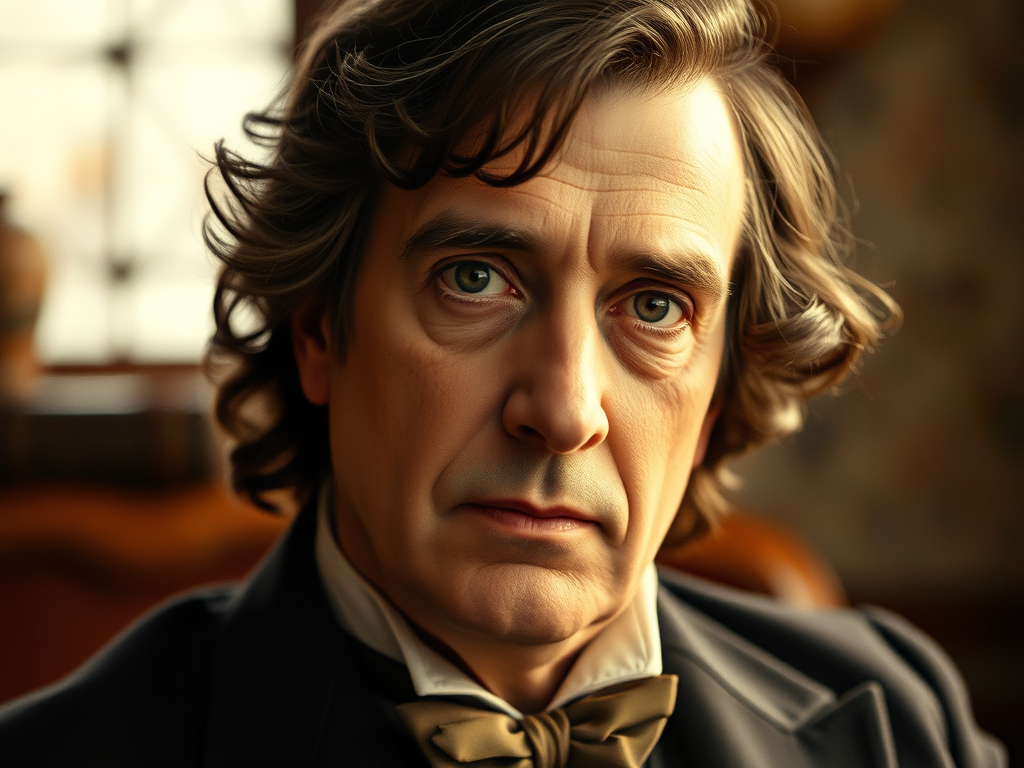
Oscar Wilde

Oscar Wilde, born on October 16, 1854, in Dublin, Ireland, was a prominent playwright, poet, and author in the late 19th century. Known for his wit, flamboyant style, and sharp satire, Wilde became one of the most successful playwrights of his time. His notable works include “The Picture of Dorian Gray,” his only novel, as well as plays such as “Lady Windermere’s Fan,” “A Woman of No Importance,” “An Ideal Husband,” and his most famous play, “The Importance of Being Earnest.”

Despite his literary success, Wilde is remembered for his tumultuous personal life. He was known for his flamboyant dress and extravagant lifestyle, as well as his involvement in a scandal that led to his imprisonment. In 1895, Wilde was put on trial for “gross indecency” due to his homosexual relationships, which were illegal at the time in England. He was found guilty and sentenced to two years of hard labour. After his release from prison, Wilde lived in exile in France, where he wrote less and struggled financially. Oscar Wilde died on November 30, 1900, aged 46, in Paris, France. Despite the challenges he faced in his later years, Wilde’s works continue to be celebrated for their wit, humour, and social commentary, and he remains an iconic figure in literature and LGBTQ+ history.

Image by AI

Charles Dickens

The renowned English novelist Charles Dickens was born on February 7, 1812, in Portsmouth, England. He was one of the most popular and influential writers of the 19th century, known for his vivid characters and depiction of social issues in Victorian England. Dickens’ childhood was marked by financial struggles as his family faced poverty and debt. At the age of 12, he was forced to work in a factory to support his family after his father was imprisoned for debt. These early experiences profoundly influenced his later writings, as themes of poverty, social injustice, and the plight of the working class are prevalent in many of his novels.

Dickens began his writing career as a journalist and soon found success writing serialized novels. Some of his most famous works include “Oliver Twist,” “David Copperfield,” “A Christmas Carol,” “Great Expectations,” and “A Tale of Two Cities.” His works often featured colourful characters, intricate plots, and a keen eye for social commentary. Dickens was a prolific writer and a tireless social reformer. He advocated for better conditions for the poor and marginalized in society. His writing shed light on the injustices of his time and called for social change.

Charles Dickens passed away on June 9, 1870, leaving behind a rich literary legacy that continues to be celebrated and studied. His works remain popular and have been adapted into numerous films, plays, and other forms of media, ensuring that his influence endures in the world of literature. 

Image by AI

John Dee

John Dee, a prominent figure in the Elizabethan era and a fascinating polymath, was known for his wide range of interests and pursuits that spanned mathematics, astronomy, astrology, and the occult. His work and writings have captured the imagination of scholars and enthusiasts for centuries, offering a glimpse into the intellectual landscape of the Renaissance period. While John Dee is most well-known for his contributions to mathematics and his role as an advisor to Queen Elizabeth I, he also delved into the realms of esoteric knowledge and mysticism. Dee’s interests in the occult and the metaphysical were deeply intertwined with his scientific inquiries, leading him to explore the boundaries between the material world and the spiritual realms.

Eschatology, the study of the End of Times or the ultimate destiny of humanity, was a topic that intrigued Dee, as it did many thinkers of his time who grappled with questions about the nature of existence and the fate of the world. While Dee did not have a single, well-defined theory on the End of Times, his esoteric pursuits and spiritual beliefs likely influenced his thoughts on the subject. In his quest for knowledge and understanding, Dee engaged in practices such as scrying, divination or seeking visions through a crystal ball or other reflective surfaces, and communication with spiritual beings. These activities were part of his broader exploration of the hidden forces and dimensions that he believed shaped the universe and human destiny.

In interpreting Dee’s writings and works, scholars have uncovered layers of symbolism, allegory, and hidden meanings that reveal his complex worldview and philosophical outlook. His involvement in the occult and his interactions with spiritual entities have added a mystical dimension to his legacy, inviting speculation and curiosity about his beliefs regarding eschatology and the End of Times. To understand John Dee’s thoughts on the End of Times, one must consider his writings, such as his journals, letters, and treatises on subjects ranging from mathematics to alchemy to angelic communication. By exploring the intersections of science, mysticism, and spirituality in Dee’s work, one can unravel the enigmatic tapestry of his intellectual pursuits and potentially glimpse his reflections on the ultimate fate of humanity and the cosmos.

Image by AI

Rudyard Kipling

Rudyard Kipling was a renowned British author and poet who was born on December 30, 1865, in Bombay, India. He is best known for his fiction, including “The Jungle Book,” “Kim,” and “Just So Stories.”

Kipling spent his early childhood in India, where his father worked as a museum director and an art teacher. However, he was sent to England at six to receive his formal education. His time in England was marked by harsh treatment at the hands of his foster family, which left a lasting impact on him. Kipling worked as a journalist and writer in his adult life, producing poetry and short stories that often drew upon his experiences in India. His writing was known for its vivid descriptions of life in the British Empire and its exploration of themes such as colonialism, the relationship between the colonizer and the colonized, and the clash of cultures.

Kipling was awarded the Nobel Prize in Literature in 1907, becoming the first English-language writer to receive this honour. Despite his literary success, Kipling faced criticism for his views on imperialism and his perceived support for British colonialism. Rudyard Kipling died on January 18, 1936, in London, England. His work continues to be studied and admired for its rich storytelling, evocative language, and exploration of complex themes.

Image by AI