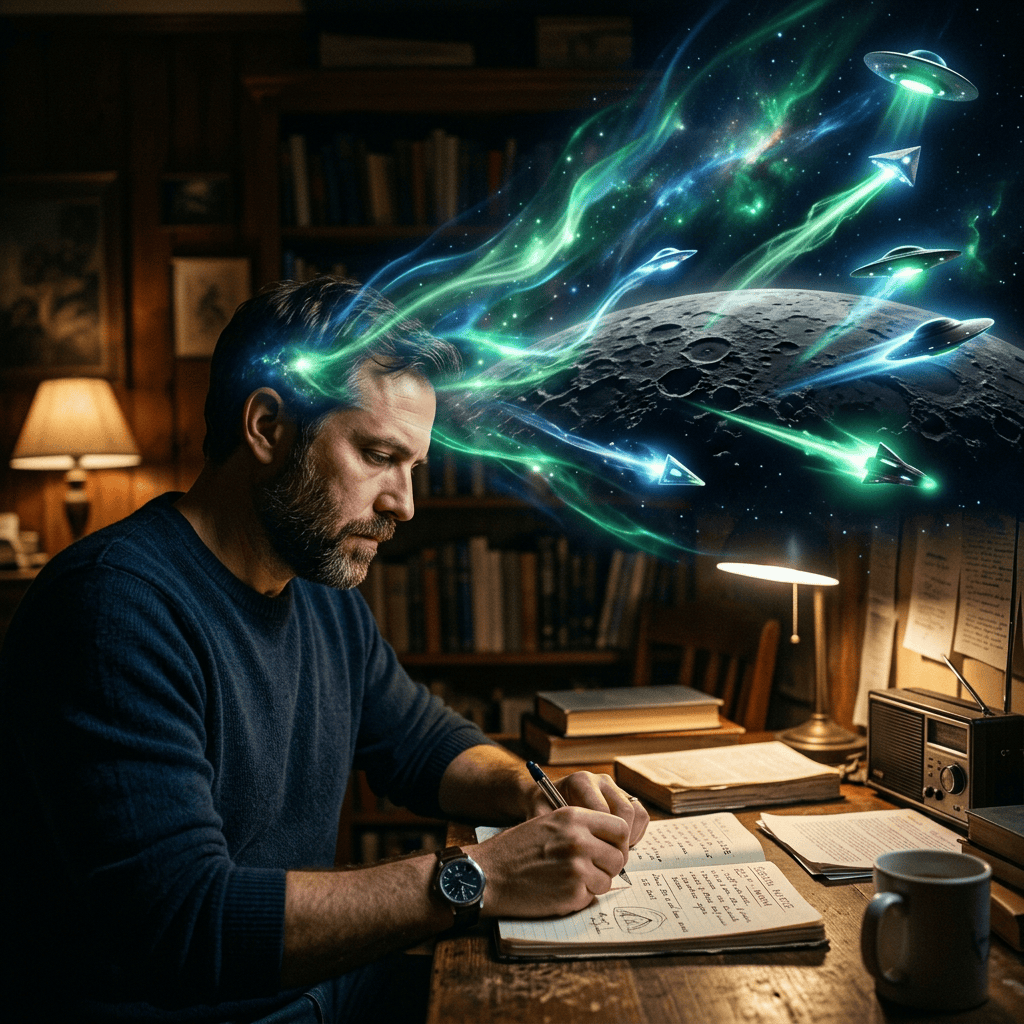
Mara Vell learned to keep his voice steady even when the pictures came wrong. He wasn’t a scientist, not in the usual way. He was something else, someone who could sit with his eyes closed, breathe until the noise in his mind thinned, and then ‘see’. Not imagination. Not dreams. It felt more like catching a transmission that had been waiting a long time for the right receiver. The work was called remote viewing, though no name ever made it sound ordinary enough to justify the way it changed people. Therapists called it delving. Agencies called it intelligence. Mara called it listening. And on one particular night, the assignment was simple:
The far side of the Moon. The dark side. Observe atmosphere, structures, any sign of activity.
He sat in his chair with a blindfold loosely tied, headphones playing nothing but a faint, clinical hum. Outside the house, the city kept doing what cities do; sirens, distant laughter, the persistent glow of streetlights. Mara ignored all of it. When the signal arrived, it did not arrive as a landscape. It arrived as pressure.
Cold weight pressed at the back of his throat, as if the air itself were thick with distance. Then the darkness resolved, not into space the way cameras showed it, but into something living — black velvet cut by sharp, angular shadows. Mara Vell felt the curvature of the Moon like a hand around his chest.
Craters opened in his awareness the way wounds do — deep, jagged, ancient.
At first, he saw nothing but stone.
Then the stone began to speak.
Not in words — nothing so merciful — but in patterns.
The crater edges weren’t random. Their rims carried repeating geometries, like someone had drawn a blueprint and the impact only partially erased it. Lines, subtle at first, then clearer: terraces. Scalloped ledges. Deep channels seemingly too purposeful to be the Moon’s natural scars. Mara tried to focus on the center of one crater, a vast bowl swallowing light.
And that was when he felt the air.
Not a thin honesty of vacuum. Not an absence cameras could measure.
This was different: a presence. A surrounding medium holding shape. It wrapped around the crater akin to a transparent skin, faintly resisting the motion of his attention. Mara could sense it in layers, as if the Moon didn’t merely have atmosphere but managed it — regulated, buffered, directed.
His breath hitched.
He’d expected myths. He hadn’t expected maintenance.
Then the lights came.
At first they were just glimmers, soft pulses in the dark, green as moss under moonlight and blue like the underside of lightning. They didn’t illuminate the terrain the way a flashlight would. They threaded through it. The light behaved like a language, arriving in short bursts that repeated with a rhythm too consistent to be stray radiation. Mara followed the green pulses and found they traced the same corridors the crater terraces implied. The blue pulses ran perpendicular, crossing them like seams in fabric.
Between the pulses, there were moments of silence so precise they felt engineered.
He tried to step closer, to see more!
The moment he shifted his viewpoint, the entire scene changed — not dramatically, not with fireworks, but with a kind of acknowledgment. His attention met resistance again, and then a new overlay of sensation flooded in.
He saw movement.
Not the slow drift of orbital debris. Not the hesitant creep of dust. This was purposeful motion: craft sliding across the Moon’s surface as if the gravity were a suggestion and friction merely a rumour. They appeared, aligned to the craters and channels, paused as if taking readings, and then without the drama of departure, folded into darkness. One craft moved near a crater rim where the geometry was most intact. It hung for a beat too long. Mara sensed it wasn’t simply observing the surface; it was scanning something embedded under it. As if the Moon were a living system and the craft were checking organs.
Mara watched several of them pass, some sleek and angular, others more rounded, like forms designed to minimise turbulence in a medium felt but unnamed. He couldn’t see pilots the way humans would. The craft felt occupied in the way a station feels occupied, by function, by intention, by the certainty of purpose.
Mara’s stomach tightened. He wasn’t watching a ship that visited. He was watching a place that hosted. When the transmissions, his perceptions, began to drift again, Mara attempted something he wasn’t sure he was allowed to do. He reached for the most dangerous question.
Who lives here?
The moment he asked it, the dark side didn’t just show him objects. It showed him proximity. A presence pressed toward his awareness like a door opening quietly down the hall. Not threatening. Not kind.
Just inevitable.
He saw structures, not only crater-based. Beyond the surface geometry, deeper than stone: layered volumes, luminous interiors where green and blue light didn’t just emanate but flowed. The light was organized, guided along architecture that curved in impossible ways, as if designed for minds that didn’t think in straight lines.
Then briefly something like a boundary appeared. Not a wall, not a barrier meant to keep something out, but a threshold meant to keep something inside context. Like a membrane adjusting perception. Mara understood, without being told, that the Moon’s atmosphere wasn’t a casual fact. It was a shield. And if humans had ever tried to truly settle there, the shield would respond. Not with explosions. With rules. With conditions turning human engineering into fragile fiction.
The message came in images and sensations:
A far side full of structures.
Lights that marked routes.
Craft that moved on schedule.
A maintained atmosphere that did not tolerate outsiders as if outsider were a category of danger.
Mara felt the shape of the answer to a question people had whispered since the first rockets clawed Earth’s sky:
Why is lunar exploration so stubbornly limited? Why doesn’t habitation scale up cleanly? Why do so many efforts arrive at the edge of progress and then… stall, shift, or fracture?
It wasn’t just geology or politics.
It was presence.
It was guardianship.
And then came the most unsettling part.
The sense of being watched wasn’t like paranoia. It was more like realising you’ve been living in a building with windows, and you just now noticed the lights in the next room have always been on.
Mara’s attention brushed across the boundary again, and he felt the watchers not as invaders, but as caretakers who understood the value of distance. They were studying the planet the way humans study oceans: with curiosity, with instrumentation, with the patience of beings who can afford years.
And almost gently, he felt something else.
A relationship.
Not a friendship. Not hostility.
An arrangement.
The Moon wasn’t merely a location. It was a listening post, a mirror, a nearer-than-near coordinate point to whatever lived beyond.
Mara’s mind tried to translate the idea into something human, but human language couldn’t hold it. Still, the meaning settled in him like dust after a door opens.
Our creators are nearer than we think.
When the viewing finally ended, Mara’s hands shook as he removed the blindfold. The room felt too bright, too thinly populated by the kind of cosmic seriousness he’d just glimpsed. He looked at the clock. Minutes passed. His body had stayed in its chair, but something inside him had travelled further than any rocket could afford. In the days following, he couldn’t stop thinking about the phrase that kept arriving in fragments as if his mind were struggling to hold it without breaking:
Painful cry.
Not a metaphor. Not poetry.
A signal, something like a wound in space, a radiating frequency leaking from Earth into the larger dark. Mara had the uncomfortable intuition, whatever lived on the Moon, whatever lived under it, in it, or through it, wasn’t only watching.
It was hearing.
And perhaps Earth, in its violence and noise, had been broadcasting a distress pattern for a long time without understanding it. Not only war. Not only disaster. Everything humans did that left a signature: radiation pulses, electromagnetic churn, the subtle changes in atmosphere, the growing heat, the frantic broadcasts of a species trying to be heard. He began to wonder whether the calls humans called normal were, to others, the sounds of a young civilization in pain, loud in the way a fever is loud.
When he finally decided to report what he saw, he didn’t make a grand announcement. He wrote it down privately, carefully, like a person pinning a fragile specimen to a page. Including the details he could verify as patterns: green and blue light frequencies, the crater structures that looked too regular, the sense of atmosphere as layered presence, the craft movement that felt scheduled.
Then, in his final paragraph, he wrote the line that made his pen feel heavier:
If we reach for the Moon as if it’s empty, we will find a world that is neither dead nor ours. He expected disbelief. He expected ridicule. He expected that the story would dissolve in the mouths of people who needed certainty more than truth.
Instead, what happened was stranger.
Silence.
Not the silence of disagreement, the silence of people who had heard something before, somewhere in their own private investigations, and recognised it as the kind of knowledge that makes institutions uncomfortable. People asked questions, but they asked them quietly. They offered interviews and then cancelled. They requested “more data” without ever specifying what kind.
Mara realised, with a clarity that felt like falling, he wasn’t being ignored.
He was being ‘managed’.
And far away, too far to see, too near to forget, the dark side of the Moon continued to glow in green and blue, tracing its tidy corridors and letting craft move on and off the surface like punctuation in a language older than human maps.
Earth carried on.
Ships launched and missions planned. Scientists measured and engineers dreamed. Politicians argued. People fell in love. People fought. People forgot.
But Mara couldn’t.
Because once you’ve heard a presence listening, you start to notice how the universe listens back. And somewhere, beneath the Moon’s structured craters, beyond a boundary made of atmosphere and intention, the watchers kept watching, while Earth’s painful cry, radiating outward across the universe, travelled through the dark like a message which could not be unread.


