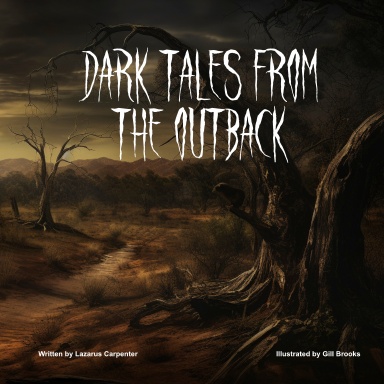
Dark Tales from the Outback – Abstract

Kaya

Once, in the remote Australian outback, there lived an aborigine named Kaya. He was a skilled tracker and hunter who roamed the vast, desolate lands with an air of quiet confidence. Kaya had always felt a deep connection to the spirits of the land, and his people often spoke of the ancient stories that warned of the dangers lurking in the wilderness. One moonless night, Kaya set out on a hunting expedition, guided only by the faint glow of the stars. His senses were sharp, and he moved through the rugged terrain with the ease of a shadow.

As he ventured deeper into the heart of the outback, a strange unease settled over him. The usual sounds of the night were absent, and an eerie silence enveloped the land. Suddenly, a piercing scream shattered the stillness, causing Kaya to halt in his tracks. The hair on the back of his neck stood on end as he tried to locate the source of the chilling cry. Following the sound, he stumbled upon a clearing where he saw a lone kangaroo, its eyes wide with terror as it desperately tried to escape an unseen force.

Kaya watched in horror as the kangaroo was dragged into the darkness by an unseen entity, its screams fading into the night. The aborigine felt a chill run down his spine, for he knew that the spirit world held many dark and malevolent forces. He knew he had stumbled upon something sinister, something beyond his understanding. Determined to uncover the truth, Kaya embarked on a quest to seek guidance from the wise elders of his tribe.

They revealed to him the ancient legend of a vengeful spirit unleashed upon the land, seeking to wreak havoc on the living. The elders warned Kaya that the spirit had become a monstrous kangaroo driven by an insatiable thirst for blood. Armed with the knowledge passed down by his ancestors, Kaya set out to confront the malevolent spirit. Armed with ancient symbols and blessed talismans, he ventured back into the wilderness. As he delved deeper into the treacherous terrain, the air grew thick with an otherworldly presence, and the ground seemed to tremble beneath his feet.

Finally, he came face to face with the monstrous kangaroo, its eyes glowing with an unholy light. The creature lunged at Kaya with supernatural speed and ferocity, but the aborigine stood his ground, wielding the protective symbols and chanting the sacred incantations. A fierce battle ensued as Kaya fought to banish the vengeful spirit from the mortal realm. The very fabric of reality seemed to warp and twist around them, and the night itself seemed to hold its breath as the two clashed in a struggle that transcended the physical world. In the end, with a final burst of mystical energy, Kaya managed to seal the spirit away, restoring peace to the land.

As the first light of dawn broke over the horizon, the outback was once again filled with the sounds of life, and Kaya knew he had fulfilled his duty as a guardian of his people. From that day on, the legend of Kaya and the malevolent kangaroo spirit became a cautionary tale, a reminder of the ancient forces that still linger in the world’s wild places. And though the memory of that fateful encounter would always haunt him, Kaya continued to roam the outback with a newfound sense of purpose and a deep respect for the land’s mysteries.

Over time, Kaya’s reputation as a protector and a keeper of ancient wisdom spread far and wide, and he became a revered figure among his people. Years passed, and Kaya’s hair turned grey, but his spirit remained unyielding. He passed down the knowledge he had gained to the younger generations, teaching them to honour the delicate balance between the physical and spiritual realms. His story became a part of the oral tradition, woven into the tapestry of his people’s history as a testament to the enduring power of courage and wisdom.

As the seasons changed and the land continued to whisper its secrets, Kaya’s name became synonymous with resilience and reverence for the natural world. His legacy endured, and the memory of his heroic encounter with the malevolent kangaroo spirit lived on as a reminder of the dangers hidden in the outback’s heart. The tale of Kaya and the vengeful spirit served as a timeless lesson, teaching the importance of humility and the need to safeguard the delicate harmony between humanity and the ancient forces that dwelled in the shadows. It became a parable of the enduring strength of the human spirit and the profound connection that binds all living things.

And so, in the vast expanse of the Australian outback, Kaya’s story echoed through the ages, a testament to the enduring power of the human spirit in the face of the unknown. And though the world continued to change, the legend of Kaya and the malevolent kangaroo spirit remained etched in the very fabric of the land, a testament to the enduring legacy of a humble aborigine who had stood against the darkness and triumphed.


Kingdom of the Trees – Abstract

Once upon a time, deep within a Kingdom of Trees, the Queen watched her daughter, the Princess, playing in the castle garden.  A warm sun shone across the princess’s golden hair, causing it to glisten and casting beams of sunlight into the shadows. The Princess was around nine years old now, and for her entire short life, she had grown up watching her mother, the Queen, rule the Kingdom of Trees wisely, kindly, and with good humour. She had known nothing but love from her mother, the Queen. After all, there had never been a King of the Kingdom of Trees. The Princess had never known a King. 

Every day, the Queen taught the Princess everything she knew, knowing that one day, the little Princess would grow into a queen herself. So, like all little princesses, especially those of such a young age, she had many difficulties understanding some of the things that went on in the castle. She played with a diablo while the Queen looked on, blinking in the bright sunlight.  The Princess tossed the spinning top and jumped high to catch it.  Her mother thought as she watched, it seemed the Princess had grown up but she knew she was really still a little girl.  The little Princess often pretended to be a queen, and everybody laughed at her jokes and antics; even the Queen smiled.

But the Kingdom of Trees made many demands upon the Queen, and the little Princess did not know or even understand this as she was far too young.  The biggest problem the Queen experienced was the loneliness she felt. She often wondered what it may be like to rule the Kingdom of Trees with a king when the Princess was fast asleep in her bed.  There had been several suitors from the neighbouring kingdoms for the Queen’s hand in previous years; however, the Queen had always said “No”.  She had always said ‘she had no time for such nonsense as she had a daughter to raise and a Kingdom to rule’.  But that was then, and this is now.

As the Queen watched the Princess replace the Diablo with a hula hoop, she thought she and the Princess did everything together.  The Princess laughed as the hoop spun up and down her body, faster and faster it went.  For a long time now, the Queen had very little time to herself, assisting other families, taking holidays with the Princess, seeing to affairs of state relating to the Kingdom of Trees, and the Princess took a part in everything.  But the time was approaching when they would need to do things separately and perhaps even spend time apart. The Queen appreciated the Princess knew this; she also knew that she was worried about it as well.  But they had not really talked about it, although there had been times when they discussed such things, and the little Princess had shown she was very upset at the mere idea.  The Queen knew this because although the Princess didn’t say much, she did have a habit of licking her bottom lip when she was worried.

The Queen had decided whilst watching the Princess hula hooping, to visit Professor Knowitallicus the Wizard.  He was a wise old man and would know what should be done. But she wondered if she should take the Princess with her.  She decided she would and they would both go after lunch.  The Queen sent a messenger to Knowitallicus to let him know to expect a Royal visit that very day.

Shel Silverstein

Shel Silverstein was an American poet, songwriter, cartoonist, and author best known for his children’s books and whimsical poetry. He was born on September 25, 1930, in Chicago, Illinois, and showed an early interest in art and writing. Silverstein attended the School of the Art Institute of Chicago and began his career as a cartoonist, contributing to magazines like “Playboy.”

His most famous works include “The Giving Tree,” “Where the Sidewalk Ends,” and “A Light in the Attic.” These books are celebrated for their playful language, imaginative illustrations, and underlying themes of love, loss, and the joys of childhood.

In addition to his children’s literature, Silverstein wrote songs for notable artists, including “A Boy Named Sue,” famously performed by Johnny Cash. His unique style and ability to connect with children and adults have left a lasting legacy.

Shel Silverstein passed away on May 10, 1999, but his work continues to be cherished by readers of all ages. His blend of humour, insight, and profound simplicity makes his poetry and stories timeless. 

Harold – the man who was always late!

Once upon a time, in a quaint little town, there lived a man named Harold who had a peculiar talent for being late. No matter the occasion—birthdays, weddings, or important meetings—Harold always seemed to arrive just after the moment had passed. Friends and family often joked that he was on a different schedule, one that ticked a little slower than everyone else’s. As a child, Harold’s tardiness was endearing. His parents would chuckle as he stumbled into the classroom, breathless and flushed, always missing the morning bell by a few minutes. In his teenage years, he was perpetually late for dates, leaving girls waiting with a mix of exasperation and amusement. “Better late than never,” he would say with a sheepish grin, and somehow, they never held it against him for long.

As an adult, Harold’s reputation only grew. He missed job interviews and deadlines, and his friends learned to adjust their plans around him. “Let’s just tell Harold an hour earlier,” they would whisper, a strategy that often backfired when he still managed to arrive late. Yet, despite the frustration he caused, his charm and good-natured spirit kept him surrounded by loved ones. One day, Harold received news that he had a serious illness. Determined to live life to the fullest, he decided to throw a party to celebrate his life. He meticulously planned every detail, inviting everyone he had ever known. But, true to form, he miscalculated the time it would take to prepare. The party was supposed to start at 4 PM, but he arrived at 5:30, just as the last guests were leaving.

“Harold, we were just about to leave!” they exclaimed, laughing at the irony.

But Harold, ever the optimist, simply shrugged and said,

“Well, at least I made it for the cake!”

And they all stayed a little longer, sharing stories and laughter, grateful for the time they had. Months passed, and Harold’s condition worsened. He was in and out of the hospital, but even there, he was late for his own treatments. The nurses would chuckle, “We’ve got to set an alarm for you, Harold!” He would laugh along, making friends with everyone he met, turning each medical appointment into a lighthearted gathering. Finally, the day came when Harold’s time came to an end. He passed away quietly, leaving behind a legacy of laughter and love. When the day of his funeral arrived, friends and family gathered in the church, reminiscing about their favourite Harold stories. But true to form, Harold was late even for this final event. As the clock ticked on, people began to murmur. Just then, the church doors swung open with a loud creak, and Harold, or rather, his spirit, walked in. He floated in, grinning widely as if he had just walked in from a party.

“Sorry I’m late!” he shouted, and laughter erupted in the sombre room.

At that moment, everyone understood that Harold had never indeed been late. He had always arrived just when he was meant to, filling every moment with joy, love, and laughter. And so, they celebrated his life and the wonderful chaos he brought into theirs, proving that sometimes, being late is the best way to make a grand entrance.

Image by http://www.gillsplace.com

Emily Dickinson

Emily Dickinson was an American poet who lived from December 10, 1830, to May 15, 1886. She is now considered one of the most important and influential American poets of the 19th century. Dickinson was born in Amherst, Massachusetts, and spent most of her life there. Emily Dickinson was known for her reclusive lifestyle. She spent most of her adult life in seclusion, rarely leaving her home. Despite this seclusion, she maintained a lively correspondence with friends and family through letters. Only a handful of her poems were published during her lifetime, and it was not until after her death that her poetry gained recognition.

Dickinson’s poetry is characterized by its unique style, use of punctuation, and unconventional capitalization. She wrote about various themes, including nature, love, death, and immortality. Her poems are known for their brevity and depth of emotion. Dickinson’s work often explores themes of mortality, spirituality, and the nature of existence. Emily Dickinson’s poetry has had a lasting impact on American literature. Her innovative style and exploration of complex themes have inspired generations of poets and readers. Her work has been studied and celebrated for its originality, wit, and emotional depth.

After her death, Dickinson’s poems were discovered by her sister, Lavinia, and were published posthumously. The first collection of her poetry was published in 1890. Since then, her work has been widely anthologized and studied in academic settings. Emily Dickinson is now considered one of the most important poets in American literary history. Her poems continue to be studied and admired for their insight, beauty, and emotional power. She is seen as a pioneer of modern poetry and a voice that continues to resonate with readers around the world. Emily Dickinson’s life and work have left a lasting impact on the world of poetry, and she remains a highly regarded and influential figure in American literature.

Image by AI