Harold – the man who was always late!

Once upon a time, in a quaint little town, there lived a man named Harold who had a peculiar talent for being late. No matter the occasion—birthdays, weddings, or important meetings—Harold always seemed to arrive just after the moment had passed. Friends and family often joked that he was on a different schedule, one that ticked a little slower than everyone else’s. As a child, Harold’s tardiness was endearing. His parents would chuckle as he stumbled into the classroom, breathless and flushed, always missing the morning bell by a few minutes. In his teenage years, he was perpetually late for dates, leaving girls waiting with a mix of exasperation and amusement. “Better late than never,” he would say with a sheepish grin, and somehow, they never held it against him for long.

As an adult, Harold’s reputation only grew. He missed job interviews and deadlines, and his friends learned to adjust their plans around him. “Let’s just tell Harold an hour earlier,” they would whisper, a strategy that often backfired when he still managed to arrive late. Yet, despite the frustration he caused, his charm and good-natured spirit kept him surrounded by loved ones. One day, Harold received news that he had a serious illness. Determined to live life to the fullest, he decided to throw a party to celebrate his life. He meticulously planned every detail, inviting everyone he had ever known. But, true to form, he miscalculated the time it would take to prepare. The party was supposed to start at 4 PM, but he arrived at 5:30, just as the last guests were leaving.

“Harold, we were just about to leave!” they exclaimed, laughing at the irony.

But Harold, ever the optimist, simply shrugged and said,

“Well, at least I made it for the cake!”

And they all stayed a little longer, sharing stories and laughter, grateful for the time they had. Months passed, and Harold’s condition worsened. He was in and out of the hospital, but even there, he was late for his own treatments. The nurses would chuckle, “We’ve got to set an alarm for you, Harold!” He would laugh along, making friends with everyone he met, turning each medical appointment into a lighthearted gathering. Finally, the day came when Harold’s time came to an end. He passed away quietly, leaving behind a legacy of laughter and love. When the day of his funeral arrived, friends and family gathered in the church, reminiscing about their favourite Harold stories. But true to form, Harold was late even for this final event. As the clock ticked on, people began to murmur. Just then, the church doors swung open with a loud creak, and Harold, or rather, his spirit, walked in. He floated in, grinning widely as if he had just walked in from a party.

“Sorry I’m late!” he shouted, and laughter erupted in the sombre room.

At that moment, everyone understood that Harold had never indeed been late. He had always arrived just when he was meant to, filling every moment with joy, love, and laughter. And so, they celebrated his life and the wonderful chaos he brought into theirs, proving that sometimes, being late is the best way to make a grand entrance.

Image by http://www.gillsplace.com

Emily Dickinson

Emily Dickinson was an American poet who lived from December 10, 1830, to May 15, 1886. She is now considered one of the most important and influential American poets of the 19th century. Dickinson was born in Amherst, Massachusetts, and spent most of her life there. Emily Dickinson was known for her reclusive lifestyle. She spent most of her adult life in seclusion, rarely leaving her home. Despite this seclusion, she maintained a lively correspondence with friends and family through letters. Only a handful of her poems were published during her lifetime, and it was not until after her death that her poetry gained recognition.

Dickinson’s poetry is characterized by its unique style, use of punctuation, and unconventional capitalization. She wrote about various themes, including nature, love, death, and immortality. Her poems are known for their brevity and depth of emotion. Dickinson’s work often explores themes of mortality, spirituality, and the nature of existence. Emily Dickinson’s poetry has had a lasting impact on American literature. Her innovative style and exploration of complex themes have inspired generations of poets and readers. Her work has been studied and celebrated for its originality, wit, and emotional depth.

After her death, Dickinson’s poems were discovered by her sister, Lavinia, and were published posthumously. The first collection of her poetry was published in 1890. Since then, her work has been widely anthologized and studied in academic settings. Emily Dickinson is now considered one of the most important poets in American literary history. Her poems continue to be studied and admired for their insight, beauty, and emotional power. She is seen as a pioneer of modern poetry and a voice that continues to resonate with readers around the world. Emily Dickinson’s life and work have left a lasting impact on the world of poetry, and she remains a highly regarded and influential figure in American literature.

Image by AI

The Rope

On a frigid day near the summit of K2, four climbers—Anna, Marco, Sarah, and Tom—were making their ascent up a perilous icy wall. The air was thin, and the biting wind howled around them, but their spirits were high. They had trained for months and were determined to conquer the mountain. As they neared a treacherous overhang, Anna, the most experienced of the group, led the way. Suddenly, her foot slipped on a patch of ice, sending her tumbling backwards. In a split second, her fall yanked on the ropes, pulling Marco and Sarah off balance. They all dangled precariously, suspended in the deadly expanse between the rock face and the abyss below. Panic erupted as Tom, the last climber, struggled to maintain his grip. He could feel the strain on the ropes intensifying, threatening to snap under the weight of three climbers. They had trained for moments like this, but nothing could prepare them for the gut-wrenching decision they now faced.

“Tom! You have to cut the rope!” Marco shouted, his voice strained. “It’s the only way to save yourself!”

“No!” Anna cried, her voice filled with desperation. “There must be another way! We can hold on!”

But they all knew the truth. The ropes were fraying, and the longer they stayed suspended, the less chance anyone would survive. Tom’s heart raced. He looked at each of his friends, seeing the fear and determination in their eyes.

“We can’t all make it!” Sarah shouted, tears streaming down her face. “You have to choose!”

The weight of the decision crushed Tom. He felt the cold metal of the knife in his hand, heavy with the burden of choice. He looked at Anna, who had always been his mentor and friend. Then at Marco, whose laughter echoed in his memories, and finally at Sarah, whose dreams of reaching the summit were so close yet now so distant.

“Please, Tom!” Marco urged. “Save yourself!”

At that moment, Tom realized their bonds were deeper than the ropes that bound them. He took a breath, fighting back tears.

“I can’t do it,” he said, trembling. “I can’t choose.”

But the mountain was unforgiving. With the rope straining and their dire situation growing, Tom knew he had to act.

“I’ll cut the rope,” he said finally, his voice resolute yet sorrowful.

He reached for Anna’s rope first, knowing she had the best chance of making it to safety.

“Tom, no!” Anna screamed, but he pressed on, his heart breaking as he made the cut.

With a final cry, the rope fell away, and Anna disappeared from view. In a moment of silence, the remaining three felt the weight lift. Tom had chosen to save the two who remained. He secured the remaining rope and pulled Marco and Sarah up to safety, his heart heavy with grief. As they reached the summit, the wind howled in mourning. Tom looked out over the vast expanse, the beauty of the world below overshadowed by the loss of his friend. They had conquered K2, but at a cost that would haunt him forever. In the years that followed, Tom would climb again, but he would always carry the memory of that day—the day he had to choose life and let go, a choice that would forever define him. 

Elian and the Wolf

Once upon a time, in a tranquil village nestled between towering mountains and lush forests, there lived a humble man named Elian. Known for his kindness, Elian spent his days tending to his small farm and helping his neighbours. However, he often felt lonely amid the beauty surrounding him. One fateful evening, as the sun dipped below the horizon, casting a golden hue over the land, Elian stumbled upon a wolf cub abandoned near the edge of the woods. Its fur was a soft grey, and its bright and curious eyes mirrored the young wolf’s innocence. Despite the warnings of the villagers, who believed wolves were dangerous, Elian’s heart swelled with compassion. He knew this cub needed a protector and felt an inexplicable bond forming between them.

Elian took the cub home and named him Kael. As days turned into weeks, the two became inseparable. While Elian taught Kael the ways of the world, Kael brought joy and adventure into Elian’s life. Together, they explored the forests, played by the river, and sat by the fire at night, sharing stories of bravery and dreams. As Kael grew, so did their bond. He became not just a companion but a guardian as well. The villagers, initially wary, began to see the gentle nature of the wolf cub and how dedicated Elian was to nurturing him. They watched as Kael learned to respect the land, helping Elian by keeping the farm safe from pests and providing companionship.

A severe storm hit the village one winter, isolating it from the outside world. Food supplies dwindled, and fear gripped the villagers’ hearts. Elian knew he had to act. He and Kael ventured into the harsh wilderness to find help. Through blinding snow and biting winds, their journey was filled with challenges, but the bond they shared fueled their determination. After days of searching, they discovered a nearby village that had supplies to spare. With Kael’s keen instincts and Elian’s unwavering spirit, they managed to gather enough food and bring it back home, saving the villagers from starvation. When they returned, the villagers rejoiced, celebrating Elian and Kael’s bravery. No longer seen as just a man and a wolf, they were now regarded as heroes. The village thrived once more, and Elian found a sense of belonging he had longed for.

Years passed, and Kael matured into a magnificent wolf, his spirit untamed yet loyal. Together, they faced the changing seasons of life, their bond only growing stronger. Elian knew that their story was one of devotion, a testament to the love that can flourish between the most unlikely of companions. In the end, Elian and Kael became legends, their tale woven into the fabric of the village’s history—a reminder that true friendship knows no bounds and that love can bridge the gap between species, proving that sometimes, the most profound connections come from the heart. 

Image by AI

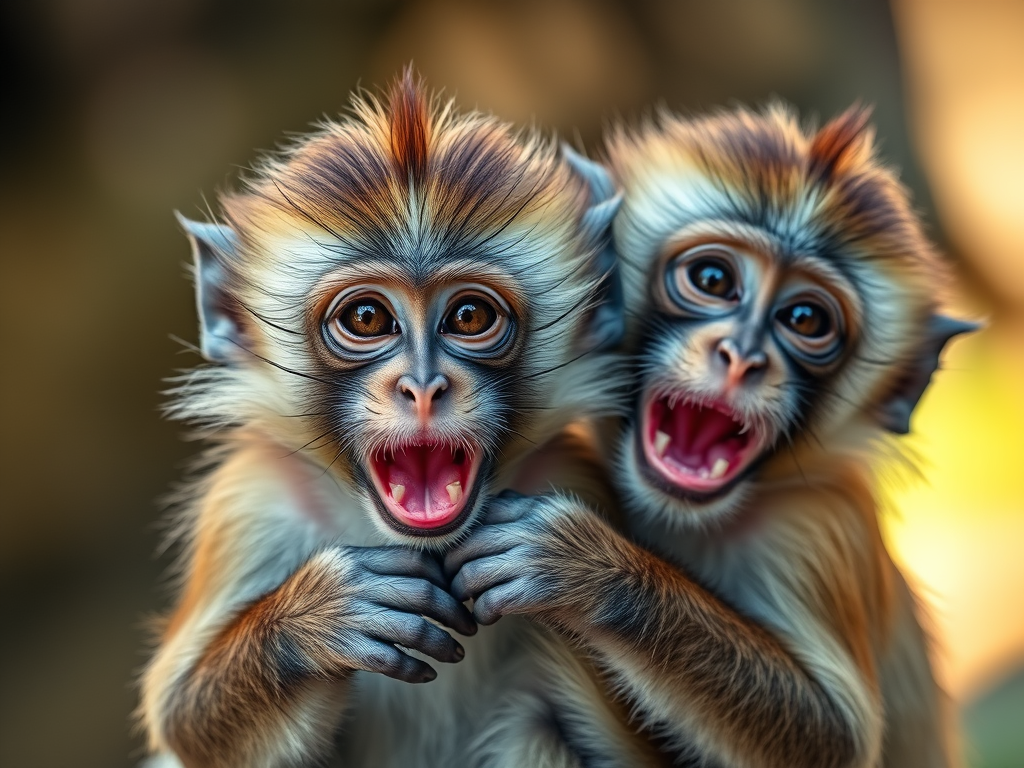
Two Little Monkeys

Once upon a time in a bustling city zoo, lived two identical twin monkeys named Max and Milo. They were the stars of their enclosure with their bright eyes, playful nature, and strikingly similar appearances. However, despite their playful antics for visitors, the twins felt a deep sense of unhappiness. Their days were filled with the same routines, the same visitors, and the same banana treats. They longed for adventure beyond the confines of their cage. One day, as they swung from branch to branch, Max had a brilliant idea.

“What if we use our identical looks to confuse the keepers? We could escape and explore the world beyond this zoo!”

Milo’s eyes sparkled with excitement.

“Yes! We can switch places! They won’t know who’s who!”

That night, as the zoo quieted down and the moon cast a silver glow, the twins put their plan into action. They practised their mimicry, copying each other’s movements and sounds. When morning came, the keepers arrived, unaware of the mischief about to unfold. As the keepers entered their enclosure, Max climbed high into the branches while Milo hung back, pretending to groom himself. When the keeper called out for them, Max swung down, but at the last moment, he let out a loud screech, startling the keeper. In the confusion, Milo took the chance to leap into the opposite corner, making it look like he was still in the same spot. The keepers were baffled.

“Wait, which one is which?” one of them exclaimed, scratching his head.

The twins exchanged mischievous glances, stifling their laughter. They knew they only had a short window before the keepers figured it out. As the day went on, the twins continued their clever ruse. They switched places during feeding time, and when the keepers tried to separate them, they would jump and play, making it impossible to tell who was who. The twins revelled in their newfound freedom to roam their enclosure without supervision, but they knew it was just a matter of time before the keepers caught on. That evening, when the zoo was closed to the public, Max and Milo knew it was time for the final phase of their escape. They waited until the keepers were distracted and then darted out of their enclosure, using the shadows to hide. They climbed over fences and squeezed through gaps, their hearts racing with excitement. Finally, they found themselves outside the zoo, standing in the cool night air. The world beyond was vast and filled with the sounds of nature. Max looked at Milo, his eyes wide with wonder.

“We did it! We’re free!”

With newfound courage, they ventured into the nearby park, trees towering above them like old friends. They swung from branches, chased fireflies, and feasted on wild fruit, their laughter echoing in the night. For the first time, they felt truly alive. As dawn broke, the twins knew they could not stay in the park forever. They missed the comfort of each other and the familiar routines, even if they were unhappy. So, they decided to return to the zoo, but not as prisoners. They would find ways to bring joy to their lives, using their cleverness to entertain not just visitors but also themselves. When they returned, the keepers were in disbelief, having searched high and low for the mischievous twins. Max and Milo resumed their antics, but now, with a sparkle in their eyes, knowing the world outside was filled with possibilities. They learned to embrace the zoo life with newfound joy, always planning little adventures and reminding each other that sometimes, happiness was a matter of perspective. And so, the twin monkeys lived on, not just as entertainers but as adventurers in their own right, forever bonded by their shared escapade and the spirit of freedom.

Image by AI