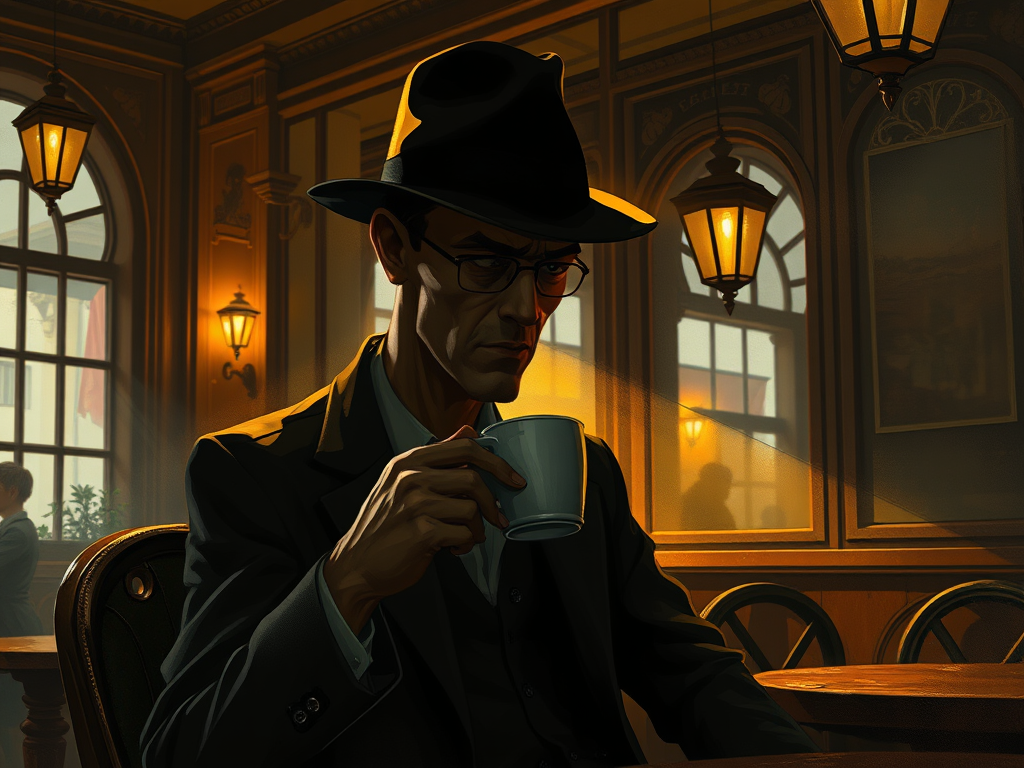
The man moved through the city like a shadow wearing a tailored suit. His name wasn’t important; what mattered were the doors he kept shut, the keys he refused to admit he carried. The world saw a man of quiet routines: a morning coffee at the same café, a stroll along the river, a desk lamp that hummed a familiar lullaby as dusk fell. But behind every routine lay a secret that bent the day to its own gravity. In the quiet moments, when the city exhaled and the streets grew thin with fog, his secrets stirred. They wore the faces of extinguished lights in a long-buried attic, the taste of copper on his tongue, and the echo of footsteps that never seemed to belong to anyone alive. He had learned early that some truths, once spoken, could devour the speaker and scatter the pieces across the floor of the world.
There were dark marks in his memory: a name whispered in a corridor, a choice made with a velocity that left no residue of doubt, a door closed on a cry that never quite stopped reverberating. Secrets like these do not simply lie dormant; they gnaw, they coil, they tighten until even the breath in his chest felt borrowed. He wore a mask of civility even as a storm brewed just beneath his ribcage, a storm that carried with it the scent of rain and something far more dangerous.
Yet not all his secrets were reservoirs of ruin. Some housed light, moments when the world revealed its softer facets, when a child’s laughter braided with a grandmother’s quiet counsel, when a neighbour’s simple act of kindness offered a compass in a night of confusion. These were the memories he visited in the evenings, after the city’s clamour settled into a muffled purr. They kept him upright, like a row of unyielding stars that refused to blink away even when clouds gathered.
There was a woman, a rare constellation in the shape of a smile, who believed in him when he believed in nothing but the ache of his own mortality. She spoke to him in the language of ordinary miracles, tea left to steep too long, a book left open on the balcony, a song that somehow threaded its way into the apartment and found the corner of his heart he had sworn off long ago. With her, he learned the texture of gentle forgiveness, the possibility that a life could be stitched back together with patience, not with punishment. Guilt was the concealing cloth behind which all his secrets wore their disguises. It wrapped him in a fabric so thick that even the simplest truth could not push through. He could tell himself the lie that to remain hidden was to preserve the fragile balance of a life others believed he had mastered. But the balance was a lie. The more he moved through the city, the tighter the cloth wound around him, until the silhouette of a man grew almost unrecognizable to himself.
In the quiet hours, when the clock’s hands scraped the wall, he would catch sight of his reflection and see not a well-groomed gentleman but a map of fault lines. The lines led to rooms he refused to open: a warehouse of memories where he kept the sins that refused to die, a cabinet of choices where the echoes of the wrongs he had done sat like dust on glassware, waiting for a gust to shatter them. Secret by secret, the doors to those rooms began to ache, and the hinges sang a tired, metallic hymn. He knew that the only way to release the pressure would be to walk into the darkness with a lantern of truth, to name what tormented him even when the name burned his tongue.
One night, the city’s skyline burned with a pale, indifferent beauty as if the stars themselves were choosing to overlook his confession. He stood at the river’s edge, where the water remembered every raindrop it had ever tasted. He spoke aloud, not to the listening world but to the part of himself that refused to listen. He spoke the names he had buried, one by one, letting the syllables fall into the current like leaves that refused to return to the tree. The words did not cleanse him at once; forgiveness never comes with a trumpet blast. But the act of naming began to loosen the strangling cloth. The air brightened a fraction, and for a heartbeat, the weight on his chest shifted. The darkness did not vanish, but it stopped pressing so relentlessly, as if it paused to witness a man choosing to open doors rather than smash them down.
In the days that followed, the man found that some secrets could be housed in the open instead of the closet. He learned to tell the smaller truths that mattered to the people who loved him—the apologies to those he had wronged, the promises he kept to those who trusted him, and the careful disclosure of his fears to the woman who stood against the tide of his guilt with a steadiness that felt almost sacred. The light he carried was not a beacon blazing for others; it was a quiet lamp he kept burning to guide himself away from the shallows of cruelty and toward the deeper currents of mercy. Some secrets, he realised, are not meant to be banished but integrated and held with care, acknowledged for what they are, and allowed to coexist with the love that is earned through steadfast, imperfect honesty.
He still walked the city streets, still wore a suit that pressed neatly to his frame, and still bore the weight of the secrets he had learned to carry. Yet the weight felt different now, less like a crushing cage and more like a map. Each step was a choice: to reveal a thread here, to withhold a fear there, to forgive himself a little more with every sunrise. In the end, he understood that being trapped by secrets does not require a single grand release. It asks for patient courage: to name the hurt, to repair what can be repaired, and to let in the light where love is willing to linger, even in the vicinity of the darkest truths.
And so he moved forward, not unscarred but unbroken in the way that matters most: open to the next, uncertain revelation, and capable of choosing love again, even after the shadows have dictated too many of his days.
 Lazarus Carpenter - Author