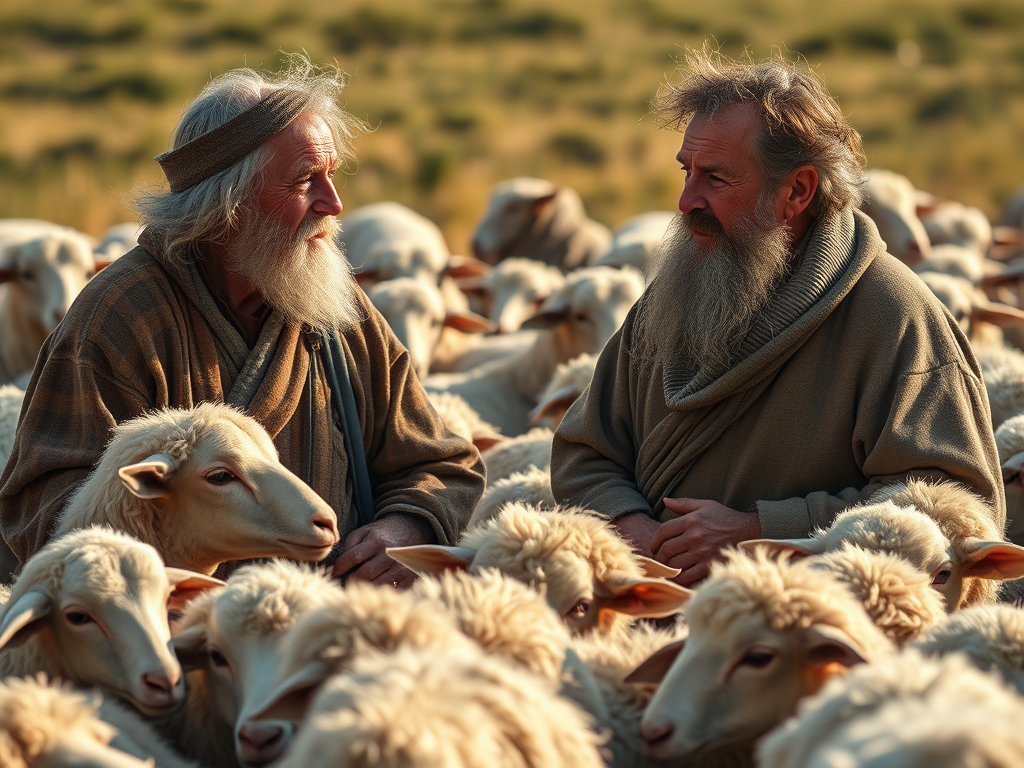
Parable of Two Shepherds

Once upon a time, there were two shepherds named Tomas and Eli. Both tended flocks of sheep and loved their animals dearly. The valley was beautiful, with plenty of grass and fresh water, but it was also small, and the grazing grounds were shared. One summer, as the grass grew sparse, Tomas and Eli found themselves in a disagreement. Tomas believed that the northern part of the valley belonged to him because he had been grazing his sheep there longer. On the other hand, Eli argued that the southern fields were his since he had started grazing his sheep there more recently. Their disagreement quickly grew into a heated argument. Tomas claimed,

“I have been here for many years, and my sheep have always grazed in this part of the valley. It is my right to continue doing so.”

Eli, in his own defence, replied,

“But I have also been here these past few seasons, and I need the grazing grounds just as much as you do. We both need to share fairly.”

The two shepherds argued day after day, each convinced they were right. Confused by the noise, their sheep began to stray and wander into the neighbouring pastures, causing more trouble. Finally, a wise old man who lived nearby heard about the dispute. He visited Tomas and Eli and asked to speak with them.

“Let me tell you a story,” he said. “There was once a river that flowed through a valley. Two farmers built their fields on either side of the river. Both wanted to use the water for their crops, but there was only enough for one to use at a time. They argued endlessly, each claiming the water was theirs.”

The old man paused and looked at the shepherds.

“One day, a wise elder suggested they build a small dam to direct the water to both fields at different times. They agreed to share the water equally, respecting each other’s needs. From then on, they worked together instead of fighting.”

Tomas and Eli listened carefully. They realised that their argument was causing more harm than good and that cooperation was better than conflict. They divided the grazing grounds equally, rotating their sheep between the two parts of the valley. From that day on, they worked together peacefully, and their sheep thrived in the harmony of shared land. So, the valley remained peaceful, and the two shepherds learned that sharing and understanding could solve even the thorniest disputes.


Parable of Three Brothers

Once upon a time, in a peaceful village, lived three brothers: Eli, Malrik, and Joran. They were born of the same parents but grew up with very different hearts. Eli, the eldest, was kind and compassionate and always sought to help others. He believed in kindness and fairness, and his gentle nature made him beloved by many. Malrik, the middle brother, was cunning and ambitious, but his heart was often clouded with greed and anger. He loved power and was not afraid to use deceit to get what he wanted. Joran, the youngest, was indifferent to everything. He cared little for rules, others’ feelings, or ambitions. He wandered through life without much thought or concern, often detached from the conflicts around him. As they grew older, their differences caused strife. Eli would try to mediate disputes, but Malrik’s schemes frequently led to misunderstandings. Indifferent to these disputes, Joran simply watched from the sidelines, often alienating himself further.

One day, their village faced a crisis—an ancient, enchanted forest nearby began to wither, threatening their homes and livelihoods. The village elders called upon the three brothers to find a solution. Eli believed they should seek the wisdom of the forest spirits and restore the balance with kindness.  Malrik saw an opportunity to exploit the situation for personal gain, perhaps to claim the forest’s treasures. Joran shrugged, uninterested, hoping it would pass without his involvement.

Despite their differences, the brothers set out together, each driven by their own motivations. Eli’s journey was filled with compassion. He helped injured animals, listened to the whispers of the trees, and sought harmony. He believed that love and understanding could heal the forest. Malrik’s path was marked by cunning—tricking creatures, exploiting resources, and seeking shortcuts to quick success. Joran, meanwhile, wandered aimlessly, often indifferent to the dangers and lessons around him, only following when it suited him.

As they travelled deeper into the forest, they faced challenges that tested their hearts. Eli encountered a wounded phoenix and nursed it back to health, learning that restoring nature required patience and love. Malrik was tempted by a treasure hidden beneath a cursed tree, but realised that greed could bring ruin. Lost in the woods, Joran finally saw the beauty of the world around him—the songs of birds, the glow of fireflies—and felt a flicker of curiosity.

One night, they camped beneath a shimmering starry sky, and their differences came to the surface in a heated argument. Eli urged kindness, Malrik pushed for cunning, and Joran dismissed their concerns altogether. But in that moment, a wise old owl appeared and spoke: 
“Only when you learn to listen to each other can you find the true path.”

Realising the importance of unity, the brothers decided to work together. Eli suggested they combine their strengths: kindness, cunning, and curiosity. They returned to the forest, where Eli’s compassion healed the land, Malrik’s cleverness uncovered the source of the curse, and Joran’s indifference transformed into genuine interest as he saw the forest’s beauty. Through their combined efforts, the enchanted forest was restored, its magic renewed. The village prospered once more, and the brothers discovered something profound: Love and understanding are the most incredible powers, capable of transforming discord into harmony.

The Stranger Who Lost His Shadow – A Parable – ‘Shadows are the echoes of ourselves—what we leave behind’

One misty morning in a quiet village nestled between rolling hills and dense forests, a stranger appeared seemingly from nowhere. He was tall, cloaked in a dark coat, and carried a mysterious air about him. No one knew his name, nor where he had come from, but he moved with unusual grace that caught everyone’s attention. As he wandered through the village square, something peculiar happened. The sun was shining brightly, casting sharp shadows on the cobblestones, yet the stranger’s shadow was nowhere to be seen. People stared in wonder, then in confusion. Children giggled, trying to spot the stranger’s shadow, but it was simply gone.

The stranger didn’t seem bothered by this. Instead, he continued his walk, observing everything with a gentle smile. That evening, he settled in the village inn, and when the innkeeper brought him a warm cup of tea, she couldn’t help but ask,

“Sir, why is it that you have no shadow?”

He looked at her with kind eyes and replied,

“Long ago, I was a man who chased after his dreams so fiercely that I forgot to look behind me. One day, I lost my shadow, not as a curse, but as a reminder. Shadows are the echoes of ourselves—what we leave behind. Without it, I am free from the past, free to become someone new.”

From that day on, the villagers saw the stranger in a different light. He was no longer just a mysterious visitor but a symbol of letting go of old burdens and embracing the unknown. When he eventually left the village, no one knew where he went, but they remembered his words. And as for the shadow? It never appeared, but perhaps, in some way, the stranger and his words stayed with them — a gentle reminder that sometimes, to truly move forward, we must let go of what’s behind.