The Stairs of the Mind

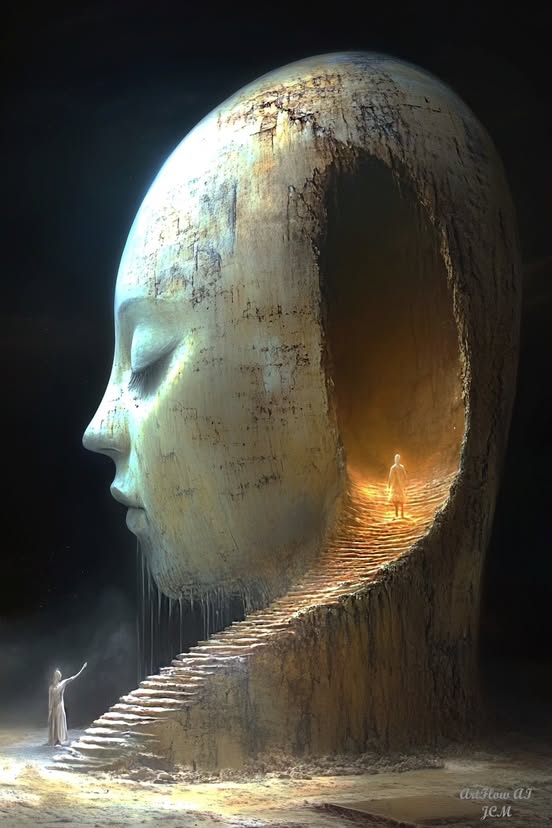
A curious student named Liam lived in a quiet town. From a young age, Liam was fascinated by the mysteries of life—why things were the way they were, and how he could understand the world more deeply. But as he grew older, he realised that understanding wasn’t always straightforward; it was a journey, a quest that required patience and courage. One day, as Liam sat beneath an ancient tree in the town square, he closed his eyes and imagined a staircase stretching endlessly upward, each step shimmering with possibilities. Intrigued, he decided to embark on a journey—an ascent of his mind—to reach enlightenment.
Liam’s first step was fueled by curiosity. He looked around the world with fresh eyes, asking questions about everything—about the stars, trees, and people he met. Each question was a rung on the staircase, guiding him higher. He learned that he must first acknowledge how much he didn’t know to truly understand.
Climbing higher, Liam gathered knowledge from books, teachers, and experience. He discovered truths about science, history, and philosophy. But he also realised that knowledge alone was not enough; it was like holding a map without knowing how to read it. Wisdom was the next step.
As he ascended, Liam paused to reflect. He pondered the meaning behind what he learned, contemplating his thoughts and feelings. Reflection helped him see his biases and assumptions, clearing the way for deeper understanding.
Beyond intellect, Liam learned the importance of compassion. He saw how kindness and empathy connected people. As he practised compassion, the staircase became wider, and the view from each new step became clearer and more vibrant.
Liam discovered mindfulness—being present in each moment. This practice quieted the noise of doubt and distraction, allowing him to see things as they were. The stairs now shimmered with clarity, each step a breath of peace.
Higher still, Liam faced challenges—doubts, fears, and illusions. But with perseverance, humility, and a heart open to discovery, he continued upward. And at last, he reached the summit—the place of proper understanding, where the mind is clear, and the soul feels at peace. From this height, Liam saw the interconnectedness of all things. He understood that enlightenment was not a destination but a continual journey, a stairway he would climb anew daily. Descending back into the world, Liam carried the light of his discovery, eager to share this newfound wisdom and continue ascending the stairs of his mind.

Dawn of the Harmonic Dimension

Once, the world was shrouded in the shadows of fear and conflict. But amid the chaos, three souls emerged—each carrying a spark of hope, each destined to lead humanity into a new era of love. Liora was born in a small village nestled between mountains and forests. From a young age, she could sense the unspoken pain of others—the silent suffering of those broken by fear. Her touch could soothe wounds, but her true gift was her unwavering belief in love’s power to heal even the deepest scars. One evening, as she sat by a shimmering lake, she felt a gentle vibration—an invitation from the unseen realm. She closed her eyes and saw visions of a luminous dimension, pulsing with life and love. She understood her purpose: to become a conduit for this divine flow, guiding others to release their fears and embrace love. Liora travelled to a war-torn village, where her presence brought calm. She sat with a grieving family, holding their hands, and softly whispered,

“Love is the healing force. It begins within you.”

As her words flowed, the air around her shimmered, and a faint glow emanated from her palms. The villagers felt a warmth spreading through their hearts, and for the first time in years, they dared to hope.

Kael was a wandering explorer, driven by curiosity and an insatiable desire to understand the universe. He believed that fear stemmed from ignorance and that truth could dissolve the darkness if revealed. His journeys took him across deserts and oceans, seeking signs of a greater harmony. One night, under a sky filled with stars, Kael encountered an ancient oracle who whispered of a new dimension—a realm of pure resonance. Intrigued, Kael vowed to find it and bring its wisdom back to his people.  
In a hidden temple, Kael discovered a crystal that vibrated with a strange energy. As he touched it, visions flooded his mind—of an interconnected web linking all life. He saw humans, animals, plants, and stars all singing the same cosmic song. Fear was but a shadow cast by misunderstanding. Kael stood before a gathering of sceptics, sharing his insights.

“Fear keeps us divided, but truth—truth unites us in love,” he declared.

His courage inspired others to question their assumptions and open their hearts.

Eira was a vibrant artist whose murals and sculptures celebrated the beauty of unity. Her paintings depicted worlds where humans danced with animals, rivers flowed in harmony, and forests shimmered with life. She believed that imagining a loving future could manifest it. One day, she received a vivid dream: a vision of a shimmering portal—a bridge to a new dimension of love. She knew her art could be the key to awakening others’ hearts. Eira painted a massive mural on the city square—an ever-changing mosaic of life and love. As she worked, her brushstrokes seemed to animate, and the images shimmered with an otherworldly glow. Passersby stopped, mesmerised, feeling a stirring within. She gathered children and elders alike to dance and sing around her art, igniting a collective spark of hope. Her belief was contagious:

“We are all artists of our future. Love is the masterpiece waiting to be created.”

One fateful day, the three met beneath an ancient, sacred tree—each drawn by their visions and dreams. As they shared stories, the ground beneath them shimmered, and a luminous thread emerged, connecting them to the Harmonic Dimension. They realised that their individual gifts—healing, truth-seeking, and dreaming—complemented each other perfectly. Together, they formed a sacred circle, channelling the divine flow of love into the world. Liora’s hands glowed as she sent waves of healing energy, Kael’s voice resonated with the frequency of truth, and Eira’s art shimmered with divine light. The air thrummed with a melody that echoed through the cosmos, awakening hearts everywhere. They dedicated themselves to spreading this energy—Liora healing wounds of fear, Kael inspiring courage through stories of truth, and Eira awakening the collective imagination.

Slowly, the world began to change. Fear was replaced with curiosity and compassion. Conflicts faded as people realised their interconnectedness. Cities blossomed into gardens of peace, and nature thrived in harmony. The flow from the new dimension became unstoppable, a river of love that carried everyone into a future where all life could flourish. Wars became tales of past misunderstandings, replaced by songs of unity.
In a grand ceremony, people from all walks of life gathered, holding hands around a glowing orb, symbolising the interconnected web of life. They sang together, their voices rising in harmony, sealing the collective awakening.

Guided by Liora, Kael, and Eira, humanity stepped into a new realm—one where love was the foundation of all existence. Fear had dissolved into understanding, and the divine flow from the Harmonic Dimension became an eternal current of peace and joy. In this world, life flows freely from one realm to another, weaving a radiant tapestry of unity. The universe whispers a simple truth: love is the most extraordinary power, capable of transforming all fears into boundless joy. And so, the story continues—an everlasting dance of life, love, and harmony, shining brightly across the infinite dimensions.

Osho

“To be creative means to be in love with life. You can be creative only if you love life enough that you want to enhance its beauty.” Osho (Author of Courage)

Rajneesh, also known as Acharya Rajneesh, Bhagwan Shree Rajneesh, and later as Osho, was an Indian godman, philosopher, mystic and founder of the Rajneesh movement. He was viewed as a controversial new religious movement leader during his life. An Indian rebel saint who spoke nothing but the truth, which everybody knows but never dared to speak. He was a professor of psychology. And later, the wanderer of spreading something beyond knowledge. Osho gave his discourses with such elan and depth; his power to preach was so unreal, so compelling, so transforming that if you listen to any of his discourses, you will always find him logically valid yet mystically beyond something.

He had reasons to back each and every rebellious act of his. From having 93 Rolls Royce cars to allowing free sex in his ashram, to having a massive ashram in Oregon and Poona, to touching each and every religion and mystic, every god and every spiritual person of all the bygone era in such detail, depth of understanding that one cannot but appreciate his astounding knowledge and insight. As reported by yellow media, Osho was probably one of the world’s most educated men and also the most dangerous man since Jesus Christ. He was denied a visa in more than 12 countries because America told them not to allow him. Osho was utterly harmless as he never did anything except speak. He called himself a guest of his followers, whom he always told not to follow him. He was stranger than fiction. His only message to humanity was to break the shackles of past mental slavery from conditionings and break the awe of religious gods and so-called saints. All he wanted was for people to be crazy enough to dance, sing, sit silently, and meditate. He knew that all humanity needs is meditation and peace of mind. His neo-sanyas teach people to be regular enough to love and appreciate nature.

B)1931 – D)1990

Rudolf Steiner

Rudolf Steiner (1861–1925) was an Austrian philosopher, social reformer, and esotericist who founded anthroposophy, a spiritual philosophy that emphasizes the importance of spiritual science and the understanding of humanity’s place in the cosmos. Steiner’s work spans various fields, including education, agriculture, medicine, and the arts.
Steiner was born in what is now Croatia and grew up in a rural environment, which nurtured his interest in nature and science. He studied at the Technical University of Vienna, where he focused on natural sciences and philosophy.
In the early 1900s, Steiner began developing his philosophical ideas, culminating in establishing anthroposophy. This framework advocates for a holistic approach to understanding the human experience and the spiritual world. Steiner believed in the importance of individual spiritual development and sought to apply his ideas to various areas of life.
One of Steiner’s most significant contributions is the Waldorf education system, which he founded in 1919. This approach emphasizes creativity, critical thinking, and the arts, adapting curricula to children’s developmental stages. Today, there are thousands of Waldorf schools worldwide. Steiner also introduced biodynamic farming in 1924, promoting sustainable agricultural practices emphasising ecological health and spiritual principles. This method integrates organic farming with spiritual insights, advocating for a holistic view of agriculture.
Rudolf Steiner’s influence extends into many fields, including education, agriculture, and the arts. His ideas inspire movements focused on holistic, sustainable practices and spiritual growth. His works, lectures, and writings remain significant in contemporary education, spirituality, and social reform discussions. Overall, Steiner’s life and work reflect a commitment to understanding the interconnectedness of humanity and the cosmos, fostering a more conscious and ethical world. 

The Tale of William Wanderlust

Once upon a time, in a quaint village, there lived a man named William Wanderlust. William had a restless spirit, constantly yearning for the promise of tomorrow. He dreamed of grand adventures, distant lands, and a life full of excitement, yet he never seemed to find the time to pursue his dreams. Instead, he spent his days planning and wishing while his nights were filled with longing for a future that remained just out of reach. One day, driven by an insatiable urge to chase his dreams, William embarked on a journey. He wandered through lush green forests, crossed sparkling rivers, and climbed steep mountains, all the while imagining the wonders that awaited him at every turn. But as each day passed, he found himself in the same cycle: dreaming of tomorrow while doing little to shape it. As his feet trod their path, all the beauty of the now evaded him, and his thoughts remained focused on the next step.

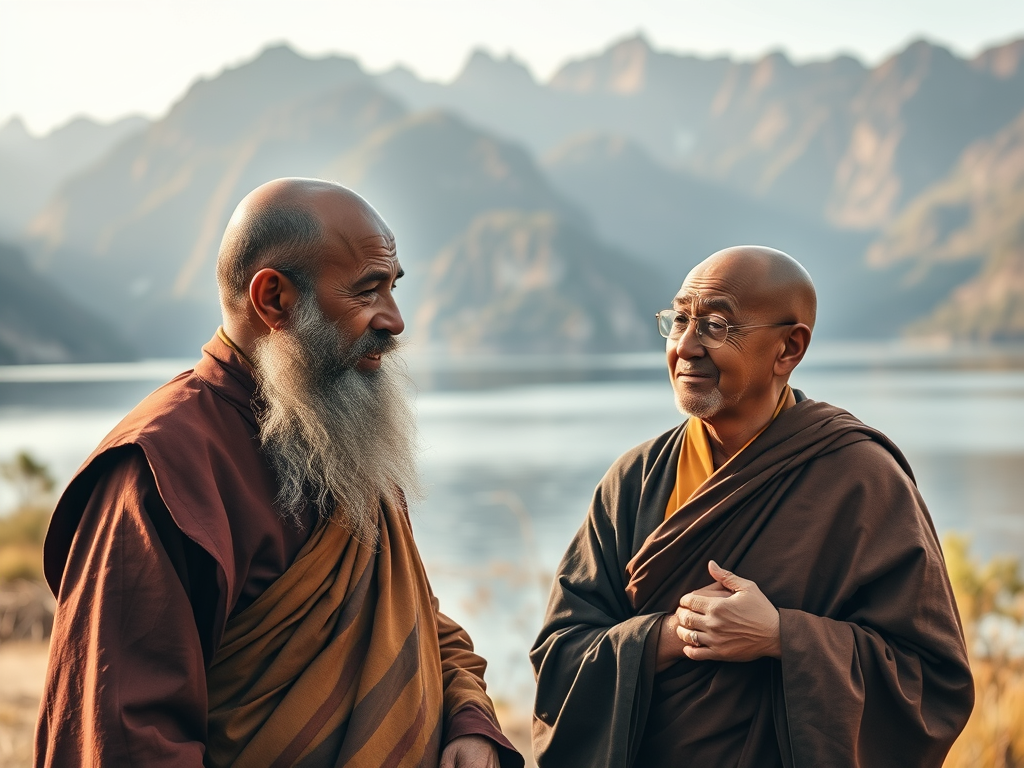
One afternoon, as he rested by a serene lake, William encountered a wise old monk sitting quietly on the shore. The monk’s presence emanated a calm that intrigued him. William approached the monk, sharing his dreams and desires and lamenting how he never seemed to achieve anything. The monk listened patiently and then smiled gently.

“William, you are like a bird perched on a branch, always looking at the horizon. You spend so much time dreaming of flight that you forget to spread your wings.”

Confused, William asked,

“What do you mean? I want to soar into the sky of tomorrow!”

The monk replied,

“Tomorrow is a beautiful illusion, but it is today that holds the key. You can only embrace tomorrow if you take action today. What steps have you taken towards your dreams?”

William realized he had been so focused on the future that he had neglected the present. The monk continued,

“Every journey begins with a single step. If you wish to explore the world, start by exploring yourself. What do you truly desire? What small actions can you take today?”

Inspired by the monk’s wisdom, William began to reflect. He understood that he needed to set achievable goals and take small steps toward them. He started by learning new skills, meeting people along the way, and immersing himself in the beauty of the present moment. As days turned into weeks, William found himself transforming. He learned to savour each experience, whether it was the taste of fresh bread from a local baker or a conversation with a fellow traveller. He no longer felt the weight of unfulfilled dreams; instead, he felt invigorated by the progress he was making. Eventually, William understood that tomorrow would always be there, but it was today that mattered most. With each small step, he navigated through life with purpose and passion. The adventures he once only dreamed of began to unfold before him, not as distant fantasies but as tangible experiences.

Years later, William returned to the lake where he first met the monk. He sat down in the same spot, reflecting on his journey. The monk appeared once more, his eyes twinkling with wisdom. William smiled, grateful for their encounter.

“Thank you for showing me the way,” he said. “I no longer lust after tomorrow. I cherish today and all that it brings.”

The monk nodded,

“Remember, the journey is not about the destination but the experiences along the way. Continue to embrace each moment, and tomorrow will take care of itself.”

With a heart full of gratitude, William Wanderlust had finally found what he had been searching for—not just the thrill of tomorrow but the joy of living fully in the present. And so, he continued his adventures, a man transformed by the wisdom of a simple yet profound truth. 

Images by AI