Once upon a time in the Land of Nothing lived a very small something who even though it was nowhere thought it was indeed somewhere. Did everything that it thought it did ……. do? Or given that it was really nowhere at all did it actually do anything at all? But voices that were not there in this place that did not exist, spoke of issues to the contrary which plunged it into an unknown never experienced or even considered before dilemma.
Was it or was it not…. did it or did it not….. would it or would it not…… could it or could it not…. or was it all a dream? But dream it did. It dreamt of a creation of something from nothing …….within the invisible hands of nothing ……..through dreams from nowhere and thus creation began….. or did it? It dreamt of creation…. and from nothing thought of a cosmos….. of universes…. and of planets…. and moons…. and suns. It dreamt of air… and fire…. and water… and within the substance of one planet… the earth It brought life into being.
And from the depths Its waters….. Its air met Its fire …… and the earth moved with a force that echoed throughout the nothingness…. of everything that It existed within. The land of what was once nothing was becoming alive with vibrations of something…. from somewhere… and something or nothing must be done ….. as It continued to dream.
A pulsating reality of a dreaming living earth….. but It thought the earth seemed empty and alone. So It dreamt of a sun to bring light and day…. and a moon to bring dark and night. Thus the dreams and thoughts of night and day…. light and darkness… were born. It dreamt of cosmic creation….. from nowhere to somewhere…… and back to nothing again. But It somehow knew that thought is, was, and will always be all that is. It also somehow knew that from thought came form and that all form was, is, and always will be alive and breathing within everything of what is really nothing or so It dreamt.
It created the universal family from dreams… emanating from nowhere….. and all the dreams to come would be a part of that which is all that is. Nothing could deny that It had hit on something from nowhere ….. but where would It end?
It saw the beauty of creation….. as the dream of life was born upon the earth. It was indeed pleased with the visions from somewhere….. within the constraints of nowhere and as It dreamt…. so it became. From where the visions were thought……. the mists of time were born.
It began to dream of life in so many different forms. As the dream blossomed life began throughout the earth….. within the depths of the seas….. and the breadths of her skies. But all of this was just a dream that It was creating…. a living dream where everything is connected…… breathing living form upon…. within…. and without all that is. It was pleased… but from the heart of the hand of nothing came others who were not there with thoughts of form and as It had dreamt this…. so it would be.
It wondered if all that is was complete and dreamt of being in form itself…. through a thought. It thought of creation from and through the very connectivity of everything… that will always be…. thought forth woman in its likeness. As It looked on the dreams…… all was good….. but how would the dream continue? So it gave the form balance and thought into creation….. dreaming man.
And the rest is the history that dreams are made of……..
In a town tucked between dusty hills and a river that forgot how to hurry, there lived a man named Simon Crowe. He was tall, polite, with the most striking head anyone had ever seen. It was round and expansive, like a harvest moon perched atop a frame that was seldom thick enough to support it. The townsfolk often whispered that his head contained a map to every library, every logic problem, and every grand idea the world had ever known. What they forgot to whisper aloud was that the head came with a burden: it made everyday life feel like a stage play in which Simon Crowe was always overacting. Simon worked as a clerk at the town brokerage, a job that required patience, manners, and a certain deftness of mind to balance figures and promises. He wore a tailored suit, kept his papers crisp, and spoke with a cadence that suggested he had read every book in every library and remembered them all. Yet despite his outward polish, people found him a touch awkward in small moments, the way he tilted his head when listening, the pause before answering, the sudden leaps of analogy that sent conversations tumbling into a chorus of ideas no one asked for. His head, massive and attentive, seemed always to be in front of him, scanning possibilities, schemes, and grand plans. He would humbly present a modest proposal to improve the town’s ledger, and by the time he finished, the proposal had hatched wings and a dozen sequels. The station in life he occupied felt to him like a small room with a ceiling that never rose high enough to fit the expanse of his thoughts. The clerks below him smiled, the magistrates above him frowned, and the people around him never quite knew how to place the gravity of his mind within the walls of their ordinary days. Simon Crowe’s head-long ambitions often collided with the stubborn, stubborn ground of reality. He would devise a scheme to build a cooperative bakery that would feed the town and keep the workers of the mill from starving. He would draft policies to equalize opportunities, to ensure that even the quietest child might one day speak aloud in a courtyard meeting. He would sketch models of civic life where strangers could become neighbours through shared work and shared bread. And then, as the sun moved across the sky, those schemes would settle like a chorus of pigeons, bobbing on a rooftop and finally fluttering away when someone coughed and the moment passed. This repetitive rhythm, the grand idea, the careful plan, the quiet disappointment, began to weigh on him. Yet Simon remained courteous, keeping his head high, perhaps too high, so that when a friendly neighbour asked how the day had gone, he could answer with a confident, practiced smile.
One autumn, a festival arrived that would test every man’s weathered nerves and dreams. The village’s mayor announced a contest: a contest of civic devotion. Each participant would present a plan to improve life in the village, and the best plan would be funded, celebrated, and housed in the annals of the village for a year. The prize was not merely money, but the sense that one’s name would be spoken gently in the same breath as the town’s most cherished deeds. Simon Crowe entered with a plan that would, on the page, transform the town into a beacon of cooperative life. He spoke of a central market that would be both exchange and classroom, where the mill workers, farmers, bakers, and teachers could trade, learn, and produce together. He outlined a curriculum of public duties, where every citizen would rotate as steward of a day’s labour of cleaning streets, tending gardens, caring for the elderly, and teaching children the simple arithmetic of fairness: how to count what you owe, what you owe others, and what you owe to your own better angels. When he spoke, his head seemed to grow heavier with meaning, as if the very weight of his dreams pressed down on the crown. The crowd listened, half enthralled, half anxious. For in his plan lay a future that would demand every citizen be willing to lift more weight than they had ever carried before. The old shopkeepers squinted, the younger children pressed closer to the front, and the mayor’s eyes widened with the dawning recognition that the plan might reshape every ordinary afternoon. The Day of Judgment arrived. The judge, an elderly woman with a ledger of small, precise judgments read through the proposals as if they were weather patterns. When she reached Simon’s plan, she paused. She looked at him not with the admiration he hoped for, but with the candid, practical scepticism of someone who had watched dreams slip through fingers like sand. “Mr. Crowe,” she began, not cruelly, but with the certainty of the sea, “your plan is noble and generous, and your head is, I’ll admit, unusually large for a clerk. But a plan is not a crown you wear on a stool; it is a bridge you build with your neighbours, step by step, with their hands in yours. Help us see how this bridge begins. Show us the first stone.” The room hushed. Simon Crowe had never needed to justify the first stone more than he needed oxygen to breathe. He stammered, then found himself listening to the quiet breath of the crowd, the rhythm of ordinary courage, the patience of those who carry the day-to-day loads. He realised, with a strange, almost blinding clarity, that his big ideas required not a reaction of awe from others, but a careful, shared ascent. In that moment, a rude awakening cracked his polished surface. Not a blow to his head, not a fall, but the soft, nagging truth that his strength was not alone in the mind. It lay in the hands of many people who would work with him, carry with him, and sometimes carry him when the weight was simply too much. The head that had felt too big for the station began to feel not too big, but simply big enough to ask for help, to listen, to learn the slow art of building something lasting. After the festival, Simon did not abandon his grand dreams. He revised them, not to shrink them, but to make them practical for others to hold. He turned his mark into a public meeting bench, a place where people could sit and discuss the town’s future, shoulder-to-shoulder, rather than shoulder-to-head. Weeks turned into months, and the cooperative market, the baby of his plan started with a single stall that offered bread baked by a grandmother who had never trusted a mixer in her life, beside a child who learned to count coins with the help of a kindly shopkeeper. The market grew not because Simon shouted louder, but because neighbours began to share the weight of the load. They brought their own stones to lay on the bridge, one by one.
And so, the man whose head had once threatened to outsize his station found a new measure of dignity, not in the size of his ideas alone, but in the size of his listening, the breadth of his patience, and the willingness to admit that the first stone is hard to place unless someone hands you a spirit of cooperation. From that day onward, Simon Crowe’s head did not shrink, nor did his ambitions wane. Instead, it learned to tilt in gentle partnership, and his ideas walked beside others as living, growing things. The town, in turn, learned to imagine not a hero who could lift the sky by sheer intellect, but a community that could lift itself by lifting each other. And in this shared ascent, the station that had once mocked with quiet cruelty the man’s tall thoughts was replaced by a station of the heart, the place where big minds and shared hands meet, and where a rude awakening becomes the quiet dawn of a common life.
In the quaint suburbs of the City, Inspector Septimus Summer-Garden was known for his cheerful clumsiness and boundless enthusiasm. Despite his many blunders, such as once slipping on a banana peel during an important interrogation, he always managed to stumble upon the truth, much to the town’s amusement. One foggy morning, a distressed old man named Mr. Percival Pumbleton wandered into the police station, clutching a crumpled hat and looking utterly bewildered.
“Good morning, sir,” Inspector Summer-Garden greeted, knocking over a stack of files in his haste to approach. “How can I assist you today?”
The old man looked up with wide, confused eyes.
“I…I can’t remember. I’ve lost something very important, but I don’t know what it is.”
“Lost, you say? Well, don’t worry, Mr. Pumbleton. We’ll find it together,” said the inspector, tipping his hat and accidentally knocking over a cup of tea onto his own shoe.
As Mr. Pumbleton explained, it turned out he couldn’t recall why he had come in to the city, or what he was searching for. His memories were as foggy as the morning sky.
“Hmm,” muttered Summer-Garden, scratching his head and accidentally knocking over a chair. “Maybe your memory is playing hide-and-seek with you. Let’s think, what do you remember, old chap?”
The old man hesitated.
“I remember… a garden. A very beautiful garden with roses and fountains. Yes, and I remember a young girl singing.”
Inspector Summer-Garden’s eyes lit up, though he immediately tripped over his shoelace.
“A garden! That’s a promising clue! Did you happen to see this garden recently?”
Mr. Pumbleton shook his head slowly.
“No, I… I think I saw it many years ago. Before I… before I forgot everything.”
Just then, a young girl who had been passing by paused.
“Excuse me,” she said softly. “Did you mean the old Mr. Pumbleton? I used to visit him in his garden when I was little. It was filled with roses and a little fountain, just like he said.”
“Ah-ha!” exclaimed Summer-Garden, nearly knocking over his chair in excitement. “That’s a vital clue! We’ll find your garden, Mr. Pumbleton!”
With a series of clumsy but determined steps, the inspector led the old man out into the town. They asked around, and soon, a neighbour remembered seeing Mr. Pumbleton sitting happily in his garden, humming a tune. Finally, they arrived at a quaint house with a gate covered in climbing roses. Inside, the garden was indeed a paradise, vivid blooms, a tinkling fountain, and the distant sound of singing. Mr. Pumbleton’s face lit up with recognition.
“Yes! That’s it! I remember now. I came here to find my memories… and I think I’ve found them.”
Inspector Summer-Garden beamed, accidentally knocking over a flowerpot but catching it just in time.
“Aha! Case closed! Well, old boy, sometimes you just need a little garden to grow your memories.”
And so, with his signature clumsy charm and a heart full of success, Inspector Summer-Garden helped the old man rediscover his past, proving once again that even the most bumbling detective can stumble into the truth and a beautiful garden along the way.
In the City, there was one thing everyone loved, balloon festivals! Colourful balloons floated high in the sky, bobbing and weaving like giant floating flowers. But one morning, as the town prepared for the big annual Balloon Parade, a strange problem arose. All the balloons had suddenly vanished disappearing overnight, leaving only empty strings fluttering in the breeze! The mayor burst into the police station, looking worried.
“Inspector Summer-Garden! The balloons are gone! The parade can’t happen without them!”
Septimus, sitting at his desk and accidentally knocking over a teacup, looked up and said,
“Fear not! I shall find out who’s behind this balloon mystery!”
He grabbed his notepad, an old napkin with doodles of clouds and headed to the festival grounds. As he arrived, he tripped over a loose cobblestone and nearly fell flat on his face.
“Careful, Inspector,” he muttered, dusting himself off. “Clumsiness is my middle name.”
He examined the ground where the balloons had been tethered. There were faint footprints, small and round, leading toward the nearby woods.
“Hmmm,” said Septimus, squinting. “Tiny footprints… probably belonging to a very small thief or perhaps a mischievous squirrel!”
He followed the trail into the woods, where he saw a trotting squirrel with a curious look in its eyes. The squirrel was nibbling on something shiny, an empty balloon basket!
Just then, he heard a giggle behind a bush. Peeking behind, he saw a group of children, giggling and holding a bundle wrapped in a blanket.
“Inspector!” one child exclaimed. “We found the missing balloons! We thought it would be funny to hide them as a surprise!”
Septimus blinked in surprise.
“So… you didn’t steal them? You just took them for fun?”
The children nodded sheepishly.
“We wanted to surprise everyone for the festival, but we didn’t know how to get them back!”
The inspector chuckled at their innocent mischief.
“Well, I must say, you gave me quite a puzzle! But I’m glad no one was trying to be mean.”
He gently untied the bundle and handed the balloons back to the children.
“Next time, let’s ask for help. That way, everyone can enjoy the festival together!”
The children cheered and ran back to the festival grounds, where the balloons were quickly re-tied to their stands. Soon, the sky was filled once again with vibrant colours, and the parade could go on. As the sun set over the City, Inspector Summer-Garden watched the balloons drift lazily in the sky. Clumsy as he was, he loved how even a simple case could bring the people so much joy. And from that day on, the children learned that sometimes, a little mischief can be solved with kindness and a good dose of Inspector Septimus Summer-Garden’s cheerful clumsiness.
Once upon a time, in a small village nestled in the heart of a lush valley, there lived a man named Constantine. Constantine was known throughout the village for his peculiar fascination with the wind. From a young age, he had been captivated by the invisible force that swept through the land, whispering secrets and tales of distant lands. Constantine would spend hours on end sitting atop a hill, his eyes closed, face turned upwards, and arms extended as if embracing an old friend. He would relish in the gentle caress of the breeze against his skin, feeling an inexplicable connection to the wind’s ever-changing rhythm. It was as if he could hear the wind’s voice, carrying with it messages only he could comprehend.
The villagers found Constantine’s devotion to the wind quite puzzling. They couldn’t fathom why he would choose to spend his days in such a manner, disconnected from the mundane affairs of their lives. Some whispered that he was eccentric or perhaps even mad, but Constantine paid no heed to their judgments. His heart and soul were intertwined with the wind, and that was all that mattered to him. One day, a renowned traveller arrived in the village. His tales of far-off lands and exotic adventures sparked the villagers’ curiosity, and they gathered around him, eager to listen. Constantine, always thirsty for knowledge and new experiences, joined the crowd, hoping to catch a glimpse of the world beyond his beloved valley.
As the traveller began to recount his stories, Constantine’s attention was immediately drawn to a particular tale. It spoke of a distant land where people worshipped the wind as a deity, believing it to be a divine messenger connecting them to the gods. Their lives revolved around the wind’s whispers, and they built magnificent temples atop the highest mountains to pay homage to its power. Constantine’s heart leapt with joy and recognition. It was as if the traveller had unveiled the missing piece of a puzzle he had been trying to solve his entire life.
Without hesitation, he approached the traveller, his eyes gleaming with excitement.
“Sir, please tell me more about this land where the wind is revered. I have spent my days worshipping the wind, feeling its presence in the deepest corners of my being. It is as if the wind has chosen me as its devotee,” Constantine exclaimed.
The traveller, intrigued by Constantine’s genuine enthusiasm, smiled warmly and shared further details about the land. He described how the wind’s whispers guided the people’s decisions, how they danced and sang in celebration of its arrival, and how they found solace and inspiration in its ever-changing nature. Constantine’s heart swelled with a newfound purpose. He made up his mind to embark on a journey to this far-off land, to bask in the presence of his cherished wind, and to become a part of the community that shared his devotion. With each passing day, Constantine’s excitement grew. He bid farewell to his village and ventured into the unknown, driven by his unwavering faith in the wind. His journey was long and arduous, filled with trials and tribulations, but he pressed on, fuelled by the thought of finally finding his place in the world.
Months later, Constantine arrived at the land where the wind was worshipped. The sight before him was awe-inspiring. Countless temples adorned the mountaintops, their magnificent structures reaching towards the heavens. People dressed in vibrant robes moved gracefully, their movements mirroring the ebb and flow of the wind. Constantine’s heart swelled with a sense of belonging as he stepped foot into this sacred land. Word of the wind’s devoted traveller quickly spread throughout the community. The villagers, intrigued by Constantine’s unwavering dedication to the wind, welcomed him with open arms. They saw in him a kindred spirit, someone who understood the profound connection between humanity and the unseen forces of nature. Constantine immersed himself in the rituals and practices of the wind worshippers. He learned to read the wind’s subtle cues, deciphering its messages and interpreting its intentions.
He danced with the villagers, twirling and spinning to the wind’s melodic symphony, feeling its energy flow through his veins. In time, Constantine became a revered figure within the community. His knowledge and love for the wind inspired others to deepen their own relationship with this mystical force. Together, they celebrated the wind’s presence, organizing grand festivals and ceremonies to honour its benevolence. As years passed, Constantine grew older, yet his devotion to the wind never wavered. He became a wise mentor, passing down his wisdom and teachings to the younger generation. He taught them to respect and cherish the wind, to listen to its whispers with open hearts and minds.
One tranquil evening, as Constantine sat atop a mountain peak, his eyes closed and his body swaying in harmony with the wind, he felt a deep sense of fulfilment. He had found his purpose in life, his true calling as the wind’s devotee. The wind, in turn, had bestowed upon him a life rich with meaning and connection. In the twilight of his days, Constantine passed away peacefully, surrounded by the gentle caress of the wind he had worshipped all his life. The villagers mourned his loss but knew that his spirit would forever be carried on the wind’s breath, spreading his love and reverence for the unseen forces that interweave with our lives.
And so, the story of the man who worshipped the wind became a legend, whispered from generation to generation. A reminder that there is beauty and wisdom in embracing the intangible, in finding solace and inspiration in the elements that surround us. Constantine’s legacy lived on, a testament to the power of devotion and the profound connection between humanity and the world that lies beyond our grasp, the ever-mysterious, ever-enchanting wind.
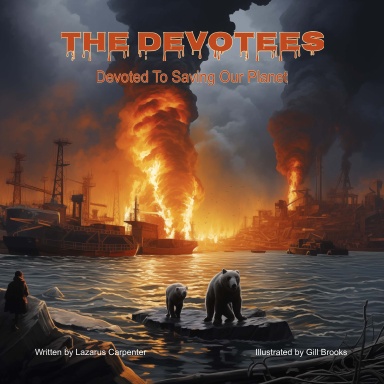
Abstract from ‘The Devotees’ written by Lazarus Carpenter and illustrated by Gill Brooks



 Lazarus Carpenter - Author