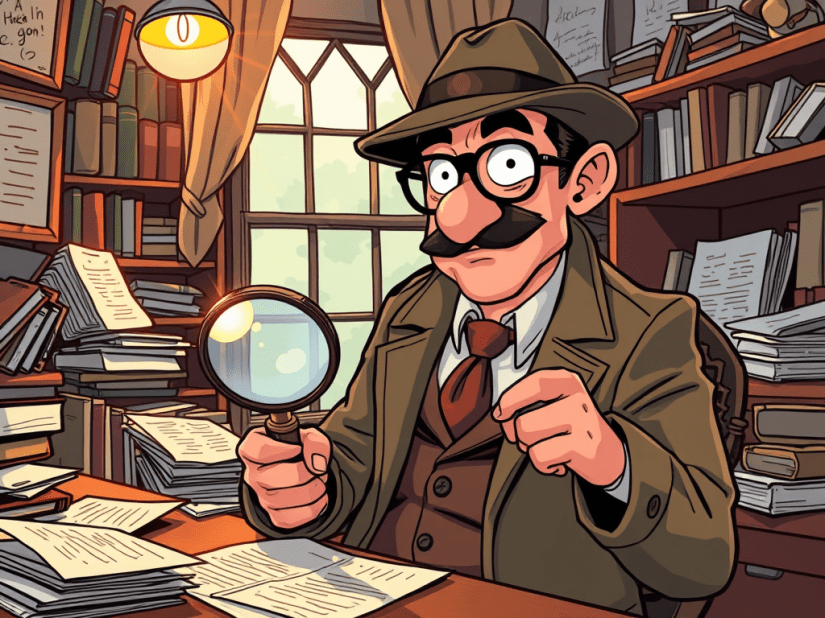
Inspector Septimus Summer-Garden adjusted his tweed cap for the seventh time in as many minutes, which was to say that his cap had convened a small confab about where it wanted to sit. It settled, finally, on the very tip of his ear, which was convenient for nothing but a good story if anyone were paying attention to his ears. He stood in the middle of Redberry Lane, a village suburb of the city, so small that the hedges knew your business better than your mother did, and even the village bench had a tendency to gossip. The case file in his gloved hand read simply: The Stolen Tractor. The tractor, a gleaming green Massey-Ferguson with a dent the size of a curry plate on the right fender, was the village’s pride and joy, the kind of machine that could make hay in the rain and still have time to win a village bake-off in the same afternoon. Septimus cleared his throat.
“If you’ll forgive the metaphor,” he began to the assembled crowd, which consisted mostly of Mrs. Wimple, who ran the tea stall and seemed to regard every crime as a personal affront to her kettle, and Mr. Horace Tindle, who claimed he could hear a crime before it happened if only the wind hadn’t blown his hat down the lane. “We shall locate the tractor with all due speed and… and precision.”
The crowd pretended to listen, but it was clear they had grown used to the inspector’s mannerisms, the dramatic pauses, the long silences, the tendency to shift his weight from one foot to the other as if balancing a teacup on a tightrope. Septimus, in turn, believed he possessed a rare talent for noticing the obvious that everyone else overlooked, which, in practice, was not much different from forgetting where he put his notebook. The tractor had vanished from the village green that morning, a quiet theft that felt like a loud opinion, one of those events that rattles the teapots and unsettles the chickens. The villagers murmured about the masterminds who used tractors to pull off grand plans and about the sort of person who would steal a tractor just to prove a point about traffic laws. Septimus, listening, noted the absence of those points in the case.
“Right then,” he announced, pulling out a notebook that was almost too small for his handwriting, and squinting as if the ink would politely start to bubble up in a readable script. “First clue: the grass where the tractor rested is unnaturally green, the further you go from the lane, the greener it gets. That can only mean…” He paused dramatically, as if waiting for inspiration to rain from the heavens, or perhaps for Mrs. Wimple to refill his tea. “It is a sign. A sign of fresh clippings left behind by a mower in a hurry.”
Mr. Tindle leaned on a fence post.
“Inspector, with all due respect, if you’re going to chase clues that are greener on the other side, you’ll be following the wind to the pub.”
Septimus frowned as if the thought had never occurred to him.
“Observation, not speculation, Mr. Tindle. The grass is greener where the tractor stood, therefore, the mower must have been at work nearby. Let us secure the perimeter and interview witnesses.”
He wrote something down with a flourish that suggested he believed he had invented the act of writing. The first witness was Old Man Crandle, the village elder, who insisted he had seen a shadowy figure driving a shadowy thing away at dawn, though the dawn in Redberry was more of a suggestion with a side of fog. Crandle had the air of a man who kept a notebook of every crime that almost happened to him, including a supposed incident with a runaway pickle jar years ago.
“Describe the thief,” Septimus pressed gently.
Crandle licked his lips as if savoring a memory.
“Tall, thin, hooded, with boots that squeaked when he walked, like a door that needs oiling.” He paused. “And he sang a tune—la-la-la—very cheerful, as if he stole for joy.” He looked at Septimus with a mix of awe and pity. “Or perhaps the tractor was simply borrowed by a village committee to entertain the annual fair. People like to co-opt machinery for processions, you know.”
Septimus did not know. He scribbled furiously anyway.
“Noted. The suspect is tall, thin, wearing squeaky boots, and sings in tune. We shall interrogate the entire village chorus.”
Meanwhile, across the lane, a certain suspect was busy living a life of quiet alibis. Farmer Jonah Pike, a man with a beard as unruly as a hedge in need of a prune, was found near the edge of the fields, pretending to mend a broken wheel on a wheelbarrow, which was not, in truth, broken at all. He claimed the tractor had been his favorite machine for years, a gift from the community for the harvest festival, and he would never steal it, he would merely borrow it to show ye olde farmers’ pride in their work and return it with a small bouquet of wildflowers and a note of apology. Septimus arrived at Jonah’s barn with the gravity of a man who believed he was about to adjudicate a nobility trial. The inspector’s approach had a certain shuffling, a confident misstep, a habitual stumble that somehow became endearing. He opened the door, and the room smelled of hay, machine oil, and the lingering aroma of someone’s late breakfast. Jonah looked up from under a cap brim that seemed permanently stuck in a state of mild confusion.
“Ah, Inspector,” Jonah said with a grin that hinted at mischief and a touch of bravado. “To what do I owe the pleasure?”
Septimus flicked a hand at the wheelbarrow.
“We are investigating the stolen tractor, Mr. Pike. It would be prudent to inform me if you know anything that could help recover it. Calm and honest, now, no tall tales.”
Jonah shrugged, and his eyes flicked toward a pile of hay bales stacked neatly near the back wall. Then, as if suddenly remembering something important, he said,
“You know, there has been talk of a parade across the village green, and the tractor is a fine candidate for the float.” He laughed, a boisterous sound that bounced off the wooden beams. “Perhaps the tractor didn’t go missing at all. Perhaps it traveled of its own accord to a function of celebration and merriment.”
Septimus, whose mind often wandered into analogies that had little to do with reality, blinked.
“A parade,” he repeated, as though the word itself would unlock some secret door to truth. “Yes, yes, a parade. We must locate the route of this parade and the cloaked procession that led the tractor away.”
There were, of course, other suspects. The baker’s boy claimed to have seen someone with a scarf the colour of spinach leaving the green. The local librarian swore she heard an engine purr like a cat in heat, that metaphor did not help Septimus, who could not tell a purr from a purr of an engine. The parson claimed the theft was a sign from above, a warning against the dangers of over-ambitious farm equipment. In the midst of the inquiry, Septimus found a clue that seemed almost too obvious to be true but perfectly capable of unraveling the entire case: a small, muddy footprint, not large enough to be a man, but large enough to indicate someone wearing boots with a heel, perhaps a short heel, the kind that would squeak on a wooden floor. He followed the print, which led him to the village pond, where the ducks had lined up as if they were witnesses to something important, though they simply quacked in their own language about the possibility of bread. Nearby, a ladder leaned against a fence post, and on the ground lay a fallen ribbon, blue, the ribbon of a festival, the colour of the village cricket team’s ballcaps. The ribbon looked as if it had been torn from something larger, perhaps a float or a banner. It carried a faint scent of lilac and motor oil, which seemed to Septimus to be the fragrance of truth. He returned to the station, a small shed beside Mrs. Wimple’s tea stall, where he spread the clues before him like a magician laying out cards. He studied the footprint and the ribbon, the scent of lilac and motor oil, the squeaking boots, the confession of Old Crandle’s memory, and the cheerful tune of a thief who sang as he ran. Then a thought occurred to him with the subtlety of a drumbeat: what if the missing tractor was an accident of cooperation? What if the village, in its endless love of a communal project, had borrowed the tractor for the parade and simply forgotten to return it? In a village, after all, things tended to drift like seeds in the wind and find their own ground.
Septimus called a meeting on the green, a place where the town’s gossip gathered as reliably as the pigeons. The crowd gathered, including the mayor, who wore a suit that always looked as though it had just learned to tie a tie; Mrs. Wimple, with her kettle ready for action; the librarian; and, of course, the farmer, Farmer Pike, who stood with a broad grin and a finger in the air, as if ready to blame the wind.
“Good people!” Septimus announced, though no one had asked for a speech. “We have a mystery to solve, one that hangs like a veil over our harvest festival. The tractor our green friend has supposedly vanished. Yet clues indicate a parade, a celebration, and the gentle art of borrowing for the common good.”
There were murmurs. Mrs. Wimple dabbed her eyes with a napkin, which she declared was a sign that the tea was too strong and the truth too weak. The librarian cleared her throat, her glasses fogging up with the seriousness of the moment. The crowd leaned in, waiting for a revelation. Septimus pointed to the ribbon draped over a fence post.
“This blue ribbon is not a sign of theft but a sign of ceremony. The farmers’ association planned a float with the tractor as its centerpiece. The missive was mislaid; the tractor was borrowed under the pretext of a village project. And it has not returned because, in the act of making a village parade, we forgot about the clock.” He paused for the dramatic effect that had become his signature. “The tractor is not stolen but temporarily detached, like a book borrowed from a shelf to be read at the festival.”
There was a moment of stunned silence, followed by a chorus of relieved exclamations. Mr. Horace Tindle looked as if a weight had been lifted from his shoulders and landed on his hat’s brim instead. Old Crandle nodded sagely, as if to say, “See? It was obvious all along, if you consider it lengthwise instead of crosswise.” Septimus, triumphant in a way that only came from the moment when a mystery yields to common sense, declared,
“Let us proceed with caution and make sure the tractor returns by the noon bell, before the parade commences.” He turned to Jonah Pike. “Mr. Pike, you will be in charge of the float’s schedule and the safe return of the machine. And you, Mrs. Wimple, will ensure that tea and biscuits are available for the crew who work to prepare the route.” He cleared his throat. “And you, inspector, will no longer confuse the case with grand theories but will simply coordinate the village’s efforts toward a harmonious event.”
Jonah slapped his knee.
“We’ll have that tractor back, Inspector, along with a few hay bales and perhaps a brass band.”
Septimus nodded, feeling a small glow of accomplishment, the sort of glow that comes when a case is resolved not by a dramatic reveal but by the patient aggregation of ordinary truths. He began to walk away, the crowd following him with their eyes, when a sudden shout stopped him in his tracks. A young girl, perhaps a neighbour’s child who had wandered from the safety of her mother’s apron strings, ran up with a muddy boot in hand and a wide smile.
“Inspector! I found something!” she cried. She held out a muddy footprint that perfectly matched the one Septimus had found before.
“Ah!” he exclaimed, recognizing the small victory of discovery. “And what does this tell us, young lady?” He squatted down to her level, which was the highest level he could manage without sinking into the ground.
“It tells us,” she said, eyes shining, “that the tractor wasn’t stolen by a mysterious thief. It was borrowed by our own village, by the children, the parade committee, and perhaps a pair of boots that squeaked with joy when they walked. And I think the tractor will be coming back after the parade, with extra biscuits, to share with the ducks and the librarian.”
Septimus stood, dusted off his knees, and offered the girl a nod of approval, a gesture that looked more like a small bow of reverence to the truth. He straightened his cap, which had somehow managed to migrate again during the exchange. As the noon bell rang and the parade began to wind its way through Redberry Lane, the tractor rolled back onto the green, now decorated with ribbons and bunting, its engine purring like a contented cat. The crowd cheered, the ducks quacked in approval, and the librarian clapped her hands in a rare moment of unreserved delight. Mrs. Wimple poured tea for everybody who wanted it, and the farmer’s association, now in possession of a stronger sense of communal belonging, prepared a feast that would have put a festival to shame. Septimus stood at the edge of the green, his mind already filing away the case as solved, though he would not write the conclusion in the official report with the flourish of a confession. Instead, he would note: Temporary detachment for communal joy. Borrowed with the intent to return. A mystery that was less a crime and more a village’s invitation to participate in its own story.
As the sun climbed higher, Septimus found himself looking at the parade with a certain pride he hadn’t anticipated. The tractors, the banners, the children’s laughter, the piper’s tune, these were not signs of a crime but signs of a community at work, of a village that remembered how to pull together when the hay needed to be gathered and the festival needed a spark. He turned to Mr. Pike and offered a rare, almost sheepish smile.
“Well done, Mr. Pike. A splendid float in the making.” He then addressed the crowd, more gently this time, with an air of someone who has learned a thing or two about human nature. “And so ends our investigation,” he announced, though the day had barely begun. “The tractor has returned, not through cunning or misdirection, but through a shared decision to celebrate our harvest. Let us all take responsibility for what we borrow and remember to return it with respect, and perhaps with a few extra biscuits.” The crowd laughed and nodded, the sense of a mystery resolved giving way to the warmth of communal joy.
The sun climbed higher, and Inspector Septimus Summer-Garden, who sometimes forgot that a garden could hide as many stories as a cupboard, felt a rare peace settle upon him. The case of the Stolen Tractor, as it turned out, was less a theft and more a gentle reminder that in a village, even a borrowed machine can belong to everyone when used with care and returned with gratitude. And so the tractor rolled on, guided by the hands of the parade, back to its rightful place, where it would rest until the next harvest, when its engine would hum again with the promise of work, laughter, and the occasional mystery that the village would solve together, one step, one quilted memory, and one squeaky boot at a time.




 Lazarus Carpenter - Author