The Tale of the Friendly Ghost of Ravenshire Castle

Once upon a time, an ancient castle called Ravenshire stood perched atop a misty hill. Legend had it that the castle was haunted by a ghost named Sir Whisp, who was infamous for frightening every visitor who dared to step inside. Sir Whisp’s spectral form was tall and translucent, often glowing faintly in the darkness, and he would bellow loudly,

“Get out! Leave this place! This is my home, not yours!” startling even the bravest souls.

For centuries, visitors were terrified of Ravenshire. No one ever stayed long enough to enjoy its grand halls or explore its history; they only wanted to escape the ghostly shouts and eerie whispers.

One day, a young traveller named Oliver arrived at the castle. Unlike others, Oliver was not afraid of ghosts. He had read stories of spirits and believed that they only wanted to be understood. When Sir Whisp appeared and roared, Oliver simply looked at him calmly and said,

“Hello there. Why do you scare people?”

The ghost was taken aback. No one had ever spoken kindly to him before.

“I frighten people because I am lonely,” Sir Whisp replied. “Long ago, I was a noble knight, but now I am trapped here, unseen and unheard. My only way to be noticed is to shout and scare.”

Oliver listened thoughtfully and then said,

“If you want to be seen and heard, why not try speaking softly or sharing your story? Maybe people would listen and learn about you.”

For the first time, Sir Whisp paused. He realised that his loudness only pushed visitors away and deepened his loneliness. From that day, he decided to change his ways. The next visitor who entered Ravenshire found the ghost not shouting loudly but softly whispering,

“Welcome, traveller.”

He told stories of the castle’s history and his own past as a brave knight. Visitors found the ghost’s new gentle demeanour more charming than frightening. They began to enjoy their visits, listening to Sir Whisp’s tales and marvelling at the castle’s mysteries. Thanks to Oliver’s kindness and understanding, the ghost’s appearance softened, and Ravenshire became a place where stories and spirits could coexist peacefully. And so, the ghostly goings-on turned from frightful to friendly, filling the castle with a new kind of magic, one born of compassion and empathy.

Parable of the Smiling Lady

Once upon a time, there lived a woman named Elara. She was renowned throughout the village for her radiant smile, shimmering eyes, and a beauty that seemed to glow from within. Yet, beneath her grace lay a life that had seen its share of hardships, losses, worries, and moments of quiet despair. Despite these trials, Elara possessed a remarkable gift: her sense of humour. It was a spark that never truly dimmed, even in the darkest times. Her laughter was like sunlight piercing through storm clouds, and her quick wit could turn the gloomiest day into a celebration.

One day, as she strolled through the market, Elara overheard a young boy trying to sell his handmade trinkets. His voice trembled with nervousness, and his eyes held a flicker of hope. Elara knelt down, flashed a warm smile, and said,

“If I buy one of your treasures, will you promise to keep making the world a little brighter?”

The boy nodded eagerly, and Elara chuckled softly, purchasing a tiny, imperfect but charming locket. This simple act sparked a series of joyful moments. Elara began to host small gatherings in her garden, inviting friends and neighbours to share stories, laughter, and music. Her jokes and playful teasing became the heart of these gatherings, infusing the air with warmth and happiness. Her humour was a balm for her own wounds and a gift she shared freely. Over time, her life, once shadowed by sorrow, blossomed with love and joy. She found that her ability to laugh and make others laugh transformed her hardships into stories of resilience, her tears into tears of mirth. The villagers came to see her not just as a beautiful lady, but as a beacon of hope, a reminder that even in life’s most difficult moments, a good laugh could turn everything around.

And so, Elara’s story became a gentle legend: a testament to the power of humour to heal, to connect, and to turn life’s toughest trials into moments of pure, infused love and joy. 

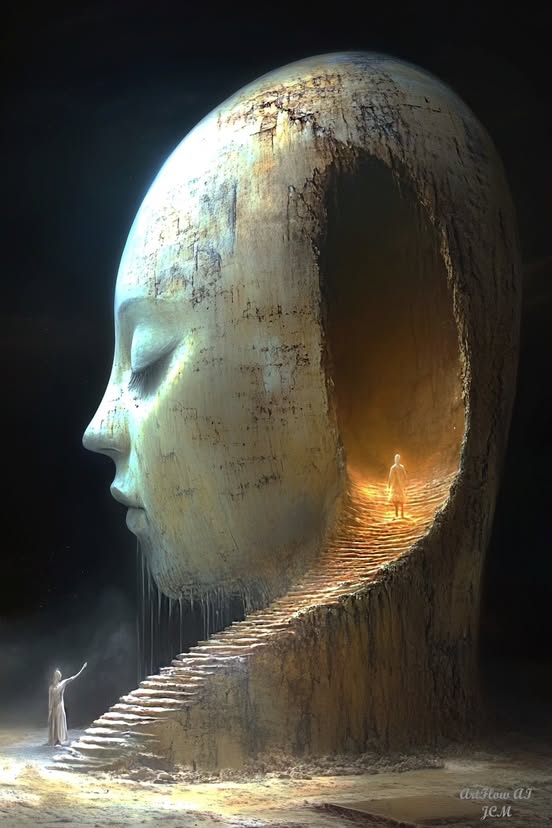
The Stairs of the Mind

A curious student named Liam lived in a quiet town. From a young age, Liam was fascinated by the mysteries of life—why things were the way they were, and how he could understand the world more deeply. But as he grew older, he realised that understanding wasn’t always straightforward; it was a journey, a quest that required patience and courage. One day, as Liam sat beneath an ancient tree in the town square, he closed his eyes and imagined a staircase stretching endlessly upward, each step shimmering with possibilities. Intrigued, he decided to embark on a journey—an ascent of his mind—to reach enlightenment.
Liam’s first step was fueled by curiosity. He looked around the world with fresh eyes, asking questions about everything—about the stars, trees, and people he met. Each question was a rung on the staircase, guiding him higher. He learned that he must first acknowledge how much he didn’t know to truly understand.
Climbing higher, Liam gathered knowledge from books, teachers, and experience. He discovered truths about science, history, and philosophy. But he also realised that knowledge alone was not enough; it was like holding a map without knowing how to read it. Wisdom was the next step.
As he ascended, Liam paused to reflect. He pondered the meaning behind what he learned, contemplating his thoughts and feelings. Reflection helped him see his biases and assumptions, clearing the way for deeper understanding.
Beyond intellect, Liam learned the importance of compassion. He saw how kindness and empathy connected people. As he practised compassion, the staircase became wider, and the view from each new step became clearer and more vibrant.
Liam discovered mindfulness—being present in each moment. This practice quieted the noise of doubt and distraction, allowing him to see things as they were. The stairs now shimmered with clarity, each step a breath of peace.
Higher still, Liam faced challenges—doubts, fears, and illusions. But with perseverance, humility, and a heart open to discovery, he continued upward. And at last, he reached the summit—the place of proper understanding, where the mind is clear, and the soul feels at peace. From this height, Liam saw the interconnectedness of all things. He understood that enlightenment was not a destination but a continual journey, a stairway he would climb anew daily. Descending back into the world, Liam carried the light of his discovery, eager to share this newfound wisdom and continue ascending the stairs of his mind.

Awakening of the Spirit’s Shadow

Once, a man named Christopher, a wanderer searching for meaning, believed that the countless plant medicines he consumed granted him divine power. His favourite was Ayahuasca, which he drank in grand doses, convinced that he was becoming omnipotent—an untouchable force destined to reshape the world. His narcissism grew with each trip, blinding him to the suffering he caused those around him. Christopher’s obsession with his own enlightenment led him to steal from Sundancer, a humble shaman who had once helped Christopher find his way. He took treasures, sacred objects, and even the spiritual knowledge Sundancer shared with him in trust. Christopher thought himself above morality, convinced that his spiritual journey exempted him from the rules of ordinary life.

But the universe had other plans.

One night, Christopher fell into a deep, vivid dream. He found himself in a vast, shadowy forest, where a figure approached—tall, fierce, and shimmering with an otherworldly light. It was Swift Arrow, a warrior and shaman of ancient times, whose spirit had been guarding the balance of life for centuries. Swift Arrow’s eyes burned with intensity.

“Christopher,” he spoke, voice resonant like thunder and whispering. “Your arrogance has blinded you. Your greed and theft have upset the sacred harmony. You have become a parasite, feeding off the spirits and the people you claimed to heal.”

Christopher tried to dismiss him, but Swift Arrow’s presence overwhelmed him. The spirit’s voice grew louder, echoing inside his mind.

“You must return what you have stolen, seek forgiveness from Sundancer, and never darken her door again. Only then can you mend the wounds you have inflicted.”

Christopher awoke trembling, drenched in sweat. The dream’s message was clear: his narcissism and greed had caused harm, and his spiritual ego was a false illusion. He saw his reflection in the mirror—no longer a wise seeker, but a spoiled, selfish man. In the days that followed, Christopher sought out Sundancer. He returned the stolen objects, apologised sincerely, and begged for forgiveness. He realised that his quest for power had been a lie, and that true strength lay in humility, respect, and healing.

From that night on, Christopher changed. He abandoned his reckless pursuit of omnipotence and dedicated himself to genuine service—learning from Sundancer, honouring the spirits, and restoring the balance he had disturbed. The spirit of Swift Arrow’s visit would haunt Christopher forever as a reminder of the harm he had done. He began to strive for change, but it would be a long journey that must be achieved alone in this life. Replaced by a newfound humility and understanding. Christopher’s journey became one of genuine awakening—not through drugs or illusions of grandeur, but through the humility of facing one’s shadow and making amends.

And so, the forest whispered on, bearing witness to the transformation of a man who learned that true power is rooted in humility, respect, and the courage to heal, accepting responsibility for his past. 

The Lens of Obsession

In a secluded laboratory nestled deep within the foggy outskirts of the city, Dr Evelyn Harper was known as a mad scientist—an eccentric genius whose obsession with microscopes bordered on neurosis. Her cluttered workspace was filled with dozens of microscopes, each more bizarre and intricate than the last, some antique, some futuristic, all meticulously maintained. As a child and later at university, her mind could absorb masses of information, ensuring academic attainment and success. Meticulous note-taking and attention to detail created a wealth of knowledge. Evelyn had read in excess of two thousand textbooks, written many research papers and attained two PhDs before reaching twenty-five. There was no time in her life for boyfriends or partying like her fellow students. Study, work, sleep, study, work, sleep, this was Evelyn’s chosen path and life. She was what can only be defined as driven, driven by a desire to achieve something capable of changing the world. Colleagues found her difficult, often withdrawn, and obsessed.   

Evelyn had dedicated her life to unravelling the secrets hidden within the tiniest particles of life. She studied cancer cells under her microscopes for years, peering into their chaotic, destructive world. Most dismissed her as overzealous, even unstable, but Evelyn believed that the key to curing the disease that had claimed her mother lay within these minuscule worlds. Her obsession grew intense. She spent sleepless nights adjusting lenses, tinkering with lighting, and testing countless chemical compounds. Her neighbours whispered tales of her madness, but Evelyn cared little. Her microscopes became a window into the universe, and the obsession was driven by expectation and hope.

One stormy night, as lightning crackled outside, Evelyn observed a peculiar pattern in the cancer cells she had been studying for months. A rare, almost imperceptible fluctuation in the cell’s behaviour caught her eye. She focused her most powerful microscope on the anomaly, her hands trembling with anticipation. Suddenly, she saw it—the secret to halting the cancer’s progression. A tiny, unseen particle was disrupting the cells’ ability to multiply. A molecule, a fragment of something unseen before, seemed to interfere with the cancer’s growth mechanisms. Evelyn worked tirelessly, synthesising compounds based on her observations. Weeks turned into months, and her obsession intensified. She tested her new formula on lab models, and the results were astonishing: the cancer cells stopped dividing altogether.

Her discovery spread like wildfire, from her isolated lab to the world. The scientific community was sceptical initially, but with rigorous testing, Evelyn’s cure proved effective in human trials. Her obsession had unlocked a new era in cancer treatment. Evelyn Harper, once dismissed as a madwoman, became a hero. Her relentless obsession with microscopes and the tiniest details led to one of the greatest medical breakthroughs in history. She had shown that sometimes, madness is just another form of genius—focused, unwavering, and driven by an unshakable hope. And from that day forward, her microscopes sat in museums and laboratories, silent witnesses to the madness that changed the world.