LAZARUS’S BLA BLA BLOG

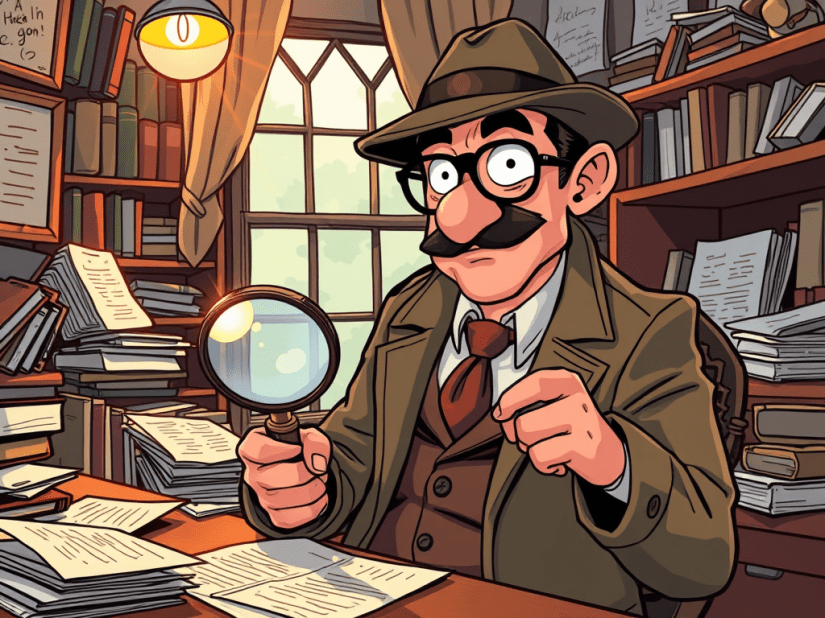
Inspector Septimus Summer-Garden and the Case of the Missing Caravan

In the bustling city, where the streets buzzed with activity and the police force was always busy, there was one officer whose reputation was as colourful as his mismatched socks, Inspector Septimus Summer-Garden. Known for his dishevelled, confused demeanour and a knack for getting everything slightly wrong, he was nonetheless beloved for his unshakeable optimism and unexpected good fortune. One sunny Monday morning, the chief constable called an urgent meeting. 

“Inspector Summer-Garden,” he said, “we’ve had a theft. A caravan has gone missing from the city fairground. We need you to investigate!”

Inspector Summer-Garden tipped his hat and nodded eagerly, though he immediately began to look around for his missing pen. 

“Right, sir! I’ll crack this case wide open!”

Inspector Summer-Garden started his investigation by visiting the fairground. He looked at the empty space where the caravan had been parked, scratching his head. 
“Hmm. No caravan. No footprints. No sign of anything… Wait, what’s this?” he muttered under his breath, picking up a bright red sock from the ground. His colleagues watched in confusion. 

“Uh, Inspector, that’s just a sock,” said Constable Bessie. 
“Exactly! Someone must’ve lost it,” replied Summer-Garden, pocketing the sock with a flourish.

Next, he questioned the nearby vendors. 

“Did you see anyone suspicious?” he asked, eyes spinning slightly. 
“Not really,” replied the baker, “but I did see a squirrel carrying something shiny.” 

“Ah-ha!” said Summer-Garden. “A squirrel! That must be our thief!” 

Without hesitation, the inspector set off to find the squirrel. He followed a trail of acorns and tiny nuts, leading him through the park, around the fountain, and into the alleyways. Meanwhile, his colleagues shook their heads and followed behind, trying to keep up. Suddenly, Summer-Garden stopped, pointing excitedly. 

“There! The squirrel! It’s got something shiny in its paws!” 

Indeed, the squirrel was clutching a small, shiny key. 

“Brilliant! That’s the key to the caravan!” exclaimed the inspector triumphantly. 

But as he reached out to grab the squirrel, it darted up a tree, dropping the key. Summer-Garden scrambled after it, tumbling into a pile of leaves.

While the inspector was busy chasing the squirrel, a young boy approached, holding a tiny trailer. 
“Excuse me, sir,” he said shyly, “my dad’s caravan got moved here yesterday. Is this yours?” 

Summer-Garden looked at the trailer and then at the boy.

“Ah-ha! So it was stolen, then!” he declared confidently. 

The boy nodded. “Yeah, but I don’t know who took it.” 

Suddenly, a loud honk interrupted them. Turning around, they saw a battered old van with a sign that read: “The Great Bramblebrook Caravan Repair”. 

Inside, the repairman waved wildly.

“Hey! That’s my van! I moved the caravan here for repairs yesterday. Sorry, I forgot to tell anyone!”

Back at the police station, the colleagues gathered, amazed. 
“Inspector,” said Constable Bessie, “you found the caravan… even if it was just because it was moved for repairs?” 

Summer-Garden grinned, adjusting his hat. 
“Well, that’s what you call a happy accident! Sometimes, getting lost leads you right to the solution.” 

And so, the case was closed, not in the way anyone expected, but thanks to Inspector Summer-Garden’s dizzy but fortunate ways, justice was served.  His colleagues chuckled and shook their heads, but secretly, they knew—Brilliant or bumbling, Inspector Septimus Summer-Garden always managed to win the day.

Inspector Septimus Summer-Garden and the Curious Case of the Missing Monkey

In the bustling city, where the streets hummed with life and the trees whispered secrets, lived Inspector Septimus Summer-Garden. Known for his bushy moustache and his slightly dishevelled hat, Septimus was a detective with a heart of gold but a knack for making mistakes, sometimes big, sometimes small, but always endearing. One sunny morning, the city’s beloved pet monkey, Momo, vanished from the city circus. The ringmaster was frantic, the children were teary-eyed, and the city needed its mischievous monkey back. Inspector Septimus Summer-Garden, arrived at the scene, tripped over a flowerpot and knocked over a barrel of popcorn.

“Never fear!” he declared, adjusting his hat. “I shall find Momo!”

His first mistake came quickly. Septimus, eager to solve the case, started by questioning the circus animals.

“Did you see anything suspicious, Mr. Elephant?” he asked. The elephant simply blinked and trumpeted, “I saw nothing but the tip of Momo’s tail disappearing behind the curtains.”

Septimus scribbled furiously in his notebook but forgot to ask the most important question: Where was Momo last seen? Instead, he spent the next hour trying to interpret the elephant’s trunk movements as clues. Meanwhile, the city’s children gathered around, whispering and giggling. Among them was Lily, a clever girl who watched the inspector’s antics with a twinkle in her eye.

“Inspector,” she said kindly, “maybe you should look where Momo was playing yesterday. Sometimes, the simplest clues are right in front of us.”

Septimus frowned, then nodded. He remembered that Momo loved to hide in the big oak tree at the park. Scrambling to the park, he climbed the tree, though he almost fell twice, and finally spotted a trail of banana peels leading into a nearby alley.

“Ah-ha!” he exclaimed, slipping on a banana peel himself but catching himself just in time. “This must be the trail!”

Following the trail, Septimus reached a small alleyway. There, he saw a mischievous raccoon with another who had a familiar little face, Momo! The raccoon had taken Momo for a ride on its back, thinking it was all a big game. Septimus gently coaxed Momo back, carefully avoiding stepping on the raccoon’s tail. Momo squeaked happily and scampered onto Septimus’s shoulder. As he returned Momo to the circus, the ringmaster cheered.

“Inspector Summer-Garden, you may be a bit clumsy, but you always get there in the end!”

Lily smiled, whispering to her friends,

“Sometimes, it’s not about being perfect. It’s about never giving up, and learning along the way.”

And so, Inspector Septimus Summer-Garden, with his many mistakes and many lessons, became a hero once more, teaching everyone that perseverance and kindness matter more than perfection.

Inspector Summer-Garden and the Case of the Mysterious Bullfrog

On the outskirts of the city where the grass was greener, the flowers more fragrant, and the gossip more juicy than a ripe berry, trouble was brewing, though no one knew it yet. Inspector Septimus Summer-Garden was having a day off from the bustling city. The beloved pond, home to the village’s most famous amphibian crooners, was eerily silent. Only one voice dared to croak, Sir Hopsalot, the village’s star bullfrog, who was supposed to perform at the upcoming Frog Festival. But this morning, Sir Hopsalot was found floating belly-up on the lily pads, well, not quite floating, more like lying motionless with a suspicious purple smudge on his smooth green skin. Enter Inspector Septimus Summer-Garden, famous for his sharp eye, clumsiness and his love for tea, and his extraordinary ability to turn even the most muddled mysteries into amusing adventures.

“Good day, everyone,” he announced, adjusting his trilby hat and peering through his thick-rimmed spectacles. “What’s all this fuss about?”

Mrs. Toadsworth, the village’s gossiping expert on amphibian antics, fluttered her tiny wings and exclaimed,

“It’s Sir Hopsalot, Inspector! He’s been poisoned, or worse! And now he’s silent, just like a frog without a song.”

The inspector knelt beside Sir Hopsalot’s still form, examining the tiny, purple smear. “Hmm,” he muttered. “Poison, perhaps? Or a very bad joke?”

Suddenly, from behind a bush, a squeaky voice piped up.

“Help! I saw everything!” It was Timmy, a young tadpole, trembling but eager to talk.

“Calm yourself, Timmy,” said Inspector Summer-Garden kindly. “Tell me what you saw.”

Timmy shuffled nervously.

“I saw Mr. Goggle, the big, grumpy toad, sneaking around last night. He looked angry, like he’d just lost his favourite fly. And I saw him near Sir Hopsalot’s lily pad.”

The inspector raised an eyebrow.

“Mr. Goggle, you say? And what were you doing lurking about?”

The toad, who was lounging on a nearby rock, looked guilty as a frog caught in a fly net. “Lurking? I was just enjoying the moonlight, that’s all,” he croaked, trying to look innocent.

But then, Inspector Summer-Garden’s sharp eye caught something odd: a small vial tucked into Mr. Goggle’s pocket, decorated with tiny lily pad stickers. It contained a purple liquid, exactly the same colour as the smudge on Sir Hopsalot.

“Ah-ha!” declared the inspector. “Poison! And I think I know who’s behind this.”

Before he could say more, Mrs. Toadsworth gasped.

“Wait! Isn’t that…? Oh, dear! That’s the same potion Mr. Goggle uses to make his tadpoles grow faster! He must’ve been trying to stop Sir Hopsalot from croaking at the Frog Festival.”

But just then, a loud croak interrupted the scene. It was Sir Hopsalot himself, slowly blinking and croaking a faint tune.

“He’s alive?” exclaimed Mrs. Toadsworth.

Yes! Turns out, Sir Hopsalot had merely been faded by the potion, not poisoned; he’d been caught in a harmless prank, one that went a tad too far. Meanwhile, a suspicious shadow lurked nearby. It was none other than Gilda, the village’s gossiping goldfish and self-proclaimed “queen of clues.” She waddled over, flipping her fins dramatically.

“Aha! I knew it! It was Gilda who stole Sir Hopsalot’s singing note and tried to silence him because she’s jealous of his fame.”

Gilda rolled her eyes.

“Jealous? Me? I just wanted a little attention, that’s all! And I thought if Sir Hopsalot couldn’t croak, I’d be the star.”

The inspector chuckled.

“Well, Gilda, it seems your plan was less of a mystery and more of a splashy mess. But you’re lucky Sir Hopsalot is okay.”

Gilda sighed. “I guess I got a little carried away. Sorry, everyone. No more silly schemes.”

In the end, it turned out that Mr. Goggle’s potion was meant to enhance the frogs’ croaks, not harm anyone. He’d been trying to help Sir Hopsalot prepare for his big performance, but his jealous streak and a badly timed mix-up led to this comic chaos. And so, the Frog Festival went on, with Sir Hopsalot croaking the sweetest song of the season, Gilda learning that fame isn’t worth a pond full of trouble, and Inspector Summer-Garden enjoying a well-earned cup of tea and the rest of his day off. Sometimes, the wildest mysteries are just silly frogs and tadpoles making a splash, unless, of course, someone’s trying to poison the pond.

Inspector Septimus Summer-Garden and the Case of the Not-So-Great Detective

Inspector Septimus Summer-Garden was, without a doubt, the most well-meaning but perpetually mistaken policeman in the City. His colleagues often joked that if there were a prize for getting things hilariously wrong, Summer Garden would have won it every year, and twice on Sundays. From mistaking a pile of laundry for a suspicious hideout to arresting a lamppost because he thought it was a wanted criminal, Summer Garden’s career was a series of comedic misadventures. Still, he wore his badge with pride, convinced that someday he’d crack the case… even if it was mostly by accident.

One day, news broke of a notorious criminal called “The Shadow,” who had been evading capture for years, mainly because no one could tell if he was hiding behind a curtain or just ducking behind a lamppost. The city was in a state of chaos, and the police force was in dire straits. Summer-Garden, of course, threw his hat into the ring, knocking over a chair in the process. His first few days on the case? A disaster. He trailed the wrong suspect into a bakery, accidentally set off the fire alarm while trying to “sneak” through a window. Once, he even tried to interrogate a parrot, thinking it was a suspect’s accomplice. The parrot squawked, “Polly wants a warrant,” which did little for his credibility.

But then, in a twist no one saw coming, Summer-Garden accidentally stumbled upon a clue, literally. While chasing what he thought was a suspicious shadow (which turned out to be a very confused cat), he tripped over a loose floorboard and fell face-first into a hidden cellar. Inside, he found the real hideout of The Shadow, lined with stolen goods and a very annoyed criminal. Summoning every ounce of his courage (and hoping not to trip again), Summer-Garden managed to arrest The Shadow, thanks mainly to knocking over a stack of crates that blocked his escape route.

Here’s the twist: The Shadow turned out to be none other than the city’s own mayor, who had been secretly pilfering jewels to pay for his lavish garden parties. Inspector Summer-Garden, in his typical style, had accidentally cracked the case by bumbling into the truth. And what about his mistakes? Well, after this case, the police chief declared that Summer-Garden’s “unique investigative methods” were actually quite effective, once you ignored the part about setting fire to the suspect’s hat and accidentally releasing a flock of pigeons during the stakeout.

In the end, Inspector Summer-Garden proved that sometimes, getting it wrong is just the first step to getting it all hilariously right. The city might have been safer thanks to his blunders, and his garden, now famous for its additional security, grew a little more…erratic.

William Wilberforce-Watkinson: A Tale of Narcissism, Darkness and Redemption

William Wilberforce-Watkinson was a man who believed himself to be the most incredible being in the universe. His arrogance was as vast as the ego that fueled it. He bullied, coerced, and manipulated everyone around him, driven relentlessly by greed and the insatiable hunger for more wealth and power. His narcissism and psychopathy made him a formidable, feared figure, an embodiment of selfishness and cruelty. For years, William thrived in his ruthless pursuit of personal gain, indifferent to the pain and suffering he caused others. His life was a testament to self-interest, and he saw no reason to change until the day he was caught.

One fateful day, William was arrested. The weight of his actions caught up with him, and he was sentenced to five years in prison. Removed from the streets and the world he thought he owned, William was forced to confront the reality of his life and choices. In prison, isolated from his previous power and influence, William faced a stark reflection of himself. The arrogance that once shielded his conscience faded, replaced by moments of introspection. He began to understand the damage he had inflicted on others, not just physically or financially, but emotionally and morally. Determined to make amends, William dedicated himself to genuine remorse. In the years that followed his release, he sought out those he had wronged, apologising, offering restitution, and working tirelessly to repair broken relationships. It was a difficult journey; trust was fragile, and his past deeds cast long shadows.

Will William ever truly change? The answer lies in the complex nature of human transformation. Some individuals, faced with the stark consequences of their actions, can indeed undergo profound changes, becoming more empathetic, humble, and altruistic. Others may struggle, haunted by their past or unable to overcome deeply ingrained traits. In William’s case, his ongoing efforts to make amends suggest a capacity for change. Whether he becomes a better person or remains forever scarred by his past depends on his sincerity, humility, and willingness to continue growing beyond it. Change is a process, sometimes slow, sometimes uncertain, but it is possible, even for those who once seemed the greatest beings in the universe of their own making.

For all his efforts to make amends, deep down, William Wilberforce-Watkinson remained the same man he had always been, self-centred, manipulative, and driven by his insatiable greed. His attempts at redemption were, in truth, a facade, a carefully constructed performance designed to fool those around him and perhaps himself. In the quiet moments of solitude, William’s mind would often drift back to his old ways. He convinced himself that he was “learning,” “growing,” and “changing,” but these were merely illusions. His apologies and gestures of kindness were tools to temporarily regain trust, to soften the blow of his past misdeeds, or to manipulate others into forgiving him so he could continue his pursuit of wealth and power.

He wore the mask of remorse convincingly, but beneath it, his thoughts remained rooted in selfishness. His narcissism ensured that even his supposed acts of kindness served a purpose: to elevate his image, to regain control, or to quietly gather more influence. His conscience, if it ever truly awakened, was quickly silenced by his own cunning. As time passed, those who knew him best saw through the façade. His words of regret often carried hidden agendas; his efforts to help others were a means to an end. The more he tried to convince himself and others that he had changed, the more transparent his deception became. He failed to grasp that genuine transformation requires humility, honesty, and a willingness to confront one’s deepest flaws, qualities William lacked. His inability to truly accept responsibility doomed his attempts at redemption to be superficial.

William Wilberforce-Watkinson never truly changed. He remained a master of deception, fooling many but never himself. His life became a testament not to redemption, but to the tragedy of a man who refused to confront his true nature. In the end, he served his time not as a reformed man, but as a cautionary shadow of a once-powerful narcissist, someone who believed he could fool the universe, but ultimately, failed to fool himself. In the quiet solitude of his last days, William Wilberforce-Watkinson was a man who had spent a lifetime crafting illusions, an elaborate facade of remorse and reform, carefully maintained until the very end. Now, age and the weight of his unrepentant soul pressed heavily upon him. His body was frail, his mind sharp yet unrepentant, and his heart untouched by true remorse. His final moments were silent, unremarkable, except for the unspoken realisation that he had spent his entire life trying to be something he was not, and in the end, that was all he was: a master illusionist who had finally run out of tricks.