The Monk, the Wolf and the Alien

Once upon a time, a wise and devout monk named Brother Kiera lived in a remote monastery deep within a dense forest. Known for his kindness and wisdom, Brother Kiera spent his days in quiet contemplation and prayer, seeking enlightenment and peace. One crisp autumn evening, whilst walking through the forest, he heard a distant howling that sent shivers down his spine. Curious yet cautious, he followed the sound until he stumbled upon a wounded wolf lying in a clearing. The wolf’s eyes met his, pleading for help.

Moved by compassion, Brother Kiera approached the wolf slowly and gently tended to its wounds. As days passed into weeks, a deep bond formed between the monk and the wolf. They often walked together in the forest, sharing silent moments of understanding and companionship. One fateful night, as Brother Kiera and the wolf were meditating under the starlit sky, a strange light appeared in the distance, growing brighter and brighter until a metallic spacecraft landed in the clearing before them. Out stepped a being unlike anything they had ever seen – an alien with shimmering skin and eyes that seemed to hold the secrets of the universe.

The alien communicated with Brother Kiera and the wolf through telepathy, sharing tales of distant galaxies and ancient wisdom. It spoke of a cosmic balance that was in peril and sought their help restoring harmony to the universe. Together, the monk, the wolf, and the alien embarked on a journey across the stars, facing challenges and obstacles that tested their faith and resolve. Through their shared experiences and unwavering bond, they learned the true meaning of unity and interconnectedness.

In the end, as they bid farewell to the alien and returned to their forest home, Brother Kiera, the wolf, and the alien knew that their encounter was not a chance but a destined meeting that would forever shape their lives and the world around them. And so, they continued to walk together, guided by the light of love and understanding that transcended all boundaries. Thus, the tale of the monk, the wolf, and the alien became a legend whispered among the trees, a reminder of the infinite possibilities beyond our known world’s boundaries. 

Images by AI
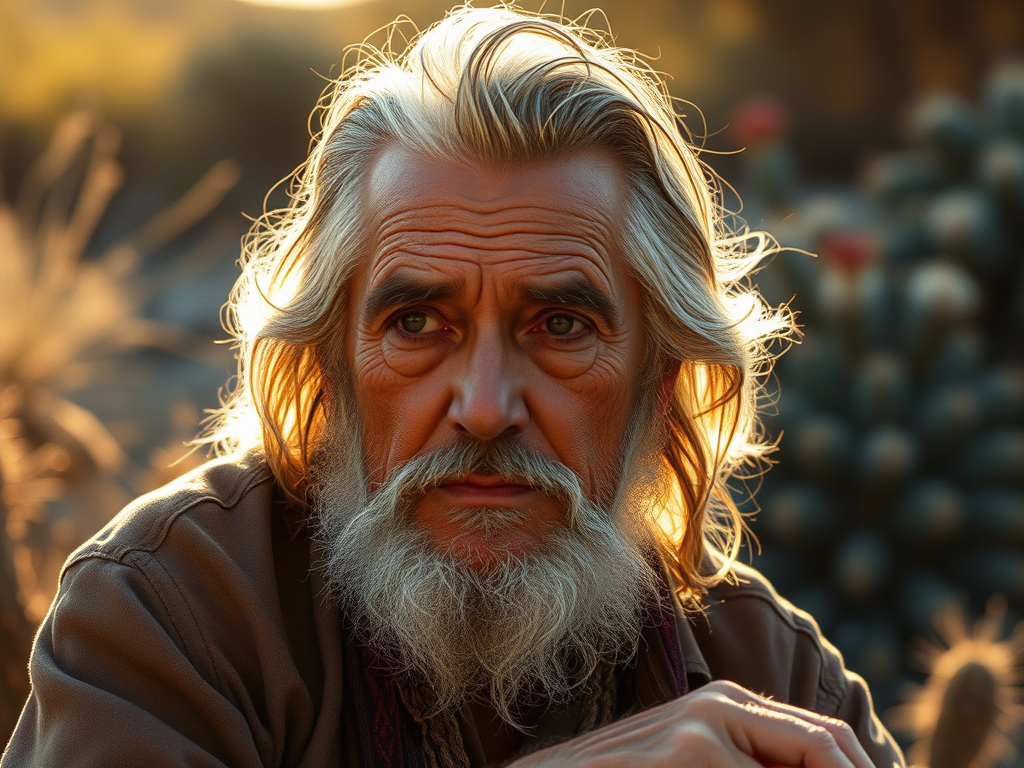
Carlos Castaneda

Carlos Castaneda (1925-1998) was an American author and anthropologist known for his controversial and influential series of books on shamanism and spirituality. Castaneda’s most famous work is “The Teachings of Don Juan: A Yaqui Way of Knowledge,” first published in 1968. This book and the subsequent volumes in the series purported to chronicle Castaneda’s experiences studying under a Yaqui Indian shaman named Don Juan Matus in the deserts of the American Southwest.

In his books, Castaneda describes his initiation into the world of shamanism, detailing his encounters with Don Juan and the teachings he received on topics such as perception, consciousness, reality, and the nature of existence. His writing style blends ethnography, personal narrative, and philosophy, creating a unique and engrossing account of his spiritual journey. Despite the popularity of his books, Castaneda’s work has been met with scepticism and criticism from various quarters. Some scholars and anthropologists have questioned the accuracy of his accounts, suggesting that he may have embellished or fabricated elements of his experiences with Don Juan. Others have raised concerns about the ethical implications of Castaneda’s interactions with indigenous cultures and the commercialization of his teachings.

Nevertheless, Castaneda’s books have had a lasting impact on popular culture and the New Age movement. His writings have inspired generations of readers to explore alternative spiritual practices, indigenous wisdom, and the boundaries of human consciousness. Whether viewed as a profound spiritual guide or a controversial figure in the history of anthropology, Carlos Castaneda remains a compelling and enigmatic figure in the realm of mystical literature. 

Image by AI

H.G. Wells

Herbert George Wells, known as H.G. Wells, was a prominent English writer born on September 21, 1866, in Bromley, Kent, England. He is best known for his science fiction novels and works of social commentary. Wells was born into a working-class family. He struggled with health issues and financial constraints throughout his childhood. Despite facing challenges, Wells won a scholarship to the Normal School of Science in London, where he studied under Thomas Henry Huxley. He later earned a degree in biology.

Wells began his writing career as a novelist and journalist. He gained fame with works like “The Time Machine” (1895), “The Invisible Man” (1897), and “The War of the Worlds” (1898), which established him as a pioneer of science fiction. In addition to his science fiction, Wells wrote extensively on social and political issues. Works like “The War in the Air” (1908) and “The Shape of Things to Come” (1933) reflected his concerns about humanity’s future. He was known for his unconventional personal life. He had numerous affairs and marriages, including his relationship with writer Rebecca West. As he grew older, Wells’ writing shifted towards non-fiction and social criticism. He continued to write and lecture on various topics until his death. He is considered one of the founding fathers of science fiction and a key figure in the genre’s development. His works have had a lasting impact on popular culture and continue to be studied and adapted today.

H.G. Wells passed away on August 13, 1946, in London, leaving behind a rich literary legacy that has inspired generations of writers and readers. 

Image by AI

The Sacred Spear

Once upon a time, in a realm shrouded in mystery and magic, there existed a sacred spear known as “Aetherion’s Grace.” This legendary weapon was said to be forged by the gods themselves and imbued with divine power to protect the land from darkness and chaos. The spear was crafted from a rare metal found only in the heart of the deepest mountains. Its tip sparkled with a brilliant light that could pierce through the shadows of evil. Its handle was adorned with intricate runes that glowed with soft, ethereal light, and those who wielded it were said to be blessed with great strength and courage. Legends spoke of a chosen hero destined to wield Aetherion’s Grace in times of great peril, to stand against the forces of darkness that threatened to consume the world. Many brave warriors sought the spear, but only the purest of hearts and the strongest of spirits could hope to claim it as their own.

One day, a young warrior named Elara heard the call of the gods and set out on a quest to find the sacred spear. Along her journey, she faced many trials and challenges, battling fierce monsters and overcoming treacherous obstacles. But with determination and unwavering faith in her cause, she pressed on. Finally, after a long and arduous journey, Elara reached the hidden temple where Aetherion’s Grace was kept. As she approached the altar where the spear lay, a blinding light filled the chamber, and the voice of the gods echoed through the halls, proclaiming her as the chosen one.

Elara lifted the sacred spear with trembling hands, feeling its power course through her veins. She knew her true test was yet to come, for a great darkness loomed on the horizon, threatening to engulf the land in shadow. As the forces of evil gathered for their final assault, Elara stood tall, her grip firm on Aetherion’s Grace. With a fierce battle cry, she charged into the fray, the light of the spear shining like a beacon of hope in the darkness. The battle raged on, but Elara fought with unmatched skill and bravery, her every strike guided by the divine power of the sacred spear. Ultimately, she emerged victorious, the forces of darkness vanquished, and the land was saved from destruction.

And so, Elara became a legend in her own right, known throughout the realm as the hero who wielded Aetherion’s Grace and saved the world from certain doom. The sacred spear remained a symbol of hope and courage for generations to come, a reminder that even in the darkest of times, the light of bravery and righteousness would always prevail. 

Image by AI

Fyodor Dostoevsky

Fyodor Dostoevsky, a renowned Russian novelist, philosopher, and essayist who lived from 1821 to 1881, is considered one of the greatest psychological novelists in world literature. His works often explored human psychology, morality, and the complexities of the human soul. Dostoevsky was born on November 11, 1821, in Moscow, Russia. He came from a middle-class family and was raised in a strict religious environment. After studying engineering, he decided to pursue a career in writing. His early works were well-received, but his later novels brought international acclaim.

Dostoevsky’s most famous works include “Crime and Punishment,” “The Brothers Karamazov,” “The Idiot,” and “Demons” (also known as “The Possessed”). These novels delve into themes such as morality, redemption, faith, and the nature of good and evil. Throughout his life, Dostoevsky faced personal challenges, including financial difficulties, health problems, and losing loved ones. He was also imprisoned and sentenced to death for his involvement in a political group, an experience that deeply influenced his writing.

Despite his struggles, Dostoevsky continued to write prolifically and produced some of the most enduring works in Russian literature. His novels are celebrated for their psychological depth, philosophical insights, and exploration of the human condition. Fyodor Dostoevsky died in Saint Petersburg, Russia, on February 9, 1881. Today, he is remembered as a literary giant whose works continue to inspire readers and provoke thought on the complexities of human existence. 

Image by AI