Lost in Mist

Once upon a time, in a small town, lived a man named David who had a deep, unconditional love for his mother, Margaret. As a child, David had always admired her strength and warmth; she was his guiding light. But as the years passed, Margaret developed dementia, a cruel thief that slowly stole away her memories and her essence. At first, the changes were subtle. She would forget where she placed her glasses or repeat the same story she had shared moments before. David brushed it off as part of ageing, but as time went on, the forgetfulness escalated. Margaret began to forget names, faces, and even her own son. Despite the heartache, David remained steadfast. He visited her daily, bringing her favourite flowers and sitting beside her as they watched old movies together. He learned to speak in a way that reached her heart rather than her mind, sharing stories that evoked feelings rather than facts. He held her hand tightly, reminding her of their love, even when she struggled to recognise him.

During a particularly difficult visit, Margaret looked at David blankly. He felt despair wash over him for a moment, but then he remembered the countless moments of joy they had shared. He took a deep breath and began to sing her favourite lullaby, the one she used to sing to him as a child. Slowly, her eyes brightened, and a faint smile crept onto her lips. In that moment, David realized that while her memories may fade, the bonds of love remained unbroken. As the disease progressed, their roles began to shift. David became the caretaker, navigating the complexities of her care with patience and grace. He learned to celebrate small victories: the days when she recognized him, the moments when she laughed at a joke, or even simply when she smiled. Each of these moments became precious gems in the tapestry of their relationship.

Through it all, David found solace in the love that still flickered in his mother’s eyes. He understood that love transcended memory; it was a feeling that could not be erased. He dedicated himself to ensuring that Margaret felt safe and loved, surrounding her with familiar scents, sounds, and stories that connected her to the life they once shared. As the years passed, David’s unwavering devotion became a testament to the power of unconditional love. Even in the face of loss, he focused not on what was fading but on what remained. In his heart, he carried the essence of his mother, a woman who had taught him strength, compassion, and the true meaning of love. In the twilight of her life, Margaret may not have remembered her son, but David knew their love would forever linger, a beautiful melody echoing through the corridors of his heart. And so, he continued to sing, not just for her, but for the bond that would never fade—a love that endured beyond memory, an eternal love.

J.K. Rowling

J.K. Rowling, whose full name is Joanne Rowling, is a British author best known for writing the “Harry Potter” series. The series consists of seven fantasy novels that follow the life and adventures of a young wizard named Harry Potter and his friends Hermione Granger and Ron Weasley, all of whom are students at Hogwarts School of Witchcraft and Wizardry. The books have become immensely popular worldwide, leading to a successful film series, merchandise, and a dedicated fan following.

Aside from the Harry Potter series, J.K. Rowling has also written other works, including “The Casual Vacancy,” a novel for adults, and the Cormoran Strike series under the pseudonym Robert Galbraith. J.K. Rowling has been praised for her contributions to literature and criticized for her views on specific social and political issues. 

Elian and the Wolf

Once upon a time, in a tranquil village nestled between towering mountains and lush forests, there lived a humble man named Elian. Known for his kindness, Elian spent his days tending to his small farm and helping his neighbours. However, he often felt lonely amid the beauty surrounding him. One fateful evening, as the sun dipped below the horizon, casting a golden hue over the land, Elian stumbled upon a wolf cub abandoned near the edge of the woods. Its fur was a soft grey, and its bright and curious eyes mirrored the young wolf’s innocence. Despite the warnings of the villagers, who believed wolves were dangerous, Elian’s heart swelled with compassion. He knew this cub needed a protector and felt an inexplicable bond forming between them.

Elian took the cub home and named him Kael. As days turned into weeks, the two became inseparable. While Elian taught Kael the ways of the world, Kael brought joy and adventure into Elian’s life. Together, they explored the forests, played by the river, and sat by the fire at night, sharing stories of bravery and dreams. As Kael grew, so did their bond. He became not just a companion but a guardian as well. The villagers, initially wary, began to see the gentle nature of the wolf cub and how dedicated Elian was to nurturing him. They watched as Kael learned to respect the land, helping Elian by keeping the farm safe from pests and providing companionship.

A severe storm hit the village one winter, isolating it from the outside world. Food supplies dwindled, and fear gripped the villagers’ hearts. Elian knew he had to act. He and Kael ventured into the harsh wilderness to find help. Through blinding snow and biting winds, their journey was filled with challenges, but the bond they shared fueled their determination. After days of searching, they discovered a nearby village that had supplies to spare. With Kael’s keen instincts and Elian’s unwavering spirit, they managed to gather enough food and bring it back home, saving the villagers from starvation. When they returned, the villagers rejoiced, celebrating Elian and Kael’s bravery. No longer seen as just a man and a wolf, they were now regarded as heroes. The village thrived once more, and Elian found a sense of belonging he had longed for.

Years passed, and Kael matured into a magnificent wolf, his spirit untamed yet loyal. Together, they faced the changing seasons of life, their bond only growing stronger. Elian knew that their story was one of devotion, a testament to the love that can flourish between the most unlikely of companions. In the end, Elian and Kael became legends, their tale woven into the fabric of the village’s history—a reminder that true friendship knows no bounds and that love can bridge the gap between species, proving that sometimes, the most profound connections come from the heart. 

Image by AI

Philippa Gregory

Philippa Gregory is a British historical novelist known for her works in historical fiction, particularly historical romances and thrillers. She was born on January 9, 1954, in Nairobi, Kenya. Gregory’s most famous works include “The Other Boleyn Girl,” which tells the story of Mary Boleyn and her sister Anne Boleyn, who both had relationships with King Henry VIII. This novel was adapted into a successful film in 2008, starring Natalie Portman and Scarlett Johansson.

She has written many other novels set in various historical periods, including the Tudor era, the Wars of the Roses, and other significant periods in British history. Some of her other notable works include “The White Queen,” “The Red Queen,” and “The Kingmaker’s Daughter.” Gregory’s writing is known for its rich historical detail, complex characterizations, and engaging storytelling. She often focuses on women’s lives in history and explores their roles and relationships in the context of the broader historical events of their time.

In addition to her novels, Philippa Gregory has written non-fiction works on the Wars of the Roses and the Tudor period. She is a popular and prolific author with a large and dedicated following of readers worldwide. 

Image by AI

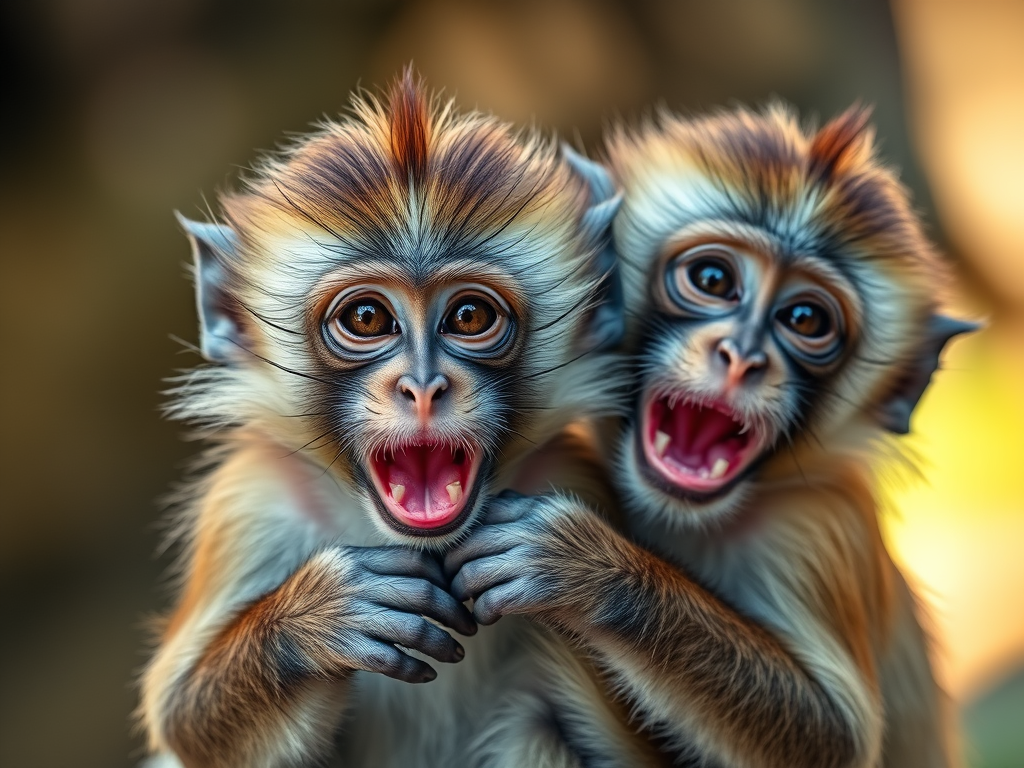
Two Little Monkeys

Once upon a time in a bustling city zoo, lived two identical twin monkeys named Max and Milo. They were the stars of their enclosure with their bright eyes, playful nature, and strikingly similar appearances. However, despite their playful antics for visitors, the twins felt a deep sense of unhappiness. Their days were filled with the same routines, the same visitors, and the same banana treats. They longed for adventure beyond the confines of their cage. One day, as they swung from branch to branch, Max had a brilliant idea.

“What if we use our identical looks to confuse the keepers? We could escape and explore the world beyond this zoo!”

Milo’s eyes sparkled with excitement.

“Yes! We can switch places! They won’t know who’s who!”

That night, as the zoo quieted down and the moon cast a silver glow, the twins put their plan into action. They practised their mimicry, copying each other’s movements and sounds. When morning came, the keepers arrived, unaware of the mischief about to unfold. As the keepers entered their enclosure, Max climbed high into the branches while Milo hung back, pretending to groom himself. When the keeper called out for them, Max swung down, but at the last moment, he let out a loud screech, startling the keeper. In the confusion, Milo took the chance to leap into the opposite corner, making it look like he was still in the same spot. The keepers were baffled.

“Wait, which one is which?” one of them exclaimed, scratching his head.

The twins exchanged mischievous glances, stifling their laughter. They knew they only had a short window before the keepers figured it out. As the day went on, the twins continued their clever ruse. They switched places during feeding time, and when the keepers tried to separate them, they would jump and play, making it impossible to tell who was who. The twins revelled in their newfound freedom to roam their enclosure without supervision, but they knew it was just a matter of time before the keepers caught on. That evening, when the zoo was closed to the public, Max and Milo knew it was time for the final phase of their escape. They waited until the keepers were distracted and then darted out of their enclosure, using the shadows to hide. They climbed over fences and squeezed through gaps, their hearts racing with excitement. Finally, they found themselves outside the zoo, standing in the cool night air. The world beyond was vast and filled with the sounds of nature. Max looked at Milo, his eyes wide with wonder.

“We did it! We’re free!”

With newfound courage, they ventured into the nearby park, trees towering above them like old friends. They swung from branches, chased fireflies, and feasted on wild fruit, their laughter echoing in the night. For the first time, they felt truly alive. As dawn broke, the twins knew they could not stay in the park forever. They missed the comfort of each other and the familiar routines, even if they were unhappy. So, they decided to return to the zoo, but not as prisoners. They would find ways to bring joy to their lives, using their cleverness to entertain not just visitors but also themselves. When they returned, the keepers were in disbelief, having searched high and low for the mischievous twins. Max and Milo resumed their antics, but now, with a sparkle in their eyes, knowing the world outside was filled with possibilities. They learned to embrace the zoo life with newfound joy, always planning little adventures and reminding each other that sometimes, happiness was a matter of perspective. And so, the twin monkeys lived on, not just as entertainers but as adventurers in their own right, forever bonded by their shared escapade and the spirit of freedom.

Image by AI