Lazarus Carpenter
I have lived in Wales for over twenty five years. Born in North Yorkshire, I am now an author, actor, musician and song writer, previously being a therapist, trainer and researcher, specialising in mental health. He was educated in Middlesbrough, Sheffield and Cambridge. With a fascination for Welsh History, I create worlds within worlds; magical, haunting, spirituality permeating sound moral codes of life. I live quietly with Debbie Eve (also my illustrator and our dog, Noodle in a small cottage surrounded by the beauty of the Brecon Beacons in the Valleys of South Wales.
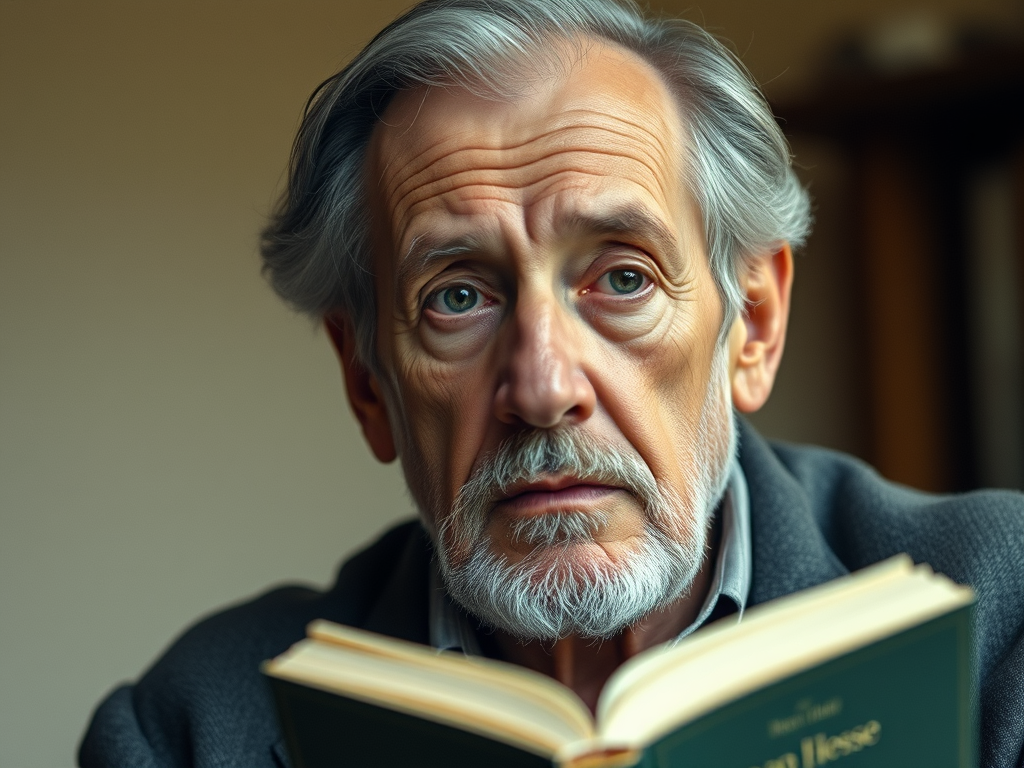
Herman Hesse was a German-Swiss author, poet, and painter, born on July 2, 1877, in Calw, Germany, and died on August 9, 1962, in Montagnola, Switzerland. He is best known for exploring individual spirituality and self-discovery, often delving into themes of duality, nature, and the human psyche.
Steppenwolf (1927) – This novel explores the conflict between the individual and society, focusing on a man named Harry Haller who feels split between his human and wolf-like instincts.
Siddhartha (1922) – A philosophical novel that follows the journey of a young man in ancient India as he seeks enlightenment, reflecting Hesse’s interest in Eastern spirituality.
Demian (1919) is a semi-autobiographical novel about self-realization and the struggle against societal norms.
The Glass Bead Game (1943) – Often considered his magnum opus, this novel imagines a future society that values intellectual and artistic pursuits above all, exploring the nature of culture and knowledge.
Hesse’s work was heavily influenced by his own experiences, including his struggles with identity and mental health. He was associated with the German Expressionist movement and later became a key figure in the counterculture of the 1960s, particularly among those seeking alternative spiritual paths. He was awarded the Nobel Prize in Literature in 1946. Hesse’s writings resonate with readers today, appealing to those interested in philosophy, psychology, and the quest for meaning in life. His exploration of the inner self and the pursuit of authenticity remains relevant in contemporary discussions of personal growth and spirituality.
In December of 2022, I had a dream to bring alive the story of Craig y Nos Castle, to relate the history, its life and times but in that of a novel format. Then, the idea came to write the story from the ‘first person’ perspective as an observer of the comings and goings of life in this Gothic mansion. What better, thought me, than to be a lump of rock in the foundations mined from the Cribarth, overlooking Cae-Brynmelyn-Bach opposite Pentrecribarth farm? Deep in the foundations I would be aware of everything that happened through vibrations emanating within the walls. Thus, the title was born, ‘Walls Have Ears’. Craig y Nos Castle has a long history of paranormal occurrences. As a ‘trance psychic channel’ I felt an opportunity presented itself to incorporate the words and stories of the spirits still present, combined with tales gained through actual historical facts and interviews with people who had family and work connections with the castle through the years. Thus my research began both with those alive, and those long gone to the world of spirit.
Abstract
I know not how long I have lain upon the Cribarth, here so high on this craggy ridge amidst passing clouds looking down to the valley below. Back in the mists of time, volcanoes roared, earthquakes cracked mountains, ice thawed, and beds of limestone and Twrch sandstone were laid down in sedimentary layers in tropical seas near the equator some 350 million years ago. They arrived where they are today by continental drift, and since then, here is where I have been, and much has passed me by. Many have trod over me through millennia, ancient Celts, Druids, invaders from Rome and England. But I am a rock, and I remember everything passing through time as only a rock can. Staring down the valley below, I see a tall man whom I know to be Captain Rice Davies Powell, distinguished, suited and whiskered, leaning on an ebony walking cane with a hand grip of gold. He stands on a field I know as Cae-Brynmelyn-Bach opposite Pentrecribarth farm. It is late in the Autumn of 1843, leaves falling and floating through the air, blown by easterly winds gather beneath stone walls and footings covering ground as a carpet of bronze. Captain Rice Davies Powell shielded his eyes with a gloved hand, the noonday autumnal sun momentarily blinding more than ambition. His companion was a much smaller yet rotund man in his fifties, with bushy dark hair swept back over a checkedcoat collar. He stood with a sketchpad in one hand and charcoal in the other. Thomas H Wyatt was an architect of some renown, and being far from his offices in Great Russell Street, London, he stood looking at the empty field of Cae-Brynmelyn-Bach. A tall,
stooped, thin man with wispy, greying hair stood at Thomas Wyatt’s shoulder. His partner, David Brandon, accompanied him travelling from their offices by rail to Swansea and then coach and four to Pentrecribarth for a planning meeting with Captain Powell. Both were well-known architects at this time, responsible for building numerous Gothic-style churches, public buildings and private mansions.
Graham Greene was an English novelist, playwright, and critic born on October 2, 1904, in Berkhamsted, Hertfordshire. He is known for his exploration of moral ambiguity and human conflict, often set against geopolitical backgrounds.
Greene’s early life was marked by a strict upbringing, with his father being a headmaster. He attended Balliol College, Oxford, where he developed a passion for literature. His literary career began in the 1920s, and he gained fame with novels such as “Brighton Rock” (1938) and “The Heart of the Matter” (1948). These works often delve into themes of faith, guilt, and the complexities of human nature.
Throughout his career, Greene wrote over twenty novels, along with short stories, plays, and screenplays. He also worked as a journalist and was involved in various political and social causes, which influenced his writing. Greene’s experiences during World War II and his travels in Africa, Cuba, and Vietnam provided rich material for his narratives.
In addition to fiction, Greene was known for his non-fiction works and essays, often reflecting his views on politics and religion. He was also a devout Catholic, and his faith significantly shaped his worldview and literary themes.
Greene received numerous accolades for his contributions to literature, including being nominated for the Nobel Prize in Literature multiple times. He passed away on April 3, 1991, in Vevey, Switzerland, leaving behind a profound legacy that continues to influence writers and readers today. His work remains relevant for its deep psychological insight and exploration of moral dilemmas
The King of ancient Gwynedd ceased fiddling with his beard and called across to the dragons. Raising a hand towards the greatest of dragons beckoned encouragement.
“Tan-y-Mynedd, the table is yours, my old friend.”
Tan-y-Mynedd sat on his huge haunches, fluttered loosely folded wings and shook his head. Flaring those rather unpredictable nostrils, his proud chest expanded, taking in the deepest of breaths.
As the great dragon inhaled, everybody, including the other dragons, ducked to seek cover. The large goblin disappeared within a flash under the grand oak table, tankards and food flew precariously in every conceivable direction. Carron and his friend took to flight, joining the other ravens perched high upon an outcrop on the cave wall above our heads. The eagle spread his enormous wings and in three sharp flaps, alighted to accompany the ravens. Needless to say, a slight squawking of discontent and fluttering of wings welcomed their elder. Fwynedd and the elven seer joined the goblin under the table, also accompanied by several dwarves, including me. It was only those from the other world that did not flinch. Math Fab Mathonwy, Myrddin Goch ap Cwnwrig, and Llwyd ap Crachan Llwyd, remained in their seats, amused by the spectacle unfurling. Tan-y-Mynedd gasped, uttered a slight cough and very slowly exhaled. He surprised us all as he controlled the whirlwind gusts he usually created, thus no damage was done, save for the flying food.
The great dragon exploded into uncontrollable laughter. Within no time, everybody scrambled from under the table, attempting to return to their seats with as much grace as the situation would allow. We all joined him in seeing the funny side of our chaotic bid for cover. The eagle returned, landing on the branch of one of the Tree Folk. Carron and his friend fluttered down from the outcrop of rock, alighting gently on a chair close to Tan-y-Mynedd. Fwynedd regained his composure and gently assisted the Elven seer to maintain her dignity by lifting her light body back onto the seat. By now, the entire cave echoed with the sound of goodhearted laughter.
“You see, I can control myself when I am of a mind to do so!” Tan-y-Mynedd laughed again. “You always think there will be disaster when I prepare to speak. Well, my friends, the only disaster is with you for thinking such in the first place.” He laughed again, as did everybody else. “And now, we have had enough frivolity, it is to business.” Tan-y-Mynedd paused.
Calmness and silence eroded the humour which had now dissipated within the ether, replaced by attention and focus to the duty confronting this ancient Great Council of Blue Stone.
“We are familiar with all we need to be familiar with. We know storm clouds linger on the horizon and the English are behind such inclemency in our Kingdom. We will not waste time with whys and wherefores as we are beyond such trivialities.” A murmur of agreement whipped up a stir from the listeners, but a cursory snort from the great snout of Tan-y-Mynedd soon silenced them. “To continue, if I may be permitted?” He snorted again. “All is now in place, as predicted by ‘The Prophecy’. Owain Glyndwr is, as we speak, receiving news of yet more betrayal from Henry. He who sits on the black throne rules unfairly, and Glyndwr will no longer endure lies and deceit. In twenty-one months, as the clouds continue to gather before the great storm, the sun will blaze across our land, and our Prince in Waiting will at last take his rightful place.” Tan-y-Mynedd flared his nostrils, but this time, nobody moved a whisker. Spreading his wings and standing erect, he inhaled forcefully. “The rise of the dragon!” He exclaimed. Everybody applauded, banged fists and tankards on the table, cheering in agreement. It was at that moment, Tan-y-Mynedd sneezed!


 Lazarus Carpenter - Author