Keir Starmer’s Concerns About Elon Musk

Keir Starmer’s concerns about Elon Musk stem from several interconnected issues related to social media, misinformation, and democratic integrity. When Musk acquired Twitter (now known as X), he implemented significant changes to the platform’s content moderation policies. These changes included reducing the workforce responsible for managing harmful content, which raised alarms about the potential increase in the spread of misinformation and hate speech.

Starmer and other critics argue that social media platforms, like X under Musk’s leadership, play a crucial role in shaping public discourse. Without adequate safeguards, these platforms can become vehicles for spreading false information, which can distort public perception and undermine trust in democratic institutions. This is particularly worrisome during election periods, where misinformation can influence voter behavior and election outcomes.

Moreover, Musk’s approach to free speech, which he often champions as a justification for his decisions, is seen by some as overly permissive, allowing harmful content to proliferate under the guise of protecting open dialogue. Starmer’s concerns reflect broader apprehensions about the responsibilities of tech giants to ensure that their platforms do not contribute to societal harm.

In addition to misinformation, there are worries about how Musk’s influence and personal views might shape platform policies in ways that could affect political dialogue. This situation highlights the broader debate over the power held by tech moguls and their platforms in the digital age, and the need for regulatory frameworks to ensure accountability and protect democratic values. 

Maurice Sendak

Maurice Sendak was an influential American author and illustrator, best known for his children’s books. His most famous work, “Where the Wild Things Are,” published in 1963, tells the story of a young boy named Max who sails to an imaginary land inhabited by wild creatures. The book is celebrated for its imaginative narrative and intricate illustrations, which capture the emotions and adventures of childhood.

Sendak’s work often explores themes of childhood fears, imagination, and the complexities of growing up. He drew inspiration from his own experiences and childhood, as well as from his Jewish heritage. His other notable works include “In the Night Kitchen,” “Outside Over There,” and “Higgledy Piggledy Pop!”

Beyond his books, Sendak’s artistic influence extended to theater and opera, where he designed sets and costumes. His distinctive style and ability to address profound emotions in a way that resonates with both children and adults have solidified his legacy as a cornerstone of children’s literature.

Max and Bella

Once upon a time, in a serene mountain village blanketed in snow, two dogs named Max and Bella set off on an adventurous stroll. Max, a spirited golden retriever, loved bounding through the snowdrifts, while Bella, a wise and gentle border collie, kept a watchful eye on her friend. The crisp air filled their lungs as they wandered down the winding path, and the world around them sparkled like a million diamonds. They chased each other, playfully leaping through the drifts, but soon, their frolic turned into a mission when they caught a faint sound in the distance—a low, desperate moan.

Curiosity piqued, and the two dogs followed the sound, weaving between the trees until they reached a clearing. There, nestled against a snowbank, lay an injured man. He was bundled in a thick coat, but his face was pale, and he clutched his leg, which was trapped awkwardly beneath him. Max approached first, his tail wagging cautiously. Bella, ever the protector, stayed close behind, her instincts sharp. The man looked up, his eyes widening with surprise and relief.

“Help me, please,” he gasped, his breath visible in the cold air.

Realizing the situation’s urgency, Bella barked encouragingly while Max nudged the man’s hand with his nose, trying to offer comfort. The man managed a weak smile, and with great effort, he shifted his weight, attempting to free his leg. Bella darted around, sniffing for a way to help. She spotted a fallen branch nearby, and with a quick bark, she grabbed it and brought it to the man. Understanding her intention, he used the branch to prop himself up, easing the pressure on his trapped leg. With Max’s encouragement, the man slowly crawled to a nearby tree, using it for support. Bella stayed by his side, her warmth and presence giving him the strength he needed. After several painstaking minutes, he managed to stand, albeit shakily.

“Thank you, good friends,” he said, his voice stronger now. “I don’t know what I would have done without you.”

The dogs wagged their tails, proud of their newfound friend. Sensing that the man needed further help, they guided him back up the path they had come, leading him toward the village where others could assist him. As they reached the edge of the village, the man’s strength began to falter again. Just then, a couple of villagers spotted them and rushed over. With their help, the man was taken to safety and treated for his injuries. Max and Bella stood by, watching as the villagers surrounded their new friend, smiling with gratitude all around. The man turned, his eyes twinkling with appreciation. “Thank you, my brave companions,” he called out. You saved my life today.”

From that day on, the two dogs became legends in the village, known not just for their playful antics but also for their brave hearts. Every winter, when the snow fell softly on the mountains, the man would return to the spot where he had been found, bringing treats for Max and Bella, ensuring that their bond would last a lifetime. 

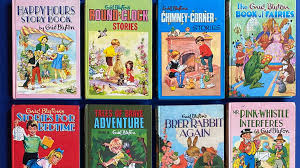
Enid Blyton

Enid Blyton (1897–1968) was a prolific British author known for her children’s books, which have captivated young readers for generations. She is best known for her series, including “The Famous Five,” “The Secret Seven,” and “Malory Towers,” which often feature themes of adventure, friendship, and mystery. Born in East Dulwich, London, Blyton had a passion for storytelling from a young age. She worked as a teacher and a governess before dedicating herself to writing full-time. Her first book was published in 1922, and she quickly gained popularity, producing over 700 titles throughout her career.

Blyton’s writing is characterized by its straightforward style, engaging plots, and relatable characters, making it accessible for children. Her work often reflects her love for nature and the outdoors, with many stories set in rural landscapes. Despite her success, Blyton’s work has faced criticism over the years for its perceived lack of depth and outdated themes. Nevertheless, her books have remained in print and continue to be loved by new generations.

Enid Blyton’s legacy endures, and her influence on children’s literature is significant, inspiring countless readers and writers alike. 

The Man Who Made a Difference

Once upon a time, in a bustling city, there lived a wealthy man named Alexander. He was known for his lavish lifestyle, opulent parties, and collection of rare artefacts from around the globe. Despite his wealth, Alexander felt an emptiness inside, a nagging sense that he was not making a meaningful impact on the world. One day, while attending a charity gala, Alexander overheard a conversation about climate change and its devastating effects on the planet. The statistics were staggering: rising sea levels, deforestation, and species extinction threatened the fabric of life on Earth. For the first time, he felt a spark of urgency and purpose.

Determined to make a difference, Alexander decided to use his resources for the greater good. He gathered a team of environmental scientists, activists, and innovators to brainstorm solutions. They realized that one of the biggest challenges was funding clean energy projects, sustainable agriculture, and reforestation efforts. With his wealth, Alexander launched the “Green Future Initiative,” a global campaign to combat climate change. He invested in renewable energy technologies, funded research for sustainable farming practices, and supported reforestation projects in deforested areas. He also partnered with local communities, ensuring that their voices were heard and that they benefitted from these projects.

As word spread about his efforts, more people joined the cause. Other wealthy individuals began to contribute, inspired by Alexander’s vision. Schools started teaching children about sustainability, and communities organized clean-up drives and tree-planting events. The movement grew, and soon it became a worldwide phenomenon. Years went by, and Alexander’s initiative began to show remarkable results. Cities transformed as they shifted to renewable energy sources, forests were restored, and wildlife returned to their natural habitats. The air became cleaner, and people started to notice the difference.

But it wasn’t just the environment that changed. Alexander found fulfilment in his work, building connections with people who shared his passion. He realized that true wealth lay not in material possessions, but in the impact, one could have on the world. Eventually, Alexander stood before a global summit, addressing leaders and citizens alike. He shared how a rich man, once lost in a world of luxury, had found purpose through service. He urged everyone to take responsibility for the planet and reminded them that change begins with a single action. As the audience erupted in applause, Alexander smiled, knowing that he had not only saved the world from impending doom but had also discovered his own place within it—a legacy built on hope, unity, and the unwavering belief that anyone, regardless of their background, could make a difference.