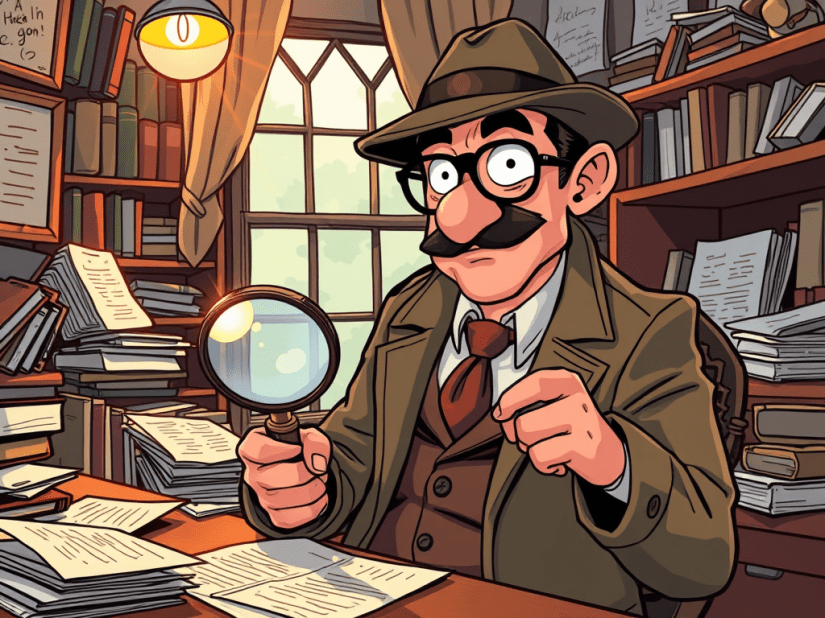
Inspector Septimus Summer-Garden stood in the town library as if it were a case to be tidied away with a broom and a glossary. He wore his badge with the solemnity of a knight donning armour, though his armour consisted mostly of a belt that wouldn’t stay up and a hat that seemed to sprout its own opinions. The locals liked Septimus well enough, he had a way of tripping over his own conclusions and then tripping over the truth, which somehow made him endearing and mildly infuriating in equal measure.
The trouble began with a silence too loud for a building full of quiet readers. The Missing Books, as the notice on the librarian counter announced in bold black letters, were not ordinary books. They were the kind of books that earned a groan from the town if you misplaced them: a first edition of a local poet’s collected odes, a bound map of the old railway lines, a child’s pop-up adventure about a dragon who loved to bake bread. The kind of books that made a librarian puff with pride and a thief itch with mischief.
Septimus arrived on the scene with two things: a notebook that looked like it had been used to mop a floor and a pen that clearly preferred nibs that didn’t exist. He stood in the main aisle, which was mostly empty except for a few readers who pretended they were not listening to the peculiarities of an inspector on a mystery buffet.
“Good morning,” he announced to no one in particular, tapping the notebook with a swagger that suggested it held all the answers, and possibly a sandwich recipe. “I understand we have… a situation.”
Mrs. Dillworth, the head librarian, emerged from behind a revolving door that sighed with a little protest whenever it rotated. She wore a cardigan that looked well-worn and well-loved, like a loyal cat that preferred to sleep among encyclopedias. Her eyes were a calm, patient blue, the sort that said she’d seen every kind of weather and still managed to keep the shelves neat.
“Inspector Summer-Garden, good to see you,” she said, with a half-smile that suggested she was amused by a child’s drawing and by the inspector’s hat at the same time. “We have Missing Books. The kind that make readers sigh and librarians sigh louder.”
Septimus puffed his chest in a motion of grand seriousness.
“I shall restore balance to literature, Mrs. Dillworth. Tell me what has vanished from the realm of reading.”
She pointed with a pencil toward the Rare Treasures shelf, where a placard proclaimed that the items there were not simply books but a trust placed in the town by generations of readers. The space around the shelf was unusually tidy, almost suspiciously so, as if someone had spent more time dusting than reading.
“Two volumes,” she explained. “A first edition by the town’s own favourite poet, and a vintage map that helps people understand how the railway once ran through our hills. Both were last checked out last Tuesday by oddly no one can recall the signature of who signed for them.”
Septimus squinted at the shelf as if he could peer through the glassy surface of the world and see fingerprints in the dust. He opened his notebook and scribbled with the sort of flourish that suggested he was signing his own autograph.
“A sign-out sheet that’s missing a signature is not a sign-out sheet,” he murmured, more to himself than to Mrs. Dillworth, who had a talent for waiting out his musings with a patient smile.
“Would you like a chair, Inspector? Or shall we begin with a search of suspects, readers, staff, and the mischievous wind that likes to tug at pages?”
Septimus straightened, which made his hat tilt at what could generously be called a jaunty angle.
“A thorough inquiry. Let us begin with the obvious: the staff. Then the readers. Then the wind.”
The first stop was the staff room, which had the curious habit of smelling faintly of coffee, pine polish, and old mysteries. A circle of chairs faced a whiteboard where a single question was scrawled: Where do books go when they decide to hide? The librarian on duty, Mr. Finch, was as even-keeled as a well-balanced scale. He looked at Septimus with a calm that suggested the inspector might be asking about a missing teacup rather than missing literature.
“Inspector,” Mr. Finch began, as if he were about to lecture a class of unruly children on the virtues of orderly shelves, “the two volumes in question are not lost to the city. They’re simply misplaced, or more accurately, borrowed by someone who forgot to bring them back. The list of sign-outs from last Tuesday shows that several patrons checked out multiple items. It’s not uncommon in summer, people take advantage of their holidays.”
Septimus tapped his notebook again, this time with a rhythm that sounded suspiciously like a lullaby.
“Or, let us consider the vanishment of intention. Perhaps a cunning thief has learned to wear the cloak of a reading habit.”
Mr. Finch gave him a look that suggested both pity and amusement.
“If a thief wore a cloak of reading, they’d be more likely to return the cloak than the book.”
Outside the staff room, Septimus conducted a line of inquiry with readers in the Reading Alcove, which was a sanctuary of cushions and soft light. He asked a grandmotherly woman who was knitting a scarf from the old library map thread, a teenager who wore headphones as if they were a part of his personality, and a shy man who kept glancing to the door as if the library might be a theatre with an open-back stage. The grandmother, Mrs. Kettle, claimed she had checked out a poetry chapbook for her granddaughter’s school project. Her granddaughter, in turn, claimed she had not left the poetry chapbook at home but had not borrowed it either. The teenager swore he had not touched the Rare Treasures shelf in weeks, though his eyes wandered toward it with the suspicious loyalty of a cat staring at a can of tuna.
Septimus wrote everything down carefully, with the dedication of a man who believed the writing of notes would outlive the crime. He asked the shy man if he had seen anything unusual, and the man admitted he had once overheard a conversation about a “book club” that might be meeting after hours. Septimus scribbled a new hypothesis: perhaps someone was using the library after hours, borrowing books without leaving a trace.
“After hours,” he repeated, testing the phrase as if it might reveal a secret password. “We must examine the after-hours claimant.”
Mrs. Dillworth appeared beside him, like a lighthouse steadying a boat.
“Inspector, may I remind you that the library is monitored by cameras and a clock that never lies?”
Septimus blinked.
“Monitors, clocks, and the truth. A fine trio.” He paused, suddenly looking quite earnest. “Is there any possibility, Miss Dillworth, that a book could be, how shall we phrase this, produced by the wind and the habit of shelves to slide?”
She smiled, the kind of smile that did not waver even when faced with a stranger’s oddities.
“In a well-ordered library, books do not walk away, though occasionally they’re moved by staff to accommodate displays, or borrowed by readers who forget to return them on time. The wind has nothing to do with it unless you’ve seen a gust in the Rare Treasures room.”
Septimus tipped his hat, which failed to hide a moment of vulnerability. He was a man who believed that every mystery began with a mislaid map and ended with a well-lit explanation. He pressed on, though his energy carried a hint of wobble like a chair with one leg slightly too short. That evening, Septimus returned to the scene of the crime or rather, the scene of the near-misses. The library was quiet as a held breath, the kind of quiet that invites the imagination to play tricks on you. He stood by the Rare Treasures shelf again, gazing at the two volumes as if they would suddenly open of their own accord and confess their whereabouts. A small, unassuming clue finally surfaced in the most unremarkable place: a tiny tag at the corner of the mapping book, tucked behind the spine of the poet’s first edition, reading in neat script, “Book Club Donations, Summer 2024.” It was not the sort of thing a thief would leave behind, and it did not scream “theft” so much as murmur “organization.”
Septimus stood very still and studied the tag as if it could reveal a deeper truth about the universe. The tag implied a new program: a “Summer Reading Club” that had recently started meeting after hours in the community room. The same room where the library’s policy declared that any club–type event should be approved by staff. Yet there had been no record of any such approval for the two volumes in question. The next phase of his investigation involved a quiet, careful conversation with the community room’s custodian, Mr. Alder, a cheerful man with a talent for telling stories that made even damp mops sound exciting. Septimus asked about after-hours activity. Mr. Alder admitted he had opened the room after hours for a local volunteer group called “Readers at Rest,” a name that sounded soothing and vaguely suspicious at the same time. He explained that during setup for a charity book sale, volunteers had moved some items to make space for a display of local authors and to stage a tiny theatre piece based on a children’s book. The Rare Treasures shelf, he said, had not been moved, but the map and the poet’s first edition had been relocated for the display.
Septimus’s face brightened with a sudden ray of half-clarity.
“So, the Missing Books are not missing at all, but relocated for a purpose and not properly logged?”
Mr. Alder shrugged with a merry honesty.
“They’ll be back in their rightful places after the sale, Inspector. We meant no harm. Just a little extra exposure for our town’s beloved literature.”
In that moment, Septimus felt a tug, the kind of tug that comes not from a rope but from a whispered realisation that the world’s mysteries sometimes wear friendly disguises. He wrote down a new theory: the crime was not theft, but transactional misdirection. The books hadn’t wandered off; they had been rehomed by well-meaning volunteers who forgot to notify the catalogue system.
The next morning, at dawn when the town’s roosters were still negotiating with the sun, Septimus convened a brief meeting in the library’s glass-walled foyer. Mrs. Dillworth stood beside him, looking both proud and exasperated, as quiet as the steady snowfall that never harms a garden.
“Ladies and gentlemen,” Septimus announced with a theatrical bow that wobbled just enough to remind everyone he wasn’t a professional actor, “we have discovered that the mysterious disappearance of the Rare Treasures was not a crime but a community cure. The books were relocated to the community room for a charity display and a little theatre project. They will return to their proper shelves after the event ends.”
Mrs. Dillworth gave a small clap of her hands, delighted by the resolution as a teacher is delighted by a correctly solved arithmetic problem. The staff and volunteers murmured their agreement, their relief clear in their relaxed postures and the seeds of good humour blooming in their expressions. Septimus, who had spent the day in a rather dramatic fashion searching for hidden panels and suspicious gaps in shelves, allowed himself a rare moment of humility. He pulled out the chair from behind his desk and sat with a quiet seriousness.
“I confess,” he told the room, though no one expected a confession from a man who wore a hat askew and carried a notebook that looked suspiciously like a map to the coffee machine, “I suspected a grand theft, a villain named Bibliophile with a penchant for dramatic exits. Yet the truth turned out to be simpler and, in its way, warmer.”
Mrs. Dillworth approached him, a hand on his shoulder that suggested both sympathy and a teacher’s patience.
“Inspector, it’s a good thing to chase a clue, and it’s an even better thing to find the truth and share it with the town. We’ll see you at the display, Septimus. Bring your notebook; there might be a few more clues in the margins.”
Septimus stood, brushing imaginary dust from his coat, then looked around the room as if noticing a painting for the first time. He could sense something in the quiet of the library, a kind of shared breath between readers and shelves, glueing the town together with stories. As he prepared to depart, a final thought occurred to him, the sort of thought that often comes after a long, wandering day in which the world isn’t as dramatic as the headlines promise, but far sweeter in its ordinary truth. He tipped his hat, a gesture that felt almost ceremonial now, and said to Mrs. Dillworth, with a hint of mischief she’d grown to tolerate,
“Librarians are the best detectives in town, aren’t they? They keep the story safe when the world forgets the plot.”
She nodded, and the two of them watched the town come alive with the hum of a morning that promised a charity sale, a theatre play, and a renewed sense of belonging to a shared library. The Missing Books, of course, returned to their rightful shelves when the charity display ended, their pages crisp with the memory of a summer’s hustle. The map found a new, glorious home in the geography corner, the poet’s first edition found itself back in the Rare Treasures room, and Septimus, well, Septimus had learned something essential: not every mystery deserves a magnifying glass. Some mysteries require listening, patience, and the gentle, stubborn honesty of a community that reads together, not merely for escape, but for the simple, stubborn joy of knowing that a library is a place where stories belong to all of us.
And so Inspector Septimus Summer-Garden, bumbling, brave, and forever hopeful, tipped his hat at the town, not with bravado, but with a quiet acknowledgment that in a library, the best clues are often heartbeats between people and the towering hush of books. He would have to humbly admit, if anyone pressed him for the truth, that his greatest discovery that day was not a missing volume catching him in a clever trap, but the warm, steady certainty that the shelves stood ready to hold not just books, but the town’s stories and the people who kept them alive. In the end, the case of the missing books wasn’t a case at all, but a reminder: in a place where stories live, every ending is merely a doorway to another beginning.

 Lazarus Carpenter - Author