Free, Fearless, and Forever a Champion.

A boy named Leo lived in a small town nestled between rolling hills and wide-open fields. Leo was born with a condition that made it difficult for him to walk without support. He wore sturdy callipers on his legs, which helped him stand and move but also made him feel different from the other children. Despite the challenges, Leo was full of dreams. He loved running, watching races on TV, and imagining himself crossing finish lines with a gold medal gleaming around his neck. His parents and friends cheered him on, constantly reminding him that his strength came from within.

Every day, Leo practised running with his callipers. Some days were tough, and he felt frustrated, but he never gave up. He believed that someday, he could run like everyone else—fast, free, and fearless. One bright morning, after many years of hard work and perseverance, Leo made a decision. He would cast off his callipers. With the help of his coach, family, and friends, he carefully removed them for the last time. It was a symbolic moment—an act of courage and hope.

The next day, Leo entered a local race. At first, his legs trembled, and doubts crept into his mind. But he remembered all the times he had practised, all the hurdles he had faced, and he pushed forward. To everyone’s surprise, Leo ran with a strength and determination that inspired everyone watching. His speed grew, and he crossed the finish line first. The crowd erupted in cheers, and Leo’s heart swelled with pride. That race was just the beginning. He trained harder, faster, and stronger, dreaming of bigger stages.

Years later, Leo qualified for the Olympics. He trained tirelessly, breaking records and defying expectations. When the marathon day arrived, Leo stepped onto the track, feeling nervous and excited. He remembered his journey with every stride, every struggle, every moment of doubt, and every time he had refused to give up. As he approached the final stretch, the crowd roared louder than ever. Leo surged forward, running with all his heart. And then, with one final burst of energy, Leo crossed the finish line in first place. The stadium erupted into applause. He had not only won a gold medal but had also shown the world that limitations are often just the beginning of new possibilities. Leo’s story inspired many, reminding everyone that with courage, perseverance, and belief in oneself, even the greatest obstacles can be overcome. From that day on, Leo ran beyond limits—free, fearless, and forever a champion.


The Blind Banjo Traveller

In a small, bustling town in the valley between rolling hills and shimmering rivers, lived a man named Enzel. Enzel was not an ordinary man—he was blind, yet his spirit shone brighter than the sun. His eyes, unseen to the world, saw through the melodies he played on his banjo, a weathered instrument with strings that hummed stories of hope and love. Enzel’s faithful companion was Jem, a wise and gentle guide dog with a nose for adventure and a heart full of loyalty. Together, they journeyed from city to city, village to village, spreading joy wherever they went.

Despite his blindness, Enzel’s sense of hearing was extraordinary. He listened to the whispers of the wind, the laughter of children, and the rhythm of life itself. His banjo was his voice—each note, word, song, and story. With Jem faithfully by his side, Enzel played wherever he could find an audience—under the shade of a tree, in a bustling marketplace, or on the steps of an old church. His music had a magical quality. It made people laugh, brought tears to their eyes, and reminded them of love in the simplest moments. Children would gather around, clapping their hands, their faces lit with wonder. Elders would close their eyes, swaying to the melodies that seemed to carry them back to days long gone.

One day, Enzel and Jem arrived at a small seaside village. The villagers had forgotten how to dream, weighed down by worries and hardships. Hearing Enzel’s music, however, their hearts began to lift. Enzel played a song about a star that guided lost sailors home—a song that shimmered with hope. As the notes floated over the waves, the villagers remembered the beauty of love, kindness, and community. They joined in singing, their voices blending with Enzel’s banjo, creating a harmony that healed weary hearts.

Years passed, and Enzel’s legend grew. His music travelled across continents, touching the lives of countless people. His story was one of resilience, kindness, and the power of love—proof that even without sight, one can see the world’s beauty with the heart.

The Dawn of Tim McDo

In a quiet town, lived a man named Tim McDo. His days were filled with solitude, his only companions the memories of a life once vibrant and full of promise. Tim had always been a gentle soul, but an accident—an unforgiving twist of fate—left him broken and lost, both physically and emotionally. The accident had stolen much from him: his mobility, his independence, and a part of his spirit. Tim dwelled in shadows for months, believing that life’s beauty had forsaken him. His world had shrunk to the stark walls of his small apartment, where he felt invisible, a ghost of the man he used to be. But life, as it often does, has a way of whispering hope when least expected.

One spring morning, as the sun shone golden light through his window, Tim noticed a small sprout pushing through the crack in his balcony. It was fragile, yet resilient, a tiny green miracle defying the odds. Something stirred within him—a faint flicker of curiosity and wonder. With cautious steps, Tim began nurturing the sprout. He watered it and watched over it, and slowly, it grew. As the days passed, he found himself venturing outside more often, walking with a cane but feeling lighter, as if the world was inviting him back into its embrace.

One day, while tending to his garden, Tim met Lily, a woman with a gentle smile and eyes that reflected understanding and kindness. She was a gardener, drawn to the same patches of earth that Tim now cherished. Their conversations blossomed like the flowers around them, filled with stories of resilience, hope, and the simple joys of nature. Lily saw beyond Tim’s scars and struggles. She saw the man beneath the pain—a soul capable of love, beauty, and rebirth. Their bond deepened, rooted in shared moments and mutual care. Over time, Tim discovered that his accident had not only changed his body but had also awakened a new perspective on life. He realised that true beauty and love often bloom from the hardest of soils, from the cracks where hope still whispers.

Ultimately, Tim’s journey was not just about healing his body but about rediscovering the love and beauty that had always been within him—and around him—waiting to be reborn. And so, under the same sun that once cast shadows, Tim McDo found his dawn, shining brighter than ever, proof that even after the darkest night, a new day begins.

Mira – Mistress of Dragons

Once upon a time, a wise and gentle woman named Mira lived in a peaceful valley cradled by towering trees and shimmering streams. Her silver hair flowed softly down her shoulders, and her kind eyes sparkled with the warmth of countless stories. Every evening, as the stars twinkled overhead, Mira would sit on a mossy stone, surrounded by a circle of tiny, curious baby dragons. These little dragons, with their shiny emerald, sapphire, and ruby scales, loved nothing more than listening to Mira’s stories. They would nestle close, their tiny wings fluttering excitedly as she opened her well-worn, leather-bound book.

“Tonight,” Mira began, her voice soft and soothing like a lullaby, “I will tell you the story of the Moonlit Blossom.”

The dragons’ eyes gleamed with anticipation. They adored tales of enchanted flowers and magical forests, especially when the flowers glowed under the full moon’s light. As Mira read, her voice danced through the evening air, describing a rare flower that blossomed only once a year, bathed in silver moonlight, spreading its gentle glow across the woods. She paused to gesture with her hands, mimicking the shimmering petals and the soft light, making the tiny dragons’ tails twitch with delight.

“Did you know,” she whispered, “this flower’s light can guide lost travellers home, just like a star in the night sky?”

The baby dragons giggled, their tiny voices like bubbling streams. They loved hearing how magic could be found in the smallest things. Mira gently turned the page, her eyes twinkling.

“And just like this blossom, each of you has a special light inside. You might glow so brightly one day that everyone will see your kindness and courage.”

The little dragons snuggled closer, feeling the warmth of her words and the magic woven into the story. Mira closed the book softly and leaned in closer.

“Remember, my dear ones, stories are the stars that guide us, the fires that warm us, and the wings that carry us to wondrous places.”

As the night deepened and the moon cast a silver glow over the valley, the baby dragons drifted into peaceful dreams, their hearts filled with hope and the magic of stories. Mira watched over them with a gentle smile, knowing that her tales would light their way for many nights to come. And so, beneath the watchful eyes of the moon and stars, the wise old woman’s stories continued to weave their magic, kindling dreams and nurturing the spirits of all who listened, young and old alike.

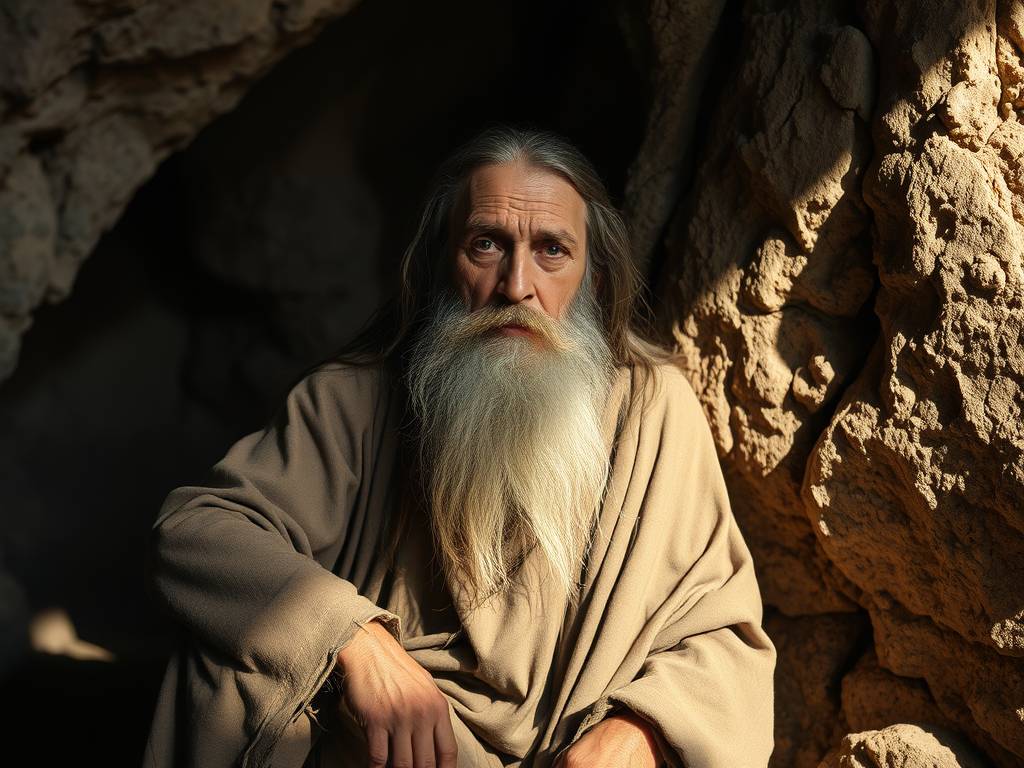
The Hermit of Dan yr Ogof

Many years ago, a man named Idris lived in the mist-shrouded valleys of Wales. Once a scholar in a bustling town, he was known for his insatiable curiosity and love of knowledge. But as the years passed, the noise of society, daily life’s clamour, and worldly burdens grew too heavy for him. Seeking solace and clarity, Idris made a decision that would forever change his destiny: he would retreat into the earth itself. He journeyed to the legendary caves of Dan yr Ogof, a vast underground labyrinth known for its otherworldly beauty and ancient mysteries. The caves, carved by centuries of water and time, stretched deep beneath the Welsh mountains—an endless maze of chambers, tunnels, and echoing halls. In the silence, Idris found what he sought: a place untouched by the chaos of the outside world.

He descended into the darkness, carrying only a small pack of provisions, a journal, and simple tools. Over time, he carved out a modest dwelling in a hidden corner of the cavern, where stalactites hung like frozen chandeliers above him, and the cold stone walls bore silent witness to his solitude. In the beginning, life in the caves was harsh. He learned to navigate the labyrinthine tunnels and listen to the subtle sounds of dripping water and shifting stones. He discovered underground springs that provided fresh water and fashioned lamps from moss and oil. He became attuned to the cave’s quiet rhythms, finding comfort in the perpetual darkness and the rhythm of his own breathing.

Idris’s only companions were the bats that flitted through the chambers at dusk, and the whispering echoes that seemed to carry voices from the distant past. To pass the endless days, he kept a journal, writing poetry, recording his observations, and contemplating the nature of existence. His thoughts grew deep and contemplative, and he began to see the caves as a mirror of the soul—a place of profound silence where true understanding could be found. Over the years, tales of the mysterious hermit spread among the villagers. Some believed he was a sage who had achieved enlightenment; others thought he was cursed, trapped forever in the depths. Children dared each other to approach the cave entrance and leave small offerings of herbs, coins, or candles, hoping to gain his blessing or wisdom.

One winter, a terrible storm struck the region. Torrential rains and fierce winds caused flooding and landslides, trapping a group of spelunkers and local villagers inside the caves. Panic grew as hope dwindled, and rescue seemed impossible. But Idris, sensing their peril, ventured out into the treacherous storm. Guided by his intimate knowledge of the tunnels and his intuitive sense of the underground landscape, he navigated the labyrinth’s dark corridors, calling out to the trapped explorers. His voice echoed through the chambers, steady and reassuring. Using his understanding of the cave’s subtle signs, he guided the stranded group through flooded passages and collapsing tunnels, safely back to the surface.

When they emerged, exhausted but alive, the villagers saw Idris in a new light. No longer simply a mysterious recluse, he was a guardian of the underground secrets, a protector who had braved the darkness to save others. As decades passed, Idris’s legend grew. Some believed he was a spirit of the caves, others thought he possessed otherworldly wisdom. He continued to live in the underground world, visiting the surface only when necessary. His days were spent in silent meditation, his nights in contemplative prayer, and his spirit deeply connected to the subterranean realm. Eventually, age caught up with him. His once dark hair turned white, and his eyes shone with the clarity of someone who had seen beyond the veil of ordinary life. Knowing his time was near, Idris made a final journey out of the caves, emerging into the sunlight one last time. His presence was gentle but commanding, his face marked by the serenity of a life lived in harmony with the silent depths. He returned to the village, but he was forever changed. He shared stories of the caves—of the beauty found in silence, the patience required to listen deeply, and the mysteries beneath the world’s surface. His words inspired many to seek quiet places of reflection and understanding. In the years that followed, Idris disappeared into the mists of legend. Some say he returned to the depths of Dan yr Ogof, becoming one with the caves he loved so dearly. Others believe he became a guardian spirit, watching over the mountains and guiding those who seek truth in silence. And so, the story of the Hermit of Dan yr Ogof endures—a tale of solitude, wisdom, and the profound peace that can be found when one listens to the quiet voice of the earth beneath our feet.