Once upon a time, in the vastness of the cosmos, the Sun and the Moon often watched over Mother Earth. They shared a bond forged by their love for her, each shining in their own way, bringing life and calm to her surface. One day, as the Sun blazed fiercely across the sky, he grew worried.
“Mother Earth is burning under my rays,” he muttered. “Her deserts are drying up, her forests withering. I must shine brighter to warm her, but I fear I’m causing her pain.”
The Moon, soft and gentle, listened quietly. When the Sun finished, she softly replied,
“Dear Sun, your warmth is vital, but too much can scorch her delicate lands. I watch over her at night, providing gentle light and cooling shadows, giving her time to rest and heal.”
The Sun frowned, flickering with concern.
“But if I don’t shine fiercely, she might freeze in the cold darkness of space. My rays sustain her life, but I worry I might be harming her through excess.”
The Moon nodded, understanding his fears.
“And I, too, worry. I see her suffering when you burn too brightly, and I see her thriving when I cast my quiet glow. Perhaps we need to find balance, for her sake.”
Suddenly, a gentle breeze whispered through the cosmos, and the stars listened intently. The Sun and the Moon looked at each other, realising their shared concern. They understood that together, their light and warmth could work in harmony, each taking turns to nurture Mother Earth, ensuring she flourished without harm. From that day forward, the Sun and the Moon agreed to share their care. The Sun would shine fiercely by day, warming and energising her, while the Moon would cast calming shadows by night, helping her rest and recover. Their argument turned into a beautiful dance—balancing light and dark, warmth and coolness—for the love of Mother Earth.
And so, under their watchful eyes, Mother Earth thrived and still is, cradled in the gentle embrace of the Sun and the Moon. If only mankind could achieve such a balance?
In a small, bustling town in the valley between rolling hills and shimmering rivers, lived a man named Enzel. Enzel was not an ordinary man—he was blind, yet his spirit shone brighter than the sun. His eyes, unseen to the world, saw through the melodies he played on his banjo, a weathered instrument with strings that hummed stories of hope and love. Enzel’s faithful companion was Jem, a wise and gentle guide dog with a nose for adventure and a heart full of loyalty. Together, they journeyed from city to city, village to village, spreading joy wherever they went.
Despite his blindness, Enzel’s sense of hearing was extraordinary. He listened to the whispers of the wind, the laughter of children, and the rhythm of life itself. His banjo was his voice—each note, word, song, and story. With Jem faithfully by his side, Enzel played wherever he could find an audience—under the shade of a tree, in a bustling marketplace, or on the steps of an old church. His music had a magical quality. It made people laugh, brought tears to their eyes, and reminded them of love in the simplest moments. Children would gather around, clapping their hands, their faces lit with wonder. Elders would close their eyes, swaying to the melodies that seemed to carry them back to days long gone.
One day, Enzel and Jem arrived at a small seaside village. The villagers had forgotten how to dream, weighed down by worries and hardships. Hearing Enzel’s music, however, their hearts began to lift. Enzel played a song about a star that guided lost sailors home—a song that shimmered with hope. As the notes floated over the waves, the villagers remembered the beauty of love, kindness, and community. They joined in singing, their voices blending with Enzel’s banjo, creating a harmony that healed weary hearts.
Years passed, and Enzel’s legend grew. His music travelled across continents, touching the lives of countless people. His story was one of resilience, kindness, and the power of love—proof that even without sight, one can see the world’s beauty with the heart.
Once, the world was shrouded in the shadows of fear and conflict. But amid the chaos, three souls emerged—each carrying a spark of hope, each destined to lead humanity into a new era of love. Liora was born in a small village nestled between mountains and forests. From a young age, she could sense the unspoken pain of others—the silent suffering of those broken by fear. Her touch could soothe wounds, but her true gift was her unwavering belief in love’s power to heal even the deepest scars. One evening, as she sat by a shimmering lake, she felt a gentle vibration—an invitation from the unseen realm. She closed her eyes and saw visions of a luminous dimension, pulsing with life and love. She understood her purpose: to become a conduit for this divine flow, guiding others to release their fears and embrace love. Liora travelled to a war-torn village, where her presence brought calm. She sat with a grieving family, holding their hands, and softly whispered,
“Love is the healing force. It begins within you.”
As her words flowed, the air around her shimmered, and a faint glow emanated from her palms. The villagers felt a warmth spreading through their hearts, and for the first time in years, they dared to hope.
Kael was a wandering explorer, driven by curiosity and an insatiable desire to understand the universe. He believed that fear stemmed from ignorance and that truth could dissolve the darkness if revealed. His journeys took him across deserts and oceans, seeking signs of a greater harmony. One night, under a sky filled with stars, Kael encountered an ancient oracle who whispered of a new dimension—a realm of pure resonance. Intrigued, Kael vowed to find it and bring its wisdom back to his people. In a hidden temple, Kael discovered a crystal that vibrated with a strange energy. As he touched it, visions flooded his mind—of an interconnected web linking all life. He saw humans, animals, plants, and stars all singing the same cosmic song. Fear was but a shadow cast by misunderstanding. Kael stood before a gathering of sceptics, sharing his insights.
“Fear keeps us divided, but truth—truth unites us in love,” he declared.
His courage inspired others to question their assumptions and open their hearts.
Eira was a vibrant artist whose murals and sculptures celebrated the beauty of unity. Her paintings depicted worlds where humans danced with animals, rivers flowed in harmony, and forests shimmered with life. She believed that imagining a loving future could manifest it. One day, she received a vivid dream: a vision of a shimmering portal—a bridge to a new dimension of love. She knew her art could be the key to awakening others’ hearts. Eira painted a massive mural on the city square—an ever-changing mosaic of life and love. As she worked, her brushstrokes seemed to animate, and the images shimmered with an otherworldly glow. Passersby stopped, mesmerised, feeling a stirring within. She gathered children and elders alike to dance and sing around her art, igniting a collective spark of hope. Her belief was contagious:
“We are all artists of our future. Love is the masterpiece waiting to be created.”
One fateful day, the three met beneath an ancient, sacred tree—each drawn by their visions and dreams. As they shared stories, the ground beneath them shimmered, and a luminous thread emerged, connecting them to the Harmonic Dimension. They realised that their individual gifts—healing, truth-seeking, and dreaming—complemented each other perfectly. Together, they formed a sacred circle, channelling the divine flow of love into the world. Liora’s hands glowed as she sent waves of healing energy, Kael’s voice resonated with the frequency of truth, and Eira’s art shimmered with divine light. The air thrummed with a melody that echoed through the cosmos, awakening hearts everywhere. They dedicated themselves to spreading this energy—Liora healing wounds of fear, Kael inspiring courage through stories of truth, and Eira awakening the collective imagination.
Slowly, the world began to change. Fear was replaced with curiosity and compassion. Conflicts faded as people realised their interconnectedness. Cities blossomed into gardens of peace, and nature thrived in harmony. The flow from the new dimension became unstoppable, a river of love that carried everyone into a future where all life could flourish. Wars became tales of past misunderstandings, replaced by songs of unity. In a grand ceremony, people from all walks of life gathered, holding hands around a glowing orb, symbolising the interconnected web of life. They sang together, their voices rising in harmony, sealing the collective awakening.
Guided by Liora, Kael, and Eira, humanity stepped into a new realm—one where love was the foundation of all existence. Fear had dissolved into understanding, and the divine flow from the Harmonic Dimension became an eternal current of peace and joy. In this world, life flows freely from one realm to another, weaving a radiant tapestry of unity. The universe whispers a simple truth: love is the most extraordinary power, capable of transforming all fears into boundless joy. And so, the story continues—an everlasting dance of life, love, and harmony, shining brightly across the infinite dimensions.
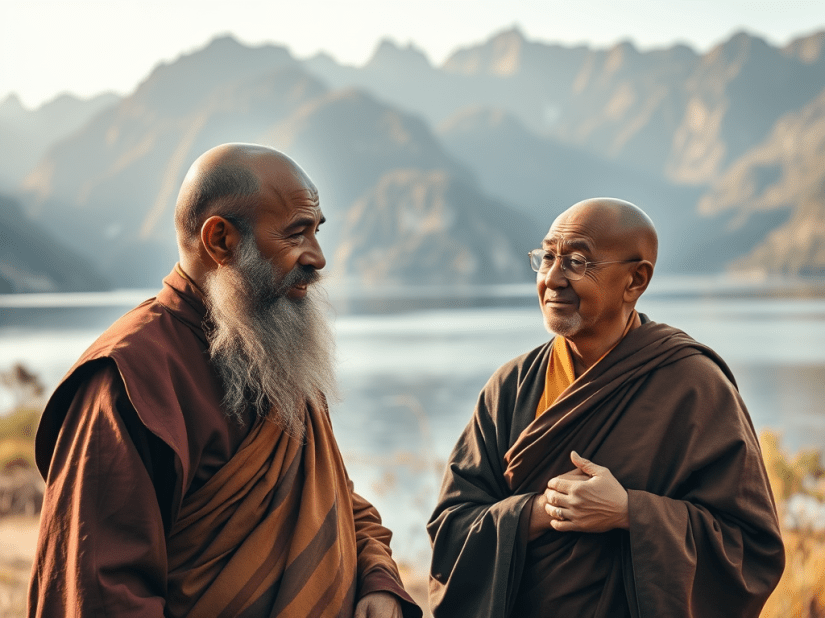
In the serene heights of Tibet, where the air was crisp and the mountains seemed to touch the heavens, lived an ageing monk named Mi Mo Tao. His days were spent in quiet contemplation within the ancient walls of a monastery, a sanctuary built from stone and prayer, where the whispers of the wind carried the wisdom of ages. Mi Mo Tao had dedicated his life to the pursuit of enlightenment, yet as he approached the twilight of his years, a shadow loomed over his heart. Long ago, he had known love—a deep, abiding love for a woman named Lian. They had met in the valleys below the monastery, where wildflowers danced under the sun. Lian was a spirit as free as the wind and as vibrant as the blossoms that surrounded her. They shared dreams and laughter, but their paths diverged when Mi Mo Tao chose the path of the monk, surrendering worldly attachments in search of spiritual truth.
Years passed, and Lian married another, starting a family of her own. Though Mi Mo Tao had found solace in meditation, the ache of unfulfilled love lingered in his heart. Every time he closed his eyes, he could see her smile, hear her laughter, and feel the warmth of her presence. The memories, once a source of joy, became a bittersweet reminder of what he had forsaken.
One autumn evening, as the sun dipped behind the mountains, casting a golden hue over the monastery, Mi Mo Tao sat in meditation. The wind carried a familiar melody, a song that Lian used to sing. It stirred something deep within him, awakening feelings he thought he had buried long ago. Overwhelmed, he opened his eyes and gazed out at the horizon, where the sky met the earth in a breathtaking embrace. In that moment of vulnerability, Mi Mo Tao felt the weight of his sadness transform. He realised that love was not something to be abandoned but instead integrated into his being. Love, he understood, was a teacher, illuminating the path to compassion and understanding. It was not merely a fleeting emotion but a profound connection that transcended time and space. Inspired, he began to write. With each stroke of his brush, he poured his heart onto parchment, weaving tales of love and loss, of joy and sorrow. He wrote of Lian, not as a source of pain but as a reminder of the beauty that love brings, even in its absence. His words resonated with the other monks, who gathered to listen, finding solace in his stories. They began to see their own struggles reflected in his tales, and together they discovered the healing power of vulnerability and shared experience.
As the days turned into months, Mi Mo Tao’s heart lightened. He spoke openly of love, encouraging his fellow monks to embrace their feelings rather than shy away from them. They practised compassion, not just for others, but for themselves, understanding that their own hearts were worthy of love and care. One day, while walking through the valley, Mi Mo Tao encountered an elderly woman weeping by a stream. He approached her gently, offering his presence, and she shared her story of loss and regret. In her sorrow, he recognised a glimpse of his own past. He listened intently, and as he did, a sense of peace washed over him. It was in these moments of connection that he truly grasped the essence of enlightenment—not in the absence of pain, but in the acceptance of it.
Years later, when Mi Mo Tao’s time drew near, he sat in the same spot where he had once felt the weight of his unfulfilled love. The mountains stood as witnesses to his journey, and as he closed his eyes for the last time, he felt Lian’s spirit beside him, not as a ghost of the past, but as a radiant presence of love. In that final moment, he understood: love, in all its forms, was the path to enlightenment. The monastery, once a place of solitary reflection, became a beacon of love and compassion, where monks shared their stories and embraced their humanity. Mi Mo Tao’s legacy lived on, not just in his teachings but in the hearts of those who learned that true enlightenment lies in embracing love, both joyful and sorrowful, and in the connections we forge along the way.
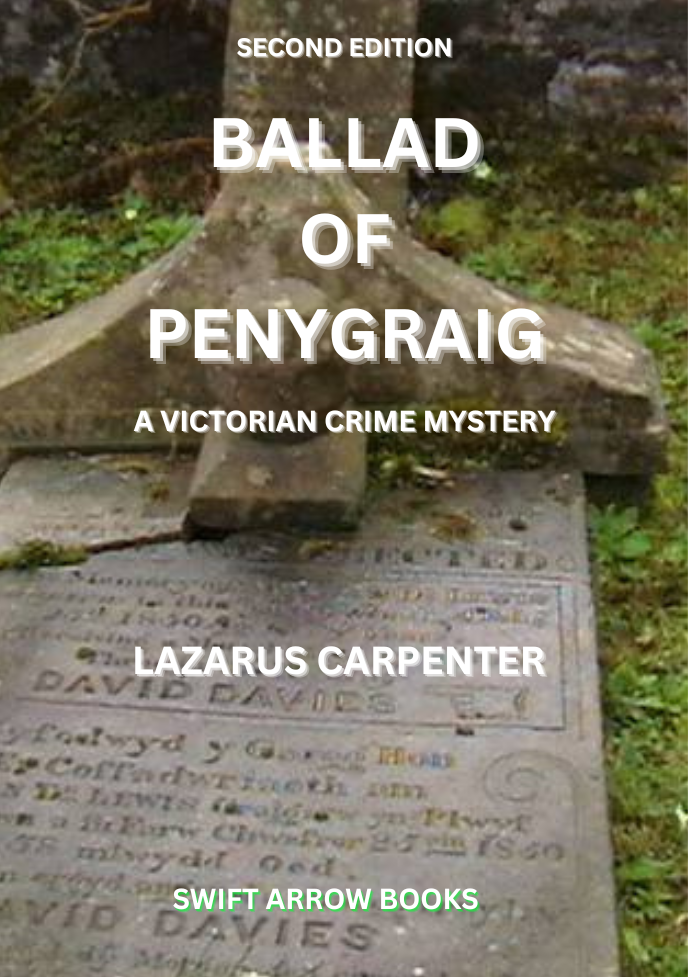
The Ballad of Penygraig is a Victorian crime mystery set in Ystalyfera, a small industrial village in the Swansea Valley of 1850. This dark tale is based on actual events, a David and Goliath story. A scandal shocking an entire community racked and divided by lies, deceit, bullying, and ultimately, murder. This novel is in the second edition and includes additions and a rewrite of parts of the story. First published in 2015.
This is the true story of a terrible tragedy in the village of Pantteg on 25 February 1850. It is the story of ordinary working folk and how everyday events and accidents between them created havoc, changing the lives of two families forever and entering the annals of valley history. The story was unknown to me until 2004, when I moved into Penygraig, ‘The House on the Rock’. Moving to Penygraig was a sanctuary where I sought to recover from sadness. I needed solitude at this time as my partner and best friend and I proved to each other that living together was an impossibility. Penygraig is five hundred yards up the mountain from our semi-detached farmhouse. Built in the early 1800s, the cottage is very isolated, and the landscape has changed much in the past one hundred and seventy odd years. Once a thriving community, it lies in ruins amidst sparse forest lost in time. Tracks once trod by horses dragging coal up the mountain to the villagers’ homes, and those bringing Welsh stone from the quarry for building the village are long gone. Also long gone are the Miner’s Arms, the Iron Works, Coal Mines and Gough Estate. The New Swan Inn is still here, though no longer used for Coroner’s Inquests, and the headstones of Morgan and Rachael still haunt the graveyard. I experienced a strange phenomenon before moving into Penygraig, accompanied by the owner, when I was viewing the cottage for the first time. We were sitting in the lounge around early afternoon when twice I started to roll a cigarette in a way that was foreign to me. I remember remarking to Andy, ‘that was a weird feeling’ as it happened when suddenly I saw a bent figure standing at the stable-doorway in silhouette looking at me, then seemingly walking on. I told Andy what I had just seen, he was not in the slightest bit surprised; he seemed to take it on the chin as an everyday occurrence – a ghost in the middle of the day!
I asked Andy if he knew who the ghost was, but he didn’t. However, he acknowledged that there had been some strange goings on in the house. He witnessed some ghostly goings on himself, and one or two tenants in the past ended up running down the hill in the middle of the night, but he never did find out why. So we left it there, and in I moved. Almost as soon as I moved in, strange phenomena seemed to be an integral part of the fabric of Penygraig. Admittedly, the isolation of the cottage, and its general bleakness, especially in the winter, could feed the most furtive creative of imaginations. Still, some of the things that were to be experienced by me, and others, could not be explained away in such dull terms. I often heard voices whispering in the corners of the cottage, and on more than one occasion heard the name John Jenkins. Only later did I understand that it was two names, and indeed later, it was revealed as the brothers of David Davies, John, and Jenkins. In my first winter at Penygraig, Christmas was followed by intrigue, and on the 25th of February, at five o’clock in the evening, a loud knock came to my back door. Still, my collie dog did not respond in her usual way of manic screeching or barking, and when I answered the door, nobody was there. Fortunately, two or three friends in the cottage at the time witnessed the event, so I could not be accused of madness. On another occasion, a photograph of the garden revealed a brick building standing in front of a giant oak tree. There is no building there now, or was there when the picture was taken, but it is believed there was one thirty years ago, back in the seventies. Something or someone lived in the attic, and it was not mice or any other creature, as my cat is a skilled hunter, but noises were often heard as if someone was moving about. Cushions in the living room were frequently moved about, and as daft as it sounds, somebody was tidying up and fluffing cushions, but who? A malevolent presence seemed to haunt the pathway through the sparse forest from the gate up to the top of the hill, opposite the main entrance, Pantteg Chapel’s graveyard. With the help of friends, I decided to find out who had lived at Penygraig in the past, and through the census, we obtained a list of names. Through this work, we accidentally discovered a grave on the boundary wall between the graveyard, and the house next door to where I had recently moved from. It said.
‘Here lies the body of Morgan Lewis whose life was taken by a stone thrown by the handof David Davies.’
In 1850 David Davies lived with his brothers John and Jenkins in Penygraig. To confuse the story even further, research through the parish records, and the census revealed that Morgan Lewis, the man killed by David Davies, along with his wife Rachael, and five children, lived in a tithe cottage fronting the garden where I lived previously, five hundred yards as the crow flies from Penygraig. All of this was such a coincidence, but why I did not know. The ‘Ballad of Penygraig’ was born or reborn on this day! Lying near Morgan Lewis’s grave, where Rachael is buried, I found to my utmost surprise the headstone of David Davies. It was sheared in half long ways. I have only been able to find this half, I picked it up from where it had been discarded, and placed it against the wall in front of Morgan and Rachael. An elder of the chapel was kind enough to tell me of the ‘stone in the hand’. He is a very elderly gentleman but remembers when he was a boy they played in the graveyard, and one of the games was called ‘blood tag’, and involved passing on fictitious blood from the stone to one’s fleeing friends running for fear of being clouted by a folk legend, Morgan Lewis. The hand has disappeared over the years, and somewhere it may be lying in a garden shed or a loft at the bottom of an old suitcase? To this day I wonder what happened to the sculptured hand with the offending murderous stone cemented to it, and whoever has that hand I wonder if they know its history? I wonder if they know about the curse long gone and forgotten. Had I moved into my own ‘Most Haunted’, was I going psychotic or was something much bigger at hand, I did not know? My research began in earnest and more and more coincidences began to emerge.
In 1850 the Swansea Guardian published a story entitled ‘Affray in Ystalyfera’. Suddenly, I was confronted with facts about the case and amazed by the coincidences between what I intuited through the apparitions in the house and what was now in black and white in front of me, which was recorded in the annals of local history. My first project included writing four songs retelling the story: The hawk cried on the moor, Poacher on the rock, The Ballad of Penygraig and Rachael’s Lament. But it was the song Ballad of Penygraig, telling the story from the reasons for the fight to its bitter conclusions, that came first. It took me a few drafts before I was happy with my lyrical content and flow. I had a tune, but there was no last line, and I could not find one I was content to use. It was very late at night, advancing through the early hours, when I played the tune repeatedly. One of the advantages of living at Penygraig was that I could make as much noise as I liked night or day without the fear of upsetting my neighbors who lived well out of earshot. I recorded the tune and struggled on through my fancy little loop pedal. At around three in the morning, almost reaching the end of the song, approaching the need for a final line, thus far not forthcoming, I felt a shiver becoming aware of the essence of Morgan Lewis standing in front of me. I carried on playing sensing Dai Davies on my left, and I still played. There was no feeling of fear or trepidation, in fact, it was like having an audience. However, approaching the song’s end, I intuited the line ‘now they are both angels in flight’. I sang the words and there was a bluish flash in the room, the essences of Morgan and Dai were gone and the song was finished. They have never been seen since, and I think the song’s final line illustrates where they went. Since that day, I have never experienced further disturbances in the house.
So, I thank Morgan and Dai most sincerely. After this, I will never be afraid of anything again and never feel alone in this life or the next.I wonder who exorcised whom?
POSTSCRIPT
Sadly, on 22 December 2012 (the day when, according to Inca predictions, the world would end) at 1am a massive landslip crashed from the mountain and Penygraig disappeared back to the earth from whence it came.
Verse written by Lazarus Carpenter and performed by Sean Edwards inspired by the novel, ‘Ballad of Penygraig’ (2025)




 Lazarus Carpenter - Author