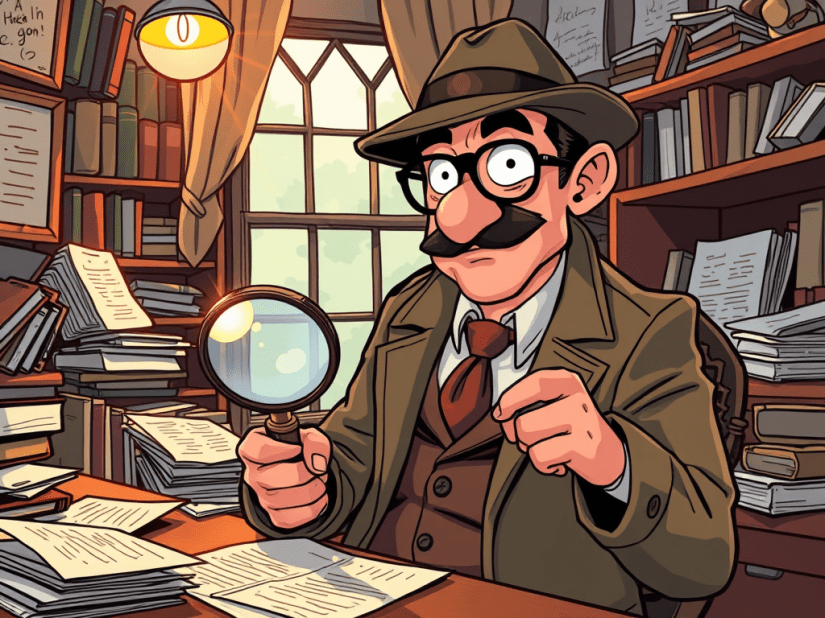
Inspector Septimus Summer-Garden stood beneath a streetlamp that hummed like an irritable bee and wore the face of a man who had forgotten where he parked his own manners. His badge hung at a jaunty angle, his hat was perched at the wrong tilt, and his notebook looked as though it had been stitched together by a pair of excitable pigeons. He took a deep, ceremonial breath that resulted in him coughing on his own suspicion.
“Right then,” he announced to the empty alley, which was not so empty as it appeared, since the alley’s resident cats stared with the cool detachment of small, furry judges. “We’ve got a mystery that requires method, perception, and a modicum of luck. Let’s begin at the beginning.”
The case had begun with a very peculiar ringing of a very ordinary morning. The city where rivers sang old songs and streetlamps kept odd hours, was not accustomed to crime that required the attention of a man who once mistook a lamppost for a suspect and interviewed it for hours. Yet here he was, standing outside the Public Library, where the windows bore the scuffs of many winters and the occasional grimace of rain. The trouble, as the constable had put it, involved a rash of broken windows. Not shattered glass with the flourish of a grand crime, but the quiet, almost polite kind that left the windowpanes with captious cracks and the owners with puzzled looks and a resume of suspicious explanations about flying hedgehogs and rogue snowflakes. The first break had occurred at Mrs. Primrose Waddle’s teashop, where a single pane on the shopfront looked as if it had politely decided to retire from service.
Septimus was told to investigate. He took a long look at the window in question, which bore a fine network of hairline cracks suggesting a tiny marching army of minuscule anvils had hammered away in the night. He peered at it with all the suspicion of a man who had once mistaken a cucumber for a suspect and had spent the afternoon interrogating it about alibis.
“It’s not a cased-crime, it’s a cracked-crime,” he muttered, and scribbled something in his notebook that looked suspiciously like a doodle of a tea kettle wearing a monocle.
His first step, as he announced to the town’s gossiping hedgehogs was to interview Mrs. Waddle. Mrs. Waddle ran the teashop with sugary efficiency and a talent for telling stories that made people feel both hungry and suspicious of pastry.
“Inspector,” she said, a polite tilt to her head, “my windows keep getting cracks in them, and I swear I do not know what to do with the concept of a flying crack. It isn’t as if a bird sits on the sill and taps its beak, though if a bird did that, I’d sell it a biscuit and a cup of tea.”
Septimus blinked.
“Cracks,” he said, as if savoring the word, “are the language of stress in glass. We must translate.”
“Or it’s a prank,” suggested a young boy who had wandered in to lick the sugar from a spoon. He wore a scarf with the city’s map on it, which is a fashion choice that only children and detectives can pull off with equal awkwardness.
“A prank?” Septimus repeated, tapping his chin with the nib of his pen, which was actually a quill he had borrowed from a historical society exhibit and had not realized was inhabited by a family of moths. The quill drooped. He wrote: Pranks?
Mrs. Waddle waved a gloved hand as if she were shooing away a particularly persistent idea.
“Oh, I don’t believe in pranks that involve breaking windows,” she said. “Pranks are for misplacing hats, not glass. Glass is expensive and polite, and it does not enjoy being broken.”
Septimus put this down as a lead, or at least as a note to himself that Mrs. Waddle considered glass “polite.” He thanked her with the gravity one reserves for a teacake that might become a suspect if it isn’t properly interrogated. Next, Septimus visited the town’s glassmaker, a robust woman named Ms. Claro who could coax a pane of glass to flex with the weather and the mood of a room. She measured the cracks, which seemed to grow or shrink according to the weather forecast she kept taped to the back of her desk like a guilty secret.
“Inspecting, are you?” she said, with a laugh that sounded like broken crystal chiming in a windstorm. “If you want to know why your windows break, you’ll need more than superstition and a hat that looks like it has misplaced its owner. You’ll need a classroom full of science and a measure of imagination.”
Septimus inched closer to the glass with the seriousness of a man who believed glass could talk if you listened hard enough. He tapped it, listening for a response. All he heard was the faintest echo of his own heartbeat and the distant hooting of a night owl that clearly approved of vandalism only when performed in a theatrical context.
“Cracks don’t just happen,” Ms. Claro continued, as if lecturing to a very slow audience. “They form from stress. Wind pressure, temperature shifts, and sometimes, if you are unlucky, a cat with a bad habit of slapping things with its paw. But here the more likely culprit is a combination of poor window maintenance and a drift of misaligned belief that windows exist to be looked at, not to be tested.”
Septimus jotted this down as a new theory: windows as an audience. He wondered if perhaps the town’s windows were watching him, judging him for a crime he had not yet solved but already felt guilty about. The case took a turn when the library’s janitor, a quiet man named Mr. Finch, reported that the broken windows did not occur at random. They appeared to concentrate around the town’s calendar of events: market days, book club nights, and the annual Lantern Parade. He swore the windows thrummed with the same rhythm as the parade drums, as if they were trying to catch a beat to dance to. Septimus, who enjoyed rhythm in a detective sense but disliked dancing in the direction of danger, took the observation as a clue. It suggested a pattern. A plan formed in his mind, half-baked as a scone and twice as sweet for its potential to mislead or delight.
That evening, Septimus stood under the lanterns along Brindlewick’s High Street, which glowed with the soft orange of a sun that forgot to set. He inspected the windows again, this time with a small instrument he had borrowed from the lighthouse keeper—a glass-tester that looked like a cross between a magnifying glass and a tiny weather vane. He tapped lightly on a pane here, pressed a thumb against a pane there, and listened for differences in the sound that windows made when they disagreed with the world.
“Cracks occur where glass fights against pressure,” he murmured, as if reciting from a very dull poetry book. Then he looked up and saw, for the first time clearly, a peculiar silhouette across the street: a figure wrapped in a cloak, moving with a measured, almost ceremonial step, as though walking to the rhythm of a long-forgotten clock. The figure disappeared as soon as Septimus blinked, but not before Septimus caught a glimmer of something metallic at the cloak’s edge. He hurried after, but the cloak turned a corner and ended up in a narrow alley that opened into a small courtyard behind the town’s tailor shop. There, the metallic glint showed itself again, a key, or perhaps a key-shaped charm, dangling from a chain. The cloak had left a signature that looked suspiciously like a thief’s calling card. Septimus returned to his desk in the station, where a kettle hissed on a stove and the station’s cat whom everyone had decided to name Sir Purrsalot despite his moody temperament, lounged atop a stack of dispatches. He laid out the clues: the calendar pattern of breaks, the glinting key, the silhouette that appeared and vanished like a bad memory.
He drafted a plan. The plan was not a good plan, but it was a plan, which, in Septimus’s world, was enough to begin a grand investigation. He would borrow a window to test his theory that the windows’ “cries” (the cracks) were propelled by something inside the walls, something small, clever, and perhaps fond of pranks. The next day, with his hat at an almost comically serious tilt, Septimus returned to the library with a bucket, a mop, and a freshly sharpened sense of misdirection. He invited the librarian, Miss Larkspur, to stand by a particularly cracked pane that faced the market square. He explained that they were going to coax the window to reveal its thoughts by performing a little test: they would play a note on a violin outside the window and listen to the glass respond.
Miss Larkspur, who had a patient smile reserved for the most impossible of patrons, nodded slowly. The violin sounded, though not rather well, since Miss Larkspur’s cat, Sir Purrsalot, had taken a particular interest in a stringed instrument and kept batting at the bow like a man with a very determined moustache. The window cracked in response, a few tiny lines sprouting as if the glass itself had decided to cough from the noise.
“Interesting,” Septimus said, scribbling furiously. “The glass is malleable to sound, and perhaps to music. Or perhaps to a certain frequency that coincides with the town’s heartbeat.”
Just then, a boy ran past, chasing a dog, and knocked into the library door. The door swung open, and in slid a figure draped in that same cloak, the metallic glint now clearly visible as a key on a chain. The figure paused, then bolted for the back stairs, dropping a glove as it escaped. Septimus leaped to his feet with the grace of a mailable teapot and knocked into a shelf, sending a cascade of books fluttering down like startled birds. He recovered his balance, grabbed his notebook, and chased after. He hurried through the hallways of the library, which smelled of old parchment and the faintest trace of cinnamon, and found himself in the back room where the town’s archives were stored. There, among boxes of faded ledgers, he found a cluster of windows, each covered by a thick layer of dust and a line of cracks that seemed to radiate outward like sunbursts.
The cloaked figure had vanished again, but the glove lay on the floor, a feathery clue that anything could be a clue if you looked at it in the right light. Septimus picked up the glove, turned it over, and found stitched on the cuff a small insignia, two crossed keys, the emblem of the city’s old guild of locksmiths. A locksmith’s guild, of all things, could be involved in something this peculiar. That evening, he visited the locksmith’s workshop, a bright, bustling place filled with the chime of hammers and the smell of oil and leather. The master locksmith, a cheerful woman named Mrs. Nettle, greeted him as if he were a long-lost customer who had finally returned after misplacing his sense of direction.
“Inspector,” she said, eyeing his notebook with a mixture of amusement and professional suspicion, “you’re chasing a rumor that windows talk, aren’t you? You’ll be chasing clouds next and charging them with a crime.”
Septimus, who wasn’t sure if this was a joke or a threat, offered a polite nod. He showed her the glove and the insignia. She studied them, then shrugged in a way that suggested she knew more than she would admit.
“The guild sometimes collaborates on delicate tasks,” she said, “like installing new glass that resists the weather or threading locks that open only for the rightful owner. But a crime of breaking windows? That would require a certain kind of mischief that isn’t usually guild business.”
“Whose mischief would that be?” Septimus asked, though he already knew the answer, a suggestion that had been tapping at the edge of his thoughts like a stubborn drumbeat.
“Perhaps someone who wants to quiet city chatter,” she replied, almost under her breath, but loud enough for the window to catch it.
Mrs. Nettle glanced toward a back door, as if listening to a distant whisper of a plan forming. Then she sighed and handed Septimus a small, delicate device that looked like a key, a tiny instrument with a dial.
“This is a window tester, built by a guild colleague who believed windows sometimes deserve a voice too,” she explained. “If you want to hear what a window has to say, you need to listen between the cracks.”
Septimus accepted the device with reverence, as though it were a relic from a saint’s pocket. He thanked her and left, the device ticking softly against his palm. Back at the library, he set up the device near the cracked pane and pressed a small button. The window gave a response, not a sound, but a sensation in the air, a slight vibrating that travelled through the room like a whisper. It was not telling him who broke the windows, but suggesting that the breaks were caused by a joint effort: weather, temperature, and an unseen force that preferred to operate during the lantern-parade nights. The parade. The concept clicked with Septimus as if a bell had just fallen from a cabinet and landed squarely in his brain. The lantern parade was the grandest event, a procession of lights that travelled the streets and filled the air with a chorus of reflections on glass. If the breaks occurred during those nights, there was a good chance that someone, or something was using the crowd’s energy to manipulate the windows.
On the night of the lantern parade, Septimus took up residence on a rooftop overlooking the square. He wore a coat two sizes too large and a hat that looked as though it had committed the sin of overconfidence. He studied the square as it bloomed with orange and gold and the soft clacking of wooden shoes on cobbles. The crowd’s laughter, music, and chatter rose like a tide, and the windows listened. Something moving, he thought, but not human. The cloaked figure reappeared, no longer a silhouette, but a clear presence: the figure moved with the rhythm of the parade, stepping from window to window and pressing something into their frames, a tool, perhaps, that tapped a tempo into the glass. The windows, in response to the tempo, cracked along the same lines, echoing and amplifying the parade’s beat. Septimus realized that the culprit was not a mastermind, but a group of pranksters who had discovered a way to synchronise their taps with the parade’s drumbeat, using a discreet device to transmit micro-vibrations through the air and into the glass for a moment of dramatic effect. The intention: to create a spectacle, to turn windows into a chorus and to make the lanterns feel all the more alive. He watched as the pranksters, three youngsters with clever hands and a glimmer of mischief moved from window to window, their cloaks flapping in the parade’s gusts. They paused as a pair of lanterns swayed, their shadows threading through the crowd like dark dancers. Then, with a nod to each other, they pressed their devices against the glass and retreated into the crowd. Septimus made his move with the clumsiness that had earned him his reputation. He slipped on a lantern’s string, nearly toppled into the fountain, and landed in a heap upon a bed of velvet hats that belonged to a vendor who swore he would sue the moon for offering such weather. He scrambled upright, chased after the trio, and managed to corner them in a narrow alley behind the tailor’s shop.
There, among the bricks and hanging laundry, he confronted them with a display of theatrical seriousness that would have done a stage actor proud. The pranksters, two brothers and a cousin, all with eyes that shone with the thrill of the chase raised their hands in mock surrender. They explained with a mixture of pride and embarrassment that they had not intended real harm; they merely wanted folk to notice the windows more, to feel alive during a city that often forgot to blink. Septimus, who believed that a detective’s job included compassion, did not arrest them on the spot. Instead, he escorted them to the city square, gathered the townspeople, and staged a small audience with the windows as honoured guests. He asked the crowd to listen to the windows and to tell him what they needed. The windows, as if they had been waiting for an opportunity to express themselves, offered a chorus of creaks and sighs, a symphony of time passing and glass sighing at the weight of the world.
In that moment, Septimus realised what the evidence had been telling him all along: the broken windows were not the crime; they were a clue to the city’s need to be seen, to be heard, to feel part of something larger than the daily grind. The lantern parade, the guild, the old clock tower, the library’s whispered stories, all of these were threads in a tapestry, and the broken windows were the needle that threaded them together. He called a meeting the next day in the square, where he stood atop a crate and addressed the crowd with the earnestness of a man who had discovered a map that led to a bakery and decided a treasure lay there. He explained the prank, the device, and the reason the windows had cracked in unison with the parade’s rhythm. He proposed a plan that would both honor the windows and prevent harm: a collaborative project to repair and strengthen the city’s windows and to celebrate them as part of living history rather than as fragile victims.
The guild master and Mrs. Nettle agreed to lead a window-restoration festival, a week of workshops where villagers could learn to repair, reinforce, and decorate glass with safety and flair. The pranksters would help, not by breaking windows, but by designing performances that used sound, light, and music to make the glass “perform” without causing damage. The town would borrow a lesson from the windows: that pressure can crack, but collaboration and care can repair and even beautify. Septimus’s report, which he read aloud with the solemn pride of a man who had spent more time with a pencil than a moral compass, concluded with a flourish that surprised even him. He recommended that the city install wind-and-temperature monitoring near the most fragile panes, train a small corps of window-keepers to watch for unusual stress signatures, and host an annual Glass Festival, where the windows would be celebrated as living witnesses to the community’s history.
The case of the broken windows, Septimus concluded, was not a crime to be solved by punishment, but a chorus to be understood and harmonized with. The town, which had always claimed to be ordinary, discovered that it possessed a kind of poetry hidden in plain sight: glass that sang, a parade that listened, and a detective who, while bumbling, could still connect the dots when they dangled like bells on a winter’s night. September rolled in with a soft grin, as if the town had finally admitted to him that it enjoyed his peculiar methods. He walked along the market square, now lined with lanterns that blinked politely at him, like a chorus of tiny, polite witnesses. He paused outside Mrs. Primrose Waddle’s teashop, which now boasted a sign that read: The Listening Glass, where every pane has a tale to tell.
He entered, as if entering a friend’s drawing room rather than a crime scene, and ordered a cup of tea that tasted faintly of lemon and old stories. The teashop’s windows glowed with a warm light that seemed to exhale sighs of relief. Mrs. Waddle poured a second cup for him, as if she had anticipated his thirst for truth.
“Inspector,” she said, with the soft humour that had first drawn him to her door, “did you catch the culprit?”
Septimus sipped the tea, let the steam fog his glasses just enough to blur his own expression into something thoughtful and slightly ridiculous.
“The culprit,” he began, “was fear, perhaps, fear of being unseen. The windows were crying out for attention, and the city finally listened.”
Mrs. Waddle nodded, satisfied, as if the answer satisfied a long hunger.
“Then may I suggest,” she added, “that we keep listening? The city may be ordinary, but it’s never dull when a window speaks back.”
Septimus smiled, the kind of smile that looked as if it might topple a shelf if he permitted gravity the indulgence. He closed his notebook and tucked it away, as though locking away a confession that was not a crime but a confession nonetheless. And so, the case of the broken windows ended not with a capture or a confession, but with a new tradition: a town that learned to listen to its own glass, to hear its stories, and to treat its windows not as fragile inconveniences but as partners in a shared life. Inspector Septimus Summer-Garden, the bumbling man who could not always tell a clue from a kite string but who could always hear a chorus in a crack, walked home beneath a sky that felt, for once, perfectly well-lit. He paused at the corner where the lanterns pressed their orange light into the night and looked up at the now-silent, content windows with a kind of quiet triumph. The case had taught him something invaluable: mysteries are often not about catching a criminal, but about catching a moment, one in which a community discovers it can be better together than apart.
 Lazarus Carpenter - Author