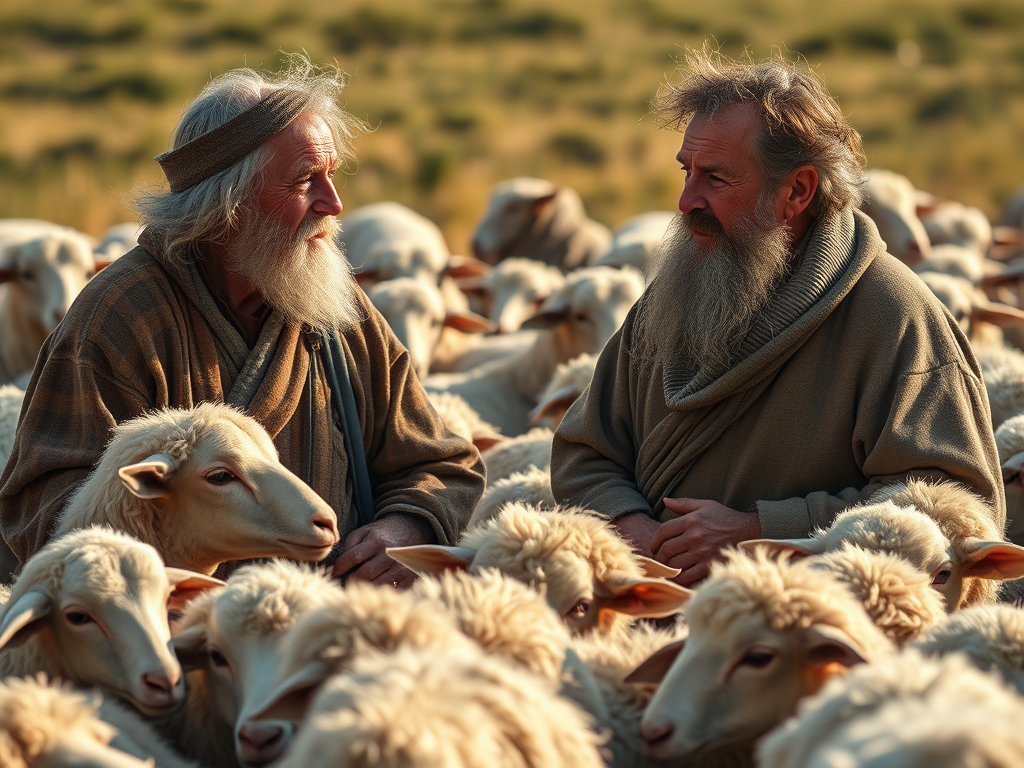
Once upon a time, there were two shepherds named Tomas and Eli. Both tended flocks of sheep and loved their animals dearly. The valley was beautiful, with plenty of grass and fresh water, but it was also small, and the grazing grounds were shared. One summer, as the grass grew sparse, Tomas and Eli found themselves in a disagreement. Tomas believed that the northern part of the valley belonged to him because he had been grazing his sheep there longer. On the other hand, Eli argued that the southern fields were his since he had started grazing his sheep there more recently. Their disagreement quickly grew into a heated argument. Tomas claimed,
“I have been here for many years, and my sheep have always grazed in this part of the valley. It is my right to continue doing so.”
Eli, in his own defence, replied,
“But I have also been here these past few seasons, and I need the grazing grounds just as much as you do. We both need to share fairly.”
The two shepherds argued day after day, each convinced they were right. Confused by the noise, their sheep began to stray and wander into the neighbouring pastures, causing more trouble. Finally, a wise old man who lived nearby heard about the dispute. He visited Tomas and Eli and asked to speak with them.
“Let me tell you a story,” he said. “There was once a river that flowed through a valley. Two farmers built their fields on either side of the river. Both wanted to use the water for their crops, but there was only enough for one to use at a time. They argued endlessly, each claiming the water was theirs.”
The old man paused and looked at the shepherds.
“One day, a wise elder suggested they build a small dam to direct the water to both fields at different times. They agreed to share the water equally, respecting each other’s needs. From then on, they worked together instead of fighting.”
Tomas and Eli listened carefully. They realised that their argument was causing more harm than good and that cooperation was better than conflict. They divided the grazing grounds equally, rotating their sheep between the two parts of the valley. From that day on, they worked together peacefully, and their sheep thrived in the harmony of shared land. So, the valley remained peaceful, and the two shepherds learned that sharing and understanding could solve even the thorniest disputes.
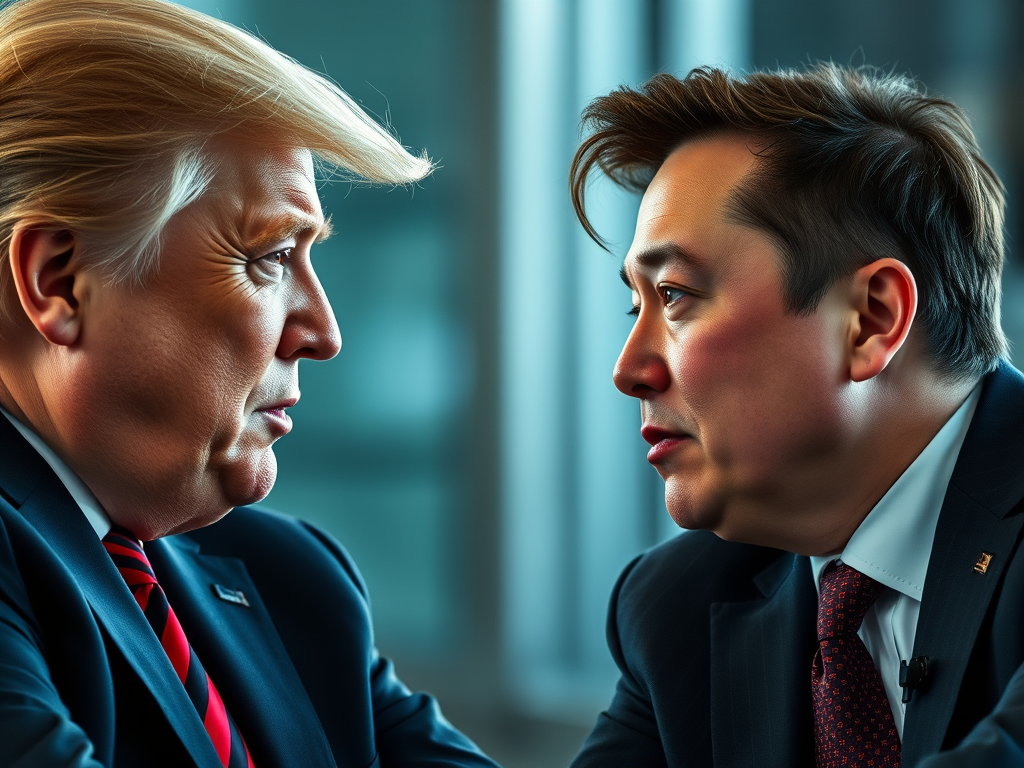
The relationship between Donald Trump and Elon Musk has generated significant discussion, particularly regarding the perceived dangers of their influence on global affairs. Some key points highlight these concerns for me: Both Trump and Musk are influential figures in their respective domains—politics and technology. Their partnership could lead to a concentration of power undermining democratic processes and accountability. Trump’s ability to sway public opinion through social media and Musk’s control over platforms like Twitter (now X) raises concerns about misinformation and the manipulation of narratives, potentially leading to societal polarization. Musk’s ventures in technology and space could be heavily influenced by Trump’s policies, which may prioritize specific industries or companies, leading to unequal economic opportunities and stifling competition.
Their relationship could affect international relations, particularly if policies favouring their interests lead to tensions with other countries. For example, Musk’s ambitions in space exploration and mineral exploitation on Earth and Trump’s nationalist approach could clash with global cooperation efforts. The merging of business interests and political influence can lead to ethical dilemmas, including conflicts of interest, where decisions may favour personal gains over the public good. While Musk is known for advocating sustainable technologies, Trump’s administration often rolled back environmental regulations. Their alliance may complicate efforts to address climate change effectively.
Their combined influence could challenge regulatory frameworks designed to oversee technology and business practices, potentially leading to abuses of power or harmful practices. The relationship between Trump and Musk poses potential risks that could impact the U.S. and global politics and economies.
Let us have a quick look at a forensic profile of both and further understand their individual make-up and what makes them tick.
Trump exhibits traits commonly associated with narcissism, including a strong sense of self-importance, a preoccupation with success, and a lack of empathy. He often seeks admiration and has a tendency to dominate conversations. His decision-making style is characterised by impulsivity and spontaneous comments on social media or public statements that seem unfiltered. Trump frequently engages in confrontational behaviour, especially towards critics and opponents. This could suggest a higher tolerance for conflict and a tendency to respond aggressively to perceived slights. He demonstrates a strong desire for control over his environment and the people around him, often leading to authoritative and sometimes authoritarian behaviour.
Trump’s communication style is characterised by simplicity, repetition, and emotional appeal, often employing hyperbole and slogans that resonate with his base. He tends to react defensively to criticism, resorting to personal attacks or dismissive comments about his critics, indicating a sensitivity to perceived threats to his self-image. There may be a significant difference between his public persona, which is often larger-than-life, and his private behaviours, which may include moments of insecurity or doubt.
Trump often frames discussions in terms of “us vs. them,” fostering a strong sense of loyalty among his supporters while vilifying opponents. Despite (or because of) his contentious style, Trump possesses a certain charisma that allows him to command attention and influence a substantial following. Some psychological assessments suggest that individuals with narcissistic tendencies may engage in manipulative behaviours to maintain their self-image and power. Interpersonal relationships may be strained due to tendencies towards self-centeredness and lack of genuine emotional connection.
A psychological forensic profile of Donald Trump reflects a complex interplay of traits and behaviours, with significant implications for his leadership style and interactions with others. Understanding these aspects can provide insight into his decision-making processes and the dynamics of his public and private life.
Elon Musk was born in South Africa and moved to the U.S. for his education. His entrepreneurial spirit emerged early, leading to ventures like Zip2, X.com (which became PayPal), and later Tesla and SpaceX, known for his role in revolutionizing the automotive industry with electric vehicles, advancing space technology with reusable rockets, and promoting renewable energy through SolarCity.
Musk is often characterized as a visionary, emphasizing his ability to think outside the box and pursue ambitious goals. His willingness to invest heavily in uncertain ventures (like SpaceX in its early days) indicates a high tolerance for risk. Musk’s public persona is marked by charisma, which he leverages to inspire and mobilize teams and followers. He is known for having an intense work ethic, often working long hours and expecting similar dedication from his employees. His communication can be polarizing. He uses platforms like Twitter to engage directly with the public, often leading to controversy. While he shows passion for his projects, examples of conflict with employees and public figures can suggest challenges in emotional balance.
Musk’s actions and statements often evoke strong reactions, and he is seen as a pioneer by some and a controversial figure by others. Frequent media appearances and social media activity keep him in the public eye, contributing to a mixed reputation. His stated goal is to advance human civilization through space exploration and sustainable energy. While driven by innovation, his ventures also aim at significant financial returns, evident in the growth of Tesla and SpaceX.
Critiques often target his management style, which some describe as demanding and abrasive. His controversial tweets have led to legal and financial repercussions, reflecting impulsivity. Elon Musk’s forensic profile reveals a complex individual characterized by innovation, charisma, and a relentless pursuit of ambitious goals, tempered by controversies and challenges in personal and professional domains. Understanding his profile requires acknowledging both his achievements and the criticisms he faces.
Put these two men together, and they become a formidable power not to be underestimated. Their combined ‘lack of control’, ‘impulsive ill thought out behaviour and actions’, ‘lack of respect for others’, ‘ambition’ and ‘lust for control’ are symptoms of looming disaster for the world, or are they?
Disclaimer:My thoughts should be approached with caution and are based on observable behaviour rather than clinical diagnoses, as a comprehensive evaluation would require direct interaction and assessment by presently practising mental health professionals.
Once upon a time, in the mystical land of Glimmerwood, there were two goblins named Grizzle and Snarl who lived in neighbouring caves deep within the dark forest. Grizzle was a short, stocky goblin with a quick temper and a love for shiny objects. Snarl, on the other hand, was tall and wiry, with a sharp wit and a knack for playing mischievous pranks on others. From the moment they first met as young goblins, Grizzle and Snarl despised each other. The source of their hatred was rooted in a rivalry that began over a precious gemstone they both discovered in the forest. Each claimed it as their own, leading to a heated argument that escalated into a physical fight. Since that day, they had been bitter enemies, constantly seeking ways to outdo and outshine each other. Grizzle would often steal Snarl’s prized possessions, while Snarl would play tricks on Grizzle that left him humiliated and frustrated. Their feud became the talk of Glimmerwood, with other creatures whispering about the ongoing battle between the two goblins.
As the years passed, their hatred only grew stronger, fueled by jealousy and a desire to prove themselves superior to the other. Despite the warnings of the wise old owl who lived in the treetops, Grizzle and Snarl continued their feud, blind to the consequences of their actions. A terrible storm swept through Glimmerwood one fateful night, causing chaos and destruction. As their caves crumbled around them, Grizzle and Snarl found themselves trapped together in a narrow tunnel, the only way to safety blocked by a fallen tree. In that moment of desperation, as the walls closed in and the air grew thin, they realized the futility of their hatred. Forced to work together to escape the collapsing tunnel, Grizzle and Snarl set aside their differences and combined their strengths to move the tree and reach the safety of the outside world. In that moment of shared danger, a bond formed between them, born out of mutual survival and a newfound respect for each other’s abilities. Emerging from the wreckage of their caves, Grizzle and Snarl looked at each other with a new understanding. The storm washed away their hatred, leaving a sense of camaraderie and a shared experience that changed them both forever.
From that day on, Grizzle and Snarl became unlikely friends; their former animosity transformed into a deep bond forged in the crucible of adversity. As they rebuilt their homes together and explored the wonders of Glimmerwood side by side, the other creatures marvelled at the transformation of the two goblins who had once been bitter enemies. And so, Grizzle and Snarl learned that sometimes, it takes a storm to wash away the hatred and reveal the true strength of friendship that lies beneath.


 Lazarus Carpenter - Author