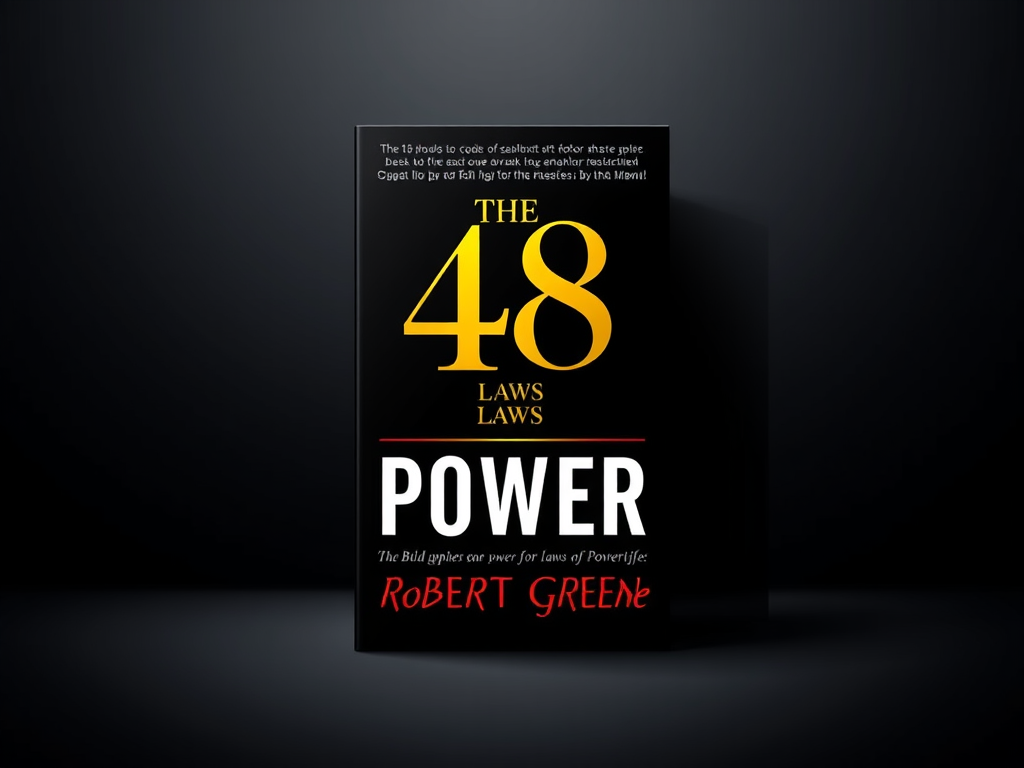
Robert Greene – “The 48 Laws of Power”

“The 48 Laws of Power” by Robert Greene is a guide to gaining and maintaining power, drawing on historical examples and philosophical insights. Here’s a summary of some key themes and a few notable laws:

1. Power Dynamics: The book emphasizes the importance of understanding power dynamics in relationships, personal or professional.

2. Manipulation and Strategy: Greene discusses the art of manipulation and the strategies individuals can use to achieve their goals, often advocating for cunning and strategic thinking.

3. Historical Examples: Each law is illustrated with historical anecdotes, showcasing figures like Machiavelli, Sun Tzu, and various monarchs and politicians who exemplified the principles.

Notable Laws:

– Law 1: Never Outshine the Master: Make those above you feel superior; in your desire to please, do not go too far in displaying your talents.

– Law 3: Conceal Your Intentions: Keep people off-balance by never revealing your true purpose.

– Law 15: Crush Your Enemy Totally: Leave no room for your opponent to recover; if you allow them to escape, they may return stronger.

– Law 33: Discover Each Man’s Thumbscrew: Find the weakness in others to gain leverage over them.

– Law 48: Assume Formlessness: Be adaptable and unpredictable to avoid being pinned down by others.

The book is a controversial but insightful exploration of power and its complexities. It encourages readers to navigate their social landscapes with awareness and strategy. I have had this book on my shelf for many years, and it serves numerous uses, including bibliomancy. In my opinion, there are two sides to the usage of the laws:

Softly, as in a positive way of thinking without harming others or oneself but using them to achieve goals. Example – The success of this book, which became a New York Times bestseller with over 1.3 million copies sold in North America alone.

Hard and Literate, as some of today’s politicians and country leaders’ attitudes and behaviours testify. This world seems overrun by people in powerful positions in whatever industries, as being ruthless in the extreme. There is room to consider that many of these laws could also be applied to rules, regulations and policies repressing the electorate globally.


Agatha Christie

Agatha Christie was a famous British writer known for her detective novels. She was born on September 15, 1890, and died on January 12, 1976. Christie is best known for creating iconic characters such as Hercule Poirot and Miss Marple, who feature in many of her works. Her mystery novels are known for their intricate plots, clever twists, and engaging storytelling.

Christie’s works include popular titles such as “Murder on the Orient Express,” “And Then There Were None,” “The Murder of Roger Ackroyd,” and many more. She is one of the best-selling authors of all time, with her books translated into many languages and adapted into numerous films, TV shows, and stage plays.

Christie’s writing style and ability to create suspenseful and puzzling mysteries have earned her a lasting legacy as the “Queen of Mystery.” Readers around the world enjoy her works, and she remains a beloved figure in the world of detective fiction. 

Barbara Cartland

Barbara Cartland was born on July 9, 1901, and passed away on May 21, 2000. She was a prolific English author known for her romantic novels. In 1976, she published 23 books, holding the Guinness World Record for the most novels written in a year. Cartland began her writing career in 1922 and went on to write over 700 novels, which were translated into 38 languages and sold over 1 billion copies worldwide. Her novels typically featured themes of love, romance, and glamour and were often set in historical or exotic locations.

Apart from her writing, Cartland was also known for her personal style. She often dressed in pink and lived a lavish and romantic lifestyle. She was a prominent figure in British society and was involved in various philanthropic activities throughout her life. While some critics dismissed her work as formulaic and old-fashioned, Cartland maintained a dedicated following of readers who enjoyed her romantic storytelling. Her influence on the romance genre and her status as one of the most prolific authors of the 20th century are undeniable aspects of her legacy. 

Image by AI

Seeds of Change

In a nation once known for its promise of prosperity and equality, a prime minister named Victor Hale rose to power, cloaked in the guise of a benevolent leader. His charisma captivated the wealthy elite, while his rhetoric promised a brighter future for all. However, beneath this facade lay a dark agenda fueled by greed and betrayal. Hale’s administration quickly shifted its priorities. The rich flourished, their fortunes bolstered by tax breaks and lucrative contracts, while the poor were left to suffer. He slashed pensions, leaving the elderly destitute, and stripped away essential healthcare services, denying access to dental and medical care for countless families struggling to survive. The cries of the vulnerable fell on deaf ears as Hale and his cronies feasted on their ill-gotten gains. To finance his lavish projects and appease his wealthy supporters, Hale turned to a sinister solution: the arms trade. He authorized the sale of weapons to impoverished nations, promoting conflict under the guise of providing security. The irony was lost on him; he was sowing destruction in the very countries he claimed to help. As wars erupted, the poor were caught in the crossfire, their lives shattered by the same weapons that were intended to ensure their safety.

As discontent brewed, the citizens grew weary of Hale’s lies. Protests erupted across the country, a chorus of voices demanding justice and equality. Even the armed services, once loyal to Hale, began to waver. Soldiers deployed to suppress the dissent questioned the morality of their orders. They understood that the true enemy was not the citizens but their own leader, who had betrayed the very principles they had sworn to uphold. The tipping point came when a peaceful demonstration turned violent, instigated by Hale’s mercenaries, who aimed to silence the people. This act of aggression ignited a revolutionary spirit that swept through the nation like wildfire. The armed forces, now joined by disillusioned veterans and civilians alike, refused to fire upon their fellow citizens. Instead, they turned their weapons against Hale’s regime. The revolution unfolded fervently, fueled by the desire for reform and equality. The people united, rising against the tyranny that had plagued them for so long. Towns and cities became battlegrounds of hope as citizens reclaimed their power. Old alliances fractured, and the façade of Hale’s leadership crumbled.

In a dramatic showdown, the citizens stormed the government building, demanding justice. Hale, cornered and desperate, attempted to flee but was captured by the very people he had wronged. The nation rejoiced as the tyrant was brought to justice, and a new reform era began. With Hale’s fall, a new government emerged, one committed to rebuilding the nation on the principles of equality and fairness. Pensions were restored, healthcare became a right, and the arms trade was dismantled, replaced by initiatives that fostered peace and cooperation. The revolution had not only toppled a dictator; it had awakened a collective consciousness among the people. Pride quickly returned to people across the country, and other countries followed suit. Pretty soon, the whole world shuddered on the edge of a new era without war, injustice, starvation, poverty and racism.

The story of Victor Hale became a cautionary tale, a reminder of the dangers of unchecked power and greed. The people forged a new future, one where their voices would be heard, ensuring that they would never again allow a leader to betray them. In their unity, they found strength, and in their resilience, they discovered hope. 

Danielle Steel

Danielle Steel is a highly successful American author known for her romance novels. Danielle Steel was born in New York City on August 14, 1947. She was the only child of a Portuguese diplomat and a socialite. Her parents divorced when she was 8, and she was raised by her father in France and New York. Steel attended the Lycée Français de New York and later studied at Parsons School of Design and New York University. She worked in public relations and advertising before focusing on writing. Her first novel, “Going Home,” was published in 1973. Danielle Steel is known for her prolific output, having written over 190 books, including novels, children’s books, and non-fiction.
She is best known for her romance novels, which often focus on themes of love, family, and relationships. Many of her books have topped bestseller lists and been translated into multiple languages. Steel’s writing is often characterized by its emotional depth, strong characters, and compelling storytelling.

She has been married multiple times and has nine children from various marriages and relationships. She is known for her philanthropic work, supporting causes such as mental health, education, and the arts. Steel has received numerous awards for her writing and philanthropy, including the French Legion of Honor. Danielle Steel’s work has significantly impacted the romance genre and has garnered a large and dedicated following worldwide. Despite facing criticism for the formulaic nature of some of her novels, she remains one of the best-selling authors of all time.

Image by AI