James Herbert (1943-2013) was a renowned British author who made significant contributions to the horror genre with his chilling and suspenseful novels. Born in London, England, Herbert began his writing career in the 1970s and quickly gained popularity for his unique storytelling style, which blended horror, suspense, and supernatural elements. One of Herbert’s most notable works is “The Rats” (1974), a novel that follows a series of gruesome attacks by mutant rats on the inhabitants of London. This book, along with its sequels, established Herbert as a master of horror fiction and garnered him a devoted following of readers who were drawn to his vivid descriptions of terror and his ability to create a palpable sense of fear.
Throughout his career, James Herbert penned over 23 novels, including bestsellers like “The Fog” (1975), “The Dark” (1980), and “Haunted” (1988). His books often featured graphic depictions of violence and horror, pushing the boundaries of the genre and captivating audiences with their fast-paced plots and intense imagery. Herbert’s influence on the horror genre is undeniable. His works continue to be celebrated for their ability to evoke deep-seated fears and provoke a sense of unease in readers. His legacy as a master storyteller lives on through his novels, which have been translated into numerous languages and continue to captivate new generations of horror enthusiasts. My own personal favourite is ‘The Magic Cottage’.
James Herbert’s impact on the world of literature is profound, and his name remains synonymous with the essence of fear and suspense in horror fiction. His legacy as a trailblazer in the genre endures, and his works stand as a testament to his unparalleled talent for crafting tales that linger in the mind long after the final page is turned.
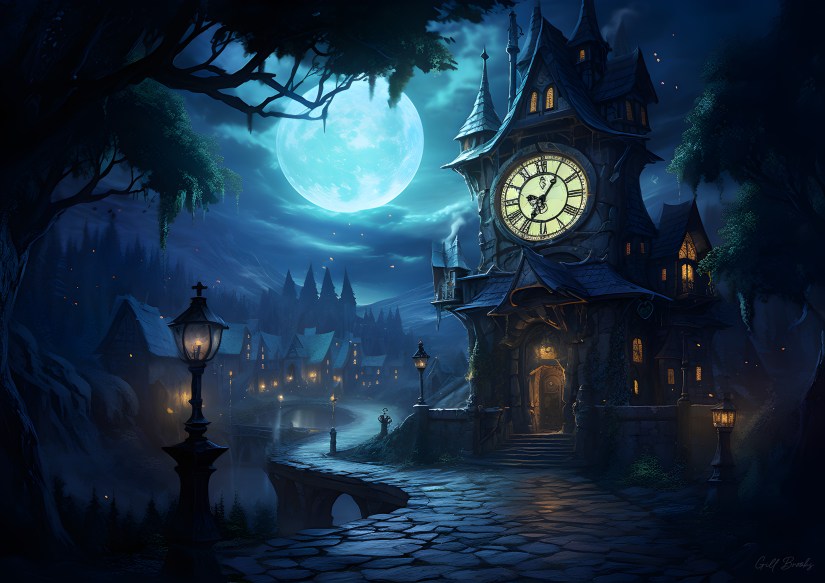
In the quaint town of Willow Creek, the legend of the Whitaker House had woven itself into the fabric of local folklore. On a moonless Halloween night, the wind howled through the barren trees, carrying the tales of the past. The mansion stood at the edge of the woods, its silhouetted form looming ominously against the dark sky. The townspeople avoided it, their imaginations haunted by stories of Eliza Whitaker, the young girl who vanished one fateful Halloween night decades ago. Despite the warnings, five adventurous teenagers, Jack, Lily, Sam, Emma, and Tom, decided to test their courage by entering the infamous house. Armed with flashlights, they approached the mansion; its grandeur faded, the windows boarded up, and ivy crawled over its stone facade.
As they stepped inside, the air turned frigid, and the scent of decay filled their nostrils. The door creaked ominously behind them, closing with a resounding thud. The group exchanged nervous glances but pressed on, their footsteps echoing through the dusty corridors. They split up to explore, each taking a different path through the labyrinthine interior. Jack and Lily entered the parlour, where cobwebs draped over antique furniture. A grand piano stood in one corner, its keys yellowed and silent. A haunting melody filled the air as Lily ran her fingers across the keys, though her hands never moved. Meanwhile, Sam and Tom found themselves in a dimly lit library, its shelves lined with ancient tomes. A heavy book lay open on a table, its pages filled with Eliza’s diary entries. As they read, a chill swept through the room. Eliza had written of hearing voices, whispers calling her to the forest, and a shadowy figure that appeared in her dreams.
Emma, exploring alone, stumbled upon the attic stairs. Curiosity getting the better of her, she ascended into the darkness. The attic was cluttered with forgotten relics and dusty trunks. There, she found a tarnished mirror, its surface cloudy. As she peered into it, the reflection shifted, revealing a young girl in a white gown, her eyes pleading. Suddenly, a loud crash echoed through the house, drawing the group back together. They converged in the hallway, their breaths visible in the freezing air. The house seemed to pulse with a life of its own, the walls groaning as if in pain. Determined to uncover the truth, they followed a trail of cold air leading to a hidden door behind a tattered tapestry. Pushing it open, they descended a narrow staircase into a forgotten basement. The air was damp and heavy, and the flickering light of their flashlights revealed a room filled with old toys and a small bed. A porcelain doll eerily resembling Eliza stood in the corner, its eyes glinting in the darkness. As they approached, the temperature dropped further, and a translucent and sorrowful spectral figure emerged. It was Eliza, her voice a mere whisper.
“You must help me,” she implored. I am trapped between worlds.”
The teens realized that Eliza’s spirit was bound to the house, unable to move on. Determined to help, they formed a circle, holding hands as they recited a passage from her diary, hoping to free her soul. As they chanted, the room filled with a blinding light, the walls trembling as if resisting the ritual. The ground shook violently, and the whispers grew into a deafening roar. Shadows writhed around them, and the dolls in the room seemed to come alive, their faces twisted in anguish. But the teens held firm, their voices rising above the chaos. The light exploded outward with a final, heart-stopping crescendo, and the mansion fell silent. The oppressive cold lifted, and Eliza’s spirit appeared before them, her face serene.
“Thank you,” she whispered, her form dissolving into shimmering light.
The group fled the basement, racing through the now-silent house and into the night. Behind them, the Whitaker House stood still, its aura of menace gone. They vowed to keep Eliza’s story alive, a reminder of the power of compassion and courage. Every Halloween, the townsfolk would gather, sharing the tale of the brave teens who freed Eliza Whitaker’s spirit, ensuring her legend would be told for generations to come. And though the house remained empty, the haunting whispers ceased, leaving only the echoes of a past finally at peace.
In the quaint town of Willow Creek, where the streets were strewed with colourful autumn leaves and the air was crisp with the promise of winter, there lived a young woman named Eliza. Eliza was known for her meticulous nature and love for everything organized. She worked as a librarian at the local library, where she spent her days surrounded by books and the comforting scent of old paper. One chilly morning, as Eliza was sorting through a stack of mail at her desk, she noticed a peculiar envelope among the usual bills and advertisements. It was a small, cream-coloured envelope with elegant calligraphy that read: “For Eliza, with love.” Intrigued, she carefully opened the envelope to find a handwritten letter inside.
The letter was from her long-lost aunt, Olivia, whom she hadn’t heard from in years. Olivia wrote about how much she missed Eliza and hoped to reconnect with her niece. Tucked inside the letter was a faded photograph of them, smiling together in the sun-drenched garden of Eliza’s childhood home. Overwhelmed with emotion, Eliza wrote a heartfelt reply to her aunt. She carefully sealed the letter, the envelope, and the treasured photograph and placed it in her bag to mail it that evening. However, as she reached for the envelope later that day, it was nowhere to be found. Panic set in as Eliza searched frantically through her desk, bag, and every corner of the library. The envelope had simply vanished without a trace. She retraced her steps, hoping to find some clue to its whereabouts, but it was as if the envelope had been swallowed by the shadows.
Days turned into weeks, and the envelope remained missing. As she mourned the lost connection with her aunt, Eliza’s days were filled with worry and regret. She couldn’t shake the feeling that the envelope held more than just a letter and a photograph, a chance to mend a broken bond and rediscover a piece of her past. One chilly evening, as Eliza was closing the library, she noticed a glint of light beneath a bookshelf. Crouching down, she reached beneath the dusty wooden shelves, her fingers brushing against something smooth. With disbelief, Eliza pulled out the missing envelope, miraculously unharmed and intact. Tears of relief streamed down her face as she reread the letter, feeling the warmth of her aunt’s words enveloping her like a long-lost hug. With renewed hope and determination, Eliza penned a reply to Olivia, promising to never let their connection fade again. And so, in the quiet town of Willow Creek, a missing envelope brought together two hearts separated by time and distance, proving that sometimes, the things we cherish most are never truly lost. They just need a little help finding their way back home.
Jerome David Salinger, known as J.D. Salinger, was an American author best known for his novel The Catcher in the Rye. He was born in New York City on January 1, 1919, and passed away on January 27, 2010, in Cornish, New Hampshire. Salinger grew up in Manhattan and attended various prep schools before enrolling at New York University. He also studied at Ursinus College and Columbia University. Salinger served in the U.S. Army during World War II and participated in the D-Day invasion of Normandy. He later suffered from post-traumatic stress disorder as a result of his wartime experiences.
Salinger’s most famous work, “The Catcher in the Rye,” was published in 1951 and became an instant classic. The novel explores themes of teenage angst, alienation, and the search for authenticity. After the success of “The Catcher in the Rye,” Salinger became increasingly reclusive and avoided the public eye. He stopped giving interviews, rarely appeared in public, and became known for his privacy. His writing style is characterized by its spare, precise prose and its focus on the inner lives of his characters. He often explored themes of innocence, disillusionment, and the struggle to find meaning in a complex world.
In addition to “The Catcher in the Rye,” Salinger published several collections of short stories, including “Nine Stories” and “Franny and Zooey.” He also continued to write but chose not to publish his later works. J.D. Salinger’s works have impacted American literature and continue to be widely read and studied. Despite his reclusiveness, his influence on other writers and his place in literary history remain significant. Overall, J.D. Salinger was a talented and influential writer whose work continues to resonate with readers around the world.
Jules Verne, born on February 8, 1828, in Nantes, France, was a prominent French writer known for pioneering science fiction and adventure novels. He is often referred to as the “Father of Science Fiction.” Verne’s works have significantly impacted the literary genre and have inspired countless authors, filmmakers, and inventors.
Twenty Thousand Leagues Under the Sea (1870) – This novel follows the adventures of Captain Nemo and his submarine, the Nautilus, as they explore the ocean’s depths.
Journey to the Center of the Earth (1864) – This novel tells the story of a group of explorers who journey deep into the Earth’s interior, encountering strange creatures and landscapes.
Around the World in Eighty Days (1873) – This novel follows the adventures of Phileas Fogg as he attempts to circumnavigate the globe in just 80 days.
From the Earth to the Moon (1865) – This novel explores the possibility of space travel and follows a group of adventurers as they attempt to launch a projectile to the moon.
Jules Verne’s works were known for their detailed descriptions of scientific concepts and technologies, many of which were ahead of their time. He had a deep interest in geography, exploration, and technology, which is reflected in his stories. Verne’s ability to combine scientific accuracy with imaginative storytelling set him apart from other writers of his time. Jules Verne passed away on March 24, 1905, in Amiens, France. Despite facing some criticism during his lifetime for his speculative ideas, his works have since become classics of science fiction literature and continue to be widely read and adapted into various forms of media.




 Lazarus Carpenter - Author