Parable of Three Brothers

Once upon a time, in a peaceful village, lived three brothers: Eli, Malrik, and Joran. They were born of the same parents but grew up with very different hearts. Eli, the eldest, was kind and compassionate and always sought to help others. He believed in kindness and fairness, and his gentle nature made him beloved by many. Malrik, the middle brother, was cunning and ambitious, but his heart was often clouded with greed and anger. He loved power and was not afraid to use deceit to get what he wanted. Joran, the youngest, was indifferent to everything. He cared little for rules, others’ feelings, or ambitions. He wandered through life without much thought or concern, often detached from the conflicts around him. As they grew older, their differences caused strife. Eli would try to mediate disputes, but Malrik’s schemes frequently led to misunderstandings. Indifferent to these disputes, Joran simply watched from the sidelines, often alienating himself further.

One day, their village faced a crisis—an ancient, enchanted forest nearby began to wither, threatening their homes and livelihoods. The village elders called upon the three brothers to find a solution. Eli believed they should seek the wisdom of the forest spirits and restore the balance with kindness.  Malrik saw an opportunity to exploit the situation for personal gain, perhaps to claim the forest’s treasures. Joran shrugged, uninterested, hoping it would pass without his involvement.

Despite their differences, the brothers set out together, each driven by their own motivations. Eli’s journey was filled with compassion. He helped injured animals, listened to the whispers of the trees, and sought harmony. He believed that love and understanding could heal the forest. Malrik’s path was marked by cunning—tricking creatures, exploiting resources, and seeking shortcuts to quick success. Joran, meanwhile, wandered aimlessly, often indifferent to the dangers and lessons around him, only following when it suited him.

As they travelled deeper into the forest, they faced challenges that tested their hearts. Eli encountered a wounded phoenix and nursed it back to health, learning that restoring nature required patience and love. Malrik was tempted by a treasure hidden beneath a cursed tree, but realised that greed could bring ruin. Lost in the woods, Joran finally saw the beauty of the world around him—the songs of birds, the glow of fireflies—and felt a flicker of curiosity.

One night, they camped beneath a shimmering starry sky, and their differences came to the surface in a heated argument. Eli urged kindness, Malrik pushed for cunning, and Joran dismissed their concerns altogether. But in that moment, a wise old owl appeared and spoke: 
“Only when you learn to listen to each other can you find the true path.”

Realising the importance of unity, the brothers decided to work together. Eli suggested they combine their strengths: kindness, cunning, and curiosity. They returned to the forest, where Eli’s compassion healed the land, Malrik’s cleverness uncovered the source of the curse, and Joran’s indifference transformed into genuine interest as he saw the forest’s beauty. Through their combined efforts, the enchanted forest was restored, its magic renewed. The village prospered once more, and the brothers discovered something profound: Love and understanding are the most incredible powers, capable of transforming discord into harmony.


Noam Chomsky

Noam Chomsky is a prominent linguist, philosopher, cognitive scientist, historian, and social critic, born on December 7, 1928, in Philadelphia, Pennsylvania. He is best known for his contributions to the fields of linguistics and cognitive psychology, particularly for developing the theory of generative grammar, which revolutionized our understanding of language structure and acquisition.

Chomsky’s academic career began at the Massachusetts Institute of Technology (MIT), where he became a professor and published influential works, including “Syntactic Structures” (1957) and “Aspects of the Theory of Syntax” (1965). His theories posited that the ability to acquire language is innate to humans, a concept known as the “universal grammar.”

Beyond linguistics, Chomsky is recognized for his political activism and criticism of U.S. foreign policy and corporate power. He has authored numerous works on politics and society, including “Manufacturing Consent” (1988), co-written with Edward S. Herman, which critiques the media’s role in shaping public perception.

Chomsky’s influence extends across various domains, and he is often regarded as one of the most important intellectuals of the 20th and 21st centuries. His work continues to inspire debates in linguistics, philosophy, cognitive science, and political theory. 

Shel Silverstein

Shel Silverstein was an American poet, songwriter, cartoonist, and author best known for his children’s books and whimsical poetry. He was born on September 25, 1930, in Chicago, Illinois, and showed an early interest in art and writing. Silverstein attended the School of the Art Institute of Chicago and began his career as a cartoonist, contributing to magazines like “Playboy.”

His most famous works include “The Giving Tree,” “Where the Sidewalk Ends,” and “A Light in the Attic.” These books are celebrated for their playful language, imaginative illustrations, and underlying themes of love, loss, and the joys of childhood.

In addition to his children’s literature, Silverstein wrote songs for notable artists, including “A Boy Named Sue,” famously performed by Johnny Cash. His unique style and ability to connect with children and adults have left a lasting legacy.

Shel Silverstein passed away on May 10, 1999, but his work continues to be cherished by readers of all ages. His blend of humour, insight, and profound simplicity makes his poetry and stories timeless. 

Dr. Seuss

Dr. Seuss, whose real name was Theodor Seuss Geisel, was an American author and illustrator best known for his famous children’s books. He was born on March 2, 1904, in Springfield, Massachusetts, and passed away on September 24, 1991, in La Jolla, California. He wrote and illustrated over 60 books during his lifetime, many of which have become classics of children’s literature. Some of his most famous works include “The Cat in the Hat,” “Green Eggs and Ham,” “How the Grinch Stole Christmas!” and “Horton Hears a Who!”

Dr. Seuss received numerous awards for his work throughout his career, including the Pulitzer Prize, three Caldecott Honors, and three Academy Awards. His books have been translated into multiple languages and have sold millions of copies worldwide. His whimsical and imaginative stories often carried essential messages about tolerance, diversity, and environmental conservation. His unique writing style and iconic illustrations have made him one of the most beloved and influential children’s authors ever. 

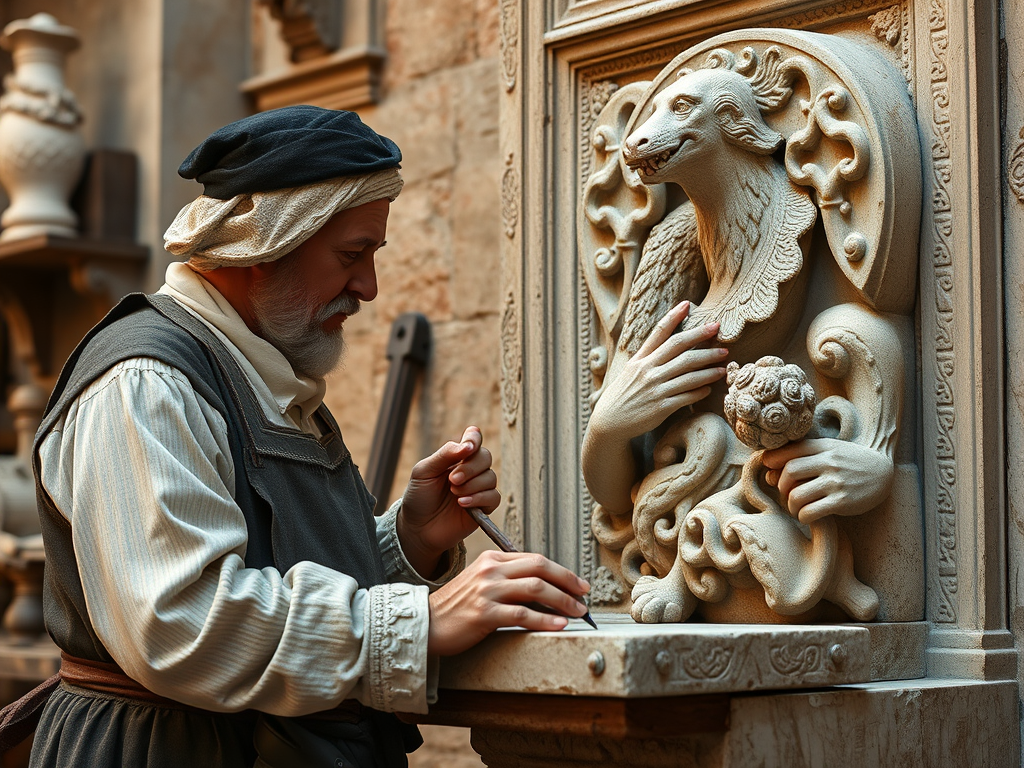
Image by AI

Bertrand the Sculptor

In the heart of Venice, amidst the winding canals and echoes of history, stood an art gallery known as “Galleria Fantasma.” This gallery was renowned not only for its exquisite collection of Renaissance masterpieces but also for its most enigmatic resident—Bertrand the Sculptor, a spectral artist who had haunted its halls since 1486. Bertrand was a gifted sculptor, celebrated for his ability to breathe life into stone. His works captured the depth of human emotion, a testament to his profound understanding of beauty and sorrow. However, his promising career was cut short when the plague swept through Venice, claiming his life at the age of 38. On his deathbed, surrounded by the unfinished sculptures that bore witness to his genius, Bertrand made a silent vow: his art would live on, even if he could not.

Upon his death, Bertrand’s soul found itself bound to his final creation—a haunting sculpture of a woman, her face a reflection of both melancholy and grace. This piece, known as “The Muse,” was said to embody a love lost to time, a muse who had inspired Bertrand’s greatest works. In the ethereal realm, Bertrand lingered, becoming a living, breathing ghost, his presence a whisper in the gallery’s corridors. Visitors to the Galleria Fantasma often reported eerie sensations—a sudden chill, the faint sound of chiselling, or a shadow glimpsed from the corner of the eye. These occurrences, though unsettling, seemed to possess an inexplicable warmth, as if the ghost meant no harm. Indeed, Bertrand’s intentions were pure; he sought not to frighten but to inspire.

Over the centuries, many artists and art lovers ventured into the gallery, drawn by its mysterious allure. Those sensitive to the supernatural sometimes found themselves in unexpected dialogue with Bertrand. He would guide them through the intricacies of art, offering insights that transcended time and space. His presence was most strongly felt near “The Muse,” where he appeared as a translucent figure, his spectral hands forever refining his masterpiece. Despite his spectral existence, Bertrand yearned for recognition—not as a ghost, but as an artist whose soul lived on through his work. As Venice evolved, the gallery became a sanctuary for those who admired the ethereal beauty of art. Yet, few understood the story behind the haunting presence within its walls.

One evening, Isabella, a fervent young art student, stumbled upon the gallery. Enchanted by “The Muse,” she felt an immediate connection as if the sculpture spoke directly to her heart. As she sketched, a gentle breeze brushed her cheek, and she sensed a presence watching over her. Encouraged, she spoke aloud, sharing her dreams and fears, the ache of unfulfilled longing. To her surprise, the atmosphere shifted, a warmth enveloping her—a sign that Bertrand was listening. Isabella returned to the gallery each night, her visits becoming a ritual. Through her art and passion, she forged a bond with Bertrand. Unbeknownst to her, Bertrand found renewed purpose in guiding this young artist. He revealed the secrets of his techniques, the emotions that fueled his creations, and the stories etched into every curve of “The Muse.” Together, they embarked on a creative journey, bridging the chasm between life and death.

As Isabella’s talent blossomed, the gallery thrived. She organized exhibitions that showcased her work and illuminated Bertrand’s legacy, weaving his story into the tapestry of her art. The tale of the living ghost who inspired a new generation spread, drawing visitors eager to experience the magic of Galleria Fantasma. In time, Bertrand’s name was spoken with reverence, his spirit woven into the fabric of Venice’s artistic heritage. No longer just a ghost haunting the gallery, he became a vital part of its story, celebrated through the creations of those he inspired. And in the quiet of the night, under the moon’s silver glow, Bertrand continued to sculpt, his heart at peace, knowing he would never be forgotten. 

Image by AI