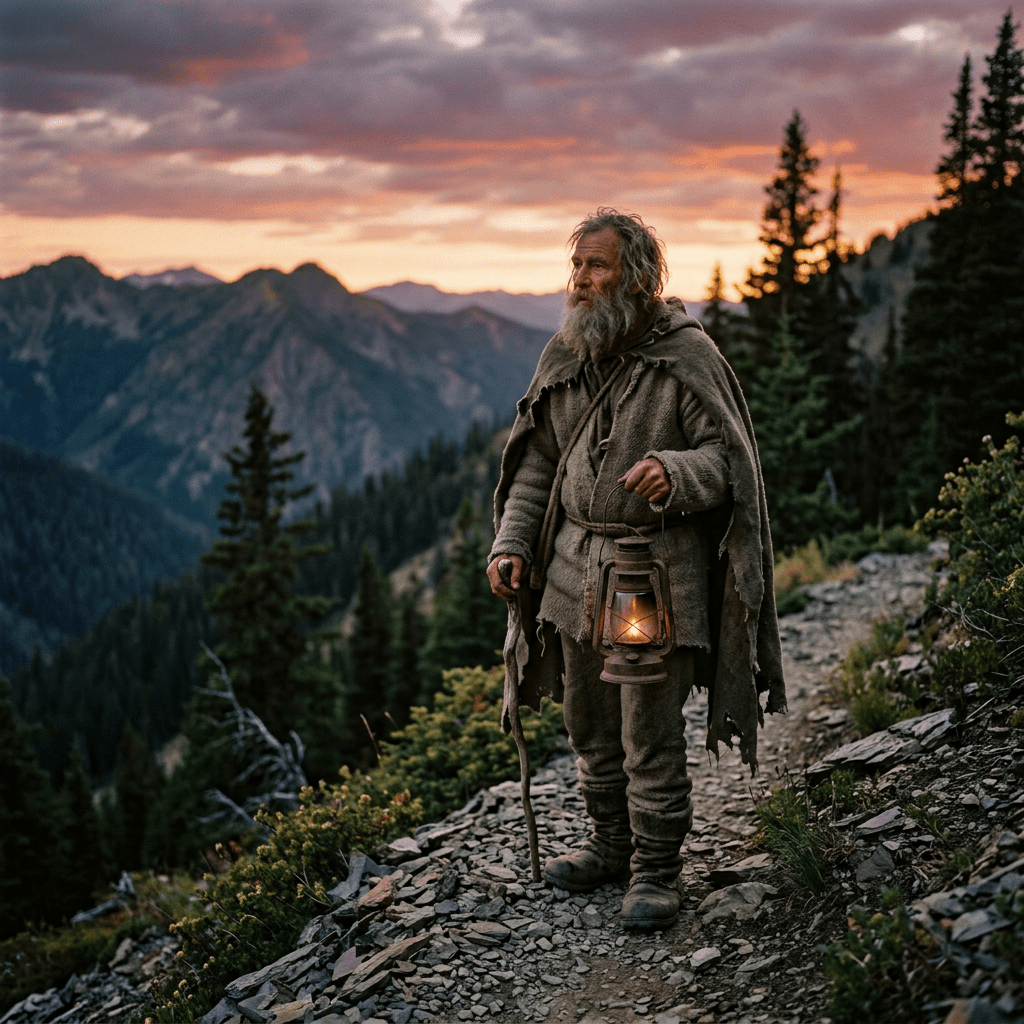
In a valley where the river learned the curvature of the stars, stood an old tower, its stones worn white by wind and memory. Atop the tower lived a solitary figure known only as the Lantern Keeper. People from nearby villages spoke of him in hushed tones, not with fear, but with a quiet reverence, as if mentioning him could wake a secret within their own hearts. On a night when the moon hung pale as a moth, a younger wanderer arrived at the tower’s base. Her name was Lysa, an author of maps and stories, who believed every road had a hidden sigh and every landmark a lesson. She carried no torch, only a small wooden lamp carved with the symbol of a star and a sigil she could not name. The Lantern Keeper received her in the doorway with a hand trembling not from cold, but from the weight of what he had seen through many winters.
“There are nights when the world is too loud,” he said, “and the only way to listen is to be still long enough to hear what the quiet reveals.”
Lysa looked past him, up the spiral stairs withdrawing into a circle of darkness.
“I have come to understand the meaning of the Hermit,” she said, though she could not quite articulate what that meant beyond a feeling of distance and clarity.
The Hermit, the Keeper explained, is not a withdrawal from life but a choosing of it with new intensity. The lantern he carried was not for others to see, but for himself, a constant reminder to illuminate the inner corridors where doubt often hides.
“Why a lantern for you, if others need light?” Lysa asked.
“Because light is not to chase shadows away,” the Keeper replied. “Light invites the traveller to see. It asks questions rather than provides answers. The Hermit learns to distinguish the voice of fear from the whisper of truth, and in discernment, solitude becomes a doorway, not a prison.”
That night they sat by the tower’s dusty window, where the world outside moved like a photograph left in rain. The Lantern Keeper spoke little, but when he did, his voice carried the weight of years spent listening to the pace of one’s breath.
“Interpretation is a patient art,” he continued. “Tarot cards assist with that patience. They are mirrors reflect not what is outside us, but what we choose to carry inside. The Hermit doesn’t seek consensus; he seeks inner alignment. The star on your lamp,” he said, turning to the sigil, “is not a guide for others but a reminder to follow your own north.”
Lysa watched the glow of the lamp shift as a draft found its way through the tall window. “And the Hermit’s map?” she asked, her curiosity sharpening the air between them.
The Keeper’s eyes softened. “A map without borders is a map of possibilities. The Hermit’s map is not a place but a practice: to listen before acting, to retire within before stepping forward, to question what you think you know until only the essential remains. Sometimes the essential is merely the quiet courage to begin again.”
In the days that followed, Lysa walked the valley with the lantern’s memory in her pocket. She learned to travel without rushing, to notice the small physics of the world, the way a creek remembers the shape of a stone, the way bark changes colour with weather, the way a solitude can feel like a sanctuary when you stop fighting it.
One evening, a storm gathered like a thought you cannot shake free. The valley’s voice grew loud with rain and wind, but Lysa stood beneath the tower’s shadow, the lantern warm in her palm. She did not seek to illuminate the storm, only to listen to how it moved through her. In that listening, a question formed, not loud, but clear: What truth does this moment ask me to hold?
When the dawn finally drew its pale thread across the sky, Lysa descended the hill with a new map in her hands, a map not of roads, but of choices. The Hermit’s lesson had become a practice: to walk with discernment, to value solitude as a sanctuary for honestly facing oneself, and to let light be a companion rather than a guidebook.
The Lantern Keeper watched her depart, not with a longing to keep her, but with the quiet satisfaction of a gardener who has planted a seed that will one day bear fruit in someone else’s garden. He returned to the tower’s quiet heart, where the lamp’s glow steadied into a steady rhythm, the heartbeat of a life chosen with intention, a life that understood sometimes the brightest wisdom is the courage to walk alone long enough to see clearly what the soul already knows.
And so the Hermit’s meaning lingered in the valley like a soft wind: a reminder that the deepest revelations are not shouted from mountaintops but whispered in quiet rooms where someone chooses to turn their gaze inward, listen intently, and carry the light onward for others who come seeking their own truth.


