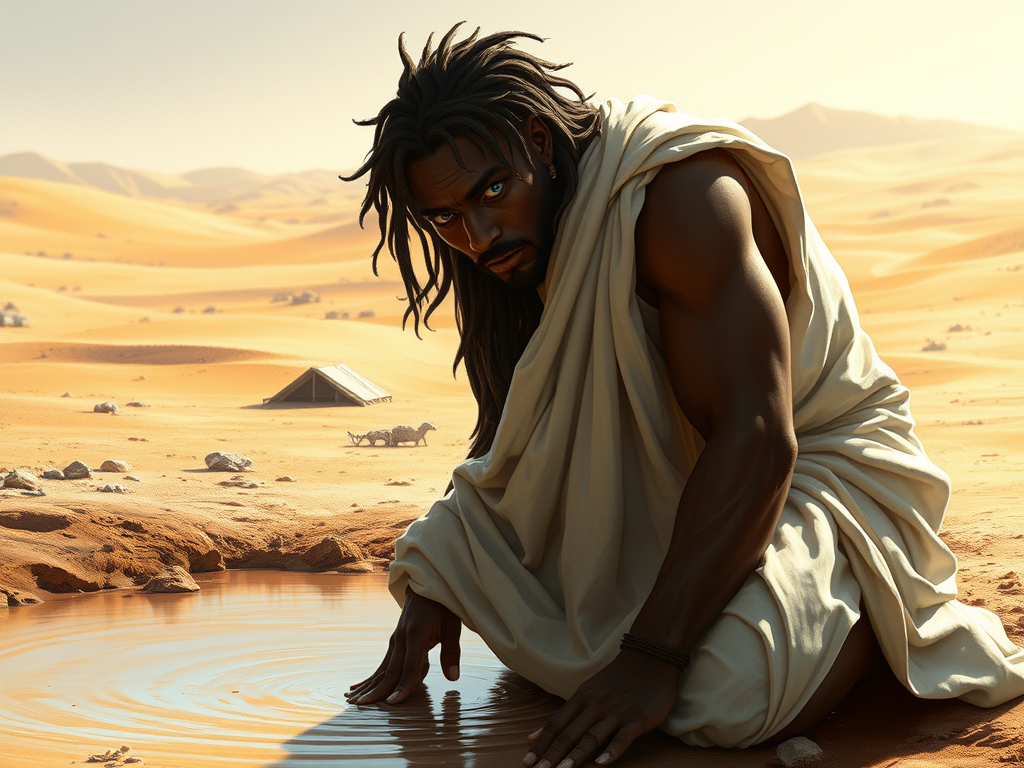
The desert was a patient thing, older than the towns that dotted its edge and the rumours that lingered like heat mirages. It did not hurry; it did not worry. It simply breathed in the dawn and exhaled, time tasting grainy, sun-warmed air. And in this vast quiet lived a man named Rafi, whose home was a shack of sun-baked bricks and a roof that sagged like a tired camel. Rafi had no access to the things most people clung to, mobile phones, televisions, and the internet. He did not miss them, exactly, because he had never known them as more than stories told by others with fingers stained by ink and eyes tired from bright screens. Instead, he carried something else, something more intimate: a cinema behind his eyes.
Each morning, the desert woke with a soft hiss of wind over sand. Rafi would rise, stretching like a cat that had slept with its gaze fixed on distant dunes. He kept his world simple: a ledger of days, a small pot of water, a handful of dates, and his memory. The memory was not a collection of dates or numbers, but a living theatre that played whenever he needed it. If he walked to the edge of a cliff where the earth dropped away into a blue heat, his cinema offered him a panorama of the day to come. He could replay the way the sun glowed first on one ridge, then on another, like a celestial painter testing colours. He could hear the crisp whisper of a breeze that would pass through the date palms by the dry riverbed. He could feel the tremor of a distant thunderstorm, even when it stayed far beyond the horizon, a rumour in the air.
If a passer-by stopped by his shack to trade news or water, Rafi would listen with the careful attention of someone who knows how stories travel through footprints, through the way a camel’s knee bends on the sand, through the scent of rain that’s only a rumour until it touches skin. And in his cinema, those stories did not simply exist as words; they became scenes with actors, with light that shifted and trembled, with music that rose and fell like dunes breathing. One evening, a girl named Luma wandered into his life, drawn by the lazy glow of a stubborn desert sunset. She carried a notebook and a bottle of ink, things the city called useless, and yet she believed writing could carry a memory from one place to another. She asked, softly, if he ever forgot. Rafi shook his head, a slow, almost imperceptible movement that mirrored the swaying of a palm tree in a gentle wind.
“I do not forget,” he said, and his voice carried the weight of a man who had learned to listen to the world until it spoke back in its own language. “I remember everything, and between the remembered shadows and the remembered lights, there is a cinema behind my eyes.”
Luma was patient. She asked to see this cinema, not as a trick or a spectacle, but as a companion to the stories they could tell together. So he closed his eyes, and the desert quiet pressed in, and the cinema opened. He saw the first dawn he could recall, not just as a colour but as a sound, the hum of distant bees, the crackle of dry grass as the sun’s first kiss touched it. He saw his mother’s hands, calloused with years of tending oil lamps and whispered prayers. He saw the first spring rain, a gentle curtain of droplets turning the clay of the earth into a mirror. She watched as the images unfurled with a patient grace, a procession of seedlings breaking through hard soil, a caravan moving like a slow river, a child learning to walk and then to run with the light of a whole village inside him. The cinema did not demand attention; it offered it as a gift, a steady tide that washed away the fear that loneliness might someday swallow a person whole.
“Why tell stories to the sand when you can tell them to the wind?” Luma asked, half-jest, half-wonder.
Rafi smiled, a quiet widening of lips that had learned generosity from years of listening.
“Because the wind forgets, sometimes. The sand remains, but the shapes it remembers fade with the sun. My cinema remembers more than a handful of days; it remembers a lifetime.”
In his cinema, he did not simply relive memories; he reinterpreted them. He learned to see the world through a sun-drenched lens where even misfortune became a scene with a turning point. A drought did not merely dry the wells; it set the stage for a decision to stay, to walk, to share a bloom of resilience with those who would listen. And people did come, beggars, merchants, and shepherds, a traveller with a cracked flute who claimed the desert had stolen his tune. They came not for news, but for a glimpse of the man whose eyes could render a full life as if it were a screen playing on a wall of air and memory. Rafi never spoke much about the cinema; he allowed it to show itself in actions, how he would mend a broken jar with wax and patience, how he would guide a wayward goat back to its penned friends, how he shared the last of his water with a stranger who asked for nothing in return. The cinema behind Rafi’s eyes was more than nostalgia. It was a compass, pointing toward moments when courage is just a decision you make while the world murmurs around you. It was a map of choices: to endure a hardship with quiet grace, to give when you have little, to remember when everyone else forgets. It was a chorus of tiny, intimate revolutions, the way a day can be survived by knowing exactly how it begins and ends, and what happens in between.
One day, a storm rolled in with the ferocity of a hundred drums. The desert weathered the night with a raw, unfiltered rage. The rain that followed was a rare confession, a memory poured into the earth until it remembered to drink again. In those hours, Rafi’s cinema did not merely show him what had happened; it rehearsed what could happen next. He saw, with crystal clarity, the steps necessary to salvage a family’s store of water and to keep their wells from going dry. He saw the faces of the neighbours who would lend their hands, the children who would gather wild grasses to feed the herd, the old man who would tell stories that stitched the community back together. When dawn finally arrived, pale and forgiving, the desert smelled of wet stone and green growth where it had never dared to show such life before. Rafi rose, not with triumph, but with a quiet resolve. He had learned that the cinema behind his eyes was not a prison of memory, but a living collaborator always ready to illuminate the path forward.
Luma stayed with him for a time, writing in her notebook the sentences the desert whispered when no one else was listening. She copied one line into her pages, a single, luminous truth: a man who lived where there were no screens could still see more clearly than most, because he did not merely observe; he remembered, and his memory became a cinema, a sanctuary where the past and future met and chose to walk hand in hand. In the end, the desert did not change Rafi’s world, and Rafi did not save the desert in any grand way. He did something quieter: he kept the space between people alive with memory. He showed that a life without modern contraptions could still be rich with connection not through notifications, but through the art of noticing, of listening, of turning a barren landscape into a stage where human warmth could perform its daily miracle: the simple act of being present.
And when the wind rose again, carrying the sigh of the dunes and the faint strains of a distant flute, Rafi would close his eyes, let the cinema behind them open, and smile at the living film of the world, clear, intimate, and forever unfolding before him.

 Lazarus Carpenter - Author