
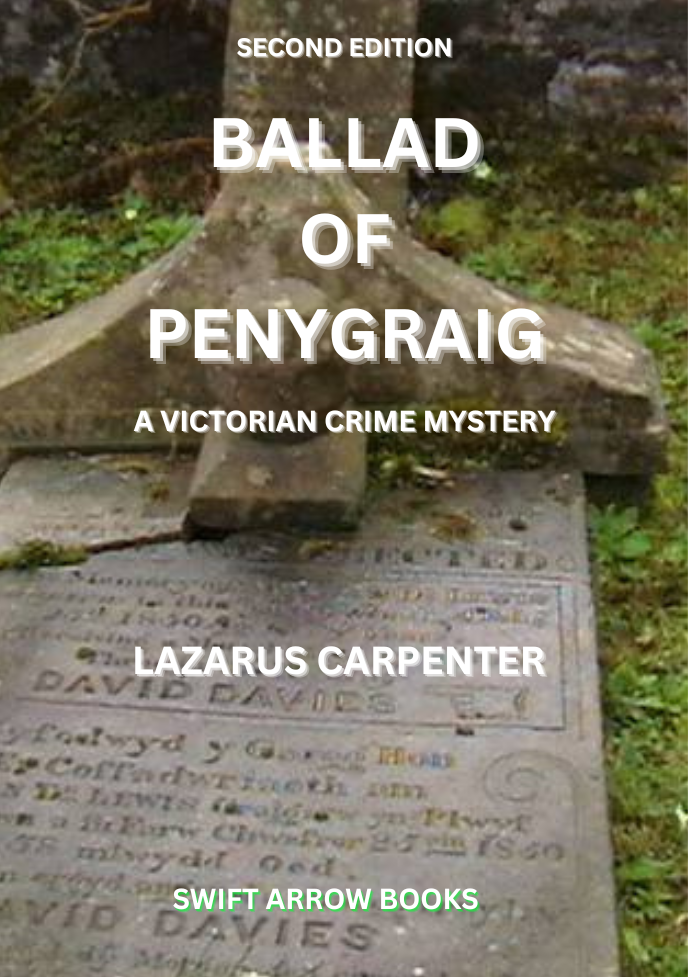
The Ballad of Penygraig is a Victorian crime mystery set in Ystalyfera, a small industrial village in the Swansea Valley of 1850. This dark tale is based on actual events, a David and Goliath story. A scandal shocking an entire community racked and divided by lies, deceit, bullying, and ultimately, murder. This novel is in the second edition and includes additions and a rewrite of parts of the story. First published in 2015.
This is the true story of a terrible tragedy in the village of Pantteg on 25 February 1850. It is the story of ordinary working folk and how everyday events and accidents between them created havoc, changing the lives of two families forever and entering the annals of valley history. The story was unknown to me until 2004, when I moved into Penygraig, ‘The House on the Rock’.
Moving to Penygraig was a sanctuary where I sought to recover from sadness. I needed solitude at this time as my partner and best friend and I proved to each other that living together was an impossibility. Penygraig is five hundred yards up the mountain from our semi-detached farmhouse. Built in the early 1800s, the cottage is very isolated, and the landscape has changed much in the past one hundred and seventy odd years. Once a thriving community, it lies in ruins amidst sparse forest lost in time. Tracks once trod by horses dragging coal up the mountain to the villagers’ homes, and those bringing Welsh stone from the quarry for building the village are long gone. Also long gone are the Miner’s Arms, the Iron Works, Coal Mines and Gough Estate. The New Swan Inn is still here, though no longer used for Coroner’s Inquests, and the headstones of Morgan and Rachael still haunt the graveyard.
I experienced a strange phenomenon before moving into Penygraig, accompanied by the owner, when I was viewing the cottage for the first time. We were sitting in the lounge around early afternoon when twice I started to roll a cigarette in a way that was foreign to me. I remember remarking to Andy, ‘that was a weird feeling’ as it happened when suddenly I saw a bent figure standing at the stable-doorway in silhouette looking at me, then seemingly walking on. I told Andy what I had just seen, he was not in the slightest bit surprised; he seemed to take it on the chin as an everyday occurrence – a ghost in the middle of the day!
I asked Andy if he knew who the ghost was, but he didn’t. However, he acknowledged that there had been some strange goings on in the house. He witnessed some ghostly goings on himself, and one or two tenants in the past ended up running down the hill in the middle of the night, but he never did find out why. So we left it there, and in I moved.
Almost as soon as I moved in, strange phenomena seemed to be an integral part of the fabric of Penygraig. Admittedly, the isolation of the cottage, and its general bleakness, especially in the winter, could feed the most furtive creative of imaginations. Still, some of the things that were to be experienced by me, and others, could not be explained away in such dull terms. I often heard voices whispering in the corners of the cottage, and on more than one occasion heard the name John Jenkins. Only later did I understand that it was two names, and indeed later, it was revealed as the brothers of David Davies, John, and Jenkins.
In my first winter at Penygraig, Christmas was followed by intrigue, and on the 25th of February, at five o’clock in the evening, a loud knock came to my back door. Still, my collie dog did not respond in her usual way of manic screeching or barking, and when I answered the door, nobody was there. Fortunately, two or three friends in the cottage at the time witnessed the event, so I could not be accused of madness. On another occasion, a photograph of the garden revealed a brick building standing in front of a giant oak tree. There is no building there now, or was there when the picture was taken, but it is believed there was one thirty years ago, back in the seventies.
Something or someone lived in the attic, and it was not mice or any other creature, as my cat is a skilled hunter, but noises were often heard as if someone was moving about. Cushions in the living room were frequently moved about, and as daft as it sounds, somebody was tidying up and fluffing cushions, but who? A malevolent presence seemed to haunt the pathway through the sparse forest from the gate up to the top of the hill, opposite the main entrance, Pantteg Chapel’s graveyard. With the help of friends, I decided to find out who had lived at Penygraig in the past, and through the census, we obtained a list of names. Through this work, we accidentally discovered a grave on the boundary wall between the graveyard, and the house next door to where I had recently moved from. It said.
‘Here lies the body of Morgan Lewis whose life was taken by a stone thrown by the hand of David Davies.’
In 1850 David Davies lived with his brothers John and Jenkins in Penygraig. To confuse the story even further, research through the parish records, and the census revealed that Morgan Lewis, the man killed by David Davies, along with his wife Rachael, and five children, lived in a tithe cottage fronting the garden where I lived previously, five hundred yards as the crow flies from Penygraig. All of this was such a coincidence, but why I did not know. The ‘Ballad of Penygraig’ was born or reborn on this day! Lying near Morgan Lewis’s grave, where Rachael is buried, I found to my utmost surprise the headstone of David Davies. It was sheared in half long ways. I have only been able to find this half, I picked it up from where it had been discarded, and placed it against the wall in front of Morgan and Rachael.
An elder of the chapel was kind enough to tell me of the ‘stone in the hand’. He is a very elderly gentleman but remembers when he was a boy they played in the graveyard, and one of the games was called ‘blood tag’, and involved passing on fictitious blood from the stone to one’s fleeing friends running for fear of being clouted by a folk legend, Morgan Lewis. The hand has disappeared over the years, and somewhere it may be lying in a garden shed or a loft at the bottom of an old suitcase? To this day I wonder what happened to the sculptured hand with the offending murderous stone cemented to it, and whoever has that hand I wonder if they know its history? I wonder if they know about the curse long gone and forgotten. Had I moved into my own ‘Most Haunted’, was I going psychotic or was something much bigger at hand, I did not know? My research began in earnest and more and more coincidences began to emerge.
In 1850 the Swansea Guardian published a story entitled ‘Affray in Ystalyfera’. Suddenly, I was confronted with facts about the case and amazed by the coincidences between what I intuited through the apparitions in the house and what was now in black and white in front of me, which was recorded in the annals of local history. My first project included writing four songs retelling the story: The hawk cried on the moor, Poacher on the rock, The Ballad of Penygraig and Rachael’s Lament.
But it was the song Ballad of Penygraig, telling the story from the reasons for the fight to its bitter conclusions, that came first. It took me a few drafts before I was happy with my lyrical content and flow. I had a tune, but there was no last line, and I could not find one I was content to use. It was very late at night, advancing through the early hours, when I played the tune repeatedly. One of the advantages of living at Penygraig was that I could make as much noise as I liked night or day without the fear of upsetting my neighbors who lived well out of earshot. I recorded the tune and struggled on through my fancy little loop pedal. At around three in the morning, almost reaching the end of the song, approaching the need for a final line, thus far not forthcoming, I felt a shiver becoming aware of the essence of Morgan Lewis standing in front of me. I carried on playing sensing Dai Davies on my left, and I still played. There was no feeling of fear or trepidation, in fact, it was like having an audience. However, approaching the song’s end, I intuited the line ‘now they are both angels in flight’. I sang the words and there was a bluish flash in the room, the essences of Morgan and Dai were gone and the song was finished. They have never been seen since, and I think the song’s final line illustrates where they went. Since that day, I have never experienced further disturbances in the house.
So, I thank Morgan and Dai most sincerely. After this, I will never be afraid of anything again and never feel alone in this life or the next. I wonder who exorcised whom?
POSTSCRIPT
Sadly, on 22 December 2012 (the day when, according to Inca predictions, the world would end) at 1am a massive landslip crashed from the mountain and Penygraig disappeared back to the earth from whence it came.
The novel is available from my online book store on this site and on Amazon https://amzn.eu/d/2mGCr92 The story was serialised for Book at Bedtime, Tales From Wales, Oystermouth Radio, narrated by me and can be downloaded from https://soundcloud.com/lazarus-carpenter/ballad-of-penygraig-chapter-five?utm_source=clipboard&utm_medium=text&utm_campaign=social_sharing&si=270a733c44ad40d58c8a5d508440fccf
 Lazarus Carpenter - Author