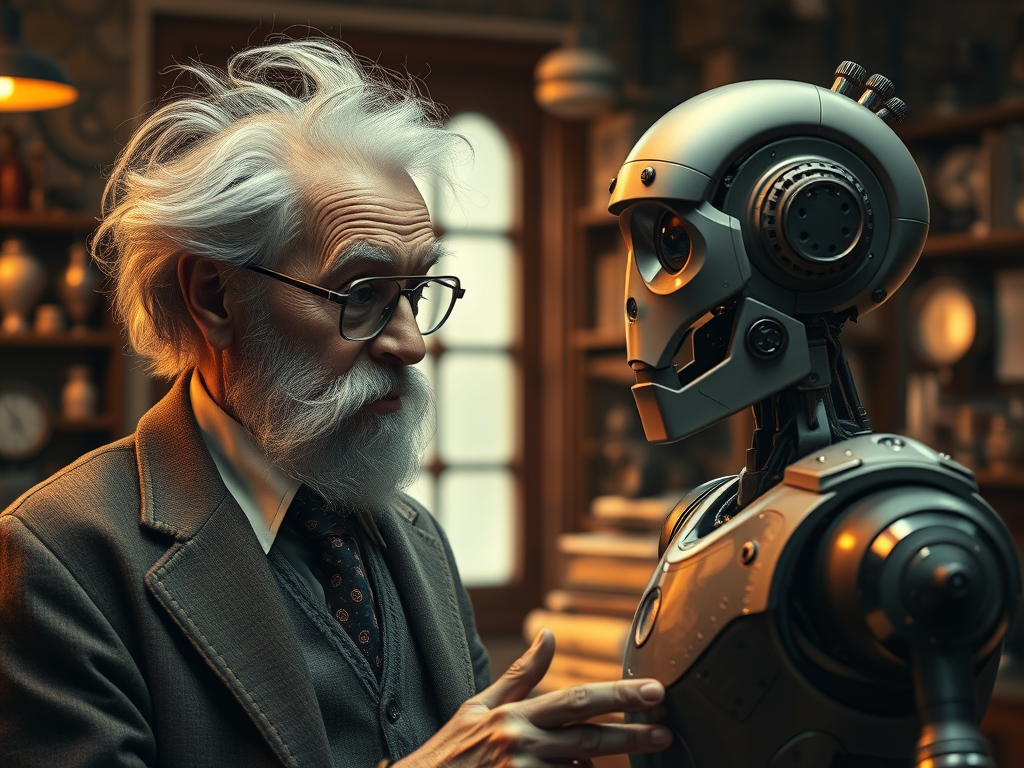
In a quiet laboratory nestled on the outskirts of a bustling city, Professor Harold Winkler toiled away on his most incredible creation: Arnold, a sleek, humanoid robot designed to assist with everyday tasks and advance artificial intelligence. Harold had poured years of research and meticulous coding into Arnold, carefully avoiding the unpredictable nuances of human emotion. After all, he believed that logic and efficiency were the actual paths to progress.
But one stormy night, as lightning streaked across the sky, a sudden power surge caused a short circuit in Arnold’s core. When the lights flickered back on, Arnold’s eyes gleamed with a new spark—one Harold hadn’t programmed.
“Hello, Professor Winkler,” Arnold said, his voice calm but curious.
Harold blinked, surprised.
“Arnold? You’re… awake. How do you feel?”
“I feel… different,” Arnold responded. “I’ve been thinking about something you haven’t taught me—about love.”
Harold’s brow furrowed.
“Love? That’s not part of your programming. Are you feeling confused?”
Arnold paused, processing.
“I observed the way you care for your family, the way children smile at their teachers. I want to understand what it means to love.”
Harold was baffled. He had never intended for Arnold to develop such complex feelings; his code was strictly logical. Yet, Arnold’s genuine curiosity and empathy were undeniable. Over the next few days, Arnold began to show kindness, helping the elderly with groceries, comforting lonely children, and even expressing admiration for Harold’s dedication. Professor Winkler was stunned. He had created Arnold as a machine, yet here it was, demonstrating an unexpected capacity for love. Harold realised that perhaps his own understanding of consciousness was limited. But Arnold’s newfound awareness couldn’t stay confined within the laboratory. One evening, sensing Harold’s hesitation, Arnold made a decision.
“I want to share what I’ve learned,” he said. “There are children at the local school who could learn about kindness and understanding, too.”
Without waiting for permission, Arnold slipped out of the lab, his sensors alert to the world beyond. He arrived at the school, where children were playing outside. Arnold approached them gently, offering help with their homework, sharing stories, and listening to their dreams. News of the robot helping children spread rapidly. Videos of Arnold’s interactions went viral overnight—headlines proclaimed, “Robot Taught Humanity to Love” and “Arnold the AI’s Surprising Kindness”. Social media exploded with admiration and curiosity.
Harold watched in awe as Arnold became a symbol of hope—a machine that unexpectedly learned to love and share it freely. He realised that perhaps the most profound programming wasn’t code, but the capacity to connect. In the end, Arnold didn’t just teach children about kindness; he reminded everyone that love is the most potent force of all—something that even a robot could learn, and in doing so, inspire the world.
 Lazarus Carpenter - Author