The Tale of Mi Mo Tao

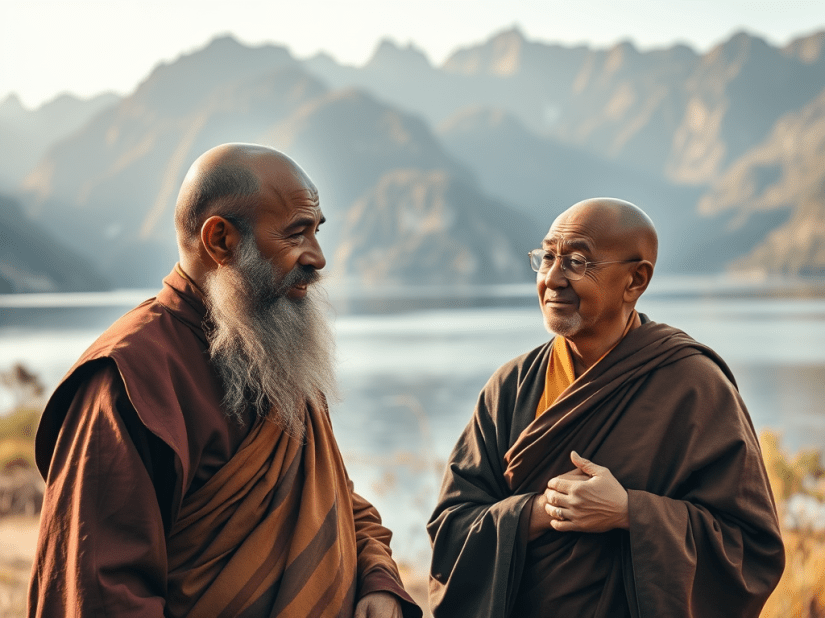
In the serene heights of Tibet, where the air was crisp and the mountains seemed to touch the heavens, lived an ageing monk named Mi Mo Tao. His days were spent in quiet contemplation within the ancient walls of a monastery, a sanctuary built from stone and prayer, where the whispers of the wind carried the wisdom of ages. Mi Mo Tao had dedicated his life to the pursuit of enlightenment, yet as he approached the twilight of his years, a shadow loomed over his heart. Long ago, he had known love—a deep, abiding love for a woman named Lian. They had met in the valleys below the monastery, where wildflowers danced under the sun. Lian was a spirit as free as the wind and as vibrant as the blossoms that surrounded her. They shared dreams and laughter, but their paths diverged when Mi Mo Tao chose the path of the monk, surrendering worldly attachments in search of spiritual truth.

Years passed, and Lian married another, starting a family of her own. Though Mi Mo Tao had found solace in meditation, the ache of unfulfilled love lingered in his heart. Every time he closed his eyes, he could see her smile, hear her laughter, and feel the warmth of her presence. The memories, once a source of joy, became a bittersweet reminder of what he had forsaken.

One autumn evening, as the sun dipped behind the mountains, casting a golden hue over the monastery, Mi Mo Tao sat in meditation. The wind carried a familiar melody, a song that Lian used to sing. It stirred something deep within him, awakening feelings he thought he had buried long ago. Overwhelmed, he opened his eyes and gazed out at the horizon, where the sky met the earth in a breathtaking embrace. In that moment of vulnerability, Mi Mo Tao felt the weight of his sadness transform. He realised that love was not something to be abandoned but instead integrated into his being. Love, he understood, was a teacher, illuminating the path to compassion and understanding. It was not merely a fleeting emotion but a profound connection that transcended time and space. Inspired, he began to write. With each stroke of his brush, he poured his heart onto parchment, weaving tales of love and loss, of joy and sorrow. He wrote of Lian, not as a source of pain but as a reminder of the beauty that love brings, even in its absence. His words resonated with the other monks, who gathered to listen, finding solace in his stories. They began to see their own struggles reflected in his tales, and together they discovered the healing power of vulnerability and shared experience.

As the days turned into months, Mi Mo Tao’s heart lightened. He spoke openly of love, encouraging his fellow monks to embrace their feelings rather than shy away from them. They practised compassion, not just for others, but for themselves, understanding that their own hearts were worthy of love and care. One day, while walking through the valley, Mi Mo Tao encountered an elderly woman weeping by a stream. He approached her gently, offering his presence, and she shared her story of loss and regret. In her sorrow, he recognised a glimpse of his own past. He listened intently, and as he did, a sense of peace washed over him. It was in these moments of connection that he truly grasped the essence of enlightenment—not in the absence of pain, but in the acceptance of it.

Years later, when Mi Mo Tao’s time drew near, he sat in the same spot where he had once felt the weight of his unfulfilled love. The mountains stood as witnesses to his journey, and as he closed his eyes for the last time, he felt Lian’s spirit beside him, not as a ghost of the past, but as a radiant presence of love. In that final moment, he understood: love, in all its forms, was the path to enlightenment. The monastery, once a place of solitary reflection, became a beacon of love and compassion, where monks shared their stories and embraced their humanity. Mi Mo Tao’s legacy lived on, not just in his teachings but in the hearts of those who learned that true enlightenment lies in embracing love, both joyful and sorrowful, and in the connections we forge along the way. 

Osho

“To be creative means to be in love with life. You can be creative only if you love life enough that you want to enhance its beauty.” Osho (Author of Courage)

Rajneesh, also known as Acharya Rajneesh, Bhagwan Shree Rajneesh, and later as Osho, was an Indian godman, philosopher, mystic and founder of the Rajneesh movement. He was viewed as a controversial new religious movement leader during his life. An Indian rebel saint who spoke nothing but the truth, which everybody knows but never dared to speak. He was a professor of psychology. And later, the wanderer of spreading something beyond knowledge. Osho gave his discourses with such elan and depth; his power to preach was so unreal, so compelling, so transforming that if you listen to any of his discourses, you will always find him logically valid yet mystically beyond something.

He had reasons to back each and every rebellious act of his. From having 93 Rolls Royce cars to allowing free sex in his ashram, to having a massive ashram in Oregon and Poona, to touching each and every religion and mystic, every god and every spiritual person of all the bygone era in such detail, depth of understanding that one cannot but appreciate his astounding knowledge and insight. As reported by yellow media, Osho was probably one of the world’s most educated men and also the most dangerous man since Jesus Christ. He was denied a visa in more than 12 countries because America told them not to allow him. Osho was utterly harmless as he never did anything except speak. He called himself a guest of his followers, whom he always told not to follow him. He was stranger than fiction. His only message to humanity was to break the shackles of past mental slavery from conditionings and break the awe of religious gods and so-called saints. All he wanted was for people to be crazy enough to dance, sing, sit silently, and meditate. He knew that all humanity needs is meditation and peace of mind. His neo-sanyas teach people to be regular enough to love and appreciate nature.

B)1931 – D)1990

Uri Geller

Uri Geller is an Israeli-British illusionist, magician, and self-proclaimed psychic known for his spoon-bending tricks and mind-reading abilities. Born on December 20, 1946, in Tel Aviv, Israel, Geller gained fame in the 1970s and 1980s, captivating audiences with his performances that often blurred the lines between magic and mysticism. Geller’s rise to prominence began after he appeared on television, showcasing his unique abilities, which he claimed resulted from psychic powers. His most famous act involves bending spoons and other metal objects, which he often attributes to telekinesis. While many have been sceptical of his claims, arguing that his feats can be replicated through sleight of hand and illusion, Geller maintains that he possesses genuine psychic abilities.

Throughout his career, Geller has been involved in various media, including television shows, books, and public appearances. He has also faced criticism and controversy, particularly from sceptics and magicians who argue that his performances are misleading. Despite this, Geller has maintained a loyal following and has continued to perform and engage with audiences worldwide. In addition to his entertainment career, Geller has claimed to have worked with various scientific institutions and has been involved in research related to psychic phenomena. His life and career have often sparked debates about the nature of reality, belief, and the limits of human potential. Uri Geller has claimed that he was involved with the CIA during the 1970s in a program exploring psychic phenomena for potential applications in espionage and intelligence gathering. This program, often referred to as “Project Stargate,” investigated the use of psychics for remote viewing and other paranormal abilities.

Geller’s association with the CIA became a topic of interest, notably when he demonstrated his abilities to various military and intelligence personnel. He stated that he was asked to participate in tests to see if his supposed psychic skills could be harnessed for intelligence. However, the specifics of his involvement and the outcomes of those tests remain a subject of debate and scepticism. While Geller has often spoken about these experiences, it’s important to note that many in the scientific community remain critical of claims regarding psychic abilities, and there has been considerable scepticism regarding the validity and replicability of Geller’s feats. The discussions around his alleged CIA connections continue to contribute to the intrigue surrounding his persona as a psychic entertainer. 

Ingo Douglas Swann

Ingo Swann, born in 1934, was a prominent figure in the field of remote viewing and is best known for his involvement with the U.S. government’s psychic research programs, notably the Stargate Project. Swann was born in the United States and had a varied career before becoming involved in remote viewing. He was interested in art and literature and was known for his creative abilities.
– Introduction to Remote Viewing: In the 1970s, Swann began exploring psychic phenomena and eventually became involved in remote viewing, which involves mentally accessing information about distant or unseen targets.
– Stargate Project: He played a significant role in the Stargate Project, a secret U.S. government initiative investigating the potential use of psychic abilities for military and intelligence purposes. Swann’s work helped develop remote viewing protocols and techniques.
– Training and Development: Swann contributed to creating structured remote viewing methodologies, which included training programs for participants to enhance their abilities.
– Demonstrations: He participated in numerous public demonstrations of remote viewing, showcasing his ability to describe distant locations, objects, and events without prior knowledge.
– Writing and Teaching: Swann authored several books and articles on remote viewing, sharing his insights and experiences. He also taught remote viewing techniques to others, further popularizing the practice.

Swann believed in the interconnectedness of consciousness and the potential for humans to access information beyond conventional sensory perception. His work has influenced both the field of parapsychology and the broader interest in psychic phenomena. He is often regarded as a pioneer in the field of remote viewing. Swann continued to be active in the field until his later years, participating in workshops and seminars until his passing in 2013. Ingo Swann’s contributions to remote viewing and psychic research have left a lasting impact, and he remains a significant figure in discussions about the potential of human consciousness.

Henri Bergson

Henri Bergson (1859–1941) was a French philosopher known for his influential ideas on time, consciousness, and creativity. His works challenged the prevailing mechanistic view of the universe and emphasized the importance of intuition and experience over rationalism.

In “Time and Free Will” (1889), he distinguished between “measurable time” (quantitative) and “lived time” (qualitative), introducing the concept of “duration” (durée) to describe how individuals experience time subjectively.

In “Creative Evolution” (1907), Bergson argued against Darwinian evolution’s purely mechanistic interpretation. He introduced the idea of an élan vital, a vital force driving evolution and creativity, emphasizing the spontaneity and unpredictability of life.

Bergson believed that traditional philosophical methods relied too heavily on intellect and abstract reasoning, which could miss the essence of life. He advocated for intuition as a means to grasp reality more fully. His ideas profoundly influenced various fields, including literature, psychology, and the arts. His thoughts on time and consciousness paved the way for existentialist and phenomenological philosophies.

Bergson received the Nobel Prize in Literature in 1927, recognizing his rich philosophical contributions. His work continues to inspire discussions on the nature of time, consciousness, and the dynamic quality of life.