Beckett – A Little Boy who Loved Trains

Once upon a time, in a small town nestled between rolling hills, a boy named Beckett was utterly obsessed with trains. From the moment he could walk, he would rush to the window each time he heard the distant sound of a locomotive whistle. His room was a treasure trove of model trains, posters of famous engines, and books filled with stories about railways from around the world. Every Saturday, Beckett’s father would take him to the local train station, where the boy would watch in awe as massive freight trains thundered by, pulling long lines of colourful cars. He marvelled at the rhythmic clatter of wheels on tracks and how the trains seemed to breathe life into the landscape. The station became a sanctuary for him, where time stood still as he immersed himself in the world of trains.

One day, while exploring the station, Beckett stumbled upon an old man named Mr. Jenkins, the retired conductor of the very train that had captured his heart. With a twinkle in his eye, Mr. Jenkins shared stories of his adventures on the rails, tales of epic journeys through mountains, across rivers, and into bustling cities. Inspired, Beckett listened intently, imagining himself as a conductor, guiding his train through the vast unknown. As weeks turned into months, Beckett’s fascination grew. He began sketching designs for his train, a magnificent steam engine that would one day traverse the land. He drew intricate plans, detailing every aspect, from the shimmering brass whistle to the plush velvet seats inside. His passion was infectious, and soon, his friends joined him in building a miniature railway in his backyard.

With his father’s help, they transformed the space into a vibrant train yard with tracks, stations, and tiny trees. Beckett and his friends would spend hours playing, racing their models, and pretending to be conductors and passengers on grand adventures. A peculiar sight caught Beckett’s eye as they played one fateful day. Unlike anything he had seen, a real train rolled slowly into the station. It was a vintage steam locomotive, its surface glistening in the sun, with billowing clouds of steam rising into the sky. Beckett’s heart raced. He could hardly believe his eyes. As if sensing his awe, a friendly conductor stepped down from the train and beckoned Beckett over.

“Would you like to look inside?” he asked warmly.

Beckett could hardly contain his excitement as he climbed aboard. The cabin was filled with intricate levers, dials, and the intoxicating smell of coal and oil. The conductor shared the secrets of running the train, and Beckett felt he was living his dream. Afterwards, the conductor handed him a small, shiny whistle.

“This is for you, young man. Keep it close, and always remember the magic of the rails.”

From that day forward, Beckett carried the whistle everywhere, a reminder of the adventure he had experienced. As he grew older, his passion for trains only deepened. He studied engineering and eventually became a conductor, travelling the routes he had dreamed about as a child. Years later, he returned to that small station, now a man in uniform, ready to guide a new generation of train enthusiasts. Looking out at the children playing in the yard, he smiled, knowing that the magic of trains still lived somewhere in their hearts. With a blow of his whistle, he invited them to join him on a new adventure, just like the one that had ignited his journey many years ago. 

Sylvia Plath

Sylvia Plath was an American poet, novelist, and short-story writer born in Boston, Massachusetts, on October 27, 1932. She is best known for her confessional style of writing, which explores themes of death, self-destruction, and the female experience. Sylvia Plath showed literary promise from a young age and began writing poetry as a child. She excelled academically and won a scholarship to Smith College in 1950. Plath studied at Smith College and later at Newnham College, Cambridge, on a Fulbright Scholarship. She struggled with depression during her college years, which would later influence her writing.

In 1956, Sylvia Plath married British poet Ted Hughes. The couple had two children, Frieda and Nicholas. Their marriage was tumultuous and ended in separation in 1962. Her poetry is known for its intense, personal subject matter and powerful imagery. The first poetry collection, “The Colossus,” was published in 1960. She is best known for her semi-autobiographical novel, “The Bell Jar,” published under a pseudonym in 1963.

Plath battled with depression and underwent electroconvulsive therapy. Her struggles with mental illness are reflected in her writing, particularly in her later works. She tragically died by suicide on February 11, 1963, at the age of 30. Her death came just a month after publishing “The Bell Jar” in the UK. Despite her short life, Sylvia Plath’s work has had a lasting impact on literature. She is regarded as one of the leading figures of confessional poetry and a critical voice in feminist literature. Her poetry collections, including “Ariel,” published posthumously in 1965, continue to be studied and admired for their depth and emotional power. Sylvia Plath’s writing continues to be celebrated and analyzed for its raw emotion, vivid imagery, and exploration of complex themes. Her legacy as a writer and poet remains influential in literature. 

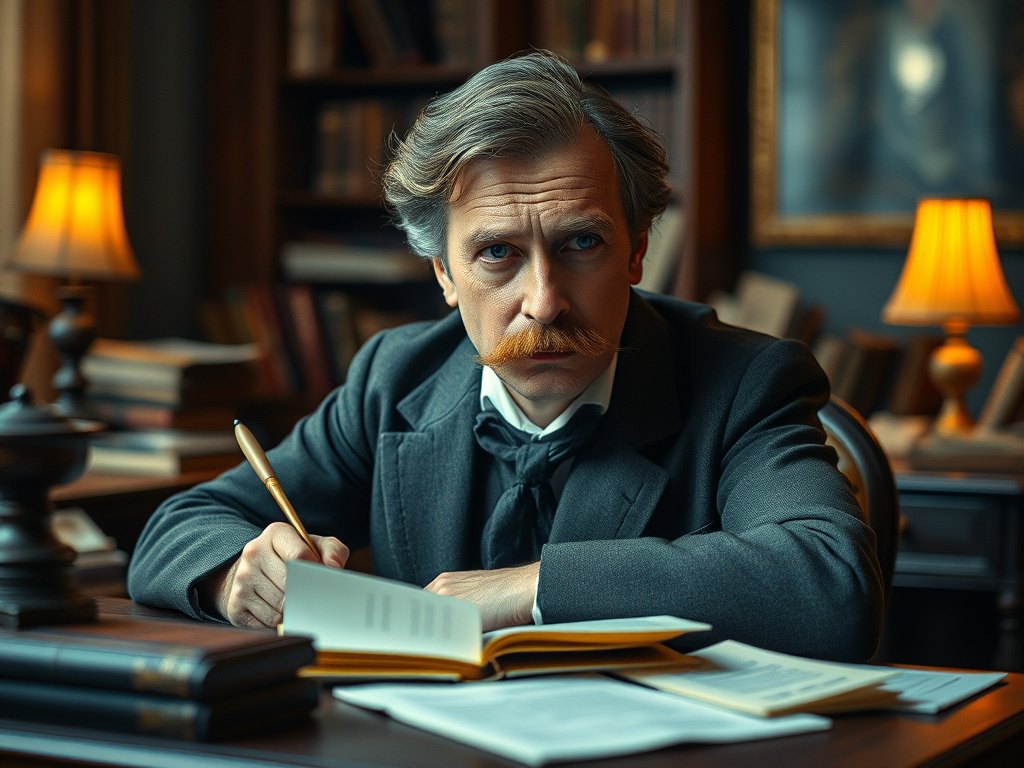
Image by AI

William Shakespeare

William Shakespeare (1564-1616) was an English playwright, poet, and actor. He is widely regarded as one of the greatest writers in the English language and the world’s pre-eminent dramatist. He is often called England’s national poet and the “Bard of Avon.” Shakespeare’s works, including plays, sonnets, and poems, have had a profound influence on literature and the arts. His plays have been translated into every major living language and are performed more often than those of any other playwright.

Some of his most famous plays include “Romeo and Juliet,” “Hamlet,” “Macbeth,” “Othello,” “King Lear,” and “A Midsummer Night’s Dream.” His works explore themes such as love, jealousy, betrayal, ambition, and the human condition. Shakespeare’s writing style is known for its rich language, complex characters, and timeless themes. His contributions to the English language are immense, with many phrases and words he coined that are still used today.

Overall, Shakespeare’s works continue to be studied, performed, and celebrated around the world, making him a cultural icon whose influence extends far beyond the literary realm. 

Nikolai Gogol

Nikolai Gogol, a prominent Russian writer of Ukrainian origin, lived from 1809 to 1852. He is considered one of the greatest authors in Russian literature and is known for his unique style and satirical approach to various societal issues. Gogol was born in the Ukrainian Cossack village of Sorochyntsi (now in Ukraine) in 1809. He studied at the Nizhyn Gogol Collegium and later moved to Saint Petersburg to work as a government clerk. His early works were heavily influenced by Ukrainian folklore and culture.
Gogol’s most famous work is the novel “Dead Souls,” which satirizes the flaws of Russian society and bureaucracy.
He is also known for his short stories, including “The Overcoat,” “The Nose,” and “The Diary of a Madman,” which often blend realism with elements of the fantastic and absurd. A master of the grotesque and the ridiculous, he used these elements to highlight society’s flaws and absurdities. His writing profoundly impacted subsequent Russian literature, influencing writers such as Fyodor Dostoevsky and Anton Chekhov.
The works he achieved have been adapted into numerous films, plays, and operas. Gogol’s legacy extends beyond literature, as his name is often used to describe a particular style of dark humour and satire. Struggling with his faith and identity later led to a spiritual crisis, and he destroyed the second part of “Dead Souls” and many of his other manuscripts, possibly due to this crisis.
Gogol died in 1852 under mysterious circumstances, and conflicting reports about the cause of his death exist. Nikolai Gogol’s works continue to be studied and celebrated for their wit, originality, and deep insights into human nature and society. 

Image by AI

William Wordsworth

William Wordsworth (1770-1850) was a renowned English Romantic poet who, along with Samuel Taylor Coleridge, helped launch the Romantic Age in English literature with their joint publication “Lyrical Ballads” in 1798. Wordsworth is known for his lyrical poetry that often celebrates nature’s beauty, the individual’s emotions, and the human mind’s power.

Some of Wordsworth’s most famous works include poems like “Lines Composed a Few Miles Above Tintern Abbey,” “I Wandered Lonely as a Cloud” (commonly known as “Daffodils”), and “The Prelude,” which is considered one of the greatest autobiographical poems in the English language. Wordsworth’s poetry often explores memory, childhood, imagination, and the relationship between humanity and nature. He believed that poetry should be accessible to the common people and spontaneously overflow with powerful feelings.

Throughout his life, Wordsworth was closely associated with the Lake District in England, where he drew much of his inspiration from the landscape’s natural beauty. His work significantly influenced subsequent poets and writers, and he is widely regarded as one of the greatest poets in the English literary tradition.