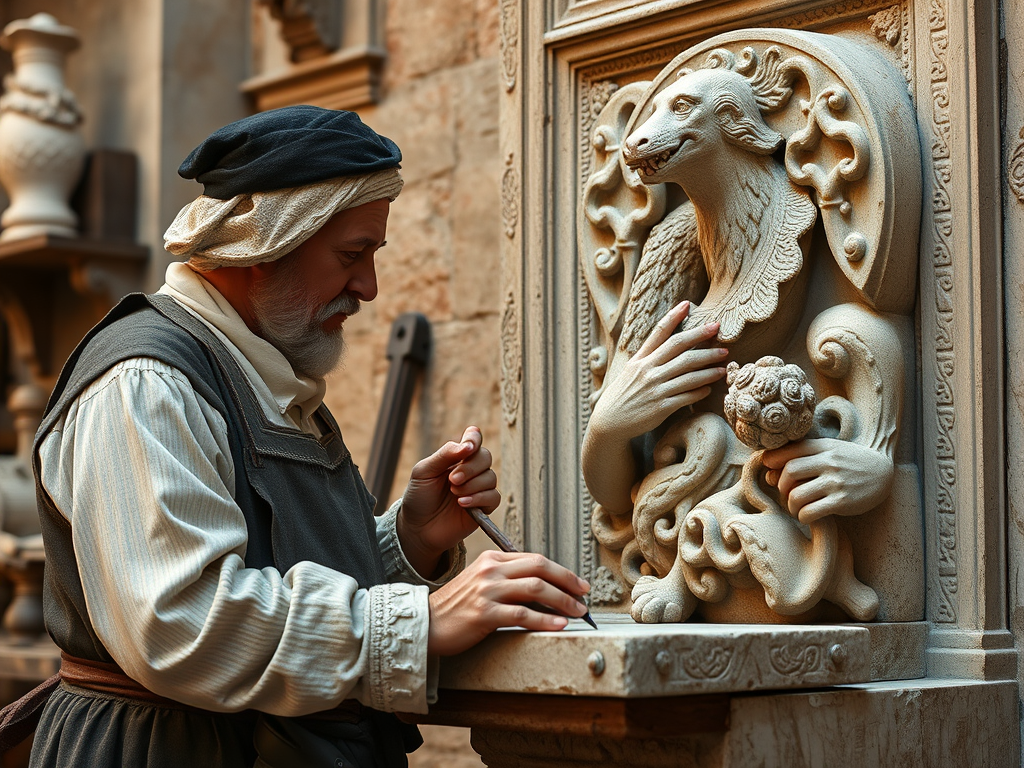
In the heart of Venice, amidst the winding canals and echoes of history, stood an art gallery known as “Galleria Fantasma.” This gallery was renowned not only for its exquisite collection of Renaissance masterpieces but also for its most enigmatic resident—Bertrand the Sculptor, a spectral artist who had haunted its halls since 1486. Bertrand was a gifted sculptor, celebrated for his ability to breathe life into stone. His works captured the depth of human emotion, a testament to his profound understanding of beauty and sorrow. However, his promising career was cut short when the plague swept through Venice, claiming his life at the age of 38. On his deathbed, surrounded by the unfinished sculptures that bore witness to his genius, Bertrand made a silent vow: his art would live on, even if he could not.
Upon his death, Bertrand’s soul found itself bound to his final creation—a haunting sculpture of a woman, her face a reflection of both melancholy and grace. This piece, known as “The Muse,” was said to embody a love lost to time, a muse who had inspired Bertrand’s greatest works. In the ethereal realm, Bertrand lingered, becoming a living, breathing ghost, his presence a whisper in the gallery’s corridors. Visitors to the Galleria Fantasma often reported eerie sensations—a sudden chill, the faint sound of chiselling, or a shadow glimpsed from the corner of the eye. These occurrences, though unsettling, seemed to possess an inexplicable warmth, as if the ghost meant no harm. Indeed, Bertrand’s intentions were pure; he sought not to frighten but to inspire.
Over the centuries, many artists and art lovers ventured into the gallery, drawn by its mysterious allure. Those sensitive to the supernatural sometimes found themselves in unexpected dialogue with Bertrand. He would guide them through the intricacies of art, offering insights that transcended time and space. His presence was most strongly felt near “The Muse,” where he appeared as a translucent figure, his spectral hands forever refining his masterpiece. Despite his spectral existence, Bertrand yearned for recognition—not as a ghost, but as an artist whose soul lived on through his work. As Venice evolved, the gallery became a sanctuary for those who admired the ethereal beauty of art. Yet, few understood the story behind the haunting presence within its walls.
One evening, Isabella, a fervent young art student, stumbled upon the gallery. Enchanted by “The Muse,” she felt an immediate connection as if the sculpture spoke directly to her heart. As she sketched, a gentle breeze brushed her cheek, and she sensed a presence watching over her. Encouraged, she spoke aloud, sharing her dreams and fears, the ache of unfulfilled longing. To her surprise, the atmosphere shifted, a warmth enveloping her—a sign that Bertrand was listening. Isabella returned to the gallery each night, her visits becoming a ritual. Through her art and passion, she forged a bond with Bertrand. Unbeknownst to her, Bertrand found renewed purpose in guiding this young artist. He revealed the secrets of his techniques, the emotions that fueled his creations, and the stories etched into every curve of “The Muse.” Together, they embarked on a creative journey, bridging the chasm between life and death.
As Isabella’s talent blossomed, the gallery thrived. She organized exhibitions that showcased her work and illuminated Bertrand’s legacy, weaving his story into the tapestry of her art. The tale of the living ghost who inspired a new generation spread, drawing visitors eager to experience the magic of Galleria Fantasma. In time, Bertrand’s name was spoken with reverence, his spirit woven into the fabric of Venice’s artistic heritage. No longer just a ghost haunting the gallery, he became a vital part of its story, celebrated through the creations of those he inspired. And in the quiet of the night, under the moon’s silver glow, Bertrand continued to sculpt, his heart at peace, knowing he would never be forgotten.
Image by AI
 Lazarus Carpenter - Author