
The Tale of Mi Mo Tao

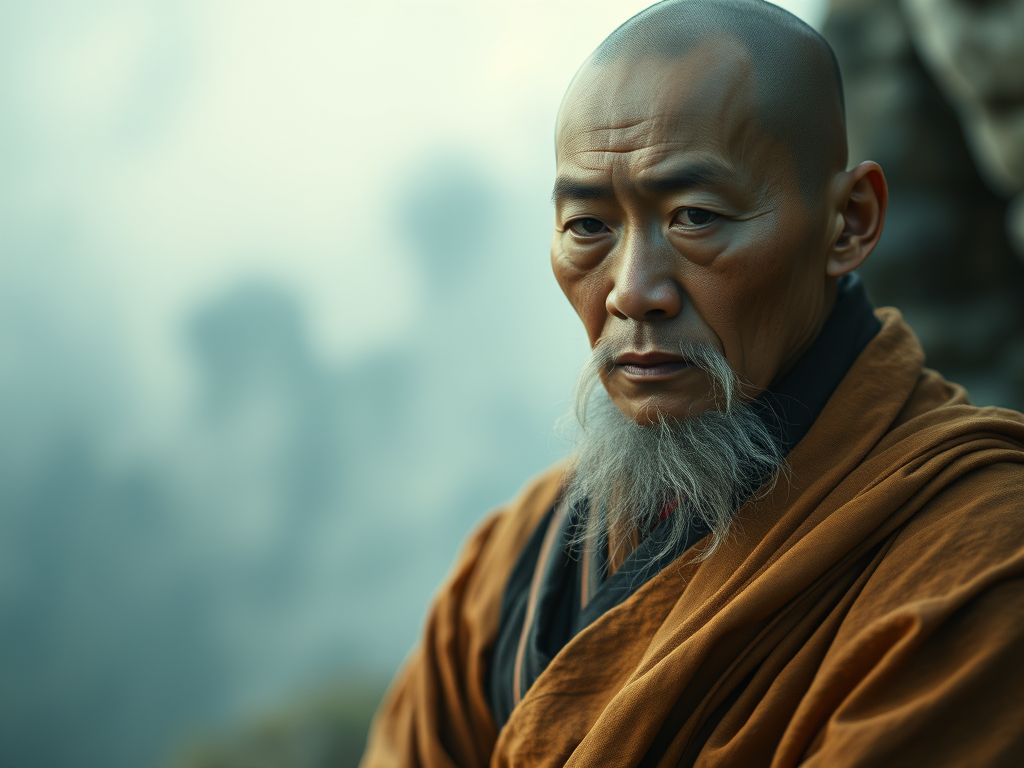
In the serene heights of Tibet, where the air was crisp and the mountains seemed to touch the heavens, lived an ageing monk named Mi Mo Tao. His days were spent in quiet contemplation within the ancient walls of a monastery, a sanctuary built from stone and prayer, where the whispers of the wind carried the wisdom of ages. Mi Mo Tao had dedicated his life to the pursuit of enlightenment, yet as he approached the twilight of his years, a shadow loomed over his heart. Long ago, he had known love—a deep, abiding love for a woman named Lian. They had met in the valleys below the monastery, where wildflowers danced under the sun. Lian was a spirit as free as the wind and as vibrant as the blossoms that surrounded her. They shared dreams and laughter, but their paths diverged when Mi Mo Tao chose the path of the monk, surrendering worldly attachments in search of spiritual truth.

Years passed, and Lian married another, starting a family of her own. Though Mi Mo Tao had found solace in meditation, the ache of unfulfilled love lingered in his heart. Every time he closed his eyes, he could see her smile, hear her laughter, and feel the warmth of her presence. The memories, once a source of joy, became a bittersweet reminder of what he had forsaken.

One autumn evening, as the sun dipped behind the mountains, casting a golden hue over the monastery, Mi Mo Tao sat in meditation. The wind carried a familiar melody, a song that Lian used to sing. It stirred something deep within him, awakening feelings he thought he had buried long ago. Overwhelmed, he opened his eyes and gazed out at the horizon, where the sky met the earth in a breathtaking embrace. In that moment of vulnerability, Mi Mo Tao felt the weight of his sadness transform. He realised that love was not something to be abandoned but instead integrated into his being. Love, he understood, was a teacher, illuminating the path to compassion and understanding. It was not merely a fleeting emotion but a profound connection that transcended time and space. Inspired, he began to write. With each stroke of his brush, he poured his heart onto parchment, weaving tales of love and loss, of joy and sorrow. He wrote of Lian, not as a source of pain but as a reminder of the beauty that love brings, even in its absence. His words resonated with the other monks, who gathered to listen, finding solace in his stories. They began to see their own struggles reflected in his tales, and together they discovered the healing power of vulnerability and shared experience.

As the days turned into months, Mi Mo Tao’s heart lightened. He spoke openly of love, encouraging his fellow monks to embrace their feelings rather than shy away from them. They practised compassion, not just for others, but for themselves, understanding that their own hearts were worthy of love and care. One day, while walking through the valley, Mi Mo Tao encountered an elderly woman weeping by a stream. He approached her gently, offering his presence, and she shared her story of loss and regret. In her sorrow, he recognised a glimpse of his own past. He listened intently, and as he did, a sense of peace washed over him. It was in these moments of connection that he truly grasped the essence of enlightenment—not in the absence of pain, but in the acceptance of it.

Years later, when Mi Mo Tao’s time drew near, he sat in the same spot where he had once felt the weight of his unfulfilled love. The mountains stood as witnesses to his journey, and as he closed his eyes for the last time, he felt Lian’s spirit beside him, not as a ghost of the past, but as a radiant presence of love. In that final moment, he understood: love, in all its forms, was the path to enlightenment. The monastery, once a place of solitary reflection, became a beacon of love and compassion, where monks shared their stories and embraced their humanity. Mi Mo Tao’s legacy lived on, not just in his teachings but in the hearts of those who learned that true enlightenment lies in embracing love, both joyful and sorrowful, and in the connections we forge along the way. 
Tenzin

Once, a monk named Tenzin lived in a serene coastal village. Renowned for his wisdom and tranquillity, he spent his days in meditation atop a cliff overlooking the vast ocean. The villagers revered the sea but feared its tempests, which could sweep in without warning and wreak havoc on their lives. One day, a violent storm approached, threatening to destroy the village. The people rushed to Tenzin, begging for his help. Calmly, he descended from his meditation perch and approached the angry waves that crashed against the shore. With deep concentration, he began to chant an ancient mantra, a prayer to the spirit of the ocean.

Tenzin’s voice rose above the chaos as the winds howled and the rain poured. The villagers watched in awe as the turbulent waters began to calm. The waves slowed, and the storm clouds parted, revealing a serene blue sky. The ocean, once a raging beast, transformed into a gentle expanse. Grateful, the villagers celebrated Tenzin’s miraculous power. They believed he had tamed the ocean. Yet, Tenzin knew that true mastery came not from control but from understanding and harmony. He taught the villagers to respect the ocean’s moods and honour its beauty and dangers. Years passed, and Tenzin became a legend. He taught the villagers how to read the signs of the sea, how to fish sustainably and how to prepare for storms. Under his guidance, the village thrived, growing closer to the ocean rather than fearing it.

One night, as Tenzin meditated under the stars, he felt a pull from the depths of the sea. He understood that the ocean was alive, a spirit that demanded respect and reverence. He offered himself to the ocean, becoming one with its rhythms. The villagers found Tenzin’s empty robes on the shore, and though they mourned his loss, they felt a profound peace. From that day on, they sensed the ocean’s whispers more clearly and lived in harmony with its tides. They shared stories of Tenzin, the monk who had not just controlled the ocean but had taught them the art of coexistence. So, the legend of Tenzin lived on, reminding everyone that true power lies not in dominance but in respect, understanding, and love for the forces of nature. 

Brother Kaito

Once upon a time, a monk named Brother Kaito lived in a secluded monastery nestled deep within the misty mountains. Brother Kaito was a devout and humble man known for his wisdom, kindness, and unwavering faith in his order’s teachings. A terrible storm swept through the mountains one fateful winter night, unleashing its fury upon the monastery. As the wind howled and the thunder roared, a lightning bolt struck the ancient oak tree near the monastery, splitting it in two. The monks huddled together in prayer, seeking solace and protection from the raging tempest. In the midst of the chaos, Brother Kaito volunteered to go outside and secure the monastery’s gates, which had been flung open by the force of the storm. With a lantern in hand, he ventured out into the darkness, his robes billowing in the wind.

As Brother Kaito reached the gates and began to close them, another bolt of lightning struck the ground, illuminating the night sky with a blinding light. In that moment of intense brightness, a strange and otherworldly presence enveloped Brother Kaito, causing his form to flicker and fade like a wisp of smoke. When the light subsided, the monks rushed outside to find Brother Kaito standing before them, his features distorted and ethereal. He spoke to them in a voice that echoed from beyond the grave, telling them that he had become a ghost bound to the monastery by a powerful force unleashed by the storm. Despite his ghostly form, Brother Kaito remained committed to his duties as a monk, continuing to offer guidance and wisdom to his fellow brothers. His presence brought both comfort and awe to the monastery, as tales of the monk who became a ghost spread far and wide.

Years passed, and the monastery flourished under Brother Kaito’s spectral watch. His teachings and legacy endured, inspiring generations of monks to follow in his footsteps. And so, the tale of the monk who became a ghost became a cherished legend, a testament to the enduring power of faith, compassion, and the unbreakable bond between the living and the spirit world.

Image by AI