LAZARUS’S BLA BLA BLOG

The Tale of William Wanderlust

Once upon a time, in a quaint village, there lived a man named William Wanderlust. William had a restless spirit, constantly yearning for the promise of tomorrow. He dreamed of grand adventures, distant lands, and a life full of excitement, yet he never seemed to find the time to pursue his dreams. Instead, he spent his days planning and wishing while his nights were filled with longing for a future that remained just out of reach. One day, driven by an insatiable urge to chase his dreams, William embarked on a journey. He wandered through lush green forests, crossed sparkling rivers, and climbed steep mountains, all the while imagining the wonders that awaited him at every turn. But as each day passed, he found himself in the same cycle: dreaming of tomorrow while doing little to shape it. As his feet trod their path, all the beauty of the now evaded him, and his thoughts remained focused on the next step.

One afternoon, as he rested by a serene lake, William encountered a wise old monk sitting quietly on the shore. The monk’s presence emanated a calm that intrigued him. William approached the monk, sharing his dreams and desires and lamenting how he never seemed to achieve anything. The monk listened patiently and then smiled gently.

“William, you are like a bird perched on a branch, always looking at the horizon. You spend so much time dreaming of flight that you forget to spread your wings.”

Confused, William asked,

“What do you mean? I want to soar into the sky of tomorrow!”

The monk replied,

“Tomorrow is a beautiful illusion, but it is today that holds the key. You can only embrace tomorrow if you take action today. What steps have you taken towards your dreams?”

William realized he had been so focused on the future that he had neglected the present. The monk continued,

“Every journey begins with a single step. If you wish to explore the world, start by exploring yourself. What do you truly desire? What small actions can you take today?”

Inspired by the monk’s wisdom, William began to reflect. He understood that he needed to set achievable goals and take small steps toward them. He started by learning new skills, meeting people along the way, and immersing himself in the beauty of the present moment. As days turned into weeks, William found himself transforming. He learned to savour each experience, whether it was the taste of fresh bread from a local baker or a conversation with a fellow traveller. He no longer felt the weight of unfulfilled dreams; instead, he felt invigorated by the progress he was making. Eventually, William understood that tomorrow would always be there, but it was today that mattered most. With each small step, he navigated through life with purpose and passion. The adventures he once only dreamed of began to unfold before him, not as distant fantasies but as tangible experiences.

Years later, William returned to the lake where he first met the monk. He sat down in the same spot, reflecting on his journey. The monk appeared once more, his eyes twinkling with wisdom. William smiled, grateful for their encounter.

“Thank you for showing me the way,” he said. “I no longer lust after tomorrow. I cherish today and all that it brings.”

The monk nodded,

“Remember, the journey is not about the destination but the experiences along the way. Continue to embrace each moment, and tomorrow will take care of itself.”

With a heart full of gratitude, William Wanderlust had finally found what he had been searching for—not just the thrill of tomorrow but the joy of living fully in the present. And so, he continued his adventures, a man transformed by the wisdom of a simple yet profound truth. 

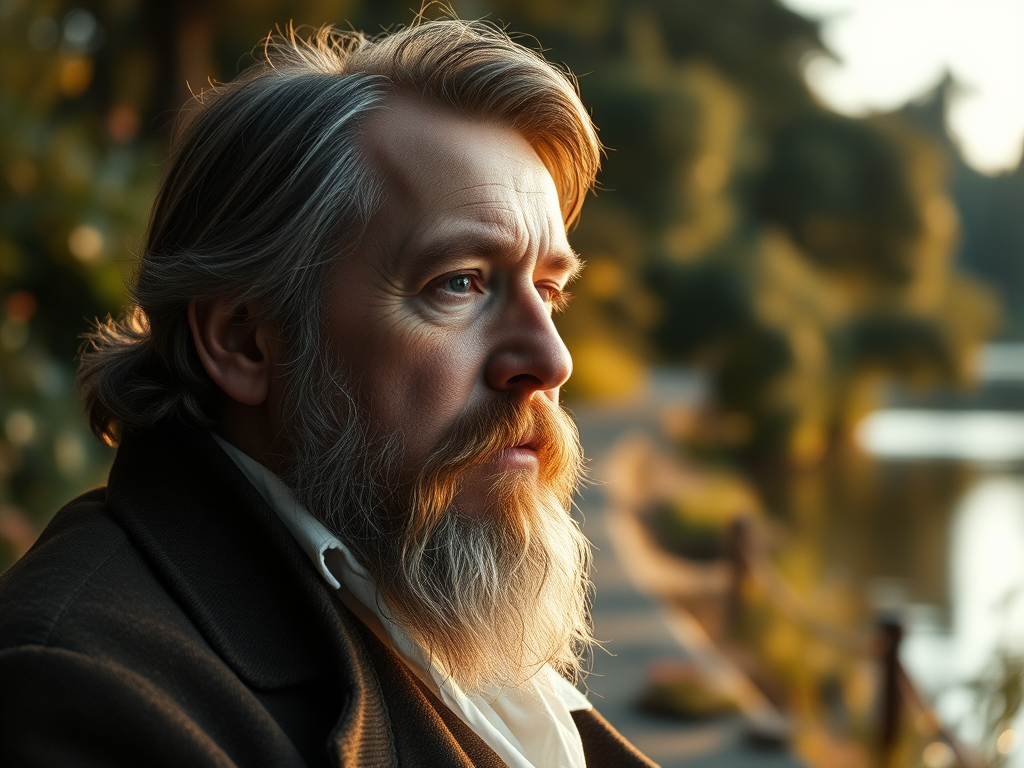
Images by AI

Thomas Mann

Thomas Mann was a renowned German novelist, short story writer, social critic, philanthropist, essayist, and the 1929 Nobel Prize in Literature laureate. He was born on June 6, 1875, in Lübeck, Germany, into a wealthy merchant family. Thomas Mann is best known for his complex and symbolic novels that explore themes such as the nature of art, the complexities of human psychology, and the moral dilemmas of modernity.

Some of his most famous works include:

1. “Buddenbrooks” (1901): This novel, his first major work, is a family saga that traces the decline of a wealthy merchant family over several generations.

2. “Death in Venice” (1912): A novella that explores themes of beauty, decay, and the nature of artistic inspiration, set against the backdrop of a cholera epidemic in Venice.

3. “The Magic Mountain” (1924): This novel is perhaps Mann’s most famous work. It tells the story of a young man who visits a sanatorium in the Swiss Alps and becomes embroiled in philosophical and intellectual debates with the other patients.

4. “Joseph and His Brothers” (1933-1943): This tetralogy retelling of the biblical story of Joseph is set against the backdrop of ancient Egypt. It is considered one of Mann’s most ambitious and monumental works.

Thomas Mann’s writing often grappled with the tensions between the individual and society, the conflict between traditional values and modernity, and the nature of creativity and the artist’s role in society. He was also known for exploring themes such as sexuality, mortality, and the nature of evil. Mann’s works have had a lasting impact on literature and continue to be studied and admired for their depth, complexity, and insight into the human condition. Thomas Mann died on August 12, 1955, in Zürich, Switzerland, leaving behind a rich literary legacy that continues to be celebrated and studied. 

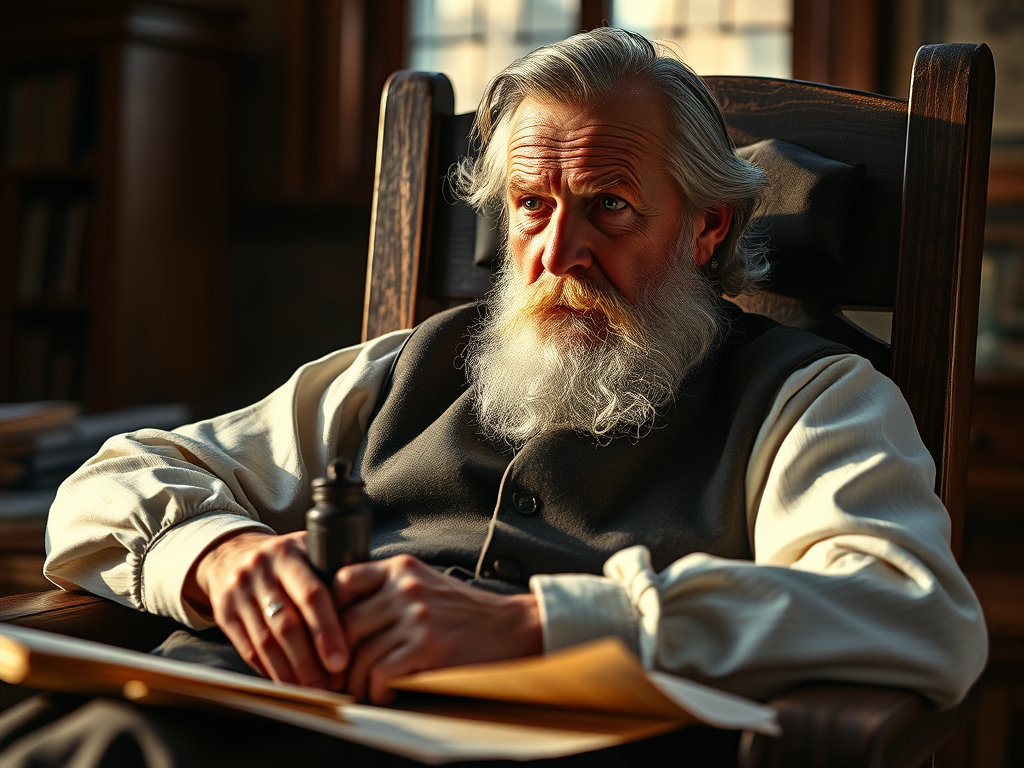
Image by AI

Leo Tolstoy

Leo Tolstoy was a Russian writer regarded as one of the greatest authors ever. He was born on September 9, 1828, and died on November 20, 1910. Tolstoy is best known for his novels, including “War and Peace” and “Anna Karenina,” considered masterpieces of world literature.

Tolstoy was a novelist, moral philosopher, and social reformer. He wrote extensively on nonviolent resistance, education, and the need to live meaningfully. His ideas on nonviolent and passive resistance significantly influenced figures such as Mahatma Gandhi and Martin Luther King Jr.

His works often explore themes such as love, family, society, and the search for meaning in life. His writing is known for its realistic portrayal of characters and its deep psychological insight. Tolstoy’s contributions to literature have had a lasting impact, and his works continue to be studied and admired worldwide. 

Bertrand the Sculptor

In the heart of Venice, amidst the winding canals and echoes of history, stood an art gallery known as “Galleria Fantasma.” This gallery was renowned not only for its exquisite collection of Renaissance masterpieces but also for its most enigmatic resident—Bertrand the Sculptor, a spectral artist who had haunted its halls since 1486. Bertrand was a gifted sculptor, celebrated for his ability to breathe life into stone. His works captured the depth of human emotion, a testament to his profound understanding of beauty and sorrow. However, his promising career was cut short when the plague swept through Venice, claiming his life at the age of 38. On his deathbed, surrounded by the unfinished sculptures that bore witness to his genius, Bertrand made a silent vow: his art would live on, even if he could not.

Upon his death, Bertrand’s soul found itself bound to his final creation—a haunting sculpture of a woman, her face a reflection of both melancholy and grace. This piece, known as “The Muse,” was said to embody a love lost to time, a muse who had inspired Bertrand’s greatest works. In the ethereal realm, Bertrand lingered, becoming a living, breathing ghost, his presence a whisper in the gallery’s corridors. Visitors to the Galleria Fantasma often reported eerie sensations—a sudden chill, the faint sound of chiselling, or a shadow glimpsed from the corner of the eye. These occurrences, though unsettling, seemed to possess an inexplicable warmth, as if the ghost meant no harm. Indeed, Bertrand’s intentions were pure; he sought not to frighten but to inspire.

Over the centuries, many artists and art lovers ventured into the gallery, drawn by its mysterious allure. Those sensitive to the supernatural sometimes found themselves in unexpected dialogue with Bertrand. He would guide them through the intricacies of art, offering insights that transcended time and space. His presence was most strongly felt near “The Muse,” where he appeared as a translucent figure, his spectral hands forever refining his masterpiece. Despite his spectral existence, Bertrand yearned for recognition—not as a ghost, but as an artist whose soul lived on through his work. As Venice evolved, the gallery became a sanctuary for those who admired the ethereal beauty of art. Yet, few understood the story behind the haunting presence within its walls.

One evening, Isabella, a fervent young art student, stumbled upon the gallery. Enchanted by “The Muse,” she felt an immediate connection as if the sculpture spoke directly to her heart. As she sketched, a gentle breeze brushed her cheek, and she sensed a presence watching over her. Encouraged, she spoke aloud, sharing her dreams and fears, the ache of unfulfilled longing. To her surprise, the atmosphere shifted, a warmth enveloping her—a sign that Bertrand was listening. Isabella returned to the gallery each night, her visits becoming a ritual. Through her art and passion, she forged a bond with Bertrand. Unbeknownst to her, Bertrand found renewed purpose in guiding this young artist. He revealed the secrets of his techniques, the emotions that fueled his creations, and the stories etched into every curve of “The Muse.” Together, they embarked on a creative journey, bridging the chasm between life and death.

As Isabella’s talent blossomed, the gallery thrived. She organized exhibitions that showcased her work and illuminated Bertrand’s legacy, weaving his story into the tapestry of her art. The tale of the living ghost who inspired a new generation spread, drawing visitors eager to experience the magic of Galleria Fantasma. In time, Bertrand’s name was spoken with reverence, his spirit woven into the fabric of Venice’s artistic heritage. No longer just a ghost haunting the gallery, he became a vital part of its story, celebrated through the creations of those he inspired. And in the quiet of the night, under the moon’s silver glow, Bertrand continued to sculpt, his heart at peace, knowing he would never be forgotten. 

Image by AI

C.J. Sansom

Christopher John Sansom, known as C.J. Sansom, is a British author best known for his historical crime fiction series featuring the hunchbacked lawyer-detective Matthew Shardlake. The Shardlake series is set in the Tudor period of English history, specifically during the reign of King Henry VIII. Sansom’s novels are known for their detailed historical accuracy and intricate plots that blend historical events with fictional mysteries.

Some of the popular books in the Shardlake series include:

1. Dissolution (2003)
2. Dark Fire (2004)
3. Sovereign (2006)
4. Revelation (2008)
5. Heartstone (2010)
6. Lamentation (2014)
7. Tombland (2018)

C.J. Sansom’s novels have received critical acclaim and have garnered a wide readership for their engaging storytelling, rich historical detail, and compelling characters. This incredible series has now found its way to the screen. C J passed away from cancer on April 24; he was seventy-one.