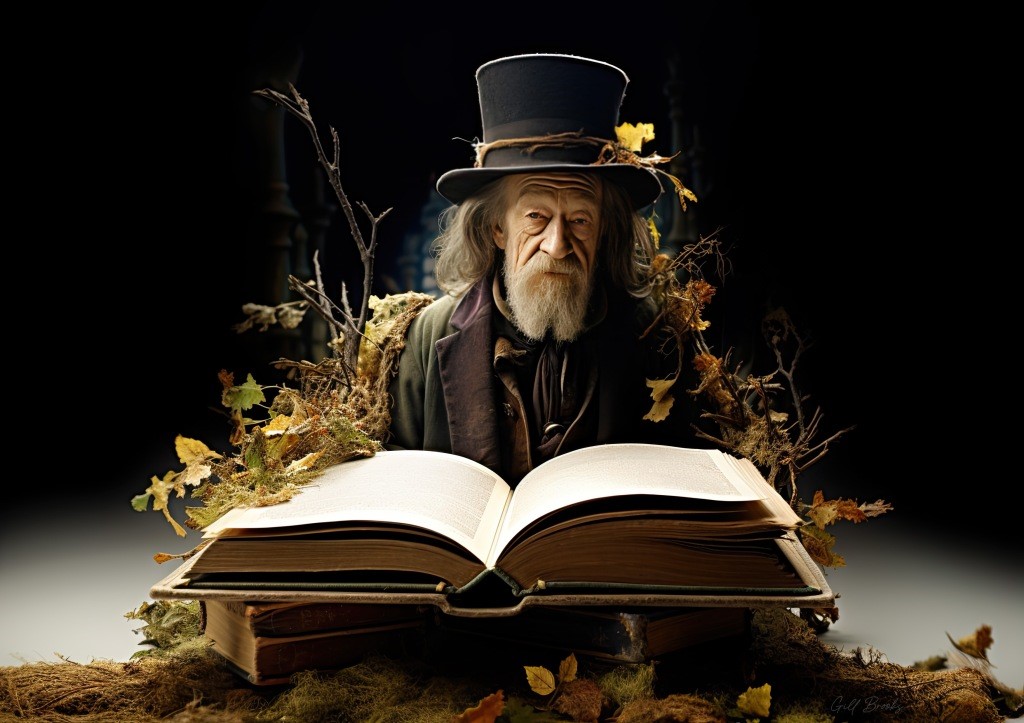
Bibliomancy, the practice of using books, often sacred texts, as oracles, is a fascinating intersection of literature, spirituality, and chance. Bibliomancy is rooted in ancient traditions and invites readers to engage with texts in a deeply personal and often serendipitous manner. This essay explores the historical origins of bibliomancy, its cultural significance, and modern applications, highlighting how this art form transcends mere fortune-telling to reveal profound insights into the human experience.
Historical Origins
The term “bibliomancy” derives from the Greek words “biblion,” meaning “book,” and “manteia,” meaning “divination.” Its roots can be traced back to antiquity when various cultures employed texts for divination. In ancient Greece, the practice was often associated with the works of Homer, while medieval Europe linked it to the Bible. Opening a book randomly and interpreting the passage as guidance or insight became a popular spiritual exercise. In many traditions, bibliomancy was not merely a whimsical act but a deeply respected method of seeking divine wisdom. For instance, the practice was prevalent among Christian mystics, who would use the Bible to obtain messages from God. Similarly, Sufi traditions incorporated the Qur’an in a manner akin to bibliomancy, emphasizing the text’s sacredness and the mystical insights it could impart.
Cultural Significance
Bibliomancy bridges the mundane and the mystical, inviting practitioners to reflect on their circumstances through the lens of literature. It embodies the belief that texts possess a life of their own, capable of speaking to the reader’s current situation. This practice highlights the relationship between reader and text, emphasizing interpretation as a dynamic process. Culturally, bibliomancy has evolved to encompass a variety of texts beyond sacred scriptures, including literary works, poetry, and even contemporary novels. This expansion reflects a broader understanding of literature’s role in society, one that acknowledges the power of narrative to provide comfort, guidance, and insight.
Furthermore, bibliomancy can be seen as a form of interactive literature. When readers engage in this practice, they become active participants, co-creating meaning with the text. This interaction transforms the reading experience into a dialogue, allowing individuals to explore their thoughts and emotions through the words chosen by chance.
Modern Applications
In today’s fast-paced and often chaotic world, bibliomancy offers a unique form of introspection. Many people turn to this practice as a means of self-discovery to navigate personal dilemmas or seek clarity in decision-making. The randomness of bibliomancy can be comforting, providing a sense of surrender to the unknown while inviting readers to trust their intuition. The digital age has further democratized bibliomancy. With the advent of e-books and online platforms, readers can engage with texts from various traditions and genres at the click of a button. Mobile applications dedicated to bibliomancy have emerged, allowing users to access a wealth of literature and participate in this ancient practice without needing a physical book.
Conclusion
The art of bibliomancy is a rich tapestry woven from threads of history, culture, and personal introspection. Far from being a mere novelty, it invites readers to explore the depths of their thoughts and emotions through the serendipitous encounter with text. As both a spiritual practice and a literary engagement, bibliomancy exemplifies the profound connection between literature and the human experience. In a world increasingly dominated by technology and distraction, bibliomancy offers a moment of pause, reflection, and connection to the timeless wisdom contained within the pages of a book. Through this lens, we can appreciate the beauty of literature and its potential to illuminate our paths in unexpected ways. As an afterthought, this author feels there is no substitute for a real book in the hands of the reader. I cannot help feeling the physical link with the actual work enhances connection, the hidden energy we cannot see. The proof of the pudding is in the eating!
Once upon a time, a man named Benjamin lived in a small town nestled among rolling hills. Benjamin was known far and wide for his big heart and endless kindness toward everyone he met. He had a warm smile that could light up even the darkest days and a generous spirit that knew no bounds. Benjamin spent his days helping those in need, whether assisting the elderly lady down the street with her groceries or volunteering at the local shelter to feed the homeless. He believed that kindness was the most precious gift one could give, and he made it his mission to spread joy wherever he went.
One chilly autumn evening, as the leaves began to fall and the air turned crisp, a stranger arrived in town. The stranger was weary and downtrodden, with a heavy heart burdened by the trials of life. He wandered the streets aimlessly, searching for a glimmer of hope in the darkness that surrounded him. Then, the stranger stumbled upon Benjamin, who was tending to a stray cat that had lost its way. Benjamin looked up and saw the sadness in the stranger’s eyes, and without hesitation, he offered him a warm meal and a place to rest his head for the night. The stranger shared his story with Benjamin as they sat by the crackling fire in Benjamin’s cosy home. He spoke of loss and hardship, pain and struggle, and a longing for a better tomorrow. Benjamin listened intently, his compassionate gaze never wavering, and he offered words of comfort and solace to the weary traveller.
In the days that followed, Benjamin took the stranger under his wing, showing him kindness and compassion in abundance. He introduced him to the townspeople, who welcomed him with open arms, and together, they worked to bring light into the lives of those around them. As time passed, the stranger’s heart began to heal, and he found solace in Benjamin’s kindness and generosity. He learned that true wealth was not measured in material possessions but in the love and compassion we share with others. He realized that the man with the biggest heart in town had opened his eyes to a world filled with endless possibilities and boundless hope. And so, the stranger bade farewell to Benjamin and the town, his heart overflowing with gratitude and his spirit renewed. As he journeyed onward, he carried with him the lessons of kindness and compassion Benjamin had taught him, vowing to pay it forward and spread love wherever he went.
As for Benjamin, he continued to be a beacon of light in the lives of those around him, his big heart shining brightly for all to see. For he knew that the truest measure of a person’s worth lay not in what they had but in what they gave, and he gave his love freely and without reservation, leaving a legacy of kindness that would live on forever in the hearts of those he touched. So, the tale of the man with a big heart became a legend in the small town, a reminder to all who heard it that kindness is a gift that transcends time and space and that a single act of compassion can change the world in ways we never thought possible.
A wise and devoted sheepdog named Max lived in the rolling hills of a quaint countryside, where the grass swayed gently in the breeze and the sun painted the sky in gold. His days were filled with the joyful tasks of herding the flock of sheep owned by an elderly farmer named Mr. Thompson. Max was not just a dog; he was the guardian of the flock, known for his intelligence, loyalty, and a heart that beat for every sheep under his watch. One fateful day, as the sun descended, casting long shadows across the fields, a sudden commotion erupted in the flock. A young lamb, curious and adventurous, had wandered too far from the herd’s safety. This little lamb, Daisy, was playful and innocent, with a coat as white as freshly fallen snow. Ignoring the soft calls of her mother, she ventured towards the edge of a dense thicket, captivated by the vibrant colours of wildflowers that dotted the landscape. Max, ever vigilant, noticed Daisy’s absence almost immediately. His instincts kicked in, and he began to search the area. With every passing moment, a sense of urgency filled the air, for the sun was setting, and the woods were home to many unseen dangers. Max barked sharply, rallying the other sheep to stay close while he darted towards the thicket where he had last seen Daisy. As he approached the thicket, the shadows deepened, and the familiar sounds of the countryside faded. Max’s heart raced as he called for Daisy, his deep barks echoing through the trees. The sun dipped lower, and soon, the twilight wrapped the landscape in a shroud of uncertainty. But Max was not one to give up easily. He pressed on, guided by the bond he shared with the little lamb. After what felt like an eternity of navigating through brambles and underbrush, Max finally heard a faint bleating. His ears perked up, and he followed the sound, adrenaline surging. He soon found Daisy trapped between the roots of a large tree, frightened and shivering. The thicket had closed around her, and her little legs were caught, preventing her from returning to the flock’s safety. Max approached carefully, his instinct telling him to be gentle. He knew that any sudden movement could startle Daisy further. With patience, he nudged her with his nose, reassuring her that she was not alone. The little lamb looked up at him with wide, frightened eyes, but a spark of hope flickered as she recognized her protector. Max began to work on freeing Daisy with a deftness that only a devoted sheepdog could muster. He barked softly, encouraging her to stay calm while he used his strong body to push against the roots. After several determined attempts, he created enough space for her to wriggle free. With a final heave, Daisy broke free and stumbled into Max’s waiting embrace. Relief washed over them both.
Daisy nuzzled against Max, her fears melting away as she realized she was safe. But their journey was not over yet. The sun had nearly vanished, and the darkness of the woods loomed ahead. Max took the lead, guiding Daisy back through the thicket, his keen senses alert for potential threats. The first stars twinkled in the night sky as they emerged from the woods. Their familiar pasture came into view, bathed in the soft glow of moonlight. The flock was still gathered together, and the comforting figure of Mr. Thompson could be seen pacing with worry. The farmer’s face lit up with relief upon seeing Max and Daisy emerge
. Max led Daisy back to the flock, where her mother rushed to her side, bleating joyfully. Mr. Thompson knelt down, scratching Max behind the ears, grateful for the sheepdog’s bravery. That night, as the flock settled under the stars, Max lay close to Daisy, their bond
stronger than ever. From that day forward, Daisy never strayed far from the flock again. And Max, the brave sheepdog, continued to watch over them all, knowing that his loyalty and courage had made a difference. In the heart of the countryside, amidst the beauty of the rolling hills, the story of Max and Daisy became a cherished tale, a reminder of the bond between the protector and the protected and the power of love and courage in the face of fear.
In the enchanted realm of Wales, where towering mountains kissed the skies and lush valleys flourished with vibrant flora, lived a remarkable dwarf named Drimple Darco. Unlike the traditional depiction of dwarves as gruff and solitary miners, Drimple was known for his boundless curiosity and adventurous spirit. He was often seen donning a distinctive helmet, shaped like a tiny caped warrior, which earned him the affectionate nickname “the Helmeted Dwarf.” Drimple’s home was a cosy burrow nestled within the roots of the ancient Oakheart tree. This tree was revered by all creatures of the forest for its age and wisdom. While many dwarves preferred the comforts of their underground homes, Drimple felt a deep connection with nature. His daily routine included foraging for herbs, crafting intricate wood carvings, and sharing stories with the woodland animals.
One day, while exploring a hidden glade, Drimple stumbled upon a shimmering portal. His heart raced with excitement as he approached the mysterious entrance. With a deep breath, he stepped through the portal, finding himself in a land unlike any he had ever seen. This new realm was filled with floating islands and vibrant skies inhabited by creatures of all shapes and sizes. As he ventured further, Drimple met a group of peculiar beings known as the Skyfolk. These gentle giants floated gracefully above the ground, their wings adorned with colours that sparkled in the sunlight. They welcomed Drimple with open arms, intrigued by his stories of Wales. In return, they shared tales of their aerial adventures, captivating him with the wonders of their world. Drimple quickly developed a bond with a Skyfolk named Zephyra, who became his guide and companion. Together, they explored the floating islands, discovering hidden treasures and overcoming whimsical challenges.
One memorable day, they encountered a mischievous cloud spirit who had stolen the Skyfolk’s precious sunstone, a gem controlling their realm’s light. With his quick wit and resourcefulness, Drimple devised a plan to outsmart the spirit, reclaiming the sunstone and restoring balance to the skies. Through this adventure, Drimple learned the importance of friendship and collaboration. He realized that his diminutive stature did not limit his abilities but allowed him to navigate spaces that others could not, proving that everyone has unique strengths to contribute. His bravery and cleverness earned him the admiration of the Skyfolk, and they celebrated his heroism with a grand feast in his honour. As the sun began to set, painting the skies in hues of gold and lavender, Drimple knew it was time to return home. He bid farewell to his newfound friends with a heavy heart, promising to return one day.
Stepping back through the portal, he found himself again in the familiar embrace of the Oakheart tree. However, he returned changed, enriched by his experiences and the friendships he had formed. Drimple Darco’s adventures became the stuff of legend in Wales. His tales of bravery, friendship, and curiosity inspired countless young dwarves to explore beyond the borders of their homelands. He taught them that true adventure lies in the quest for treasure, our connections, and the worlds we discover. In the years that followed, Drimple continued to explore, each journey bringing new lessons and friendships. He became a beacon of light and inspiration, proving that even the smallest among us can leave a lasting impact on the world.
In a realm cloaked in mist and mystery, where the mountains kissed the sky, and rivers whispered secrets, there existed an ancient throne known as the Throne of Regret. It was said to be crafted from the wood of the Gloomwood trees, a rare species that thrived in the darkest corners of the kingdom. This throne was not merely a seat of power, but a vessel of memories, a repository of the choices made and the paths not taken.
The story of the Throne of Regret began with a young prince named Alaric. He was the only heir to the throne of Maxaria, a prosperous kingdom known for its flourishing trade and vibrant culture. However, Alaric was burdened by a heavy heart. From a young age, he was aware of the expectations placed upon him. The weight of his future loomed large, and as he grew, he found himself increasingly torn between the desires of his heart and the responsibilities of his lineage.
One fateful day, a grand festival was held in Maxaria to celebrate the prince’s coming of age. The kingdom was alive with laughter, music, and the scent of blooming flowers. Yet amidst the festivities, Alaric felt a growing sense of unease. He longed for adventure, for the freedom to explore the world beyond the castle walls, but duty called him to remain. That night, as the stars twinkled like diamonds scattered across the velvet sky, Alaric wandered into the castle’s enchanted garden. There, he stumbled upon an old, wise woman known as the Keeper of Secrets. She had a reputation for her uncanny ability to see into the hearts of those who sought her counsel.
“Why do you look so troubled, young prince?” she inquired, her voice soft like the rustle of leaves.
“I feel trapped,” Alaric confessed. “I wish to explore the world, to forge my own path, but I fear I will disappoint my family and my people.”
The Keeper nodded knowingly.
“Every choice carries its weight, dear prince. You may seek adventure, but remember, the Throne of Regret waits for those who are not true to themselves.”
Intrigued yet apprehensive, Alaric left the garden with the Keeper’s words echoing in his mind. As days turned into weeks, he became increasingly drawn to leaving the kingdom behind. The allure of freedom was intoxicating, yet the thought of the throne he would one day inherit filled him with dread. One stormy night, he made a decision. Under the cover of darkness, he slipped away from the castle, determined to find his destiny. His heart raced excitedly as he journeyed through enchanted forests, crossed roaring rivers, and climbed steep mountains.
He met people from distant lands, learned their stories, and discovered the beauty of a world untouched by royal decree. However, the thrill of adventure was tinged with loneliness. Alaric missed his family, the warmth of his home, and the familiar laughter of his people. As he travelled, he often wondered about the kingdom he had left behind. Would they understand his choice? Would they forgive him for abandoning his duties? Months passed, and one day, while resting at an inn, he overheard a group of travellers speaking of his kingdom. They talked of unrest, of a power struggle brewing in his absence. As King Alaric settled into his role, he began to transform the very essence of the throne itself. He invited the people of Maxaria to share their stories, fears, and dreams. The once-silent throne room became a vibrant space filled with laughter, tears, and heartfelt confessions. Citizens from all walks of life were welcomed, each sharing their own moments of regret and triumph. With each tale, the throne absorbed the energy of their experiences, becoming a living testament to the journey of the kingdom. Alaric realized that leadership was not just about making decisions but about listening and understanding the hearts of his people. The Throne of Regret evolved into a symbol of shared humanity, a reminder that everyone carries the weight of their choices.
One day, a young girl named Elina approached the throne, her eyes wide with curiosity.
“Your Majesty,” she began, hesitating slightly, “I have a question. Why do you share stories of regret when we could be celebrating only the good?”
Alaric smiled, his heart warmed by her innocence.
“Elina, every story, whether filled with joy or sorrow, teaches us something important. Regret is a part of life, but it doesn’t have to define us. It can guide us, helping us make better choices in the future.”
Inspired by this exchange, Alaric decided to establish a festival dedicated to the themes of reflection and growth. He called it the Festival of Choices, a day set aside each year for the people of Maxaria to come together and share their stories. The festival became a cherished tradition, where laughter mingled with tears, and wisdom was passed down through generations. During the inaugural festival, Alaric stood before the crowd, his heart swelling with pride.
“Today, we celebrate our choices,” he declared. “Let us honour our past, learn from our mistakes, and courageously embrace the future.”
As the sun set, casting a golden hue over the kingdom, people gathered around the Throne of Reflection, sharing their tales. An elderly farmer spoke of the land he had lost due to a hasty decision, while a young warrior recounted his journey of redemption after straying from his path. Each story resonated deeply, weaving a tapestry of resilience and hope. But as the years passed, Alaric still grappled with his own regrets. He often reflected on the time he had spent away from Maxaria. While he cherished the adventures he had experienced, he could not shake the feeling that he had abandoned his responsibilities during a critical time. He sought counsel from the Keeper of Secrets, who had become an invaluable advisor.
“Keeper, do you think I have made too many mistakes? Am I unworthy of this throne?” he asked, his voice tinged with doubt.
The Keeper looked at him with wise, knowing eyes.
“Regret is not a sign of weakness, dear prince. It is a teacher. Embrace, learn from, and use it to guide your future. Your heart is in the right place, which matters most.”
With renewed determination, Alaric returned to his kingdom, implementing reforms to strengthen the bonds between the monarchy and the citizens. He initiated programmes to support the less fortunate, created opportunities for the youth, and fostered a culture of open dialogue. Once a source of personal regret, the throne became a beacon of hope and progress. As the Festival of Choices became a hallmark of Maxaria, it drew visitors from neighbouring kingdoms, all eager to share their stories and learn from each other. Alaric’s vision transformed the Throne of Reflection into a symbol of unity and resilience, inspiring countless others to confront their regrets and embrace their journeys. Years later, as Alaric grew older, he wished to pass on the lessons he had learned to the next generation. He called upon his daughter, Princess Lyra, to take her place beside him on the throne. Her bright spirit and unwavering determination embodied the hope of a new era.
One day, she said, “Father, do you think I will face regret as you did?”
Alaric smiled gently.
“You will face choices, my dear, both good and bad. But remember, regret is not the end. It is a stepping stone to wisdom. Embrace your journey, no matter where it leads.”
On her coronation day, Lyra stood before the people of Maxaria, the radiant sun illuminating her path. She sat on the Throne of Reflection, feeling the weight of history and the warmth of her father’s teachings.
“Today, I promise to honour our stories,” she declared. “Together, we will learn from our past and forge a brighter future.”
At that moment, the Throne of Regret had completed its transformation. No longer a symbol of sorrow, it became a powerful reminder that every choice, every misstep, and every triumph contributed to the rich tapestry of life. The people of Maxaria embraced their stories with open hearts, understanding that it was through their collective experiences that they would continue to grow and thrive. And so, the legacy of the Throne of Regret lived on, a testament to the resilience of the human spirit and the power of reflection. In Maxaria, the throne stood not just as a seat of power but as a sanctuary for all who sought to learn, heal, and embrace life’s journey.